Even the best-intentioned reporter cannot cover all the concerts of the New York season. Here are some highlights that got left behind
Two violinists presented spectacular recitals: Joshua Bell with his frequent partner Jeremy Denk, and Augustin Hadelich with the esteemed collaborative artist Rohan De Silva. Hadelich, making his New York debut, played in the Frick Collection’s intimate auditorium; Bell played in Carnegie Hall, whose size hardly suited his program of sonatas by Bach, Saint-Saëns, Schumann and Ravel. But his brilliant technique and glorious, intense tone came through, as did his elegance, romantic ardor, and passionate involvement. Hadelich, winner of the 2006 Indianapolis Violin Competition, is every inch a virtuoso. He reveled in the fireworks of Ysaÿe’s “Ballade” and Saraste’s “Carmen Fantasy,” and filled Prokofiev’s second Sonata with sunshine and charm.
The American String Quartet played Beethoven’s daunting Op. 127 with admirable technical and tonal control, poise and expressiveness. With violist Michael Tree, Brahms’ G major Quintet sounded rich, romantic and exuberant; the Finale had true Gypsy abandon. The Orion Quartet also performed Brahms in G-major (the Sextet, with violist Hsin-Yun Huang and cellist Barbara Mallow), along with Beethoven, Bartók, Mozart and Smetana. Perhaps influenced by the prevailing fashion, they have been over-projecting recently, but their playing is always deeply felt and beautiful.
The Tokyo Quartet continued its Beethoven cycle with a warm, serene performance of Op. 59 No. 2, notable for the seamless continuity of its lines. Formed 20 years ago, the Leipzig Quartet displayed remarkable transparency in Haydn’s “Sunrise” Quartet; wrenching grief in Mendelssohn’s F-minor Quartet; longing and passion in Janácek’s “Intimate Letters.” The Panocha Quartet, founded in 1968 at the Prague Conservatory, is distinguished by its limpid tone, simplicity, and unaffected eloquence. An early Mozart Quartet was lovely; Martinu’s cheerful No. 7 (1947) incorporated both his native Czech and jazzy American idioms. In Dvorák’s great Op. 106, the players relished the luscious melodies and spiky Slavic rhythms while weaving a tapestry of independent voices.
Festival Chamber Music, a rotating group of freelance musicians, presented an unusual program in delightful performances: Milhaud’s humorous Suite for clarinet, violin and piano; Beethoven’s lyrical, exuberant Trio for clarinet, cello and piano Op. 38, transcribed from his Septet; songs by Amy Beach with violin and cello obbligatos, and Schubert’s “Shepherd on the Rock.” Cellist/director Ruth Sommers, violinist Theodore Arm and soprano Amy Cofield Williamson were excellent; pianist Hélène Jeanney and clarinetist Charles Neidich, the program’s busiest participants, captured the music’s diverse moods and styles with soloistic brilliance and collaborative sensitivity.
To celebrate his 85th birthday, Pierre Boulez conducted the Chicago Symphony Orchestra in two concerts featuring Béla Bartók: the Concerto for two pianos and percussion, splendidly performed by Pierre–Laurent Aimard and Tamara Stefanovich, and “Bluebeard’s Castle,” sung with mesmerizing impact (in Hungarian) by Michelle DeYoung and Falk Struckmann. The orchestra’s principal flutist Mathieu Dufour played Marc-André Dalbavie’s Concerto brilliantly; the orchestra showed its virtuosity and wonderful sound in works by Ravel, Boulez, and Stravinsky’s “Firebird.”
Boulez shared conducting duties with Daniel Barenboim when Carnegie Hall invited the Vienna Philharmonic to open its season with three concerts. The orchestra sounded glorious; intonation and balance were perfect; the playing was rich and homogeneous, yet clear. Except for two Beethoven symphonies, the programs departed from the orchestra’s usual fare with substantial works by Schoenberg, Webern and Boulez. In the first concert, Barenboim’s “Pastoral” Symphony was expansively lyrical; juxtaposing the lush, sensuous finale of Wagner’s “Tristan” with Schoenberg’s Variations demonstrated the birth of a new style from the ashes of the old one. A noisy exodus of disgruntled listeners midway caused Barenboim to announce an encore “for those who stayed” – a fast and furious Johann Strauss Polka.

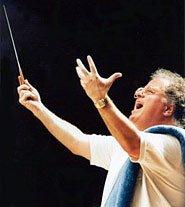 James Levine, who just recovered from spinal surgery, has returned to the Metropolitan Opera pit and the concert stage in fine fettle. At his January 24th Carnegie Hall appearance with the MET Orchestra – their second this season – his high-voltage energy, fiery temperament, exuberance, and emotional—as well as mental—concentration were totally unimpaired. However, his conducting technique seemed to have undergone a startling change. Since the musicians, after many years of collaboration, are so attuned to him that they respond to the merest lift of his eyebrows, his motions used to be “close to the vest” and so small as to be invisible to the audience. His rapport with the orchestra is still palpable, but his gestures have now become big and sweeping: he waves his arms in all directions, turning and swaying from side to side. It was very exciting. The program was framed by two of the repertoire’s most popular symphonies: Schubert’s “Unfinished” and Beethoven’s Fifth. Levine seems to have succumbed to the current penchant for extreme dynamic contrasts, from the softest murmur of whispering strings to the most thunderous use of timpani. The opening of the Schubert was nearly inaudible, but otherwise, it was beautifully lyrical and introspective. The Beethoven was extremely dramatic, and the orchestra played splendidly, as always. Levine, in addition to conducting four operas at the Met, is returning to Carnegie Hall for two concerts with the Boston Symphony, plus directing Met Chamber Ensemble Concerts and master classes. The audience gave this intrepid musical superman a hero’s welcome and rewarded him with standing ovations.
 Born in South Korea, Rira Lim began playing the piano at age four, and at age 14 made her orchestral debut in her native Gwangju. After graduating from Yonsei University in Seoul, she continued her studies at the University of Texas, earning Master and Doctor degrees. She has performed in solo and chamber music in Asia and Europe, and won prizes in several international competitions.