
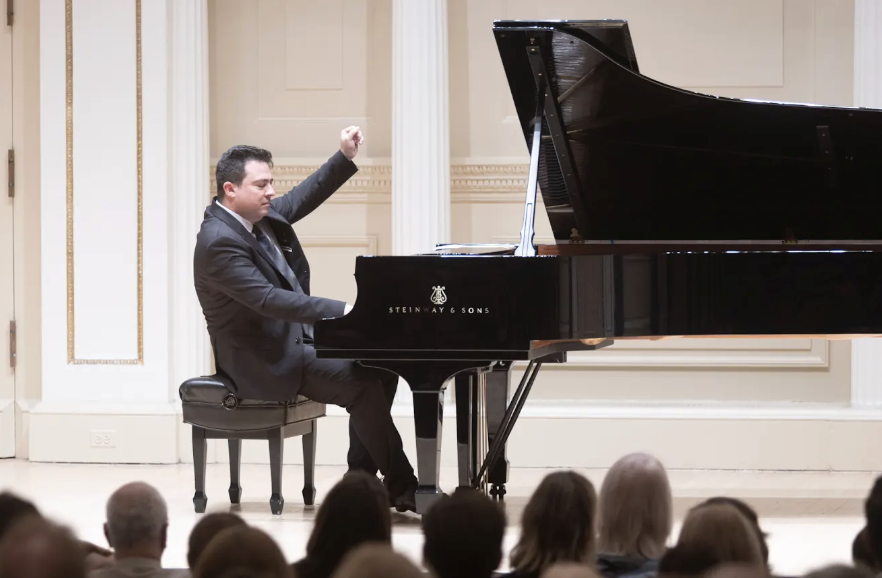
Cziffra Festival Hungary and Liszt Institute New York presents János Balázs in Review
János Balázs, piano
Weill Recital Hall at Carnegie Hall, New York, NY
November 9, 2025
How do we pay homage to our idols? How do we trace our inspirations and, once we acknowledged them openly, how do we avoid being compared (probably less favorably) to those who we admire so passionately? On November 9th at Weill Hall, the Hungarian pianist János Balázs (who is the Artistic Director of the Cziffra Festival, the co-presenter of the event, together with the Liszt Institute in New York) tackled this difficult task. For his Carnegie Hall debut, he constructed a program meant to celebrate the great Hungarian pianist György Cziffra, who was apparently the reason why young János became fascinated with the piano, and especially with the fiery Romantic repertoire in which his illustrious predecessor shone.
Mr. Balázs’ name is tightly connected with that of Cziffra; he not only won a couple of Cziffra competitions in Europe, but also created a Festival in his name and is a tireless promoter of his artistic legacy. In other words, he does the good work. He also speaks lovingly about his role model, inspiring the listener to seek out older recordings of the great master, something which is touching and relatively rare in today’s world where the “me” culture is taking over more and more aggressively. He is also a good speaker- considering that there was no printed program and no intermission during the performance, it would have been easy for the less savvy audience members to get lost in the intricacies of the program, but Mr. Balázs offered charming and informative “notes” before every group of works, making the evening flow organically and avoiding lulls.
The selection of works included pieces famously performed by Cziffra, such as Liszt’s Dante Sonata and Hungarian Rhapsody No. 6; works which he adapted or arranged, such as the paraphrase on Strauss’s The Blue Danube; and also a few novelties by Hungarian composers Peter Eötvös, László Dubrovay and by Mr. Balázs himself, who treated his very appreciative audience to an improvisation on Hungarian folk tunes. In the latter selections, the young pianist proved to be a genial, humorous and slightly cheeky performer/improviser. The two miniatures, one by Eötvös (Dances of the Brush-Footed Butterfly, full of imagery and character), and the second by Dubrovay (Swallow Songs, a very short and winged musical afterthought) were especially welcome additions to the otherwise heavily Romantic entries.
In these Romantic masterpieces, János Balázs had the opportunity to emulate his famous fellow Hungarian, but to my ears the attempt was not very successful. Cziffra was, by all accounts, an enfant terrible of the keyboard, with a monster technique that allowed him to attack some pieces at supersonic speed, which often led to criticism by the more conservative critics. He was, however, an artist of supreme musicality, who paid great attention to detail and delivered each performance with absolute grace. In contrast, Mr. Balázs seemed to me a forceful performer, concerned more with physical power than spirituality. Where Cziffra demonstrated agility in service to the music, Mr. Balázs demonstrated – musically speaking – an approach that has some majesty but stresses athleticism. His interpretation of Chopin’s Ballade No. 3 lacked the poetic fluidity which is one of this piece’s elusive challenges; the pianist often produced a warm, singing tone but suffered from stiff phrasing and an almost militaristic feel. In Liszt’s Les Jeux d’eau à la Villa d’Este the lowest dynamic was somewhere in the mp vicinity, which is unfortunate when one has the advantage of performing in a hall with such superb acoustics as Weill. Cziffra’s paraphrase on Strauss’s The Blue Danube (slightly embellished by Mr. Balázs’ own contributions) was given an interpretation that felt harsh and needed more finesse. In Isolde’s Liebestod (a famous Liszt transcription after Wagner) the notes were there, but the meaning between them remained opaque; the most transcendental moments sounded like exercises in polyphony, and the grand climax was, again, a beastly fff. In Liszt’s Dante Sonata the demonic quality was always placed in the foreground (complete with a facial frown), but it never really sounded ominous; the only truly frightening element was the volume itself. Last on the program, but not least in decibel levels, the Hungarian Rhapsody No. 6 unfolded as a cascade of fast octaves leading to an apocalyptic finale, but all the opportunities to convey wit and nostalgia – as so often is the case with these virtuosic little poems – faded in the shadow of technical wonderment.
Such are, in the opinion of this reviewer, the challenges of linking one’s performance too closely to that of a legendary artist. Perhaps if Mr. Balázs had chosen a more personal selection, filled with more improvisations (to which he seems quite gifted) and a few more contemporary works (which he plays with vitality and a keen sense for contrasts), his incontestable gifts would have shone brighter; such as it was, in a repertoire very much associated with Cziffra, I regret to say that the younger pianist fell short of carrying the torch, so to speak. What I found disappointing is that he seemed to have misunderstood what made Cziffra really special- it wasn’t how many notes he could play per second (and admittedly he could play more than most pianists!), or how much power he released into the keys; it was the razor-sharp lucidity with which he penetrated each piece’s meaning, and the way he imbued every phrase with meaning and grace. János Balázs is undoubtedly a talented pianist who is capable of giving convincing and vivid interpretations. I’m just not sure that it is meant to happen in the same repertoire that Cziffra played.
