
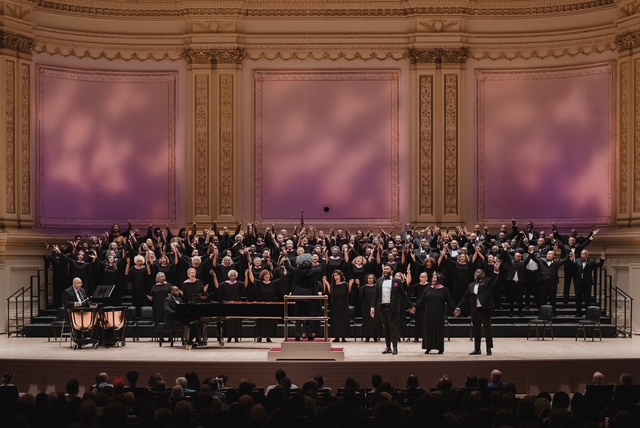
Distinguished Concerts International New York (DCINY) presents Sanctus X 3 In Review
Distinguished Concerts Singers International; Distinguished Concerts Orchestra
Martín Palmeri and Jean-Sébastien Vallée, conductors
The Community Concert Choir of Baltimore; Marco K. Merrick, conductor
Warwick Valley High School Symphony and Chamber Orchestra; E’lissa Jones Maynard, conductor
W. Patrick Alston and Gabriel Evans, organ; Marcus D. Smith and Violetta Zabbi, piano;
Rodolfo Zanetti, bandoneón; Bobbi Harris, timpani;
Johnetta Jackson and Madeline Apple Healey, sopranos;
Alejandra Malvino, mezzo-soprano; Robert Brown, tenor; Edmund Milly, baritone
Stern Auditorium, Carnegie Hall, New York, NY
June 8, 2025
Distinguished Concerts International New York (DCINY) concluded their season this weekend with a program entitled “Sanctus x 3” – and though the printed program was voluminous, it could be summarized in three separate sections as its title suggests. First, the Community Concert Choir of Baltimore sang a group of short soulful selections including mostly spirituals and hymns and one Beethoven oratorio movement. Next, as the second segment and centerpiece, came two Masses – Martin Palmeri’s acclaimed Misatango and Fauré’s magnificent Requiem – performed by the DCINY’s Distinguished Concerts Singers International with the Distinguished Concerts Orchestra. Third and last of all, we heard a set of purely orchestral compositions and arrangements, ranging from Joseph Boulogne (18th century) to current composers, played by the Warwick Valley High School Chamber and Symphony Orchestra (NY).
If just the above paragraph seems unwieldy, it is with good reason. As with many of DCINY ‘s concerts, there were hundreds of performers and a wide range of styles; as usual, however, DCINY was overly generous, and the program (including stage transitions) lasted close to three hours even without any intermission. A presenting business which draws ever greater numbers of people into the magic of making music is certainly to be commended for that – and by all appearances the performers and their families and friends were too busy with flowers and bouquets to look at a clock; that said, if drawing “outside” audience members is a goal, then their experience should be considered as well. An all-you-can-eat buffet is lovely as an option, but not as a requirement, and concert audiences (particularly assigned reviewers) generally commit to staying until the end. Too much of a good thing – with all respect to Mae West – is not always wonderful.
On to the music, the Community Concert Choir of Baltimore did a great job opening the program under the inspired leadership of conductor Marco K. Merrick. Though the spiritual I’ve Been ‘Buked (arr. Hall Johnson) started with almost tentative softness, Maestro Merrick proceeded to draw every drop of energy from his choir. Ain’-a That Good News (arr. William Dawson) was simply bursting with joy. The old favorite Rock a My Soul (arr. Nathan Carter) really did rock, and an unannounced singer from the basses stepped forward to add his impressive falsetto improvisation to the mix. It was a hard act to follow, but Beethoven’s Hallelujah, from Christ on the Mount of Olives, was given a noble spirit, starting with a fine introduction by organist W. Patrick Alston. They followed the Beethoven with a grand rendition of The Lord Is My Light by Frances Allitsen. Soprano Johnnetta Jackson’s superb diction and powerful voice communicated the text even through the heightened dynamics of the choir.
A mood of supplication took hold in the traditional hymn Come Here Jesus, If You Please (arr. Roland Carter), with Marcus D. Smith at the piano. Boldness rebounded in William Runyan’s Great Is Thy Faithfulness (arr. Nathan Carter), with excellent tenor solo singing from Robert Brown and added drama from timpanist Bobby Harris. A finale of Richard Smallwood’s I Love the Lord / Total Praise (arr. Peter Lutkin) brought all forces together with unbridled spirit, drawing cheers and a standing ovation.
It was hard to believe that ahead would be not one but two Masses (and then a strictly orchestral segment) – but as the Community Concert Choir of Baltimore exited the stage, in filed an army of DCINY choristers from Illinois, Indiana, New York, Texas, Virginia, France, Germany, Italy, Netherlands, Ontario, Switzerland, and the UK (and, as the program adds, “individual singers from around the globe”).
We were fortunate enough to hear Martin Palmeri’s Misa a Buenos Aires, subtitled Misatango, with the composer himself conducting the combined DCINY chorus and orchestra. Naturally he conducted with unique authority and the choristers gave their all. Several writers at New York Concert Review have expressed their need to overcome initial doubt about this traditional Latin Mass text (Latin, as in Ancient Rome) being set as steamy tangos (a different kind of “Latin”), but the ingenious writing won the day, as it reportedly has since its Buenos Aires premiere in 1996. To this reviewer, any misgivings had nothing to do with national flavor but with dance associations, which is why one might also balk at Straussian waltz settings for such canonical material. It was a struggle to rethink the Mass, but worth the effort. The six movements (Kyrie, Gloria, Credo, Sanctus, Benedictus, and Agnus Dei) are a far cry from Mozart or Palestrina, but they are captivating in their intense musical language. Misatango is a boldly individual expression of belief requiring an open-minded listener. One is reminded of the story of the child who announces that he is drawing God – and when a teacher chides him, saying, “we don’t know what God looks like” the child replies, “you will now.”
As with most tango-inspired music, the bandoneónist is vital in Misatango, and Rodolfo Zanetti took on this star role with aplomb. The bass lines in tangos are also crucial, and the DCINY’s lower strings came through as ever. Pianist Violetta Zabbi added gusto with her sweeping glissandi and vibrant support. Last, but definitely not least, special praise is in order for mezzo-soprano soloist Alejandra Malvino who not only has a stunning voice but sensitivity to each harmonic inflection of her fellow musicians. She is a treasure. An enormous ovation followed the work.
If any traditionalists were not enthralled with the newer Mass conception, the Fauré Requiem followed in a much more traditional vein. Though this Fauré masterpiece has always been high on my list of favorite pieces, it was hard to appreciate it here, squeezed into what already felt like a surfeit of riches. No amount of wizardry or speedy stage crews (which there certainly were) could restore to the music the breathing room it needed. Even the excellent conductor, Jean-Sébastien Vallée, who tamed the enormous choral forces with a deft hand, seemed somewhat pressed, as if aware of time constraints. One of casualties, sadly, was the ethereal In Paradisum, which simply felt rushed. (One usually hears just slower than a beat per second for this movement, as marked on most scores, but their tempo was markedly faster.)
On more positive notes, there were some standout performances. Edmund Milly’s baritone lines were both suave and penetrating. Soprano Madeline Apple Healey gave the Pie Jesu a silvery purity with her thoughtfully shaped phrases. Organist Gabriel Evans was given well-deserved special mention in the program booklet, but just as worthy of mention was concertmaster Jorge Ávila who – true to form – made the most of the violin lines as soloist.
It was life-affirming, at the end of two substantial Masses, to hear from the relative youngsters of the Warwick Valley High School Chamber and Symphony Orchestra (NY) – extended concert duration aside. Conductor E’lissa Jones Maynard led the ensembles with energy and decisiveness. With combined forces of about 87 players, the Warwick Valley High School has done something very right.
The chamber orchestra opened with Dmitri Shostakovich’s Waltz No. 2, a piece popularized in film (notably in Stanley Kubrick’s “Eyes Wide Shut”), heard here in an arrangement by Paul Lavender. The players showed strength and verve. Perhaps the percussion section was a bit too dominant, but there was no question of a solid beat! Featured in excellent melodic lines were violist Angelina Nguyen and cellist Jakob Yon, the latter instrument more prominently.
In a stylistic pivot, the program continued with the first movement of Symphony Concertante in G, Op. 13, No. 2 by Joseph Bologne (1745-1799), as arranged by Sandra Dackow. Bologne, also known as Chevalier de Saint-Georges, composed in a style not unlike Mozart’s, and his music still deserves more recognition than it receives. This arrangement was a joy to hear, and the players did quite well with it.
The first movement of Edouard Lalo’s Symphonie Espagnole followed, in a Todd Parrish arrangement, and the young concertmaster Andrew Redling stepped forward for the solo part, doing a commendable job.
The forces were then expanded from chamber to full symphony for the next work, The Dance Of Iscariot, by Kirt N. Mosier. There were a few raggedy edges, as one might expect from such a large and young ensemble, but they did well overall with this dramatic piece. The concert concluded with the work Gravitas (2024-2025) by Soon Hee Newbold, and it lived up to its title. Newbold’s film score background was definitely evident in its overt drama, and the players seemed to relish its spirit of heroism – the audience as well, giving them a huge ovation. Hats off to E’lissa Jones Maynard and the Warwick Valley High School ensembles, as well as to all who performed in this marathon concert.
