
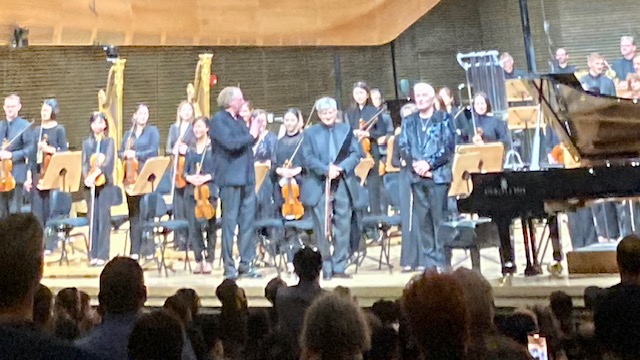
Jean-Yves Thibaudet and Pines of Rome: New York Philharmonic in Review
The New York Philharmonic; Stéphane Denève, conductor
Jean-Yves Thibaudet, piano
David Geffen Hall, Lincoln Center, New York, NY
November 26, 2025
David Geffen Hall was filled to capacity on the eve of this Thanksgiving by listeners eager to hear – among other enticements – the New York Philharmonic with superb pianist Jean-Yves Thibaudet under the baton of the dynamic Stéphane Denève. For this reviewer, it was one of their most striking, brilliantly played programs in recent memory. Combining music of Aram Khatchaturian – his Piano Concerto Op. 38 – with music of Lera Auerbach, Einojuhani Rautavaara, and Ottorino Respighi, the program itself was inspired, uniting a vast range of mythological, historical, natural, and emotional themes, all building to a powerful and uplifting finale.
Maestro Denève proved to be an intensely musical leader, showing a strong rapport with the orchestra and easy communication with the audience. He drew his listeners in by commenting on the works from the podium – though there were generally good printed program notes as well. To start, he remarked before the opening Auerbach piece that this program could have been named “The Augmented Orchestra” concert, as the scoring of each work extended well beyond traditional orchestral instrumentation. He briefly explained, while also crediting the instruments’ guest performers, who had been omitted from the printed program.
Starting with Lera Auerbach’s Icarus, Denève cited its remarkable inclusion of the theremin. For those unfamiliar with the sound of this instrument, he asked for a demonstration from guest thereminist Rob Schwimmer (who chose to riff on an excerpt from the main theme of the television show Star Trek – to the delight of the audience). In addition, Denève noted, there would be Khatchaturian’s use of the musical saw, to be played by Dale Stuckenbruck in the Piano Concerto, Op. 38, with Jean-Yves Thibaudet. After intermission would be two works that incorporated bird songs into orchestral textures via recording, first in Rautavaara’s Cantus Arcticus, Concerto for Birds and Orchestra, using a recording created by the composer in 1972, and then in Respighi’s Pines of Rome, using bird sounds recorded decades earlier on a 78 recording (the exact one specified by Respighi to be used in the New York premiere under Toscanini in 1926). An imposing 1909 phonograph behind the winds had been lent to the New York Philharmonic for this occasion. It was just one way in which this entire concert wedded a rich musical history with the exhilaration of the new.
While such unusual scorings were certainly exciting to highlight for all present, the true excitement followed, thanks to the composers’ vivid conceptions and the performers’ impassioned commitment. The opening Icarus by Lera Auerbach evoked the ill-fated flight of the mythical character Icarus as he dared come too close to the sun. The work is based on material from her 2006 Symphony No. 1, premiered in its current version in 2011 at Verbier, and given its New York premiere at this concert. Though the program notes stated that Ms. Auerbach chose the title after the piece was composed, anyone present at this concert would now surely link the music inextricably with Icarus. One felt his initial urgency to escape earthly imprisonment, the chimeric rise, the ecstatic soaring, and even perhaps the melting of his wax wings in theremin waves near the final tragic plummet to earth. As Ms. Auerbach stated in her notes, “Sometimes I think that it is the law of gravity that truly defines our existence.” This twelve-minute work conveyed that sense, and all that comes with it, from courage in the face of the unknown to glorious aspirations and hubris, from the inevitable fall to the reflections on both beauty and pain. It was a powerful experience, and Ms. Auerbach was present to take a well-deserved bow.
Though the Khatchaturian Piano Concerto (1936) is not a new work for the New York Philharmonic (having given its New York premiere in 1942 following its 1937 Moscow premiere), it enjoyed at this concert a long-overdue revisiting in the hands of the brilliant Jean-Yves Thibaudet. Maestro Denève announced Mr. Thibaudet as “the most American of the French pianists” (again to the delight of the audience) – but one wasn’t sure whether that was a reference to Mr. Thibaudet’s playing style or a certain wardrobe flair that brought to mind Hollywood (not far from where he is artist-in-residence at the Colburn School). His playing itself was free of sheer display, as he simply made short work of the tremendously challenging score, handling fiendish sections with suavity. Whether rapid-fire double notes, octaves or whiplash-inducing ritards after accelerandi – all in remarkable synchronization with the orchestra – Mr. Thibaudet was precise and indefatigable. The second movement was memorable for its bass clarinet lines, soulfully projected, and Mr. Stuckenbruck’s musical saw lent it all an otherworldly feeling. As the program notes reminded us, this work and others were “not instruments of musical propaganda” despite coming out of the early Soviet years, but Khatchaturian meant them as celebrations of Armenian culture. Just two years ago, in fact, another outstanding performance of this concerto was reviewed by New York Concert Review, as passionate Armenian pianist Kariné Poghosyan performed it with the MidAtlantic Philharmonic Orchestra in honor of Armenian Independence Day. The New York Philharmonic’s last performance of it for some reason dates back to 1961, but after the tremendous response from this week’s audience, one doubts there will be another sixty-year hiatus. Mr. Thibaudet responded to the huge ovation with an encore of O polichinelo from Prole do bebê by Villa-Lobos, played with panache.
After intermission came Einojuhani Rautavaara’s Cantus Arcticus, Concerto for Birds and Orchestra, Op. 61 (1972), a favorite of this reviewer for over twenty years on the basis of a recording by the Royal Scottish National Orchestra (RSNO, Naxos 1999). It is hard to believe that this evening marked the New York Philharmonic’s first programming of it, but the magnificent performance it was given on this occasion will surely keep planners from waiting another half-century to include it again.
From its chromatic flute lines at the opening to the wind-like whistling and deep chant-like basses, the piece evokes a vast frigid landscape that is raw and melancholy as well as miraculous. The bird sounds are about as far as they can get from the Romantic sentimentalizing of, say, Henselt’s If I Were a Bird – these are birds that cry, wail, squawk, warble, and merge into a unified texture that inspires an awe of nature. When the audience can unite in recognition of such a landscape, the experience can be potent and life-affirming, and it was. Maestro Stéphane Denève gave his all to it, and the orchestra gave theirs.
Just when one thought nothing further could add to the evening, Respighi’s Pines of Rome (1923-24) capped off the program with its own its magic. The Pines of the Villa Borghese was jubilant and shimmering. The Pines near a Catacomb was doleful, yet regal, bolstered by the exceptional brass section. The Pines of the Janiculum found the sparkling piano part setting the tone for a moonlit night, and the clarinets were sublime in their lines – rivaled perhaps only by nature’s own “winds” – the birds via phonograph. Not far after the last heavenly strains of the harp in this third movement, one of the most glorious crescendos of music begins in The Pines of the Appian Way – and how glorious it was in this orchestra’s rendition!Trumpets emerged in the upper boxes drawing looks of wonder from the audience, as the other brass, percussion, and strings built to a majesty that simply exploded. What a great finale to a great evening!
There are still two performances left at the time of this writing – so I do urge music lovers to run, not walk, and hear one!
