
Lincoln Square Music Management and Consulting Inc. presents the Chinese New Year Concert in Review
Weill Hall at Carnegie Hall, New York, NY
February 11, 2026
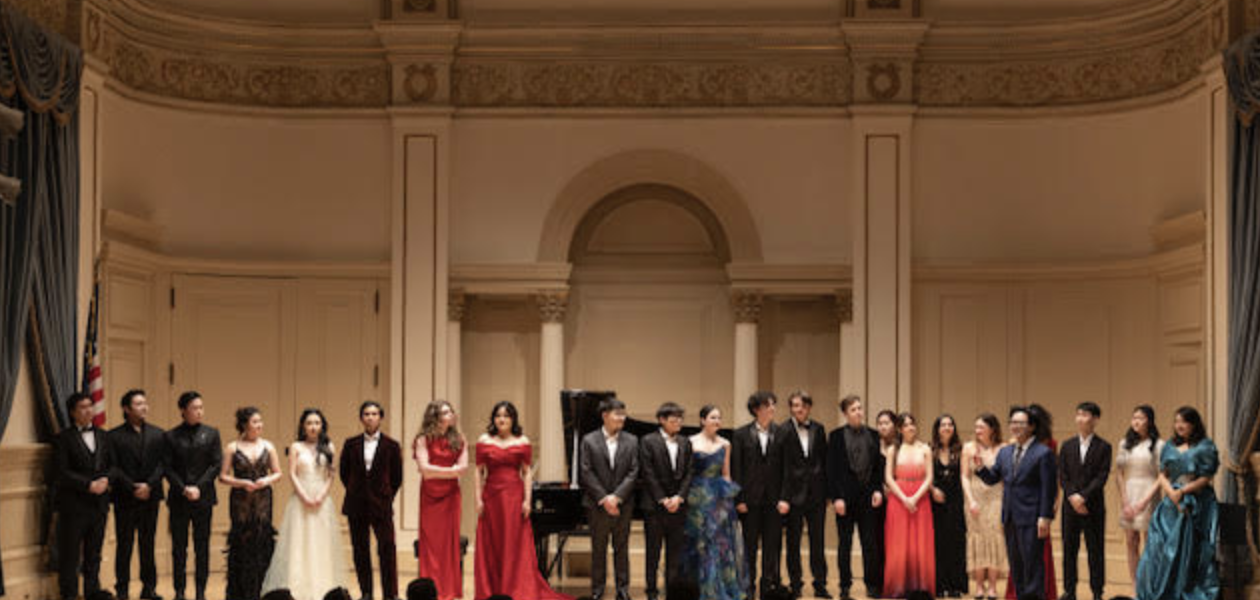
The Chinese New Year is bringing in celebrations all over the world, and none the more festive (and extensive!) than the one I listened to last night (February 11th) at Weill Hall! Pianist Tiehan Pan (a graduate of Manhattan School of Music who is currently serving on the institution’s International Advisory Board) has put together an evening full of talent and joy, featuring many of his colleagues from MSM and a few other young musicians from Juilliard, the Special Music School, and the Central Conservatory of Music in Beijing. Mr. Pan, who is also the leader of Lincoln Square Music (described in the program notes as “an education consulting firm that supports institutions and individuals in modernizing arts education for real-world impact.”), is a very fine pianist and a talented curator and presenter. I rather liked his idea of assembling a group of young artists to evoke a 1980’s “Operatic Gala” feel, where each artist performs just one work, not longer than a few minutes, trying to win over the audience in an almost contest-like display of artistry. It must be said, the concert went on for too long (I will get to that later on), but I admit I didn’t feel the time passing and, for the most part, I was completely taken with the impressive musicianship of these young performers.
The first half of the program – which lasted close to two hours! – was divided into three sections: The Classic (where well-known and much loved works from the mainstream repertoire were presented), The Exotic (still mostly repertoire with a “stamp of approval” pedigree, but slightly more adventurous), and The New (a combination of vibrant and exciting new works and AI generated compositions, a fascinating and very intriguing offering).
The Gala opener came from tenor Tong Zhang, whose rendition of Lehár’s Dein ist mein ganze Herz impressed with excellent diction and beautiful phrasing, though the projection seemed a bit forced at times, especially with such perfect acoustics as provided by Weill Hall.
Next, violinist Marina Alba proved to be an enchanting presence and produced a beautiful tone while resolving all the technical challenges of Kreisler’s Recitative and Scherzo Caprice, showing musical intelligence and refinement.
Pianist Guanxiao Yang delivered the fiendishly difficult Feux Follets by Liszt with elegance and humor. His playing was supple and never heavy-handed, but perhaps a little too careful of taking risks with tempo and thus lacking fire.
Mozart’s Cherubino aria Voi che sapete from Le nozze di Figaro was given an odd interpretation by Zimo Wang: she had problems with the intonation, and the meaning of the words (and the whole story of the character) seemed lost on her. She did, however, wear a stunning and elaborate dress!
Weiwei Kong’s rendition of Dvořák’s Song to the Moon from Rusalka was lovely and fittingly floating. She could have use more nuance and freedom in the phrasing, but her voice and projection were beautifully adjusted to the magical resonance of the hall.
Ending the Classic section of the program, violinist Alix Auclair was joined by pianist Michael Wang in the first movement of Richard Strauss’ Violin Sonata, Op. 18. Ms. Auclair gave a polished and dignified performance, always in full command of the technical difficulties of the piece. She produced a warm tone and played with intelligence and good taste. I felt that at times she could have been better supported by the pianist, especially when navigating the sweeping long lines upon which the entire movement is built.
The Exotic segment was opened by baritone Wei Chen with a shaky version of the Toreador Song from Bizet’s Carmen. The performance lacked gravitas and both performers – singer and pianist – seem to push and pull in different direction, never quite settling on the right pacing for this music.
Tenor Ramon Gabriel Tenefrancia is the possessor of a stunningly beautiful and capable instrument, as evident in his very musical rendition of Francisco Santiago’s Madaling Araw, but he still needs time to develop and tame that raw material.
Next, pianist Daria Podorozhnova played the Infernal Dance from The Firebird by Stravinsky (arranged by Agosti) with the authority of a fully mature artist. The more intimate and poetic moments were also fully realized. While she produced crystal clear sound throughout and her voicing of the dense chords was perfect, I felt that she could have built up to a more ferocious finale.
Jamil Salizade’s lyrical playing and stylistically accurate performance of Rachmaninov’s Étude-tableaux, Op. 39, No. 8 still needs time to mature and find all of the magic of this heartbreaking music.
Ares Economides’ version of Bartók’s Piano Sonata (first movement) proved very capable but undifferentiated. The accents didn’t have enough “bite” and the rhythmical patterns were softened to the point where they almost lost their potency.
Violinist Betania Johnny and pianist Ainslie Mathew had fun performing African Dancer, the first movement from William Grant Still’s Suite for Violin and Piano, but could have used a more diverse pallet of dynamics which would infuse the music with even more excitement.
Closing this section of the evening, the piano duo Yufei Liu – Yuyue Zhou brought top level energy with an engaging version of Lisa Kaplan’s Boogie-Woogie, complete with elbow clusters and hand tapping for maximum response from the audience.
The next and final segment of the first half was, for me, the most successful and fascinating of the evening. Soprano Zihan Ning seemed to have stepped out of a Chinese fairy tale to deliver her interpretation of Jin Se (Brocaded Zither), which was truly magical. She was also perfectly supported by Mr. Pan, whose gorgeous piano introduction will stay in my ear for many weeks!
Equally beautiful and full of emotion and imagery was the performance of Yuehan Wang in My Faithful Heart Doth Wait for Thee. The voice and the piano blended perfectly and both artists (Mr. Pan was again the pianist) took full advantage of the pristine acoustics of Weill Hall.
In one of the evenings’ most memorable moments, pianist Vladislav Kern achieved the almost impossible- he introduced us to one of his own works, Dreamworld Suite, which not only would I want to listen to again and again, but as a pianist myself I would absolutely love to learn and introduce to more audiences throughout the world. In his composition, Mr. Kern creates a magical sound world in which both performer and listener can dream together. A superb pianist as well as an immensely talented composer, he blends melody, harmony and rhythm in a way that is at once fully original and universally relatable, without copying any previous style. As the piece came to an end, I thought to myself this is the kind of new music we need in order for classical music to survive and thrive into this century!
Saltwater, a piano piece by Elle Gurevich, was a fluid evocation of water and perpetual motion, reminiscent of Ravel. Written with intelligence and deft handling of a composer’s arsenal, and performed by Ms. Gurevich with grace and charm, the work was easy on the ears but not particularly original.
Olivia Wu, a 13 year-old singer and performer, decided to employ AI to help her tell the story of the White Horse (related to the Year of the Horse, celebrated this year in the Chinese tradition). The result was a piece that may very well give us a look into what the future holds for the creation of new music and how we as humans will (or will not) be slowly replaced by technology. I commend the idea and I found the result fascinating, albeit not necessarily convincing. The work sounded like a pop song (sung in English and Chinese by Ms. Wu) with simple harmonic progressions which are very effective in insinuating themselves into the ears of less sophisticated listeners. What it lacked in originality, it made up in sentimentality and cuteness. The question is what do we value more, and what will help our art form survive- giving in to the taste of a wider audience, or preserving an appetite for the hard-won challenges?
As if this last question was hanging too heavily on our minds, the finale of the evening’s first half (!) was appropriately cheerful and low-key: baritone Peiming Cai (expressive and very musical, with a sure and powerful voice) was joined by Wei Chen, Zihan Ning and Yuehan Wang in the song The Moon represents my Heart, a lovely way to end a joyous celebration.
But of course the evening was not over! After a rather long (but much needed) intermission, I was stunned to see how few people opted to come back for the second half. I strongly believe that, in spite of the excessive length of the evening , neither the performer (Yingxin Wang) nor the featured composer of this second half (veteran Chinese composer Weijie Gao) deserved such treatment. In fact, while I was wondering if I would manage to keep my mind fresh for yet another 40 minutes of music, I found myself very much convinced by Ms. Wang’s excellent performance and by the rich musical offerings of this part of the concert.
The small piano suite Age of Childhood is composed of five short pieces, like pastel-colored sketches on faded paper. Ms. Wang played them with bristling clarity and sharp articulation. They were followed by Three Songs after Poems from Yuan Dynasty, which she played with a singing tone and a wide range of dynamics. Her articulation left me speechless. The music (all by Mr. Gao) is sweepingly romantic and descriptive; it belongs to a specific time and place, and its charm resides in transporting us there effortlessly.
Autumn Fields had a different feel, employing more dissonance, sharp rhythmical figures and expressionistic gestures. The score is technically challenging but Yingxin Wang had everything under control. The musical language reminded me of Szymanowski’s piano suite Masques, a work which I wholeheartedly admire and which deserves a better place in today’s concert life. At times, I felt that Ms. Wang could have explored using even quieter dynamics. The following piece, Winter Snow, employed similar language and further showcased the pianist’s technical and artistic gifts. The next work, Three Preludes, was played with great virtuosity and commitment.
The last selection on the program (we were now approaching 11:00 pm) was a two-movement suite titled Memories of Childhood. The first piece, Nostalgia, felt a little forceful in its tone, but it did feature some beautiful, evocative moments. The second, Childhood Innocence, lacked a bit in… childhood innocence, and I could not quite see why the composer chose that title. But these were minor quibbles which should not cloud the effect of a truly enjoyable evening (both parts!) which was put together with thoughtfulness and love. Love for music, for young talent, and for the Chinese tradition!
