
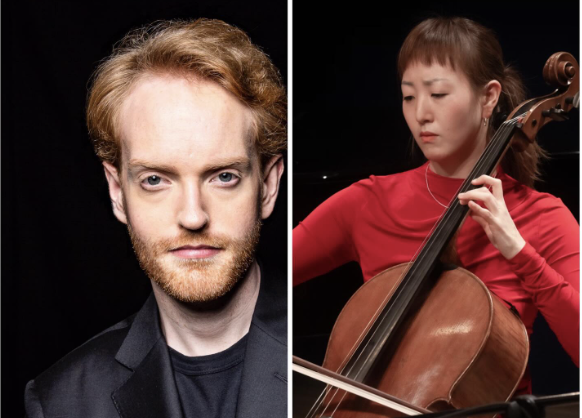
Sociedad de Compañerismo de Compositores presents Ross Avant – Cello Suite No. 2 in Review
Yoon Jin Park, cello
Marc A. Scorca Hall, The National Opera Center, New York, NY
December 6, 2025
On a breezy Saturday evening in New York City, the Spanish based Sociedad de Compañerismo de Compositores (The Composers’ Fellowship Society) presented the world premiere of Ross Avant’s monumental new work for solo cello, the Suite No. 2 titled Venient Tenebrae (which translates to “Let the Darkness Come”). Initially I was surprised that the entire concert was to consist of only one piece, but the fifty-minute performance time of this work soon made me understand that the performance would feel anything but short.
The master of ceremonies for the evening was Jeanette Hoelscher, who introduced herself as a New York-based actress and model. She was a lovely presence, wearing a very high cut dress, and she brought elegance and a breath of fresh air (no pun intended) to the event; however, I couldn’t help wondering if perhaps the services of a classically trained musician would have better served the purpose of this concert, especially during the post-performance talk (with the composer and the performer). Ms. Hoelscher was obviously well prepared and asked pertinent and sometimes interesting questions, but since this was a new work, reaching the audience’s ears for the very first time, it would have helped to have a moderator who could dive deeper into more specific questions about the motivations, goals and inspirations which led the composer to write this unusual (at least for our times) piece of music.
When using the title “cello suite,” one inevitably thinks of Bach and the legacy he left with his extraordinary works in this genre. Even if the musical language is very different, I did feel that Ross Avant was somewhat paraphrasing (or at least paying homage?) to his famous predecessor. Mr. Avant’s work also comes in six movements, which is the established form used by Bach. Both composers use the specifics of the instrument in order to convey a wide range of emotions, from the intimate to the cathartic. Bach looks at traditional dances (such as Allemande, Courante, Sarabande) as inspiration and heartbeat for each movement, and perhaps because of this he achieves great diversity (both in tempo and expression) from one movement to another. In Mr. Avant’s work, the first five movements sounded too similar, almost to the point where I had trouble deciding whether we were still listening to one movement, or have graduated to the next. Only in the last movement did the composer really stir up more contrasting material (an entire pizzicato section, some syncopated melodies) which brought a much needed climax to an otherwise meandering opus. As I was listening to the former movements, I wondered if they had titles, or at least some suggestion as to what inspired them- sadly, the programs were not ready in time for the event, and nobody who was present had the benefit of knowing anything about the piece which was being performed. The answer – which I found later on – is that no, there are no titles for the movements. When I was eventually provided with the missing playbill, I read that Mr. Avant wrote the suite as an homage to the German-Jewish philosopher, critic and essayist Walter Benjamin, who tragically committed suicide in order to avoid being sent to a concentration camp. Mr. Avant’s intent is to evoke not only Benjamin’s memory, but also that of countless victims of the Holocaust and other authoritarian atrocities perpetrated during the Second World War.
As such, the piece is important and undoubtedly deserves to be heard. It is also very refreshing to hear a fifty-minute work for solo cello, crafted with passion and minute care for details, especially in an era obsessed with two-minute Instagram videos, instant gratification, and shorter and shorter attention spans. Ross Avant works here against the current, and that is not only commendable but also encouraging- perhaps, after all, classical music, and its most traditional forms, can still provide a thoroughly stimulating and enjoyable experience, without any gimmick. Mr. Avant, who apparently dabbles successfully into many different genres (movie and TV soundtracks, pop tunes) is perhaps an ideal link between the old and the new, bringing to the classical parameters a bit of 21st century salt and pepper. His writing is atmospheric, evocative and I would describe it as faux-melodic in the sense that one can hear many beautifully shaped lines which are, however, impossible to reproduce with the voice or even to remember them exactly after they brushed against your ears. I felt at times that this music might work better as an accompaniment for a beautifully shot sunset in an art house movie than as a stand-alone, listen-with-your-eyes-closed musical journey, but perhaps this is a (small) price to pay for bringing a less savvy audience into the concert hall.
In the program notes (which I could only read the day after the concert), it is said that the Suite is a “meditation on finality, sacrifice, and the power of resilience.” These are very big words, and listening to the piece as it was performed on Saturday night I would not say that they all came to my mind. Perhaps the cellist, Yoon Jin Park, would need more time to explore the depth and meaning of this complex and ambitious work. Ms. Park is a wonderful performer who plays with grace and a lovely genuineness, making even the most technically awkward passages sound organic and natural. Considering the sheer length of the work, her accomplishment is exceptional and her commitment truly inspiring. I did feel, however, that she was almost avoiding big contrasts as if not to disturb a delicate balance, embedded somewhere in the DNA of the piece. I’m not sure this approach is consistent with the feelings of finality, sacrifice and strength; I dare suggest that a larger spectrum of colors, moods and dynamic changes would help the music seem fresher and even more exciting. Still, there was much to admire in the performance, and in the work itself; towards the end of the fifth movement, the young couple sitting directly ahead of me touched their heads and embraced with sweet affection. What more can we ask from a piece of music, then to bring out the love within us and allow us a moment to savor it?
