
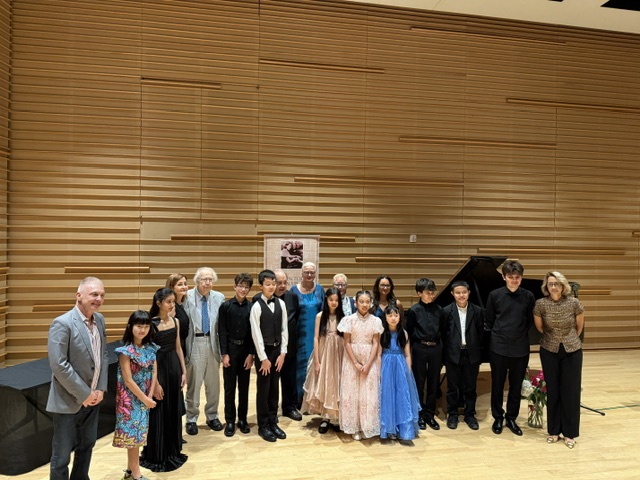
Winners of the 8th Rosalyn Tureck International Bach Competition in Review
Winners: Pianists Claire Li, Olivia Li, Eunha Basu, Olivia Tianqing Ye, John Samuell, Edward Hikaru Neems, and Antonio Alessandri
Bezanquen Hall at the DiMenna Center for Classical Music, New York, NY
July 27, 2025
As Beethoven famously remarked, Johann Sebastian Bach should be called not “brook” [as Bach’s name means in German], but “sea” to convey his inexhaustible gifts. As most musicians know, a lifetime can be spent studying Bach’s works without even approaching its breadth and depth. It is thus especially heartening that, thanks to the Rosalyn Tureck International Bach Competition (TIBC), there is an increasing incentive for the next generation of talented young pianists to explore the range of Bach’s entire keyboard output. Last week, seven young winners of the 8th TIBC demonstrated just that in their Gala Winners Concert at the DiMenna Center for Classical Music.
Founded and directed superbly by pianist Golda Vainberg-Tatz to honor her mentor, the renowned Bach interpreter Rosalyn Tureck (with Dr. Tureck’s blessing shortly before she passed away in 2003), the TIBC has now taken place in 2008, 2010, 2013, 2015, 2017, 2019, 2022, and 2025 just this July. This reviewer has heard and been assigned to review several of the competition’s recitals, and they all were impressive; the level of this 8th TIBC, however, seemed to reach new heights. The performances of the seven young winners were astonishingly polished and compelling – and thankfully, even with a scheduling conflict, this reviewer could see and hear them all via live video via YouTube (8th TIBC Winners) and on audio recordings.
As there are many details to process and seven pianists to discuss, we’ll dive right into the performances, but to learn more about the history of the TIBC, the reader may visit its website TIBC, and also read the competition booklet available there for information on the participants and jury members.
To start, we heard Claire Li, age 11 playing Bach’s Fantasia in C minor, BWV 906 (Category 1: Short Preludes and Fugues). She showed remarkable poise and focus even before starting, sitting quietly beforehand to gather inspiration. The preparation paid off, as her performance was reliable , rhythmic, and robust. The Fantasia is a complex one for such a young player, but it gave her a chance to exploit her impressive independence of lines between the two hands. Only one very minor distraction during the repeat of the second section threatened to diminish her focus, but she stayed on track like a professional.
The next pianist, Olivia Li, played the Sinfonia No.11 in G minor, BWV 797 (Category 2: Inventions and Sinfonias). The listing of her as “age 8” gave this listener a brief double-take, but then again, the competition’s early categories allow for age 8 (and more advanced categories through age 28); her playing, however, caused another double-take, as she showed the control and expressiveness of a musician far beyond her years. She played with a singing tone, perfectly tapered phrases, and beautifully gauged ritardandi. Ordinarily for such a young player, a teacher might have opted for one of the more accessible Inventions – or even might have stayed within the Category 1 repertoire – but clearly someone sees her as exceptional, and she is. This piece gave her opportunities for marking phrases in an expressive way – and these surely set her apart as a winner.
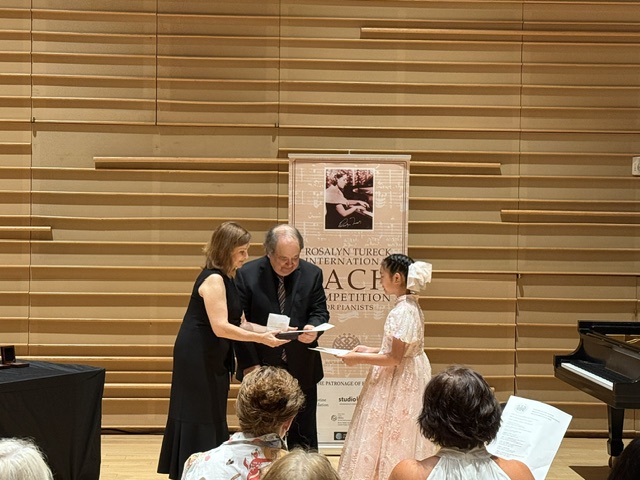
The older participants deserved special kudos for walking onstage to play after such cherubic little wunderkinder who may not even have learned yet what nerves are. In addition, what was already a good half-hour wait through speech-making (before the first notes were played) grew longer with each performance. Especially in view of this format, all of the winners deserved kudos.
The next pianist was Eunha Basu, age 15 (Category 3: Well-Tempered Clavier, Preludes and Fugues), who played the Prelude and Fugue in G minor, BWV 885, from Book II. Seemingly unfazed by the waiting or anything else, she dove into her music with poise and assurance. She played with an authority that was vehement but – refreshingly – never harsh. She simply inhabited the music, with thoughtful control of dynamics and excellent layering of parts. Her four-voice fugue was masterfully projected, reflecting a clear understanding of its structure through skilled voicing and articulations.
Another remarkable 11-year-old pianist came onstage next, Olivia Tianqing Ye (winner in the Category 4/A of Suites and also the Contemporary category). She played the Sarabande and Gigue from the English Suite No.5 in E minor, BWV 810, both revealing astonishing maturity. She showed a genuine sensitivity to the Sarabande‘s long lines, artfully delineating its phrases and ornamenting it judiciously on repeats. The very athletic Gigue of this suite has such leaps and chromaticism that it can be awkward even just for a listener to grasp, but Ms. Ye made short work of that as well. If she were an adult musician, one might say that she turned it into child’s play, but in this case she is, in fact, a child – so how can one describe such utterly natural facility?
Still more astonishing was young Ms. Ye’s rendition of Lowell Liebermann’s Nocturne No. 4, Op. 38, which she played next. She established its eerie hypnotic feeling from the start with her steady repeated figures in the left hand against a crystalline voice in the right. As it developed, she handled its growing technical challenges with amazing ease for one so young and built to a powerful – and beautifully controlled – climax. One had to keep reminding oneself that she is just 11.
After the high drama of the preceding Liebermann piece, it could seem anticlimactic to present the rather spare textured and cerebral Duetto BWV 804, but it was performed with such conviction and musical understanding by Edward Hikaru Neems, age 14 (Category 5 – Assorted works) that one almost forgot what preceded it. His clarity of voicing and clear delineation of themes captured the listener, and his movements from the main statements through the lighter episodic sections always conveyed a sense of musical narrative. As excellent as young Mr. Neems was, one would have loved to hear his more extended offerings, including Bach’s Aria variata alla maniera italiana, BWV 989 and some Preludes of Robert Muczynski. Alas, time limits!
Similarly commanding was John Samuell, age 13 (Category 6: Assorted works), playing the Toccata in C minor, BWV 911. He projected a vivid sense of the character of the different sections and allowed each one to unfold with inevitability. The fugal sections thrived on his excellent control and brilliant fingerwork. He is a formidable musician for one so young, and it was thus not a surprise upon reading his biography to learn that he is also a budding composer and highly credentialed organist. One looks forward to hearing more from him. In addition to winning the Rosalyn Tureck Prize in his category he was also awarded the Kern Foundation “Aspiration” Award.
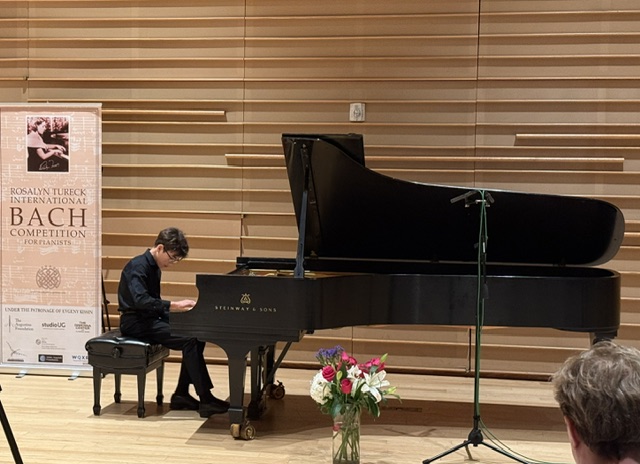
Last but not least we heard Antonio Alessandri, age 19, playing excerpts from the Goldberg Variations (Category 8). He played the Aria, Variations 1, 2, 3, 4, 28, 29, 30, and the return to the Aria (so basically the beginning and end of the piece, as time limits dictated). Well on his way to an active career, young Mr. Alessandri already recorded his debut album of these variations in 2024, and his performance of several excerpts served as a tantalizing invitation to hear them in their entirety. Though it is always frustrating to hear this work in an abbreviated version, one could certainly hear glimpses of every quality it requires, from a sensitivity to the hallowed feeling of the Aria, to the emotional range of the subsequent variations and the control of a wide variety of dynamics, articulations, and fingerwork to project that range. Of course judging the pianist’s conception of the work as a cohesive whole was simply not possible here, but what we heard of Mr. Alessandri’s artistry certainly bodes well. One quality that stood out was his rhythmic expressivity, particularly his use of agogics in poignant moments. He is a very special pianist. Along with winning the Rosalyn Tureck Prize in his category, he won the TIBC’s Dame Myra Hess Recital Award and its Evgeny Kissin Grand Prize/Steinway Award.
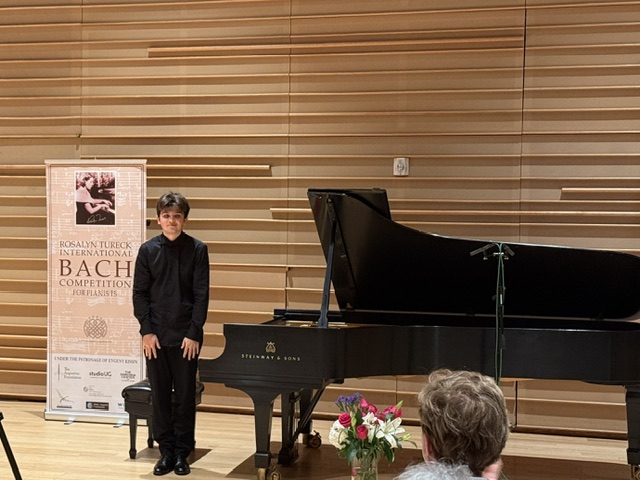
Congratulations go out to all the winners and to all those who contributed to this important cultural event. It has been a joy to watch it develop over the years and become more and more refined in each detail. One can hardly imagine it growing still further in its next edition, but it will be worth the wait to see and hear! Bravi tutti!
