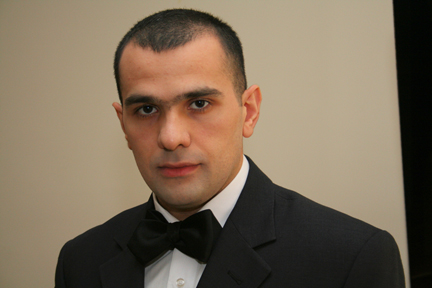
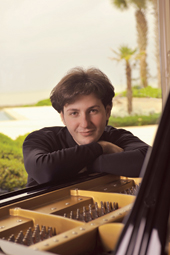
 Pianist Mikhail Lifits is on quite a winning streak. At his recent solo recital as First Prize winner of the Hilton Head International Piano Competition, his impressive biography did not even list his top prize in the Busoni Competition, which he had won too recently to list!
Hearing his Schumann Arabesque, Op. 18, one could easily imagine how Mr. Lifits charmed several juries in one season: he has strong musical imagination, highly personal phrasing and dynamics, and none of the noisy hokum that abounds in contests. That said, it should be interesting to see how he develops and controls (or doesn’t) some rather eccentric tendencies apparent throughout the evening. Rubato was stretched at points to excess, and phrases were frequently what one might call “front-loaded” with lines starting richly and fading to perilously fine threads (occasionally disappearing or needing to be revived, as with a string player running out of bow). While the latter characteristic enhanced moments of the Arabesque, it can seem formulaic if one is not careful. In any case, there was in each work a compelling individuality that kept one listening intently, and Schumann’s Fantasy Op. 17 was given an especially sensitive and poetic reading, closing the first half quite well.
Four “Moments Musicaux” Op. 16, by Rachmaninoff opened the second half with brilliance and a wonderful flexibility in shifts of mood. Occasional reverse dynamics baffled here, as elsewhere, but the overall performance was potent.
The Suite for Piano by Daron Hagen was brought to life by more of this pianist’s expert changes of mood, from the jazzy and conversational to the haunting and lyrical. The work itself (a commissioned piece at the Van Cliburn Competition, given its NY premiere here) came as an effective buffer between two Russian giants, particularly before Prokofiev’s Seventh Sonata, which concluded the program. Lifits lit into the Prokofiev with no holds barred and some stunningly powerful contrasts.
An encore of Chopin’s posthumous Nocturne in C-sharp minor (of debatable provenance) closed the evening, offering more of this pianist’s sensitive inflections. The magical close left one looking forward to much more.

 Pianist Aglaia Koras suffered through a car accident on her way to her concert on November 5th, so it wouldn’t be fair to go into detail about technicality, memory or specifics of her program. It must be said, however, that her sold-out, full-house crowd was happy to hear her, and I felt that she gave some of the most thoughtful, touching playing of Beethoven and Chopin I have heard her play. She was the come-back kid, and she should be proud to have had the courage to put on a program that many others would have canceled.
  Born in South Korea, Rira Lim began playing the piano at age four, and at age 14 made her orchestral debut in her native Gwangju. After graduating from Yonsei University in Seoul, she continued her studies at the University of Texas, earning Master and Doctor degrees. She has performed in solo and chamber music in Asia and Europe, and won prizes in several international competitions.
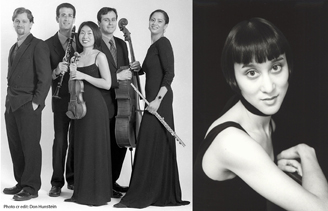 This was my first visit to Le Poisson Rouge, a multimedia art cabaret which has become the hip and trendy place to hear classical music in New York. The audience sat at tables and could eat and drink before, during and after the performance. Fortunately one heard very little table noise, and the wait-staff was quite discrete. I might add that the mac and cheese was delicious.