
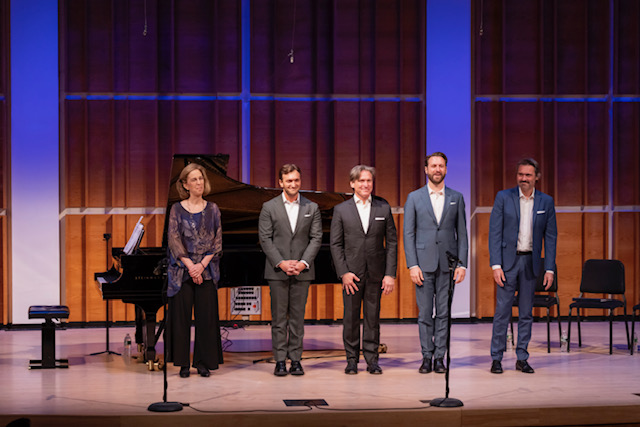
Mirror Visions Ensemble “Listen!” in Review
Daniel McGrew, tenor, Scott Murphree, tenor, Jesse Blumberg, baritone
Mischa Bouvier, baritone, Margaret Kampmeier, pianist
Merkin Hall, Kaufman Music Center
October 5, 2025
An extraordinary concert exploring the ties between text and music took place this weekend at Merkin Hall under the auspices of the Mirror Visions Ensemble (MVE). Devotees of new music may know of the organization, as it has been part of New York musical life for over thirty-two years, commissioning over 105 new works by more than 35 composers. For those unfamiliar, though, some of its performers demonstrated on Sunday just what makes it unique. As expressed on the organization’s website (mirrorvisionsensemble.org), “Mirror Visions Ensemble (MVE) was founded from a desire to explore the relationship between music and text, initially through the creation of ‘mirror visions’ — settings of the same text to music by different composers.” Sunday’s concert explored this relationship with four songs set to the same Elizabeth Bishop poem (“I am in Need of Music”) and two songs set to the same poem of Siegfried Sassoon (“Everyone Sang”). This already made for a fascinating concert, but to add to the diversity there were six songs interspersed which did not “mirror” any others. These included the world premiere of a work by Randall Eng entitled Song, set to a text by Brigit Pegeen Kelly and commissioned by the MVE.
Four excellent singers alternated as soloists, joining in one duet and a quartet for the program’s finale. They were tenors Scott Murphree and Daniel McGrew and bass-baritones Jesse Blumberg and Mischa Bouvier. The superb pianist for the entire evening was Margaret Kampmeier, moving seamlessly from composer to composer, heard in the following order: Kamala Sankaram, Deborah Pritchard, Lori Laitman, David Sisco, Jake Heggie, Ben Moore, Jodi Goble, Chris DeBlasio, Paul Moravec, Tobias Picker, Ricky Ian Gordon, and Randall Eng.
The opening selection “Listen” by Kamala Sankaram (b. 1978) was a gently lyrical welcome to the concert, and it shared its title with the program. billed as “LISTEN! Reflection, Resonance, and Reverence in Song.” Scott Murphree, the Director of MVE who had just eloquently introduced the program, was the soloist. What one noticed immediately about Ms. Sankaram’s music was that it clearly communicated the text by Mark Campbell. The plea to listen to children took us to an airy register, and words of pain took us through darkness and dissonance. We hardly needed printed lyrics. If this all sounds like Text-setting 101, it is quite common to encounter the opposite – with words about rhythm set to unmetered meandering and text about calm set to shrieking dissonance. It was refreshing to hear Ms. Sankaram’s unity and clarity of message. (This is not, by the way, to say that she succumbs to the old film score ways known as “Mickey Mousing” – as she is neither obvious nor predictable.)
From this opening call to listen, the concert proceeded with the U.S. premiere of “Everyone Sang” composed by Deborah Pritchard (b. 1978) and sung by Daniel McGrew. Ms. Pritchard’s setting conveys the layers of feeling in Siegfried Sassoon’s text, reflecting shock mixed with ecstasy over the end of World War I (in which Sassoon was a soldier), along with tears, as the horrors of war are recalled. Ms. Pritchard’s music captures these mixed emotions with dizzying color, much of it coming from the piano’s repeated treble patterns and coruscating scales. It was stirring to hear.
Six songs followed before the second setting of the Sassoon text, that of Paul Moravec (b. 1957) sung by Jesse Blumberg; for clearer “mirroring” of the two settings, though, your reviewer will skip over those six for now. In a most striking difference from Pritchard’s setting, Moravec takes Sassoon’s bird imagery as a springboard – not quite as stylized as Pritchard’s magical treble effects, but rather weaving birdsongs into a pervasive texture starting from the pianist’s introduction. Another striking difference is that when Moravec’s vocal lines do enter, they have a robustness that conveys victory beyond what is sensed in the Pritchard version, piano and voice parts projecting more strength and energy. Where the Pritchard song comes to a distinct break before shifting the focus to words of tears and horror, the Moravec song does not, instead folding those darker words into the flow of overall release. The contrasts are thought-provoking – as with beliefs about Sassoon himself, based on his life and letters. One kept thinking throughout the afternoon that these pairings deserve more than an afternoon, as they would fill a week-long seminar.
If the different takes on Siegfried Sassoon’s poem were remarkable, the settings of Elizabeth Bishop’s sonnet ranged still more widely. “I Am in Need of Music” was heard in settings by Lori Laitman, Ben Moore, Chris DeBlasio, and Tobias Picker, all separated by “non-mirroring” works as before.
The setting by Lori Laitman (b. 1955) stood out first of all for being the only duet, sung here by Jesse Blumberg and Mischa Bouvier. Having two singers allowed for restatements and echoes, underscoring the impassioned effusions. Particularly beautiful were the softer evocations and musical colors in the last six lines, or sestet, of the poem – about the “magic made by melody” and the sinking into sleep. The same poem, set by Ben Moore (b. 1960) and sung by Jesse Blumberg, stood out for its very nostalgic musical language at first, then expanding its range in an urgency that grew and flowed continuously over the ends of lines and into the sestet.
One could marvel at the differences in just the above two settings, but the same Bishop poem was heard again in the setting of Chris DeBlasio (1959-1993), the only composer on the program no longer living. It had a haunting sadness right from its dreamy piano introduction – made sadder with thoughts of how this composer left the world far too soon. This song was the only one to repeat the first eight lines of the poem, giving it an A-B-A form and a feeling of emphasis on the return of “I am in need of music” – sung with great involvement by Scott Murphree. In the last of these eight lines (both times), Mr. Murphree (or Mr. DeBlasio?) replaced the word “quivering” with “trembling” – not of huge consequence and possibly unintentional (but mentioned to show we respect the imperative to “listen!”).
The last of the Bishop settings was that of Tobias Picker (b. 1954), sung by Mischa Bouvier. The heaviest in feeling of the four, helped along by the choice of the bass-baritone register, it seemed to emphasize the feeling of “need” more than the feeling of what was needed – just demonstrating again what contrasting interpretations lie in a poem, a line, and even just a single word.
Interestingly your reviewer stumbled on one more setting of this same Elizabeth Bishop poem – a gem by Alva Henderson (b. 1940). It just goes to show that such obsessions can be contagious! Aside from the joy of such discovery, this listener had a few reservations as well. It seemed, during some of the four performances of this sonnet about music, that so much felt overwrought and angst-ridden. How much was in the compositions, and how much was due to the performances? Certainly some settings stressed the “need” versus “the music” that is needed, explaining a lot, but somewhere along the way it also struck this listener how few moments of softness there had been. All four singers may have been concerned with projecting for the sake of diction and clarity, especially given the central role of text in this concert, but all could be heard more than clearly, and some intimacy was lost in what occasionally resembled operatic auditions. One longed to feel the singers relax and let the music speak, including the music from the piano, which held much of the afternoon together.
Onward to the “non-mirroring” texts, there were six, and they added much color to the program. Scott Murphree brought out the beauty in David Sisco’s Bird Song (to poetry of Dennis Rhodes), an outstanding example of how music can illuminate meaning. Mischa Bouvier gave oceans of energy to Vachel Lindsay’s wash of words in the setting of In Praise of Songs That Die by Jake Heggie (b. 1961). If songs that die were the focus in Heggie’s piece, the message soon after in Yone Noguchi’s poem My Song Is Sung offered the comforting antithesis, that “the real part of the song, its soul, remains after it is sung.” Noguchi’s poem came to life in the setting by Jodi Goble (b. 1974), sung soulfully by Daniel McGrew. Mr. McGrew also gave impetus to another call to “listen!” in the song Demand by Ricky Ian Gordon (b. 1956), based on Langston Hughes. Like so much by Mr. Gordon it had a captivating vibrancy. Ms. Kampmeier added an electric energy to the piano part.
The finale of the afternoon, and the longest work at around twenty-five minutes, was the world premiere of Song by Randall Eng (b. 1972) set in six sections to a most disturbing poem of Brigit Pegeen Kelly (1951-2016). In the composer’s words: “Brigit Pegeen Kelly’s heartbreaking poem Song centers around an act of shocking violence, as a group of boys behead a girl’s beloved pet goat. The world of masculine brutality that it conjures is a natural fit for a song cycle for four men, but my setting attempts to equally focus on the responses to that violence. Kelly’s direct, precise language offers a canvas to explore not only the perspective of the knife-wielding boys, but also the girl’s joyful memories of the goat, the community that tries to shield her from seeing its carcass, and eventually the goat’s severed head itself. The head sings its sweet song to haunt the boys, it sings to bear witness to what has been done, it sings as an act of justice.”
It is difficult to say that one “enjoyed” this work, as the gruesome subject matter obliterated any alleged surrounding “sweetness.” In fact, this listener thought at first that the final word “sweetness” was intended to be ironic. Moving on (and because no one wants to hear this reviewer’s songs, “Where Were These Boys’ Parents?” or “Goats Don’t Call That Justice”), one could appreciate the tremendous virtuosity of composer Randall Eng in narrating the tale vividly through the music, artfully punctuating key moments like the word “joke” (the misguided premise for the crime), fleshing out the story with sections of jazzy dancing rhythms (often in sevens), and accentuating the pain at one point by having all four singers join the pianist in brutal, percussive clusters and extended techniques. It was certainly unforgettable, and a thought-provoking close to the concert. As Mr. Eng concluded in his notes, addressing the power of music, “you can behead a goat, but you can’t kill its song.”
