
JH Arts & IC Artists Series presents Whispers of Fall in Review
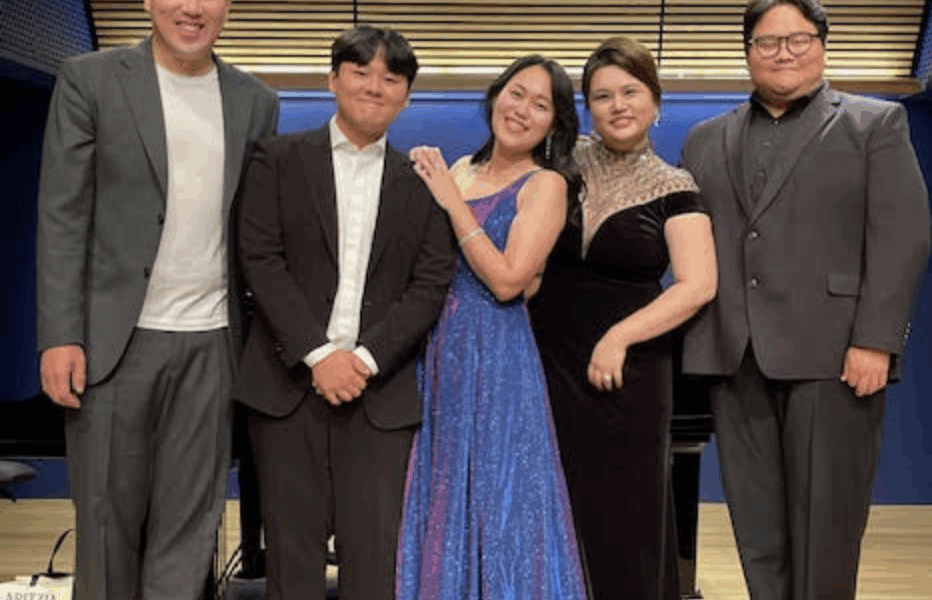
Hyunjung Choi, Heesoo Shin, sopranos; Boosung Park, tenor; Seoyong Lee, bass/baritone
Dohyun Lee, piano
Opera America National Opera Center, Marc A. Scorca Hall, New York, NY
October 4, 2025
On October 4th, JH Arts & IC Artists presented Whispers of Fall, the third in their 2025 series of concerts, in the Marc A. Scorca Hall at the Opera America National Opera Center. Arias and songs from Poulenc, Verdi, Clara Schumann, Rachmaninoff, Puccini, Tosti, and Rossini were performed by the four vocalists: Sopranos Hyunjung Choi and Heesoo Shin, tenor Boosung Park, and bass/baritone Seoyong Lee. Each half concluded with a selection featuring all four singers. In addition to these vocal selections, two solo piano works, Mélancolie, FP 105, by Poulenc, and two of the four Skazki (Fairy Tales), Op. 26, by Medtner, played by Dohyun Lee, rounded out the program. Dohyun Lee was also the accompanist for the evening. The hall was filled with friends and supporters of these artists, which is always a pleasure to see.
As I have noted in previous reviews at this venue, the Marc A. Scorca Hall has the intimacy of a salon, with very live acoustics that give the listener a sense of immediacy not felt in larger (or less acoustically live) venues. Texts for the selections were provided, with English translations – which is always appreciated. I would advise the presenter in the future not to use a microscopic font on the program flyer – it was impossible to read without resorting to a magnifying glass.
Instead of commenting on the program in a strictly linear fashion, I will comment on each artist separately. As pianist Dohyun Lee opened the program, I will start with him. His performance of Poulenc’s Mélancolie (written in 1940) conveyed much of the emotional impact without becoming overwrought. There were opportunities to project the obvious allusions Poulenc was making to war-torn France more deeply, but the overall effect was excellent. The Medtner Skazki were well-played, and not without charm, if somewhat undifferentiated. Dohyun Lee does deserve major kudos for his superb work as an accompanist – he was rock-solid all evening.
Let’s move now to the sopranos, Heesoo Shin and Hyunjung Choi. Ms. Shin’s offerings were a Poulenc song set and a Puccini aria. “Tu, che di gel sei cinta” (Turandot), issung by Liù as she is being tortured, just prior to her suicide. Puccini himself wrote the words for this aria, and the librettists decided they could not improve on his text. Ms. Shin’s projection of Liù’s resolve to maintain the secrecy of the Prince’s identity and her defiance even while being tortured was heartbreakingly poignant. Of the three of Poulenc’s Métamorphoses, FP 121, “Paganini,” stood out – Ms. Shin has a sense of play, and she brought to the quirky text an almost whimsical approach that this listener found irresistible.
Hyunjung Choi’s selections were three of the Sechs Lieder, Op. 13, by Clara Schumann (with texts by Heinrich Heine), and “Caro nome che il mio cor” from Verdi’s Rigoletto. The second of the lieder, Sie leibten sich beide, was the most compelling to this listener. The tragedy of lost love and missed opportunities that are simultaneously heartbreaking and infuriating in this song are challenging to capture, yet Ms. Choi did so in impressive fashion. It would be easy to overdo either the sadness or the frustration, which would completely spoil the effect. The singing was compelling, but the artistry was what made it exceptional. In the Verdi, her vocal agility, clarity of diction, and range (especially in the extreme upper register) without strain, stridency or loss of intonation, were notable. It all seemed easy, which of course, it is not. This went beyond what one might expect, and it made a strong impression on this listener.
Tenor Boosung Park performed “Quando le sere al placido” from Luisa Miller (Verdi) and two Tosti songs, L’ultima canzone and Ideale. The overriding theme in Mr. Park’s selections was sorrow, and that can present its own complications. In the Verdi, the dramatic impact is everything. Emotions abound, and one must be nearly overwrought without being a caricature. Thankfully, Mr. Park showed mastery in pushing the emotional limits to the edges while maintaining a body language of complete composure. If anything, he could have “loosened” up a touch, which would have only enhanced the effect of his strong, confident voice. The Tosti songs were light fare after the emotional wallop of the Verdi. Well done!
Bass-baritone Seoyong Lee gave us arias from Rachmaninoff’s Aleko and Rossini’s Il barbiere di Siviglia. He has a powerful voice that would easily fill any hall, but he also was sensitive enough to make the adjustment to the acoustics of this venue. “La Calumnia” was a delight, as he dealt with the rapid-fire parts with a smile. He is certainly not lacking in charisma, which he projects with a natural ease. All the charisma in the world means nothing without vocal ability, which he has in spades. The “Aleko cavatina” proved that he is not just about acting – this cavatina is formidable music that requires a formidable singer. The Verdi was great fun, but the Rachmaninoff showed Seoyong Lee is the “real deal” as an artist.
Finally, the entire group numbers – “Dunque e propio finite” from La Bohéme ended the first half. Without wishing to take anything away from “Mimi” (Ms. Choi) or “Rodolfo” (Mr. Park), the sassy “Musette” (Ms. Shin) and the vexed “Marcello” (Seoyong Lee) stole the show with their antics. “Libiamo ne’ lieti calici” from La Traviata, one of the most popular and well-known opera melodies, was the final selection of the evening. Seoyong Lee offered a champagne flute to each audience member as he made his way to the stage to join the others, who all had their own glasses. Several audience members happily waved their glasses to the music – some even quietly singing along, in what was a delightful end to the evening. All four performers took a bow together to the applause of the appreciative audience.
