
Modus Operandi Orchestra (MOO): Modus plays Mozart @ Merkin in Review
Modus Operandi Orchestra
Justin Bischof, conductor
Chloé Kiffer, violin
Merkin Hall, Kaufman Music Center, New York, NY
October 15, 2025
The Modus Operandi Orchestra (MOO), under the direction of Justin Bischof, presented a concert entitled “Modus plays Mozart @ Merkin”- an all-Mozart program at Merkin Hall on October 15, 2025. Violinist Chloé Kiffer was the featured soloist in the Violin Concerto No. 5 in A major (“Turkish”), K. 219. Opening the program was the Symphony No. 40 in G minor, K. 550, and closing it was the Symphony No. 41 in C major (“Jupiter”), K. 551.
The program included extensive biographies of the conductor, soloist, concertmaster, guest conductor (not even appearing on this program), and the orchestra itself. As for the music itself, not a single word. Why is the 41st symphony called “Jupiter”? Why is the violin concerto called “Turkish”? What cadenza(s) did Ms. Kiffer play? Joachim? Her own? Yes, Mr. Bischof does talk about the works in a light, accessible manner, and this is always a nice touch, but by necessity it is always short. This is not the first time I have said this – not everyone is an expert, nor do they wish to do post-concert research, so some written notes about the program would enrich the concert experience.
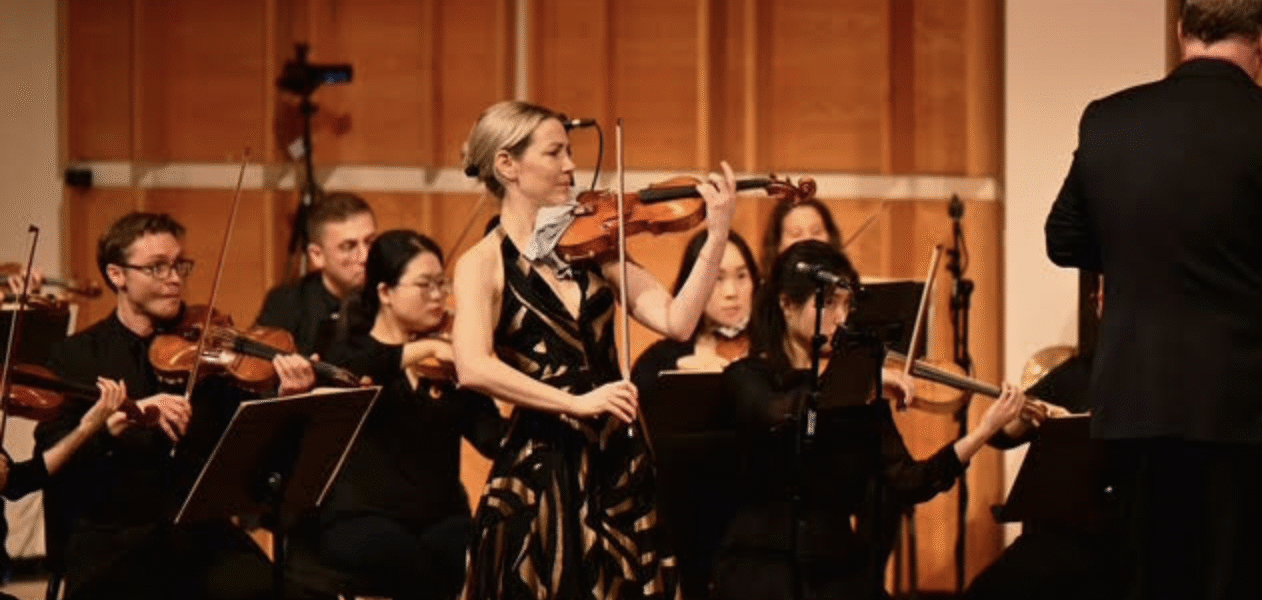
Even though the Symphonies were not played consecutively, for this review I will pair them together, but will start with the Violin Concerto. Violin soloist Chloé Kiffer took the stage with Maestro Bischof. This was not their first collaboration, as Ms. Kiffer had previously played the Coleridge-Taylor Violin Concerto, as reviewed in these pages. The first thing that caught my attention was that Ms. Kiffer was using an iPad, with a foot pedal for page turns. This seems to be a growing trend.
This concerto is not a demonic display of pyrotechnics a la Paganini, but that does not mean it is without virtuosic demands. One must “sing” but also dance around the intricacies with an almost off-handed elegance. Failure to meet these requirements results in what could be described as lumbering or heavy. The orchestra must join in kind. Ms. Kiffer played with a rich, singing tone that she projected with a natural ease – there was nothing forced or contrived about it. The small confines of Merkin Hall make any tonal imperfections manifest, but when an artist of Ms. Kiffer’s caliber plays, the listener is rewarded with a true sense of immediacy that would not be possible in a larger concert hall. Her stage manner is notable – engaging without any excesses or histrionics, etc. The passagework was crisp, light, and accurate, making it look simple when it is anything but (the occupational hazard of a highly skilled player)! The cadenzas had the right amount of “fire” that showcased her virtuosity while keeping in character of the work. Incidentally, to answer one earlier question, her cadenzas were by Joseph Joachim. (As for the other question, the “Turkish” name comes from the use of so-called Turkish music, and the same A major-minor shift that appears in the “Rondo alla Turca” in K. 331.)
The rapport with the orchestra was excellent, and both MOO and Maestro Bischof were as deserving of praise for their outstanding work as Ms. Kiffer. The audience gave them a well-deserved standing ovation.
As Maestro Bischof related, the last three Mozart Symphonies were written in 1788 in the space of three months (!). To just get the notes on the paper for three symphonies in that time would be challenging enough, but to complete three fully-formed masterpieces is simply mind-blowing. Maestro Bischof also related that Nikolaus Harnoncourt was of the opinion that these three symphonies were conceived as one grand work (I disagree). There Is also debate on whether or not Mozart heard these symphonies performed in his lifetime. (Answer to earlier question: According to Mozart’s son Franz Xaver, the impresario Salomon gave the 41st symphony the nickname “Jupiter.”)
The 40th symphony exists in two versions (the second has the addition of clarinets). The autograph scores of both versions were acquired by Johannes Brahms (who later donated the manuscripts to the Gesellschaft der Musikfreunde in Vienna). The version sans clarinets was played.
The 40th symphony is one of the most frequently performed and recorded works of Mozart. With its tragic underpinnings and passionate nature, it foreshadows the Romantic era by several decades. From the reading of Maestro Bischof and MOO, it was clear that they understood that Mozart provided everything and a successful performance is one that honors the score. One might have wished for a bit more simmering mystery in the opening movement, but it was still very effective. The lyrical second movement was played with grace. The angular, defiant minuet of the third movement had the right amount of “growl” that gave way to a gentle and elegant trio, played with suitable charm. The finale, launched with a Mannheim rocket, was played with vigor. Other than a few isolated instances of imbalance between the strings and the winds, this was a fine performance.
The 41st Symphony was the final work on the program, and the dictum “save the best for the last” was certainly in play here. One might wonder if Mozart was aware this would be his final symphony, as he unleashed the full power of his unmatched genius (complete with a quintuple fugue in the final movement!). It could be argued not only is this work the greatest “classical” symphony, but the greatest symphony of any era. Maestro Bischof and MOO came fully prepared. There were no half-measures – the playing was polished, involved, and highly energetic, almost at times to the point of overexuberance. This latter point is only a minor criticism, as seeing and hearing passionate playing is always preferable to the workaday playing one often sees. If this was the first time for an audience member hearing this work, then they were given an outstanding “introduction.” To this listener, it more than held its own with any number of performances and recordings he has enjoyed. The audience reacted with an enthusiastic standing ovation. Bravo Maestro Bischof and MOO!
