
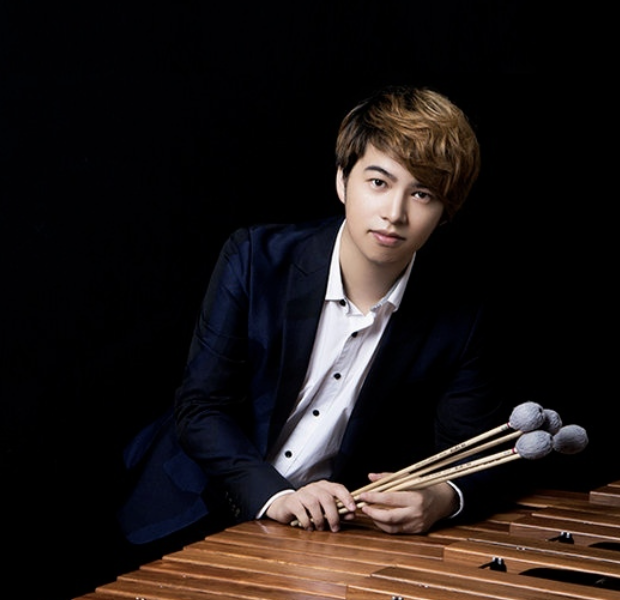
Shiqi Zhong Percussion Recital in Review
Shiqi Zhong, percussion
YoonJung Hwang, violin; Qianci Liu, cello; Jiacheng Xiong, piano; Jonathan Haas, timpani/percussion; Kelsey Choi, percussion
New York University, John H. Paulson Center, New York, NY
December 18, 2025
On December 18th, Shiqi Zhong gave what was his third recital towards the completion of a DMA degree in percussion at New York University. Mr. Zhong is the first DMA candidate in the newly created doctoral program for percussionists. The sole work on his program was the Viktor Derevianko/Mark Pekarsky arrangement of Dmitri Shostakovich’s 15th Symphony for piano trio, percussion, and celeste, which is obviously not a percussion-centric work, so one assumes that this recital is to meet a chamber/ensemble requirement. Mr. Zhong was joined by violinist YoonJung Hwang , cellist Qianci Liu, pianist Jiacheng Xiong, and percussionists Jonathan Haas and Kelsey Choi .
Mr. Zhong welcomed the audience and thanked them for attending. Before the recital proper, there was some pre-recital “bonus” content – a pipa/piano piece and a presentation of handpan drumming, featuring Mr. Zhong with some of his young students. The Handpan is a steel drum that resembles a large tortoise shell. It has both melodic and rhythmic qualities, which Mr. Zhong demonstrated. He is currently writing a method book for handpan, and two studies that he wrote were offered – the first highlighting the melodic possibilities, and the second, the rhythmic with a focus on hand independence. It was nice to see how much pride Mr. Zhong has in his young students. Of course he is an outstanding musician, but one has the sense that he is also an outstanding teacher who wants to share his love and enthusiasm for music and percussion with his students, regardless of their level of prowess.
After this demonstration, Mr. Zhong invited his advisor/mentor Jonathan Haas to speak as the other musicians took their places in preparation for the Shostakovich. Professor Haas spoke about Shostakovich and this arrangement of the 15th Symphony in a manner intended to be a very quick overview of his life and trials. (He had written some informative notes that were included in some pre-concert publicity, but unfortunately those notes were not distributed at the recital.) He did take a few liberties – for example stating that Shostakovich’s first three symphonies had aroused Stalin’s ire, though in fact it had been the composer’s opera Lady Macbeth of the Mtsensk District that had caused such trouble. Also, Professor Haas suggested that a fear of Stalin figured into Shostakovich’s compositional mindset, whereas Stalin had been dead for nearly two decades when Shostakovich wrote this symphony, so such fear was unlikely.
Like many of Shostakovich’s works, the 15th Symphony has definite autobiographical underpinnings, but what exactly they are in this work have been, and continue to be, debated by experts. A plausible explanation suggests that the composer knew that this was going to be his final symphony, and that he shared memories of his life, from childhood to his final days, when the end was imminent. There are quotes from other composers, the most obvious being Rossini’s William Tell overture, which appear throughout the work.
In an earlier review in these pages ( Shiqi Zhong in Review), Mr. Zhong was the focal point, showcasing his “seemingly limitless technical abilities.” Tonight, he was tasked with a supporting rather than starring role. In this context, it is not easy to offer any specific praise, other than he was an attentive and sensitive team player, moving seamlessly between the components of the percussion battery. His collaborators were all top-notch musicians as well, and the combination of their skill and the very effective arrangement of this symphony resulted in one of the more memorable concerts this reviewer has experienced in some time. There were of course some individual highlights. Violinist YoonJung Hwang captured the gallop-like motifs with a jaunty insouciance that was perfect. Cellist Qianci Liu’s purity of tone brought out the emotional impact of the simple but profoundly beautiful solos from the second movement. Pianist Jiacheng Xiong was a force as he served as the de facto “orchestra”. Last, but certainly not least, percussionists Kelsey Choi and Jonathan Haas joined Mr. Zhong as the “heart” of the work. The forty-five minute performance time seemed to pass in a few moments – this is how spellbinding it was. And yes, the audience members were all smiles when the William Tell quotes appeared in the opening movement. Kudos to all, and best of luck to the soon-to-be Dr. Zhong in all his future endeavors.
