
WA Sinfonietta presents The Craft of Perfection: Mendelssohn and Brahms in Review
WA Sinfonietta
Charles Neidich, Music Director/Conductor
Good Shepherd-Faith Presbyterian Church, New York, NY
March 15, 2026
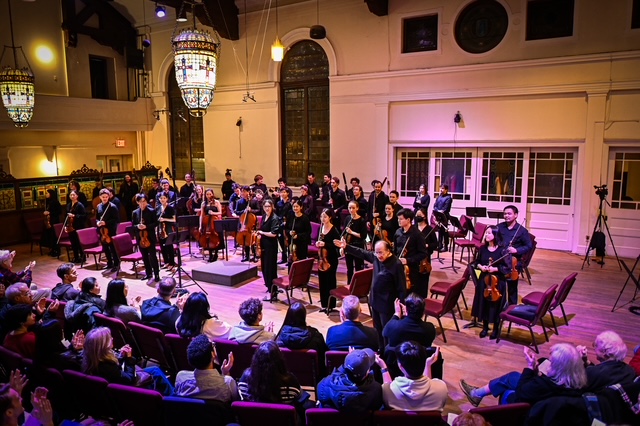
The WA Sinfonietta, under the baton of the world-renowned clarinetist Charles Neidich, gave its first 2026 performance on March 15th at the Good Shepherd-Faith Presbyterian Church, with works by Mendelssohn and Brahms. The first two concerts ever of this ensemble (the inaugural concert on March 23, 2025, and May 13, 2025) had already shown the great potential and promise of this ensemble. (Interested readers can click on the following links to read about those concerts: WA Sinfonietta in Review March 23, 2025 and WA Sinfonietta in Review May 15, 2025.) As one has come to expect from the intellectually curious Mr. Neidich, this was a concert program of both historical interest and scholarly investigations combined with highly energized performances. The Sinfonietta has already built up a devoted fan base – the hall was filled, and extra chairs were added to accommodate to overflow. This is something that makes any lover of the arts very happy (are you listening, Timothée Chalamet?), and it bodes well for the future.
As has become standard for these concerts, Mr. Neidich spoke about the program and various points of interest, but (again) was all but completely inaudible to anyone who was not in the first or second rows. The audience members next to me were visibly frustrated by this. Thankfully, the excellent program notes (which I am assuming were written by Mr. Neidich) were both interesting and informative.
Mendelssohn’s Overture for Winds in C major, Op. 24, opened the program. Originally written in 1824 for eleven instruments with the title Nocturno, the updated version was in response to a call for improved military music in Prussia (amongst other countries). Mendelssohn added a few measures and expanded it for a large band of twenty-five instruments and gave it the new title. The program notes called this work a model for future large wind works, and one can hear how Sousa (an intelligent and skilled composer too often marginalized) must have drawn inspiration for his own works. The winds of the WA (all players who no doubt have had extensive band experience) played with great energy. The one reservation I had was it did seem that there was an exaggerated effort to bring melodic lines to the fore in the first section at the expense of overall ensemble balance. A quick glance at the score does not suggest that this was intended, so perhaps it was an interpretive choice. The second section was what I would expect from players of quality and experience – crisp, with martial precision and precise balance.
The 1834 revision of Mendelssohn’s 4th Symphony (“Italian”) followed the Overture. The program notes tell us that Moscheles, who conducted the second (unauthorized) performance in London, wrote Mendelssohn “…its shortcomings might only be evident to you and me.” Mendelssohn took this as the call to make revisions. The end result was that the second, third, and final movements underwent revisions; the first movement was left as it was. History seems to have landed firmly on the side of the original, which is the overwhelming choice for performance. About the revised version the noted English music critic Edward Greenfield wrote “Surprisingly for so perceptive a composer he (Mendelssohn) undermined the original’s freshness, smoothing over melodic lines (as in the Pilgrim’s March) and extending linking passages. A fascinating comment on the danger of second thoughts after white-hot inspiration.” Even Mendelssohn’s beloved sister Fanny was critical of the changes.
Mr. Neidich is very fond of exploring such non-standard versions, such as in his WA Sinfonietta inaugural concert, which had a similarly non-standard addition to the Brahms 4th symphony. His presentation of this 1834 version is a welcome attempt at introducing listeners to new ideas of works that they might already have known well in their original forms. Whether or not one prefers this version or the original, it is indisputable that the WA Sinfonietta gave an excellent performance, and likely one of the very best of this version. Mr. Neidich is a meticulous musician, and he brings that quality to the podium, which in turn he imparts to his ensemble. The opening Allegro vivace had a lively freshness that was notable, with an exuberance that always remained controlled. The Andante was brooding, but in a thoughtful fashion, and not self-indulgent. The Menuetto had charm, but it also had heft, with some exceptional brass playing. The stormy Saltarello finale was played with gusto. The audience responded with an enthusiasm that one usually hears at the end of a concert. Mr. Neidich shook hands with many of the ensemble members; indeed, one senses that he is truly overwhelmed with gratitude for both the audience and his ensemble.
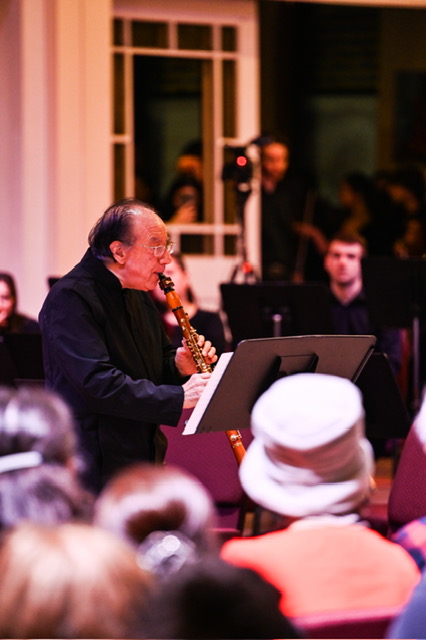
After intermission, Mr. Neidich offered a short solo clarinet work of his own, the title of which I was not able to hear when he announced it in an even softer voice than his opening remarks (and it was not listed on the program). It was hauntingly evocative and filled with passages that highlight Mr. Neidich’s considerable virtuosity. There were also some interesting extended techniques, such as blowing into the mouthpiece without forming notes, but producing a swirling wind sound.
The ensemble then returned for their sole work of the second half, Brahms’s Symphony No. 3 in F major, Op. 90. For some background, Mr. Neidich has spoken about the connection between Brahms and the Meiningen Court Orchestra (A conversation with Charles Neidich), and how the WA Sinfonietta is modeled after the Meiningen. Brahms was well known for his penchant for revision and refinement, and the 3rd symphony is no exception.
If the earlier Mendelssohn works were evidence of playing at a high level, the Brahms raised the bar even higher. It might be premature to state this, but based on this and the earlier Brahms 4th, it seems that the WA Sinfonietta has a special affinity for Brahms. I was reminded of an earlier performance of the 3rd by another ensemble that had been workman-like, with notes all there but an overall lack of differentiation. In contrast to this, the Sinfonietta offered a powerful reading, filled with urgency and a robust quality that one not only wants, but requires for this symphony. The lovely clarinet in the second movement must have gladdened Mr. Neidich’s heart. It was one of the better Brahms 3rd that this listener can recall hearing, which is no small achievement, especially for an ensemble still in its early stage. The audience loved it, and the ovation was loud and long for Mr. Neidich and the Sinfonietta. It is my hope that this fine ensemble continues its upward trajectory and that Mr. Neidich’s obvious passion keeps rubbing off on his talented players. The WA Sinfonietta is well worth any music lover’s attention, so if one has the opportunity to hear them they should not hesitate. They might have to get there early for a good seat!
