
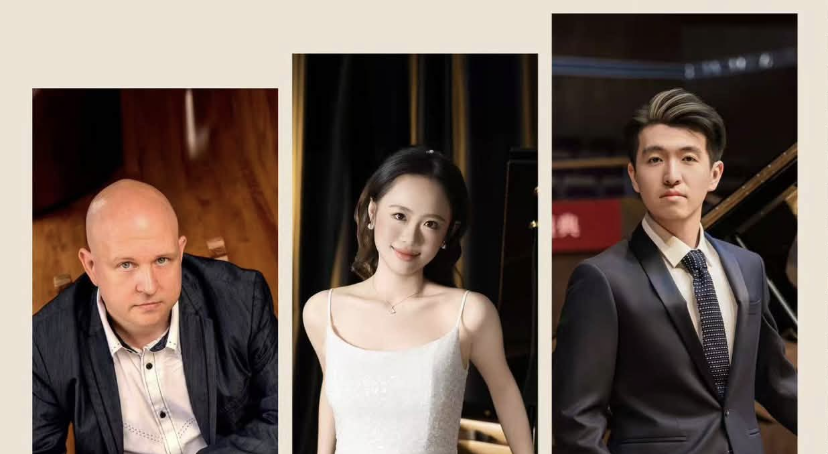
Hong Kong Bay Sea Art Co. Ltd. presents “The Inheritance” in Review
Mohan Liu, Piano; Yangmingtian Zhao, Piano; Steven Spooner, Piano
Weill Recital Hall at Carnegie Hall, New York, NY
October 4, 2026
This weekend at Carnegie’s Weill Hall a most unusual concert took place featuring pianists Mohan Liu, Yangmingtian Zhao, and Steven Spooner. What was unusual was that Mr. Spooner was once the teacher of Dr. Zhao, and Dr. Zhao was listed as the teacher from 2017 of Mohan Liu, who currently also studies with Mr. Spooner at Peabody, so we had in a sense three musical generations (in terms of educational lineage, that is, as they are not quite a generation apart in age). The program was fittingly entitled “The Inheritance.” While there are many recitals that present teachers and students, ones spanning from teacher to “grand-student” are relatively rare.
The program included music of Mendelssohn, Schubert, Liszt, Debussy, Respighi, Gershwin, Poulenc, Wenhe Han, Benchao Yang, and Steven Spooner performing his own etudes (with nods to Richard Rodgers, Keith Jarrett, and the rock band Queen). Rather than zigzagging from pianist to pianist, the program was divided into what felt like three distinct mini-recitals. The “middle” generation, pianist Yangmingtian Zhao, introduced the whole concert, starting with the youngest pianist, Mohan Liu.
The poised Ms. Liu walked onstage to begin Mendelssohn’s Variations Sérieuses, Op. 54 – a change from the printed program, which had listed Schubert – and right from the opening theme, one sensed her great care in matters of tone and phrasing. Naturally there was a bit of time needed to tame the instrument completely, but she adjusted quickly. Particularly beautiful were Variations XI with its cantabile lines and the soulful XIV. Variation XII with its repeated notes took on the speed of a riveting machine, as did the exciting finale.
She proceeded next to the first movement of Schubert’s Piano Sonata in A minor, D. 784, which had been originally listed to open the program. It was unfortunate that the format of this recital had not allowed the complete sonata, as such a work deserves to be heard in its entirety, but three substantial mini-recitals in a row hardly allow for such a thing. At any rate, she showed fine command. Occasionally one wanted a bit more connection in the two-note octave slurs, which, even if they cannot be connected physically, can certainly be tapered tonally, one to the next. Interestingly she showed the ability to do just that – and wonderfully – in the Liszt Transcendental Étude that followed, Chasse-neige. Here one felt cohesive lines of treble octaves despite Liszt’s intervening flurries. It made for a brilliant close to an auspicious debut. One did not need to guess how proud her teachers were, as they were there.
After a great round of applause for Ms. Liu, Yangmingtian Zhao came onstage and spoke a bit about his selections. Not everything could be heard distinctly over the rustling of the audience (a microphone would have helped), but it was clear that Dr. Zhao is a musician who enjoys sharing, a quality that is paramount for classical performers and is not as universal as it should be. That same communicative quality emerged equally in his playing, starting with Les chemins de l’amour of Poulenc. Originally a valse chantée, this elegant song has been embraced by a growing number of pianists as a solo piece, and quite understandably. In Dr. Zhao’s hands this gem was just right, combining the elegance of Parisian boulevardiers with a disarming wistfulness. Following with more French music, he captured well the washes of color in Debussy’s Pagodes.
Having spoken a bit about the connections between Debussy and Asia (particularly the gamelan music), Dr. Zhao then made a natural segue to Chinese pieces from our own era starting with Indigo Blue Water, newly composed by his friend Wenhe Han (b. 1989). Relaying the composer’s suggestion that the listener be free and not feel tied to the title, Dr. Zhao characterized the music as more post-Impressionistic than Impressionistic, with qualities of Cubism – and with that thought, one could almost imagine the multiple musical “angles” converging. If one understood completely Dr. Zhao’s spoken introduction, he had only learned this brand new composition quite recently but he seemed to have a strong sense of it already. Also newly composed was the next selection, Love Is Humanity’s Ideal by Benchao Yang (b. 1987) – in fact, as Dr. Zhao explained, it is a transcription of themes from an opera still being composed by Yang for an upcoming concert, so in a way this performance was a preview. Dr. Zhao played its lyrical themes with much expressiveness, and where they were embellished in Lisztian fashion, he unleashed plenty of firepower.
Dr. Zhao’s set, including talking, was turning out to be the longest of the three, in a program of nearly two hours without intermission. Someone perhaps ought to have considered durations more carefully – as such shared programs may not seem long to the performers who play a mere fraction of them, but the entirety may feel long to an audience. That said, there was thankfully a good variety of styles and moods. Respighi’s seldom heard Intermezzo-Serenata offered some contrast from the flamboyance of the Yang transcription, and the final piece, Gershwin’s Rhapsody in Blue (in the solo version)brought not only a new style, but Dr. Zhao’s surprisingly individual version. Some added noodlings, approximated slides, and a well-placed glissando were among the stylish touches. Occasionally, beloved themes were overwhelmed by subsidiary material – and some moments struck this listener as too slapdash and frenetic, but there was enough spirit to make up for almost anything, and quite a spirit of adventure.
Contrary to what one might expect, this concert’s eldest player of the three, Steven Spooner, showed the most adventurous streak of all. For readers who have not heard of this tremendous pianist, his website is here: Steven Spooner – and for those who have not heard him play, there is great exploration ahead. He plumbs the depths of the more standard repertoire – as we heard in his Schubert-Liszt Ständchen to open – but also retains that youthful spirit of pure fun and innovation, as we heard in his own Three Concert Etudes.
Ständchen was a revelation. Few are unfamiliar with this treasured Schubert melody – or even Liszt’s framing of it for that matter – but rarely has this listener heard such emotion wrung from each note of it. Slightly slower than one generally hears it – which some would undoubtedly find too slow – his tempo showed fearless devotion to the moment, in what was a meltingly beautiful interpretation. It may be too tempting to draw connections between his strengths and those of his students – after all, the best teachers of artists foster individuality, as clearly he has – but a special sensitivity to tone seems to be among the cultivated traits. Moments of Ms. Liu’s Schubert and Mendelssohn, Dr. Zhao’s Poulenc, and Mr. Spooner’s Ständchen (plus his second etude yet to come) all had moments of such tonal beauty that they seemed to be portals to another world.
Shifting gears, Mr. Spooner concluded the recital with his amazing Three Concert Etudes, the first called Étude-Toccata, à la Argerich. In it were the rapid-fire repeated notes that definitely did bring to mind some Argerich performances, set in a Latin-flavored jazz toccata that also had one thinking of Ginastera. The audience was quite captivated – and more than amused when the performance seemed to have resulted in a broken a treble string.
The second etude, entitled Keith Jarrett, took a sadder tone, in reflection on this great musician of classical and jazz worlds, whose two strokes cut his composing life short. As Mr. Spooner announced, this performance would be improvised so it would never be heard exactly the same way again – then quipping modestly that, “maybe that’s a good thing.” In fact, it would be very much worth hearing again as it stood, so hopefully it was recorded. This was the hypnotic music of daydreaming, with hints of “My Funny Valentine” poignantly placed. One could hear the proverbial pin drop in the hall.
He proceeded attacca to the final work on the recital, his Vladimir Horowitz: Concert Paraphrase of Queen. It was a bravura closer that introduced Queen’s We are the Champions with the sort of outsized pyrotechnics at which Horowitz excelled. Horowitz’s own fondness for giving audiences a tune to hum while leaving the hall was also a springboard of inspiration – and Mr. Spooner’s treatment of Queen was an imaginative one, even if this reviewer’s “bombast meter” went on the fritz somewhere in the middle of it. It also did with Horowitz sometimes. What we heard, though, seems destined to thrill a wide audience.
Kudos are in order for all three pianists. At one point in his comments from the stage, Mr. Spooner quoted from Hans von Bülow that, “There are no great teachers, only great pupils.” Maybe there are both.
