
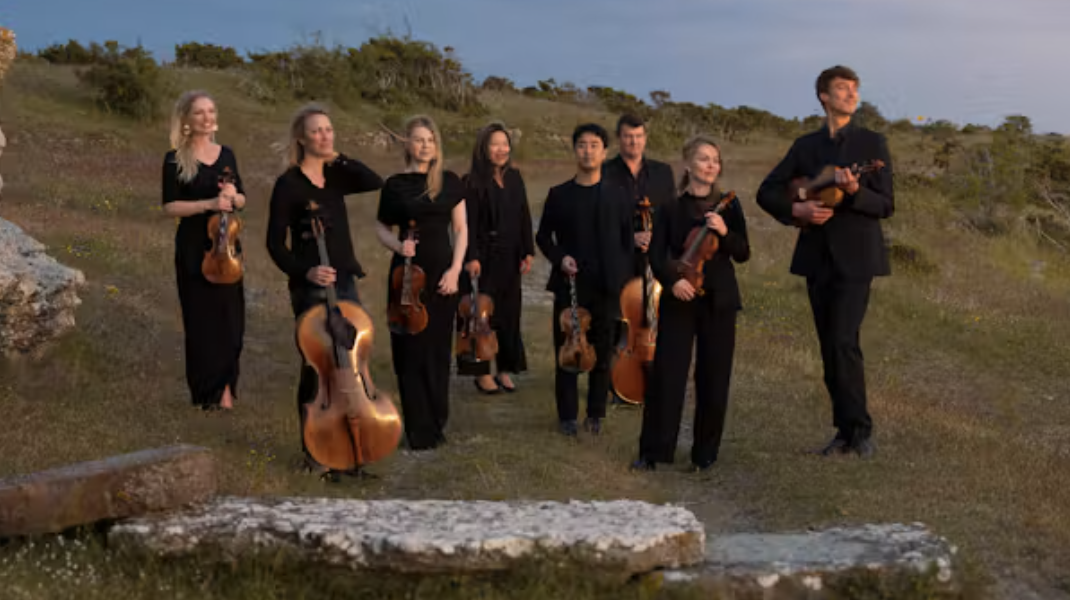
Camerata Nordica Octet in Review
Camerata Nordica: Shuichi Okada, Hanna Helgegren, Katarzyna Szydłowska, Daina Mateikaitè, violin; Kimi Makino, Sebastian Steinhilber, viola; Zéphyrin Rey-Bellet, Sabina Sandri-Olsson, cello
Weill Hall, Carnegie Hall, New York, NY
September 30, 2026
Camerata Nordica is a group of eight extremely accomplished string players described, in their printed biography, as an ensemble that has “garnered a reputation for its distinctive style, captivating audiences by performing standing up and occasionally by heart.” They hail from Sweden, from across different orchestra and chamber groups. I had not heard them (or of them) until now, but it was a pleasant occasion to spend an evening in their company, the other night at Weill Hall. Under the artistic direction of cellist Zéphyrin Rey-Bellet (who is also one of the performers), the group is composed of violinists Shuichi Okada, Hanna Helgegren, Daina Mateikaitè and Katarzyna Szydłowska; violists Kimi Makino and Sebastian Steinhilber (both terrific on Wednesday night); and cellists Sabina Sandri-Olsson and Mr. Rey-Bellet.
The evening started with two traditional songs (Song to My Father and Polska in A minor), in part arranged by the ensemble, played in perfect harmony with one another, and with the character of the music. Next on the program was a piece commissioned by Camerata Nordica and written by one of its players, violinist Hanna Helgegren. She introduced her work titled The Nordic Seasons, but unfortunately I could only hear a few words of her presentation. She needed a microphone, but in her defense, the audience was still restless, and some of the late arrivals were still trying to find their seats. The composer related that she was inspired by Nordic folk music, and tried to explore the shades of each season in the northern lands, the mystique of the transition between day and night, light and dark, and her own fascination with nature. The music was accompanied by a video clip which lasted for the entire duration of the piece (all four movements, each dedicated to a season), and was projected on the stage, behind the standing performers. Many of the images had a distinct “National Geographic” feel, such as vistas of water (both frigid looking and sun kissed), polarized flowers, fields ready to be harvested, and puffy clouds. The music had a very tonal and conventional structure, reminiscent of Grieg or early Sibelius. Each movement was more “illustrative” than heart-grabbing. The melodies were gentle, tickling the ears most pleasantly, and the rhythms always with a folkish beat. In other words, we were a world apart from, let’s say, the much more dramatic albeit stark feel of Ingmar Bergman’s Fārö Island, which to my mind would be a more intriguing starting point in exploring the Nordic soundscape; there was no mystery here, just a gentle caress of the senses. The harmonies hugged each other in perfect agreement, without any sense of real drama or conflict. The players delivered each phrase with clarity, beautiful tone and swift phrasing. The splendid acoustics of Weill Hall also contributed to engulf the audience in a comfortable bubble of “feel-good.” This was safe and comfortable music- charming, evocative, but – to my ears – unmemorable.
The first half of the recital was concluded by Shostakovich’s Two Pieces for String Octet, Op. 11 – a work of much more substance, where these highly talented musicians got a better chance to showcase their virtuosity and emotional versatility, always delighting us with lush tones and perfect togetherness. Listening to them, one realized how valuable the experience of playing in an orchestra can be for solo musicians, but also what a truly remarkable soloist is able to achieve when paired with a small group of their peers. The eight outstanding players made out of each instrument a soloist who could only truly shine in the company of the others.
Mendelssohn’s Octet in E-flat major constituted the second half of the program. Written when he was only 16 years old, the Octet has long been considered one of the masterpieces of the genre- a monumental work which leans more towards virtuosity and youthfulness, but does also feature an occasional pang of drama and transcendence. Camerata Nordica played throughout with luminous energy, taking very few interpretation risks and therefore not necessarily bringing anything revelatory to the table; however, the phrases unfolded beautifully and spoke with eloquence. The lines were long and well-constructed; each climactic point reached with authority and conviction. The emotions, though, with the possible exception of fervor, remained at the surface level. The Andante moved perhaps a tad too swiftly, somewhat missing the darker undertones. The hauntingly beautiful counterpoint in triplets felt overplayed and sounded earthy. The Scherzo, on the other hand, was as spirited and playful as a midsummer’s night dream. Here the musicians were unafraid to whisper in softer shades, suggesting a much needed otherworldliness. The fire-eating Presto travelled on wings from start to finish, without neglecting moments of suave delicacy and mischievous humor.
All in all, a beautiful evening of smart programming and effortless charm, crowned with an energetic encore, a Swedish Polka!
