
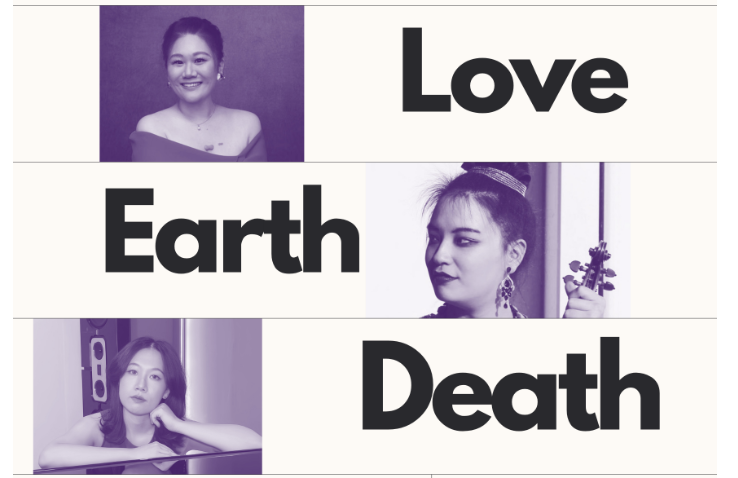
Love, Earth, Death: A Dialogue Between Black and Chinese Voices in Review
Love, Earth, Death: A Dialogue Between Black and Chinese Voices in Review
Almost Quintet Trio
Peiyao Yu, piano; Zhengyingue (Elaine) Huang, soprano; Xenia Deviatkina-Loh, violin/viola
Saint John’s in the Village (St. John’s Church), New York, NY
August 14, 2026
On August 14th, the Almost Quintet Trio presented a program entitled “Love, Earth, Death: A Dialogue Between Black and Chinese Voices,” at St. John’s Church in New York City. It was to be an interesting program that showcased the talents of three accomplished musicians, Peiyao Yu (piano), Zhengyingue (Elaine) Huang (soprano), and Xenia Deviatkina-Loh (violin/viola).
As Peiyao Yu explains, the trio’s name stems from the fact that the pianist also plays organ and the violinist also plays the viola – thus it is “almost a quintet.” Their mission (according to their website) is “dedicated to championing underrepresented composers, with the ultimate goal of a future where no composer need be labeled ‘underrepresented’ at all.” This is an ambitious goal, but one might take issue the suggestion that Bright Sheng is an “underrepresented” composer. It would be a good idea to clearly define what is meant by underrepresented.
This listener had a general feeling that this performance was a trial run in preparation for a larger one. There were no printed programs (rather, a helper asking people in the audience if they needed a program and sending digital copies to those who asked for one), and even the digital copy was missing any biographical information or program notes. It seemed to fly in the face of the stated mission – would it not be helpful to introduce these composers and give some information about their works? There were some brief comments made, but were rendered so quietly that a lot of what was being said was lost.
The program itself alternated between Chinese composers and African-American composers. It was not immediately apparent what form the “dialogue” took, supposedly the listeners were to decide for themselves. The opening and closing selections, On One Side of River (Qingjia Lin b. 1934) and Until Now (Kui Dong b. 1966) could best be described as popular songs, with sentimental touches and soaring melodies. They were rendered with great passion and devotion by soprano Zhengyingue (Elaine) Huang, with able support from Peiyao Yu and Xenia Deviatkina-Loh. These songs brought some of the more enthusiastic responses from the audience, so one might assume the songs were familiar to them. Two selections, Blue Flower, and At the Hillside Where Horses Are Running from Three Chinese Love Songs by Bright Sheng (b. 1955) joined the traditional Chinese Opera style from the vocalist with modern “Western” writing for the pianist, including some extended techniques (playing inside the piano, etc.). Of the “Chinese voices,” this was the most compelling to this listener, and the favorite of the Chinese works. Ms. Huang showed her versatility and strong voice throughout the evening, projecting clearly while remaining sensitive to the acoustics of the small venue. She maintained a carefully controlled vibrato that was just right. Ms. Yu was an excellent collaborator, highlighting the dramatic effect without ever overwhelming the vocalist. There was an opportunity for violinist Xenia Deviatkina-Loh to have her starring moment in selections from the highly popular (primarily in China) Butterfly Lovers’ Concerto by Chen Gang (1935-2026) and He Zhanhao (b. 1933). She is a stylish and assured player, dashing off passagework with ease while avoiding the trap of over-sentimentalizing the melodic material (which would be so easy to do in this work). I’m sure that Ms. Deviatkina-Loh will continue to display those qualities in a planned future performance of the entire work.
The two works that formed the “Black” portion of the program fit the mission statement of the trio more closely than that of the Chinese portion. As a side note, it would have been good to have the texts/translations for all works. The first, BORN FREE (NYC premiere) by Dr. Edward W. Hardy (b. 1992), a song cycle (Sorrow Home, Lineage, The Struggle Staggers Us, and Southern Song) for soprano, violin, and piano, is the work of a promising and talented composer. There are languorous blues, “fire-in-the belly” storms, plaintive despair, and a stately dignity of voice and purpose that all figure prominently in these songs. I’m certain that if Dr. Hardy were present, he would have been thrilled with the outstanding performance from the Almost Quintet Trio. Sorrow Home was the favorite of this listener, and the one that showed the individual talents of the musicians to the maximum advantage.
The second work was Sonnets on Love, Rosebuds, and Death (1975) for soprano, violin, and piano by Dorothy Rudd Moore (1940-2022). Four selections of the set of eight were offered, I Had No Thought of Violets of Late (Alice Dunbar Nelson), Song for a Dark Girl (Langston Hughes), Idolatry (Arna Bontemps), and Invocation (Helene Johnson). While Dorothy Rudd Moore is not completely unknown, she is far from a household name, and she does not seem to be drawing the same amount of attention as others (Florence Price, for instance) in the present day. This is unfortunate, as this work proves her outstanding compositional skills. She had an understanding of the voice (having been a vocalist herself) that shows through with her idiomatic writing. This set was the highlight of the concert, and I do not wish to select a favorite of the four, as they all were impactful. Kudos to the trio for programming this remarkable work, and bravo for the first-rate performance. One hopes that the trio’s performance of it might generate more interest and performances of Moore’s works.
I wish the Almost Quintet Trio success in their mission, and do hope they will heed the suggestions offered.
Jeffrey Williams
