
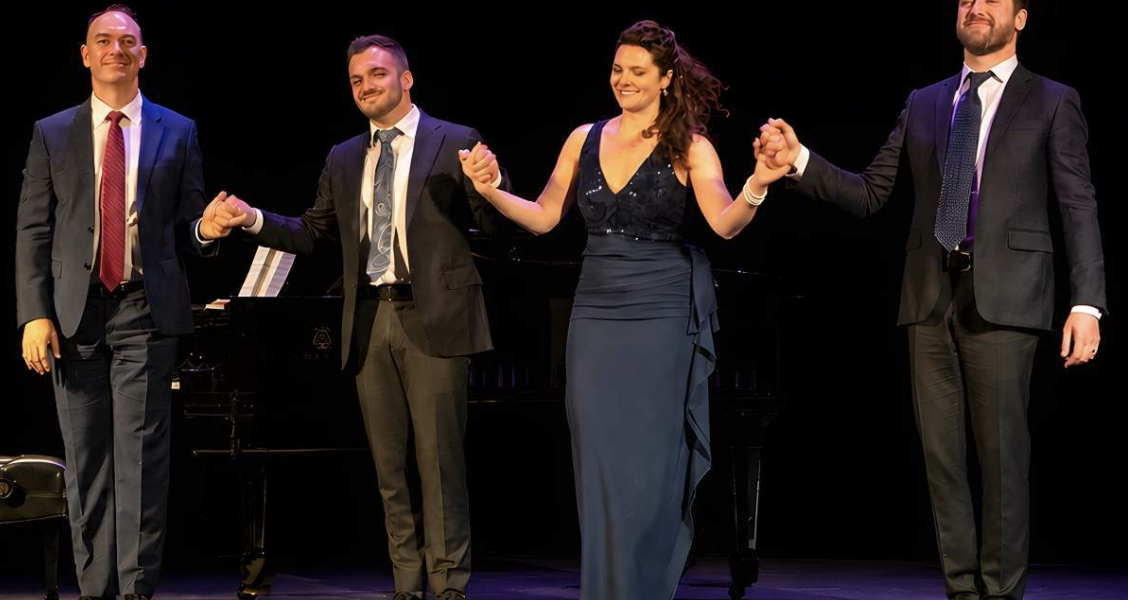
Mirror Visions Ensemble presents AFTERIMAGES, the Music of Christopher Berg, in Review
Mireille Asselin, soprano; Daniel McGrew, tenor; Jesse Blumberg, baritone
Grant Wenaus, pianist
Merkin Hall at Kaufman Music Center, New York, NY
November 2, 2026
The Mirror Visions Ensemble (MVE), one of the treasures of New York City musical life for the past 34 years, gave another memorable concert this Monday at Merkin Hall at the Kaufman Music Center. The MVE is a flexible group of performers with several core members, headed since 2023 by founding member and Director Scott Murphree and Associate Director Dr. Grant Wenaus. The organization has become especially noted for innovative themed programs that juxtapose several different musical settings of the same poem or text within a single concert – hence the “mirror” idea of Mirror Visions. (This reviewer was assigned to one such concert last year, and a description can be found here: Mirror Visions Ensemble in Review). In addition to such “mirroring” programs, they have presented concerts outside of such frameworks and have commissioned over a hundred new works. Among their more frequently commissioned composers was Christopher Berg (1949-1926), who passed away just this February at the age of 76, and in tribute to his long partnership with the MVE, their program entitled AFTERIMAGES showcased seven of his vocal works for solo, duo, and trio combinations. The outstanding performers were soprano Mireille Asselin, tenor Daniel McGrew, baritone Jesse Blumberg, and pianist Grant Wenaus.
The program was thoughtfully crafted, as one would expect from this ensemble, and though it was the music of a single composer, it encompassed quite a wide range of styles and emotions. This was music of drama, wit, and color, spanning four centuries of texts. Though Mr. Berg’s work clearly projected a strong connection to his art song predecessors (especially in his Hommage à Francis Poulenc), his own original voice was always present. His affinity for all things French (as he divided his time between New York and France) was evident in his settings of French texts (Robert Desnos and Marie de Sévigné), but he seemed equally at home with texts in English (Jeffrey Greene, Linda Pastan, and Stephen Mitchell’s translation of Rilke).
It struck this reviewer as odd, with such a beautifully printed program (including set of texts, translations, summaries of the works, and biographies of all the performers), that there was no biography in the printed material of the composer Christopher Berg, himself. It may be that his music was expected to speak for itself – which it did – but some more details would have been appreciated.
A quick internet search of Christopher Berg (who is not to be confused with a guitarist/composer of the same name), yields information on an artist of both admirable credentials and a rather low profile. He is described by several sources as largely a self-taught composer, though he graduated from the Manhattan School of Music, where he studied piano with Robert Helps. He also worked with Noel Farrand and Richard Hundley. His publishers included Oxford University Press, and his recordings were released by Albany Records and Opus One, among others. He received fellowships and grants from Yaddo, Meet the Composer, the American Music Center, The National Endowment for the Arts, and the Martha Baird Rockefeller Fund for Music. Known chiefly for his art songs, he set texts by Gertrude Stein, Vladimir Nabokov, Frank O’Hara, Stevie Smith, and many other writers. On this program the chosen texts were Portrait en miniature de Madame de Sévigné, a specially selected set of letters by Marie de Sévigné herself (1626-1696), The Unicorn by Rainer Maria Rilke (1875-1926), Hommage à Francis Poulenc by Robert Desnos (1900-1945), The Months by Linda Pastan (1932-2023), and The Night Gallery and The Ghost of Madame de Sévigné by Jeffrey Greene (b. 1952).
The program began with the World Premiere of The Unicorn, Rilke’s otherworldly poem about the title’s mythical beast becoming real through the power of imagination. It was the perfect eerie invocation for an evening that blended reality with the surreal and the past with the present. It was sung captivatingly by all three of the evening’s singers, with atmospheric piano support. Jeffrey Greene’s poem The Night Gallery continued in this dreamlike vein, bringing Jesse Blumberg back to sing the part of a mummy awakening at the Metropolitan Museum of Art in the middle of the night. His deep baritone voice was perfect for it.
Linda Pastan’s The Months followed, with a movement for each month of the year, each showing Christopher Berg as not only a colorist, but a master of pacing. The remarkably unified duo of soprano Mireille Asselin and tenor Daniel McGrew conjured a wide spectrum of moods and shadings in response. Mr. McGrew was one of the singers who impressed in last year’s MVE concert, and this year’s performances were outstanding as well. Ms. Asselin was a wonderful new discovery for this reviewer.
From the bleakness of January through thin spare dissonances to the faint comfort of December amid the “white dove” of winter snow, a personal glimpse of each month was created through the music and conveyed sensitively. The quirkily premature orchid in February and the March winds, carrying hints of Schubert’s Erlkönig, created indelible impressions. A special highlight was April, with its downward pentatonic washes in the piano part, bringing to mind the origin of the text’s cherry blossoms. Dr. Wenaus conveyed this beautifully, as he did the noisy fauna that introduce the June movement and the jaunty accompaniment of August. The singers were equally persuasive advocates for this music, whether in soaring solo lines or as an ensemble. Their feverish overlapping of voices seemed especially effective in suggesting superabundance – whether of the bright colors in May or the fruits in August. September by contrast, was touching as a faded reflection of summer romance, with a faintly jazzy dance-like feel to it. If there was an underlying unity to this musical year, it was in the composer’s unique sensitivity to the text – not merely in matters of color and style, but in matters of tempo and texture.
Mr. Berg’s humor was apparent in several songs, such as the end of February, where the final lines – “Abbreviated month. Every kind of weather” – ended the song so abruptly that several in the audience laughed out loud. Such punchline-type endings and other musical “winks” recurred throughout the evening, but nowhere was the humor more overt than in the five-song set Hommage à Francis Poulenc by Robert Desnos. Composed in homage to Poulenc’s cycle of animal poems, Le Bestiaire, it features an ambitious pike, a formidable lobster, a sinuous glow worm, an impetuous badger, and an ant, which, despite reported exploits, is sadly relegated to non-existence. Jesse Blumberg projected each text with clarity, imagination, and flair. It was a festival befitting not only Poulenc and Apollinaire but also Saint-Saëns and Nash.
The concert was to end with Berg’s substantial set, Portrait en miniature de Madame de Sévigné, but first – in a typically brilliant MVE fashion – came the setting of another Jeffrey Greene poem entitled The Ghost of Madame de Sévigné at the Carnavalet. One can only guess whether these both were part of a prior themed program or subsequent commissions, but whatever the case, the programming was a dream. The Greene poem even mentions Sévigné’s portrait hanging “like a distant mirror” in the Carnavalet. For full disclosure, the Ghost song made little impression on this listener strictly musically – seeming rather a bland, hymn-like prelude to the finale – but it was sung with the perfect air of mystery by the trio, thus building interest in the finale.
There was nothing “ghostlike” about Madame de Sevigné as presented in the final work, Portrait en miniature de Madame de Sévigné. For those unfamiliar with her, she was a French marquise whose many letters (to her daughter and friends) placed her in history as an important chronicler, something of a French counterpart to England’s Samuel Pepys. If the word “chronicler” has a whiff of dust about it, though, be assured that there was nothing dusty about these letters, eight of them set for solo, duo, and trio combinations. Certainly there were important events mentioned in what we heard – such as in Le Comète, about the sighting and interpretations of comets – but the real spirit of the set came from the letters about her personal day-to-day life and moods. Christopher Berg’s music, through inspired pacing, brought her voice a modern freshness. Whether in gossip bubbling forth about an imminent wedding or in the musical swoons over food, drink, and other delights to the senses, she sprung to life. All three singers had important roles in the letters, but it was Mireille Asselin who seemed particularly at home, with her effortless French and stunning soprano voice. All three, of course, conveyed the ultimate feeling of immediacy, such that it felt hard to imagine this writer living so many centuries ago. All that she seemed to be missing was a smartphone.
In the program notes for this piece, one read of such lingering presences, “Perhaps that is the ultimate afterimage: not simply what remains after something or someone is gone, but what continues to live and resonate within us.” It became clear through this concert that Christopher Berg left some very strong afterimages himself. The musicians blew kisses heavenward in response to the hearty applause.
