
The Jamanis Project presents “Fits of Passion” in Review
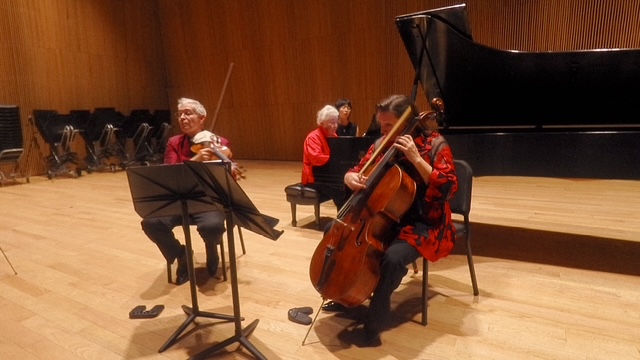
Michael Jamanis, violin; Susan Moyer Bergeron, cello; Frances Veri, piano
Mary Flagler Cary Hall at The DiMenna Center, New York, NY
October 10, 2026
Positive energies and family kinship were the driving themes of the chamber music concert organized by violinist Michael T. Jamanis at The DiMenna Center’s Mary Flagler Cary Hall on Saturday, October 10th. The trio comprising Mr. Jamanis, his mother, Frances Veri, and cellist Susan Moyer Bergeron, his old friend and colleague, brought to life a successful program with soaring interpretations of works by Beethoven, Rachmaninoff, Johan Halvorsen, and Richard Field.
The personal histories of the three players intertwine in a lovely counterpoint. Michael Jamanis has described in an interview the family dynamic of growing up in a musical household in Lancaster, Pennsylvania, with his active duo-pianist parents. His father, also named Michael Jamanis, toured extensively with Frances Veri for six decades; the pair released more than twenty commercial two-piano recordings, including works by Brahms, Moszkowski, and Gershwin; and they co-founded the Pennsylvania Academy of Music, a school active from 1991 to 2011. It was only natural that Michael Jamanis, Jr. should carry the torch. An emissary for musical education and social justice, he received degrees from Juilliard and Yale, capped by a doctorate in performance from Rutgers, has won many awards for innovative programming, and has served as a faculty member at Franklin and Marshall College and artistic director at a Lancaster non-profit, Music for Everyone. Susan Moyer Bergeron, also from Lancaster, reunited with the Jamanis family in 2024 after earning a University of Miami DMA and performing with the Florida Philharmonic, Naples Philharmonic, New World Symphony, and with Sir Georg Solti in London.
The collective decades of experience of the three players were apparent in their feeling of command and vibrancy on stage. With much to express, they poured forth a fullness grounded in the Juilliard-trained tradition, both sensitive and rich, without overpowering the music or each other. The obvious corollary, with three life-long teachers in the spotlight, was the inherent masterclass in music appreciation demonstrated by the group’s demeanor and disciplined polish.
Ludwig van Beethoven at age twenty-seven knew how to “network” as well as any modern career entrepreneur. The grande dame of Viennese high society, Countess Wilhelmine von Thun-Hohenstein, had been the recent dedicatee of Vienna’s famed opera composer Joseph Weigl’s new dramma giocoso, L’amor marinaro, first performed in October 1797. The trio “Pria ch’io impegno” (Before I Go to Work, I Need a Snack) from this brand-new masterpiece became an instant earworm throughout the town, and Beethoven seized his opportunity, writing a set of variations on the theme as the last movement of his Trio in B-flat major, Op. 11. At the same time, the Viennese clarinetist Franz Joseph Beer had requested a piece from Beethoven to showcase the special timbre of the clarinet in its native key, with its breathing patterns and evolving mechanical structure. The clarinet trio was a perfect career move, glorifying Beethoven’s patroness, flaunting his knowledge of new musical hardware, and giving the public a tune to hum in the streets (thus the nickname “Gassenhauer” for the final movement’s theme). The only problem was finding enough customers: boxwood and a small bore contributed to a naturally intimate and expressive color in the clarinet, but performers had to adapt to a rudimentary fingering technique and an upward-facing reed. To expand sales of the score, Beethoven published an edition of the piece for violin, cello, and piano the following year.
Presenting this standard work as concert opener established the Jamanis group’s clear, Classical strength. Healthy balances, marked by generous sonic contributions of the cello and the pianist’s left hand, combined with a vivid communal sense of pulse to give the trio an impeccable German style, notwithstanding the occasional flicker of asynchronous rhythm. Ms. Veri, a youthful octogenarian, played with a facility and vigor honed from her years as a conservatory prizewinner; Mr. Jamanis led with flair and well-defined intentions. Nuances could have been more delicate, particularly in the piano’s repeated-quarter motive in the transition, or the Adagio’s sustained accompaniment, which seemed slightly overpropelled. The third movement’s theme and comical variations were delightful, although Variation One’s deliberately offset basses were given accents that disturbed the metric goals of Beethoven’s phrasing. Variation Four (Minore) delivered the first truly poetic moments of the evening. Beethoven evidently had expressed concern that his composition would outlast the fame of the original Weigl opera, and he was absolutely right.
Sergei Rachmaninoff’s Trio élégiaque No. 1 in G minor (one of two trios with the name) is a single-movement statement of dark despair, written within four days in 1892, two weeks before Rachmaninoff’s Moscow début at the age of eighteen. (It was published posthumously in 1947.) Strongly influenced by Tchaikovsky’s “Pezzo elegiaco” movement from the A-minor Trio, which was composed after the death of Nikolai Rubinstein ten years earlier, the Rachmaninoff spins out endless melody accelerating from an opening Lento lugubre to a violent storm of virtuosic passagework. The rhythmic underpinnings that had made the group’s initial performance of Beethoven so persuasive led, here, to a somewhat demarcated style in which triplets, sextuplets, and large chords were set and measured. Admirably crafted figurations and cultivated sound in the piano nevertheless stopped short of realizing the luminous freedom we often associate with Rachmaninoff’s extravagant keyboard writing. The strings dared at times to employ a more layered approach, and the violin’s sliding shifts in the recap summoned a longed-for eeriness. The closing funeral march, with its muted octave lines in the violin and cello, showed a beauty of matched intonation that deserves special mention.
In Lieder recitals of yore, at this point the star vocalist would sit offstage during a solo piano interlude, to vary the program and to acknowledge the artistry of the collaborative partner. In an inversion of the salon-era practice, here the pianist handed the platform to violinist and cellist, who treated the audience to a work by the Norwegian Johan Halvorsen (1864–1935). A celebrated concertmaster and conductor of the Bergen Philharmonic, Halvorsen was married to Anna Grieg, Edvard Grieg’s niece, and arranged music for Grieg’s funeral in 1907. He is known for his three symphonies, a violin concerto, rhapsodies on Norwegian folk songs, and incidental music for over thirty plays including Shakespeare’s Macbeth. Judging from the present duo, an enhanced transcription of the last movement of Handel’s Keyboard Suite No. 7 in G minor, Halvorsen must have been a showstopping technician capable of devilish feats of prestidigitation. To be clear, this piece is neither a true passacaglia (a repetitive ornamentation of a bass line) nor a true transcription; nor did it follow the instrumentation of the Halvorsen score, which calls for viola rather than cello. A program could have given credit to this version by Michael Press, which was every bit as effective with a darker cello timbre. The dramatic flourishes of spiccato à la Paganini and extreme displays of triple-stops and three-octave scales were heartily enjoyed by the Lancaster students in the audience.
The trio reconvened to play the final work, Richard Field’s ambitious five-movement Fits of Passion (U.S. première), which had donated its title to the concert announcement. Mr. Field, born in 1967, is a former college roommate of Michael Jamanis and former piano student of Frances Veri. Not solely a composer, Mr. Field can be found in the larger world as a real estate manager and philanthropist whose mission is to bring an end to corruption and poverty in Hungary. His foundation, American House, has donated over two million dollars to the Hungarian Red Cross and local organizations. Saving the world, for Mr. Field, is not idle talk; given this background, it is easier to understand the source of the motoric intensity and persistent optimism of his trio.
Like super-charged Bach, the first movement of Fits of Passion brims with enthusiasm, boosted by a perpetuum mobile of quick chords in the piano over which homorhythmic string motives flash by in staccato unison. Unlike the minimalism of John Adams or Philip Glass, Mr. Field’s music seems to take its cues from the new-age modulations of Eric Ewazen or Lowell Liebermann, shining one ultra-accessible harmony onto another like a slowly changing strobe light. All three instruments steered the momentum of the fast-paced eighth notes, although the progressive escalation to sixteenths in the violin created a slight pullback in tempo.
Mr. Field’s neo-Baroque style, not limited to quasi-fugal imitation, polyphonic single lines, and cross-rhythms, extended to the printed score, which bore no descriptive movement titles, tempo markings, or dynamics. (The sparsest of performance clues might be the indication of a quarter note to 126, or 74, or, in the fourth movement, 54.6 beats per minute.) Complete sections or movements unfolded without let-up, and sudden cadences periodically brought the celebration to a halt, as if a Bach prelude were running off the edge of the page. The fifth movement, with an extended piano introduction giving a nod to Claude Bolling’s Suite for Flute and Jazz Piano, settled into a bumpy piano bass line seemingly borrowed from Samuel Barber’s Excursions. On the whole, the work’s most successful attribute was in its clever use of articulation; the prevalence of staccato and pizzicato riffs, although providing potential challenges of stamina to the players, kept the music’s forward motion alive without allowing the texture to become thick. A congenial twenty-four minutes passed without drama or psychological tension.
Several aspects of this very tonal score could have been notated more efficiently (scales in D-flat major spelled with diminished 3rds from E-flat to C-sharp, for example, or leading tones in A minor spelled as A-flat, or chords for one hand spanning almost two octaves). These vexing issues, unfortunately common to many contemporary scores, often betray a minimally edited copy which has been composed at least in part with the aid of “smart” software, expedient for the calendar but not for the musicians. It is an even greater compliment to the pianist’s expertise that she could seamlessly skirt these notational hurdles and keep such a buoyant tempo amidst thickets of extra notes.
The underlying message of this uplifting event was the reminder of music’s social purpose, the way in which it can affect today’s world chemistry. Michael Jamanis often speaks of music as a “public health tool” and the blend of historical genres in contemporary performance. His views are not far removed from those of Benjamin Britten, an unusually successful—and outspoken—composer, performer, and educator of the twentieth century. Britten, among others, believed that our primary responsibility is to help people through music. If the arts are to survive, we can indeed step out of our ivory towers and take to heart the projects which bring more music to everyone.
