
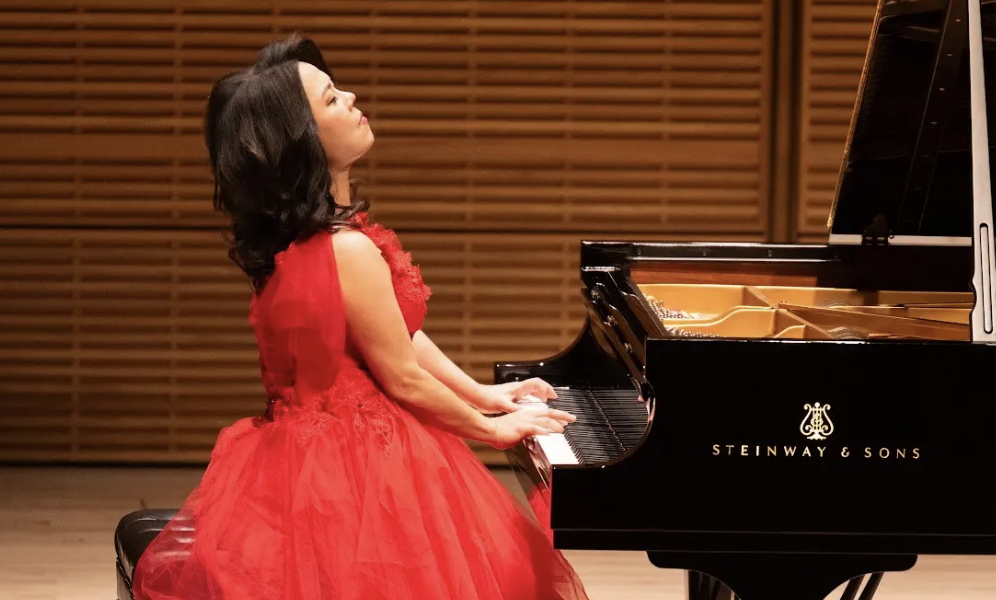
The Suh Hai Kyung Foundation presents “In Love” – Pianist Hai-Kyung Suh in Review
Hai-Kyung Suh, piano
Zankel Hall at Carnegie Hall, New York, NY
October 3, 2026
Carnegie’s Zankel Hall was sold out this Saturday with fans clamoring to hear pianist Hai-Kyung Suh in a concert entitled “In Love” – a program which according to the notes “follows love through four of its aspects: love lost, love unspoken, love newly born, and love made into poetry.” With a first half largely devoted to Brahms and a second half largely devoted to Liszt, the offerings were Romantic with two exceptions – the beloved Gluck-Sgambati Melodie as opener and the World Premiere of a work by Jeajoon Ryu, commissioned by and dedicated to Ms. Suh. The program itself was luscious, and the connections to literature and composers’ lives intriguing, but it seemed that the “theme” could just as well have been oatmeal for such a devoted audience – they had clearly come as fans of Hai-Kyung Suh in what was one of the big piano events of the season.
As anyone following classical music in the 1980’s probably knows, Hai-Kyung Suh burst onto the music scene in 1980 with her victory in the Busoni International Piano Competition (that year’s top prize) and from there built a reputation as an especially passionate virtuosa. She went on to accumulate more honors, performances with the finest orchestras in the world, and a substantial discography with Deutsche Grammophon and Decca, including four Mozart concertos and the complete Rachmaninoff and Tchaikovsky concertos. All was interrupted by a 2006 breast cancer diagnosis, but nothing could stop Ms. Suh. A comeback occurred two years later as she returned to the stage at Seoul Arts Center playing Rachmaninoff’s Second and Third Concertos in one evening; as anyone with such a diagnosis knows, however, coming back can be a long road; it was thus extremely heartening and exciting to learn of this Zankel Hall concert with such a robust program.
As the pianist wrote in her own program notes, reminiscing about learning much of this program as a teenager, “Then, it was about the thrill of playing very difficult pieces, to incite awe and excitement. Now, it is much more about using virtuosity to reveal the artistic intent of the works… Tonight I return to music I have known nearly all my life, carrying everything that has happened in between. That is what I hope you will hear. In the end, it all comes back to love.” The whole evening was imbued with such sentiments – and a refreshing antidote to the dehumanizing influences that encroach on the arts these days.
From the very start, one knew that this concert would be emotionally charged – but it was clear how unusual it would be when a voice came over the hall’s loudspeaker, announcing that the opening Gluck-Sgambati Melodie would be played with the stage lights turned off, to approximate the darkness of Orpheus’s journey into the underworld to rescue his Eurydice. Many closed their eyes. It was quite a special experience, emphasizing not only the tale’s darkness but also the message that music is, after all, an aural art. Glittering gowns and theatrics notwithstanding, we attend concerts to listen. It was an inspired move – and not an easy one to pull off, as this transcription has its own challenges even when one can see the keyboard – but the piece shone as the gem that it is. A huge ovation followed.
When the lights came back on, Ms. Suh returned to the stage for Brahms, first the Two Rhapsodies, Op. 79, then the Intermezzo in A Major and Ballade in G Minor, from Op. 118, and finally Book II from Variations on a Theme by Paganini in A Minor, Op. 35. As strange as it had probably been to play in the dark, one worried a bit that it might be still more unsettling to adjust to bright lights afterwards for these more vigorous works. Sure enough, there were some glitches, attributable perhaps to the newly bright lights or the need to settle into things – but one felts always that there was a pro onstage. Overall, the Two Rhapsodies conveyed just what the program notes suggested, “passion under strict formal control.” The Op. 118 selections were commanding, with the Intermezzo in A major full of warmth and the Ballade given just the right drive, offset artfully by its poignant B-major section.
The first half concluded with power, as Ms. Suh approached the Paganini Variations with the seeming fearlessness of one who had learned them many decades ago – which she had. She made short work out of the sections that hobble many pianists. Variation 4 was especially beautiful (full of the feeling that would permeate the commissioned Valse later), and Variation 11 was so fleet and brilliant that the audience could not contain its applause after. The only scuffs were from occasional impetuousness – something that can happen in performances of repertoire one knows so well as to take almost for granted – but that will be addressed later. The entire set concluded with great virtuosity, again to a huge ovation.
After intermission came perhaps the highlight of the program, the World Premiere of the Valse per pianoforte by Jeajoon Ryu. The piece belongs to a third suite of dance-based piano works still awaiting publication. As the composer explains, it contains “a four-note motif that persists through every variation, surfacing in changing guises from a solitary opening to a virtuosic coda.” Such a description does little justice to the work, which in this pianist’s hands emerged as a masterpiece of nostalgia, languishing lyricism, and blazing pyrotechnics. Ms. Suh seemed to reach her height of command here, perhaps relishing the act of bringing something entirely new to her audience, and it was a tour de force. Mr. Ryu may need to brace for an onrush among virtuoso pianists, akin to the frenzy over Ravel’s La Valse.
In a judicious switching of order, we then heard Liszt’s Sonetto del Petrarca No. 104 from Années de pèlerinage followed by his Transcendental Etude No. 10 (rather than the printed program’s reverse order). The meditative qualities of the former were just what was needed after the exuberance of the Ryu piece – and that is not to say the etude is any kind of breather for the pianist. The demanding fioritura passages were absolutely sparkling – but the long lines were sustained beautifully and just what was called for. It was amazing that there was no flagging during the Transcendental Etude that followed, but it was given a bravura ride, and Liszt’s Rhapsodie espagnole capped things off with a fittingly fiery finish.
Alongside the well-deserved praise for Ms. Suh, a few reservations prompted some thought. At several points in the recital, this reviewer was becoming so spoiled with what Ms. Suh can do, that the minor nicks in some impetuous leaps and other slips started to stand out as unnecessary. One wondered whether perhaps these could have been helped by a bit more patience – yet another form of love for musicians. Just an extra millisecond here and there might have refined these wonderful performances still further. Also, sometimes we have a tendency to lavish all our attention on our favorite moments and leave parts connected to them orphaned in a sense (either through missed notes or aspects of phrases deemed “lesser”) – but these are all integral to the whole towards which our work is infinite. So, when we speak of teens being more preoccupied with technical perfection than the concerns of the mature artist, there may be a bit of a false dichotomy here. Optimally we try for both, and if anyone can do it all, it seems that Ms. Suh can. She very nearly has. As Virgil wrote, Omnia vincit amor.
After a well-deserved standing ovation, Ms. Suh rewarded us with Liszt’s Liebesträume No. 3 and the Schumann-Liszt Widmung, both offering moments of great beauty. Widmung concluded with an unusually fortissimo chord – quite a surprise – but given what this program represented, a triumphant flourish was in order. Brava – and encore!
