
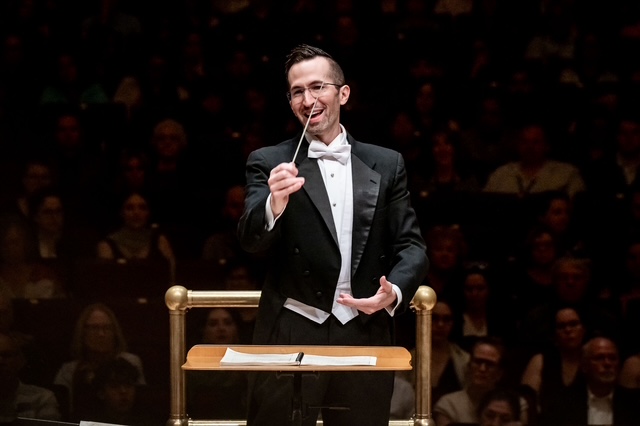
MidAmerica Productions presents Michael J. Glasgow in Review
New England Symphonic Ensemble; Preston Hawes, Artistic Director
Michael Glasgow, composer/conductor
Haley Sicking, soprano; Michael Kelley, baritone
Isaac Stern Auditorium, Carnegie Hall, New York, NY
June 6, 2026
The New England Symphonic Ensemble, under the auspices of MidAmerica Productions (MAP), continued their impressive concert schedule at Carnegie Hall this weekend in a program pairing them with choruses from far and wide, in music from the Baroque period to the present. From Vivaldi’s Gloria in D major (RV 589) and Schubert’s Mass No. 2 in G major (D. 167) to Elaine’s Hagenberg’s Illuminare and Michael J. Glasgow’s Gloria, MAP offered its usual surfeit of riches. I was assigned, though, to review just the Glasgow piece which closed the program, so will keep this review focused on that. To cite just a few highlights leading up to it, though, there was some captivating solo work from mezzo-soprano Jordan Seguin-Gascoigne (in the Vivaldi, the Dominus Deus agnus Dei in particular) and from baritone Robbie Raso (in the Schubert, Agnus Dei, in particular). Elaine Hagenberg, whose music I reviewed favorably in 2024 and 2025, did not disappoint. The guest conductors, Yelitza Green, Jay Dunn, Jed Hyun Ragsdale, and Scott L. Martin, were commendable in corralling the forces.
By 10:40pm (with the concert having started at 8:30), the performers finally filed onstage for the Glasgow Gloria to finish well after 11pm.It did something of a disservice to Mr. Glasgow (and to his audience) to have so much preceding what would be a thirty-plus-minute work. With two intermissions for multiple choruses to file in and out through the course of the evening (and their respective fans in the audience doing much the same) such extravaganzas – as festive as they are – can easily devolve into a string of “selfie” opportunities. This reviewer was starting to think that nothing short of an explosion would reclaim the musical focus. As luck would have it, the musical equivalent was imminent.
Michael J. Glasgow walked onstage to conduct his own piece, and at the very opening of the first movement (of three) he led the orchestra in such a massive buildup of brass and percussion – with a cymbal swell to a full impassioned choral tutti – that one wondered where it could possibly go from there. Sure enough, though, it was just the first of multiple peaks. Though the declamatory opening was followed by a drop in dynamics, there was no drop in energy. The momentum continued in pulsing rhythms (of 3,3,2) to build again – and again – throughout the work. The excellent orchestral players sustained it well, and the agile Mr. Glasgow, seeming almost ready for liftoff, led with exuberance. The singers combined with the orchestra in a massive sound, producing a potency worthy of the words Gloria in excelsis Deo. As the composer states in his notes, “I’ve taken care to ensure that this Gloria actually sounds like what it says: the first movement is one of jubilant praise and faith.”
For those unfamiliar with Mr. Glasgow there is much to read at his website (Michael J. Glasgow), but suffice it to say this was not his first Carnegie Hall appearance, nor even the first Carnegie performance of his Gloria, which had its world premiere there in 2022, after a pandemic forced its postponement.
Settings of the Gloria within masses are many, and the standalone settings number quite a few as well, but this was clearly a Gloria reflective of its time, a twenty-first-century expression distinct from its predecessors. If the opening of the Gloria unleashed the heroic might one associates with blockbuster film scores, a more contemplative section of the first movement had the harmonic familiarity of a simple pop ballad. Occasionally such juxtapositions gave the piece a feeling of having been “assembled” (as opposed to unified organically) but transitions were helped along by skillful orchestration – and, after all, such styles and contrasts reflect much about our time. Just as the more intimate mood and texture were established, the beautifully complementary voices of soprano Haley Sicking and baritone Michael Kelley sent the music skyward again to still more exultant heights. After multiple fanfares, climaxes, and an abundance of “bells and whistles” (or in this case bells and cymbals), one might be tempted to call such writing “over the top” but given the subject of the text, what should one expect? The audience was so taken with the first movement that it couldn’t refrain from applauding. Mr. Glasgow has many fans, and the choristers were surely among them, described on the program simply as “Friends of composer Michael J. Glasgow (from throughout the USA).”
The second movement, described by Mr. Glasgow as “a quiet prayer” with the text qui tollis peccata mundi (“who takes away the sins of the world”), was actually the first part of the piece he composed. As he recounts it, “The last day of November 2018 was what I identified as a ‘despairing day,’ and as is often the case in difficult times, I composed music for comfort. The fruit of my labor that day was the introduction and coda of the second movement. I didn’t know what would happen with the rest of the work (I didn’t even know what would happen with the rest of the second movement!), but I knew that the music I had created – which completely redeemed my ‘despairing day’ – would one day bookend the middle movement of a three-part Gloria.” If only everyone’s despairing days were so fruitful!
Though composers have traditionally and understandably set the peccata mundi (“sins of the world”) to dark harmonies and dissonances, the comfort of this setting’s initial inspiration seems to have bathed the movement in a wash of relative tranquility. The mood seems less from the “despairing day” and more from redemption of it – fair enough – more tollis than peccata. Though the composer’s notes mention setting those central words peccata mundi in a minor key, the bulk of the movement is actually dominated by major harmonies. It was a surprise to hear, but thankfully, composers can shine their musical “light” where they choose, even in traditional texts. It still offered contrast between the buoyant outer movements.
The third and final movement (and this reviewer’s favorite) was set to the Quoniam tu solus sanctus (“For Thou alone art holy”). It took back up some of the material of the first movement and developed it expertly. As the composer writes, “the final movement is an explosive celebration of mixed meter (with more than 70 time-signature changes), syncopation and cross-rhythms, culminating in ecstatic Amens that I envisioned as ‘an amazing party that you don’t want to leave.’” Indeed, and it was remarkable, after such a full evening, to see that he was able to rouse audience so thoroughly. What might have seemed like excess in the opening movement felt just right in the third, with crescendo upon crescendo and all the stops pulled out, towards an ecstatic finish. Michael J. Glasgow knows how to keep a chorus “on its toes” tossing material excitedly from voice to voice and building momentum, so one can expect this work to gain increasing popularity in the choral world. This chorus was “all in” and so was the audience, who gave it a standing ovation.
