
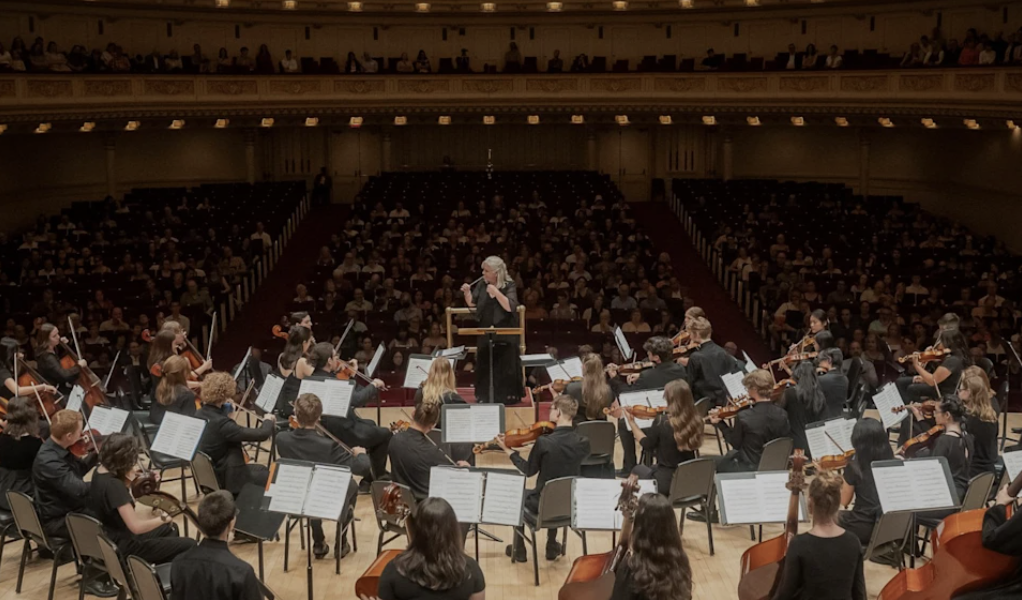
MidAmerica Productions presents the New England Symphonic Ensemble in Review
Richard A. Nichols, Bobby G. Helms, Joshua Chism, Victoria Gau, and Kathleen Allan, conductors
Chessa Metz, soprano; Kameron Keller, tenor; Sherryl Sewepagaham, vocals and drums
Listed collaborative pianists: Mary Nelson and David Brewster
Narrator: Nathaniel Sullivan
Stern Auditorium at Carnegie Hall, New York, NY
May 25, 2026
MidAmerica Productions continued their fine record of outstanding concerts with their 1pm concert this Memorial Day (with another one scheduled for the evening). They combined the excellent New England Symphonic Ensemble with choruses from throughout the US and Canada, uniting choirs from Idaho, Oklahoma, Maryland, Mississippi, New Jersey, New York, Texas, and Ontario. Their program included a varied selection of contemporary choral works including three world premieres and four Carnegie Hall premieres – all alongside the masterful and well-loved Schicksalslied of Brahms. Among the premieres were works by Richard A. Nichols, Sherry Blevins with Raphael Fusco, Cris Derksen, Sherryl Sewepagaham (including one co-written with Andrea Neumann), and Patti Drennan. Among non-premieres- aside from the Brahms, of course – was the increasingly performed Te Deum by Dan Forrest. It was a long program, well over two hours including two intermissions, so to keep this review brief, those interested in reading the program notes can find them here: Program Notes
First off, a hat tip is in order for the overall selection of works on this concert. For a holiday that observes both loss and heroism, sorrow and triumph, this music encompassed it all. To start were three selections of movements from Requiem for Patriots by Richard A. Nichols set to speeches of three U.S Presidents – narrated here by Nathaniel Sullivan. The first, entitled Requiem, set a dramatic tone for the whole program with low string tremolos, a soulful trumpet entry, and bells, all leading to the stirring recitation of Abraham Lincoln’s Gettysburg Address, supported by the ensemble, coloring the speech emotionally. The second (Kyrie), was based upon the words of George W. Bush at National Cathedral after the attacks of 9/11/01. To this listener, who recalls vividly the horror of the attacks, the music had a sweetness that was hard to reconcile with the day’s reality (think “Music of the Night” for harmonic flavor at the opening), but then again, its gentleness allowed some more words about the murdered innocents to stand out. The bravery shown that day connected to the third and final movement (In Paradisum), drawing on words of comfort and courage from the speech of Ronald Reagan after the 1986 Challenger disaster. Together the movements conveyed feelings of courage and faith, with the texts enhanced by imaginative musical scoring. These were memorable and moving performances, and the introduction and conducting by the composer himself made them even more so.
Moving to more familiar day-to-day subject matter (though still grand in its own way and certainly set musically as such), we heard To Truly Love, by Sherry Blevins / Raphael Fusco, five movements set to texts about unconditional love and the nature of parent-child relationships. Bobby G. Helms conducted, leading the chorus in admirable balance with orchestral forces in the opening movement, entitled The Wonder of Your Life. The second movement, Your Masterpiece, introduced tenor Kameron Keller, who projected the text with a penetrating and pure sound befitting a child’s pleas for love. The orchestra set a somber mood in the minor harmonies of the third movement, When Darkness Came, but all grew brighter with the pristine sound and intonation of soprano Chessa Metz in Stay Here with Me, followed by To Truly Love – an expansive finale that drew a large ovation.
After the first intermission came the magnificent Schicksalslied, Op. 54 (Song of Destiny) of Brahms. Based on a free-verse passage of Friedrich Hölderlin’s novel Hyperion, the text can be described as invoking “a pantheistic vision of the world and … the return of the golden age through poetry and love” (as summarized in the helpful notes by Leonard Burkat). The creation of this work represented a three-year struggle for Brahms, to frame somehow the poem’s heavenly visions with earthly struggles. To hear the end result, though, is to hear Brahms in a warm musical embrace of the universe. It is always transporting, and this was no exception. It was conducted beautifully by Victoria Gau and made a perfect addition to the program.
If a trip to the water (specifically the North Sea) was said to have helped inspire Brahms to compose his Schicksalslied, the reverence for water (in fact activist concern for it) continued to be present in several Cree-inspired pieces that followed, but first there was a musical greeting by Sherryl Sewepagaham. Ms. Sewepagaham was present not just to sing these but to play drums, under the dynamic conductorship of Kathleen Allan. We heard Tawâw (Welcome Song) – conceived, we are told, in a time combining earthly births and the passing of a loved one, and the music reflected that. Its triadic and pentatonic motifs were indeed accessible and welcoming, but the steady underlying drumbeat gave it a dark, almost ominous quality.
To add to the day’s sadness, we were informed through an insert in the program that the composer of the next Cree works, Chris Derksen, lost her life on May 15 in a tragic auto accident – one which also left her wife critically injured. To add to that pain, one learns that she had been en route from her father’s funeral. The insert paid heartfelt tribute to her, with Ms. Sewepagaham dedicating her Tawâw performance to her and the conductor Kathleen Allan dedicating her performance as well. There is little one can say of comfort after such a tragedy, but Ms. Derksen’s music did, in a sense, speak for her. Her mission to protect our planet’s water was not necessarily the kind of military fight one associates with Memorial Day, but it loomed as life-and-death to her. Selections from her Mass For Nîpîy: A Prayer for Water included A Prayer for Nîpîy’s Spirit and Prayer for the Rivers, both evoking a ritual solemnity through repeated minor motifs and both gradually building a powerful sense of urgency. We also heard later her Never Dry (from the same Mass for Nîpîy), with percussive suggestions of rain mounting in primal rhythms to a visceral energy, all skillfully handled by Ms. Allan.
In between these water-inspired pieces of Ms. Derksen’s we heard Papîyahtik (Peace Chant) composed by Sherryl Sewepagaham with Andrea Neumann. One quibble this reviewer had was that there were no pauses between the two Nîpîy pieces by Ms. Derksen and this. In a concert with all unfamiliar music, no breaks for applause, a dramatic midair cutoff, some circling back in composer order, and a few similar ceremonial qualities among pieces, all can start to blur together, which does a disservice to the composers. If it hadn’t been mentioned in the program notes that Papîyahtik starts with an alto flute solo, one would not have known which was which (and yes, there were QR code program notes – sadly right above the request to turn off mobile devices and with little time to access Wi-Fi). At any rate, Papîyahtik announced itself with a soulful alto flute solo, followed by indigenous chant enhanced by various extended techniques, swaying, and stomping that blended evocatively with the indigenous chant. The music seemed to bring joy to audience and performers alike.
In a surfeit of riches (translation for the presenters: please consider curbing the length in future programs), the program had a third and final segment after the second intermission, and there was a switch from the printed program, so that it started with Patti Drennan’s The Mighty Power Of God (World Premiere), rather than Dan Forrest’s Te Deum, which was saved for the concert’s finale. Ms. Drennan’s piece opened boldly, with a heraldic spirit. Unequivocally tonal, this music simply burst with passionate energy, bringing to mind some epic film scores. While it was not the easiest to understand every single word of the text from the large chorus, that became moot upon the entry of the Wyatt hymn, O God, Our Help in Ages Past, set beautifully here. Joshua Chism kept all well in hand and concluded the concert with the familiar Te Deum by Dan Forrest. A highlight was the hallowed middle movement entitled simply Prayers, but the final Praise to Christ was pure musical celebration.
Congratulations are in order to all the participants and musicians, and to MidAmerica, for whom this was their 1,528th concert worldwide, 1,186th concert in New York, and 732nd concert in Carnegie Hall – a huge achievement.
