
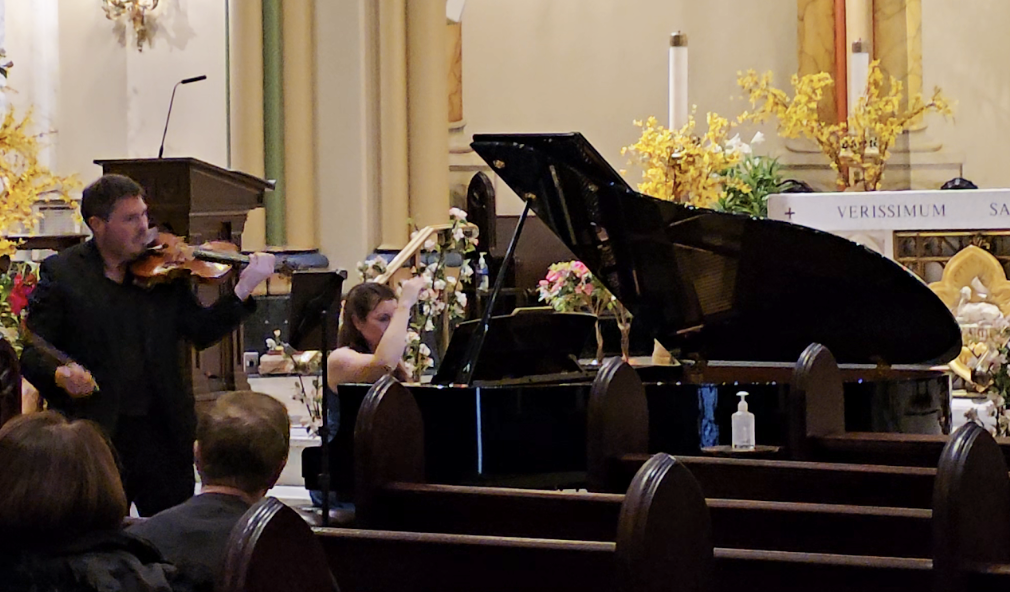
Les Trois Sonates in Review
Robert Radliff, violin; Sharon Niessen, piano
St. Monica’s Church, New York, NY
April 19, 2026
Brightening a dreary afternoon this Sunday, the Saint Monica Concert Series presented a program of three French masterpieces played by the excellent duo of violinist Robert Radliff and pianist Sharon Niessen. The concert, entitled Les Trois Sonates, included sonatas for violin and piano by Franck, Debussy, and Ravel.
There were no printed programs, which also meant no printed biographies of the artists, but one could glean from a brief web search that Mr. Radliff received his B.M. degree from Peabody Conservatory and his M.A. degree from Montclair State University. His years of experience as a soloist, chamber musician, and orchestral violinist were made apparent through his ease at the instrument. Ms. Niessen, whose website was more easily accessed, is credited with various prizes and performances, as well as studies with Ton Demmers, Jan Wijn, and Joop Celis at the Conservatory of Amsterdam and Fontys Academy of Music and Performing Arts in Tilburg. Her biography can be found here: Sharon Niessen. The duo’s dedication to these works is clear from other concerts featuring the same program.
The duo opened their concert with one of this musician’s favorites, Maurice Ravel’s wonderful Violin Sonata No. 2 (composed 1923-27, often referred to as simply “Ravel’s Violin Sonata” without any number, as it overshadows the posthumously published Sonata No. 1). From the opening movement’s first statement in the piano and on through the conversational alternation of themes and shifting colors, the duo captured Ravel’s curious mixture of brooding and magical mischief. Both performers played with intense commitment, projecting large gestures and lush sonorities even through the church’s acoustics, which (as with so many churches) tended to obscure some details. Some contrasts of articulation were awash with what verged on a sonic fog, but the beauty of the music still shone through.
The jazz-infused second movement, Blues, was a joy, though it seemed that the pizzicato chords at the start could have been more pronounced (despite being marked pianissimo) to give the louder bursts something from which to rebound; all in all, however, the spirit felt just right. Even when something in the sanctuary area started to cause some sort of steam-like hissing sound towards the end of the second movement – yet another distraction – the music prevailed. The third movement’s Perpetuum mobile made for a brilliant finale, with especially impressive pyrotechnics from Mr. Radliff, who had described it to the audience as “a barn-burner.” Both performers made it live up to that description. The audience offered their hearty applause.
On the subject of the audience, it was inspiring to note that very few rows were completely empty in the large space of St. Monica’s church. For such a young series (founded in 2019, and with the pandemic interrupting things subsequently), the series seems to have been more than welcomed by the Yorkville area of Manhattan. It was also encouraging to note that, even without printed programs for guidance, one could hear the proverbial pin drop between movements. There were no interruptions of applause or shuffling noises throughout the entire concert.
After the Ravel, we heard César Franck’s Sonata in A major for Violin and Piano, (composed in 1886 as a wedding gift to the violinist Eugène Ysaÿe). This work has long been considered one of the crown jewels of the violin-piano repertoire, and though it has been plundered by arrangers for numerous other instruments, it truly seems most “at home” on the violin. It was played with sincere dedication by Mr. Radliff and Ms. Niessen duo. Memorable aspects included the expansive phrasing in the opening Allegretto, the pianistic ease in the tricky second movement, and the violin’s lovely sound in the dolce F minor section of the same. The mutuality of feeling through much of the third movement was truly special, with Mr. Radliff’s expressivity standing out in the Recitativo-Fantasia. The sublime finale saw what may have been some flagging, with the occasional slip or glitch of intonation, but these became nearly negligible as they savored each canonic entry, building the work to a rousing finish.
A brief break was announced, completely in order given that there was no real intermission (though all that remained was the Debussy Sonata which lasts only around thirteen minutes). It was a welcome breather during which to admire the magnificent church with its stunning stained glass windows and architectural beauty.
With the ebullient spirit of the Franck’s finale still floating in the air, the Debussy Violin Sonata in G minor that followed felt frankly a bit anticlimactic, despite its well-deserved stature as a masterpiece. Composed in 1917, it reflects a period that was for Debussy quite dark, both from wartime depression and the struggle with a cancer that would end his life the following year. Its melancholy and mercurial shifts can make it difficult for a lay audience to grasp, and so your reviewer, a fan of happy endings, would have placed Debussy and Ravel as the first “half” and Franck as the second – but “Chacun à son goût,” as they say. Most importantly the duo played it well, capturing the sensuous and searching qualities throughout, as well as its puckish moments in the second movement. The last movement was a tour de force, showcasing the violin’s huge range (from the lowest open G up to what on the piano would be the highest C-sharp), and here the duo’s split-second timing was particularly impressive. They were rewarded with an appreciative ovation. Several could be heard on the way out saying, “wow” and “that was incredible!” One looks forward to hearing more from this engaging duo.
For music lovers who are interested in attending the final concerts of the Saint Monica Concert Series season, there are two left, May 17 at 3 pm and June 5 at 7 pm. For more information, visit: Saint Monica Concert Series .
