
The Elsewhere Ensemble presents Icarus Quartet in Review
Elsewhere Ensemble: Colin Pip Dixon, violin; Alwyn Wright, violin; Arnaud Ghillebaert, viola; Kathryn Brunhaver, cello
Camille Ortiz, soprano; MacIntyre Dixon, narrator
All Angels Church, New York, NY
March 24, 2026
On March 24th, the Elsewhere Ensemble presented a program entitled Icarus Quartet, “music, stories, and poetry brought to life,” featuring two works by Elsewhere Ensemble co-director and violinist Colin Pip Dixon, Hear My Prayer (from a larger work, Invocation) for soprano and string trio, and the Icarus Quartet, for string quartet and narrator. Between these works was On Poetry and the Earth, two short pieces for actor and string trio inspired by John Keats, composed by Samuel Lord Kalcheim. A sizable crowd of enthusiastic supporters filled the All Angels Church to enjoy what proved to be a thought-provoking program.

Colin Pip Dixon welcomed the audience and spoke at length, some about his personal experiences in music in Poland, and some about the current state of the world (with the implication that all knew to what he was referring) and the anxiety that accompanies it. This eventually segued into the introduction of the first work on the program, Hear My Prayer. The text for Hear My Prayer was inspired by a quote from Albert Einstein (from the Russell-Einstein Manifesto), “We implore, as human beings to human beings, remember your humanity and forget the rest.” Mr. Dixon stated the “prayer” is not one of a religious nature.
This six-minute work is strongly reminiscent of Henryk Górecki’s 3rd Symphony (“Symphony of Sorrowful Songs”). Perhaps Mr. Dixon’s time in Poland influenced his writing. It opens with an extended viola/cello duet that builds in intensity as the violin joins. The soprano enters with a plaintive “Hear my prayer”- there are no vocal gymnastics, just simple passages which were delivered with bell-like clarity. Soprano Camille Ortiz was compelling as she brought the text to life with her radiant voice – the emotional impact was undeniable. The trio of Mr. Dixon, violist Arnaud Ghillebaert, and cellist Kathryn Brunhaver was excellent, never overshadowing Ms. Ortiz, but rather heightening the impact with their ensemble.
Poetry by, and inspired by, John Keats formed the texts of On Poetry and the Earth, by Samuel Lord Kalcheim. The two poems were Keats’s On the Grasshopper and the Cricket, and To John Keats, at Springtime, by the Harlem Renaissance poet Countee Cullen. Mr. Dixon told the audience that Mr. Kalcheim is a great admirer of Keats’s poetry, and that the concept of adding music to these texts resembled a “dialogue across time and space” – an idea I found fascinating. MacIntyre Dixon (who is Colin Pip Dixon’s father) brought the poems to life with the practiced skill one would expect from an experienced actor. Mr. Kalcheim was most successful in his music to Keats’s poem, which had the underpinnings of the Romantics (Schumann came to mind). One might have hoped for a slightly “jazzier” Cullen, but it was still quite effective. Mr. Kalcheim was in attendance, and stood to acknowledge the warm applause of the audience.
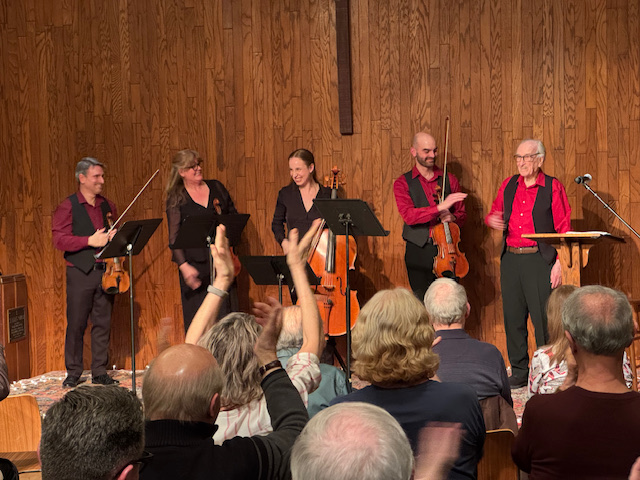
After a short break, the final work of the program, the Icarus Quartet, was played. This nearly fifty-minute work (in ten sections) tells the story of well-known story of Icarus, recited by narrator, accompanied by string quartet. Violinist Alwyn Wright joined Colin Pip Dixon, Arnaud Ghillebaert, and Kathryn Brunhaver. The story presented here was not the familiar cautionary tale of the consequences of hubris, but a call not to impede the dreams and passion of the young. One can draw one’s own conclusions about this revisionist take. MacIntyre Dixon was the narrator, and while one might quibble with the story, there could be no doubt that he was a powerhouse. It’s no easy feat to keep a large audience spellbound for nearly an hour, but he did just that.
How much the text depended upon the music would be debatable – to this listener, it seemed to be the opposite, that the music depended upon the text. To clarify, there were many examples of the music being a “description” of the words, which accentuated the text’s effect (in film music a quality called “Mickey Mousing”), yet without the text, the music would have not evoked any thought of the myth. This last point is moot, however, as one could hardly expect a performance without the text. All credit to the quartet members, as it would have been quite easy to have been overshadowed by such a dynamic force as MacIntyre Dixon, but they were quite heroic in an understated way. The audience responded with a well-earned standing ovation. As an encore, the quartet and Camille Ortiz (with the addition of pianist Miriam Leskis), offered Song to the Moon, from Antonin Dvořák’s opera Rusalka, which was the highlight of the evening for this listener. The already happy audience responded with another standing ovation. Congratulations to all!
