
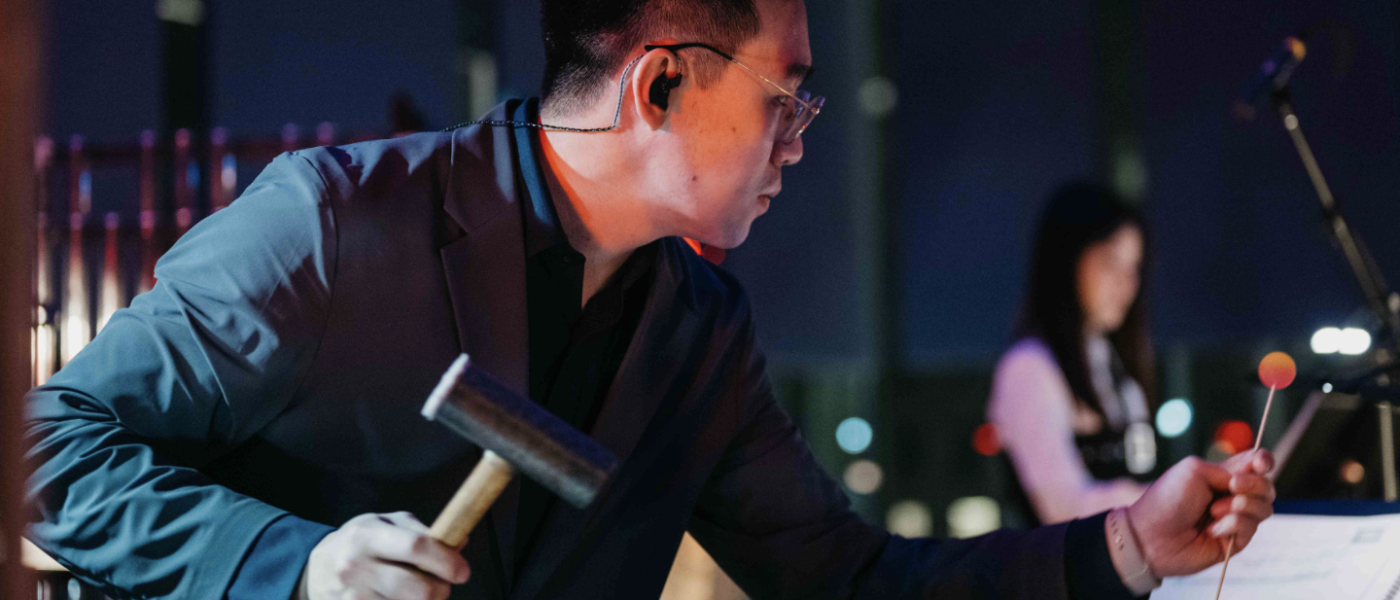
Zhaoxuan Song Percussion Recital in Review
Zhaoxuan Song, Percussion
Bowen Zheng, vocalist; Natalie North, percussion; Vio C, Electronics & Audio Support; T. C. Kincer, piano
New York University, John H. Paulson Center, New York, NY
May 8, 2025
On May 8, 2025, Zhaoxuan Song gave a recital towards the completion of a DMA degree in percussion at New York University. Mr. Song is the second DMA candidate in the newly created doctoral program for percussionists to be reviewed in these pages. Mr. Song is completing his studies under the guidance of the internationally renowned timpanist and percussionist Jonathan Haas.
The program notes state that Mr. Song’s performance and research focus on innovative collaborations between percussion and voice, with particular emphasis on the expressive and theatrical dimensions of contemporary music. The program reflected this focus, as all three works on this program were by contemporary composers (two living) and had highly theatrical content. Mr. Song was joined by vocalist Bowen Zheng, percussionist Natalie North, pianist T.C. Kincer, and had electronic and audio support from Vio C.
For full disclosure, this reviewer was not present at the actual recital but was provided an (unedited) video for review. It is inevitable, given such circumstances, that the impact of the performance was somewhat diminished, as there is no real substitute for the live experience.
Before talking about the music, I would like to mention logistical matters. Set-up is an art in itself – placing the battery of percussion instruments to allow quick access without disaster (and within the confines of the space, which in this case was rather limited) requires careful planning. It was notable how gracefully and unhurriedly Mr. Song navigated this maze throughout the recital.
Silk Road (1989) by Tan Dun (1957), with vocalist Bowen Zheng joining Mr. Song (text by Arthur Sze), opened the recital. About this work Tan Dun writes, ”the rhythms of English verse are combined with the tonal qualities of Peking Opera, in a linear structure like the connected brush-strokes of calligraphy.” Tan Dun is an expert at mixing Eastern and Western elements, and this work is no exception. With evocative vocals by Ms. Zheng, and the seamless mixing of Chinese and Western percussion instruments by Mr. Song, it was not only a demonstration of Mr. Song’s expertise with the percussion battery, but also his highly developed dramatic sense that was apparent throughout the recital.
Animus II (1967/1968) by Jacob Druckman (1928-1996) followed the Tan Dun. Scored for mezzo-soprano (Bowen Zheng), two percussionists (Mr. Song and Natalie North), and electronic tape, the work transforms the concert experience into what the composer called “an orgiastic ritual.” The ritual aspect was clear (a solemn processional to open and an equally solemn recessional to close), but I will leave it to others to decide to what degree Mr. Druckman’s assessment is accurate. The recorded sounds added a layer of mysticism. There was a definite theatrical build-up, as each performer’s role became more urgent and frenzied. At one point, all three performers were striking a gong with different materials (metallic stick, mallet, and tubular bell hammer) as tension reached its peak. Kudos to Mr. Song, Ms. Zheng, and Ms. North for both their dramatic and musical excellence.
The Percussion Concerto (1998) by Chen Yi (1953) closed the recital. Commissioned by Evelyn Glennie and the Singapore Symphony Orchestra, this work blends Western orchestral forces with the spirit of Beijing Opera in three movements (I. The Night Deepens II. Prelude to Water Tune III. Speedy Wind). This arrangement for piano and percussionist was made by Mr. Song. T.C. Kincer was the pianist. For more detailed information about this work, one can read Chen Yi’s own notes by clicking on the following link: Chen Yi Percussion Concerto. This work is a tour-de-force for the soloist, and like the previous two works, it has a strong theatrical element. Mr. Song displayed his considerable talents with gusto throughout. The opening movement, The Night Deepens, had a nervous energy that reminded me of Prokofiev with an Eastern flavor. The middle movement, Prelude to Water, requires the soloist to recite poetry while making his way around the battery, which is probably a lot more difficult that then average listener could imagine. Mr. Song did make it look very easy! The finale, Speedy Wind, has a knockout cadenza that Mr. Song dispatched brilliantly. Credit is also due to pianist T.C. Kincer for his role. The audience gave Mr. Song a very enthusiastic ovation that was well-deserved.
I wish Mr. Song good luck and continued success as he works towards his degree.
