
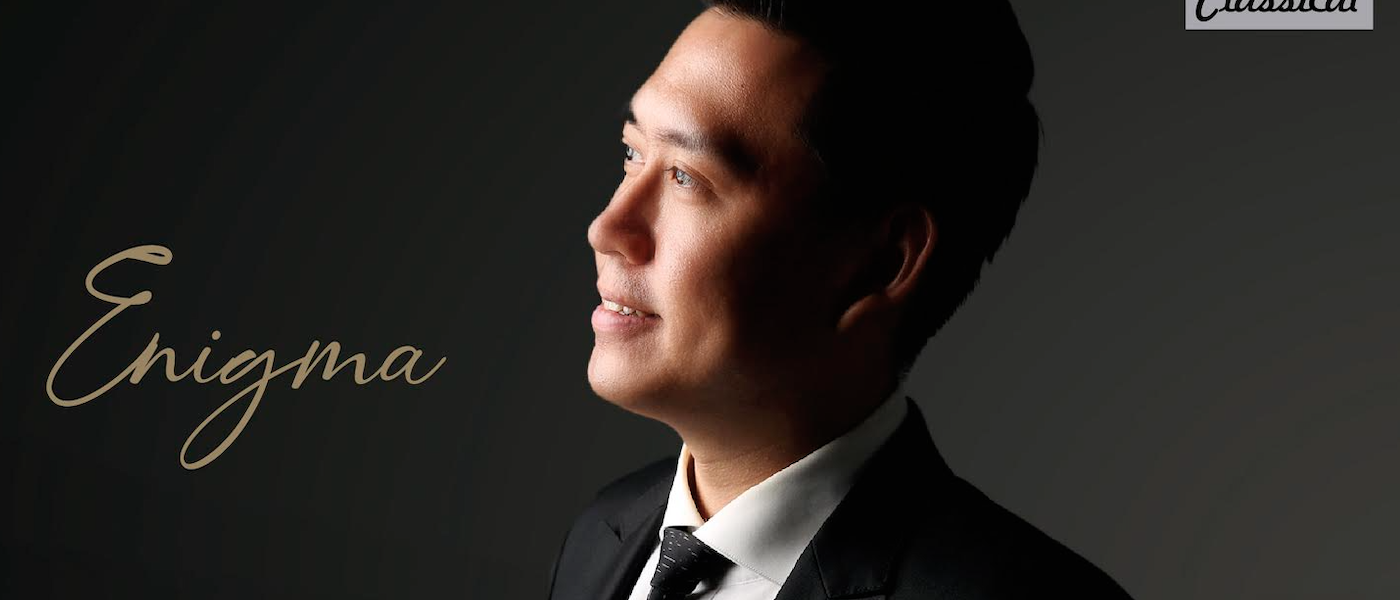
CD Recording in Review: Enigma
Wenting Yu, piano
KNS Classical KNS A/202
Acclaimed pianist Wenting Yu’s new recording Enigma on the KNS Classical label (KNS A/202) is a thoughtfully curated tribute to the French piano tradition, centered on the legacy of Robert Casadesus (1899–1972). The album brings together works by Rameau, Debussy, Ravel, and Casadesus, tracing stylistic connections across French composers. Rather than presenting a simple anthology of French works, Enigma explores the musical lineage surrounding Casadesus and the enduring influence of the French piano school.
Wenting Yu is from Shenyang, China. Mr. Yu earned a Doctor of Musical Arts degree from Rutgers University’s Mason Gross School of the Arts, where he studied with Vladimir Valjarevic and served as a Graduate Teaching Assistant. He previously earned his master’s degree from Mannes School of Music under Pavlina Dokovska, and was the recipient of the 2019 Steinway & Sons Award. His career has been marked by numerous international competition prizes, including distinctions at the Fontainebleau Festival, where he received both the Ravel Prize and the Robert Casadesus Grand Award. His artistic interests have increasingly focused on French repertoire and the performance legacy of the Casadesus family, a fascination that ultimately led to the recording of Enigma.
The recording begins with three works by Jean-Philippe Rameau (1683–1764). Here Mr. Yu sets the scene for the French sound world that is present throughout the album with these expressive works. Les Tendres Plaintes from the Suite in D from Pièces de Clavecin is intimate and unfolds naturally. The ornaments are elegant while imbuing the music with pathos. Les Cyclopes, the most virtuosic of the three works, stands out for its perpetual-motion figurations. Mr. Yu handles the repeated notes with grace while maintaining a supple pulse. An even more driving rhythm, however, could have enhanced the work’s dramatic qualities. Next comes the Allemande from the Suite in A from Pièces de Clavecin. Though beautifully played, this performance lacks a consistent flow and employs frequent Romantic rubato, which obscures the clarity of the work’s structure.
Next is a selection of preludes by Claude Debussy (1862–1918), works that demonstrate the composer’s extraordinary ability to evoke atmosphere, color, and imagery through the piano. Mr. Yu proves to be a sensitive guide through these landscapes, creating a wide palette of colors from the instrument while maintaining a strong sense of line and direction. Drawn from Books I and II, Mr. Yu presents Voiles, Ce qu’a vu le vent d’Ouest, La Puerta del Vino, and Feux d’artifice. These four preludes showcase different facets of Debussy’s writing and approach to the instrument, which is welcome, though the selection does not feel entirely congruous within the context of this recording.
The performances, however, are strong. Voiles has a vivid sense of mystery, and Mr. Yu delineates its layers sensitively. In Ce qu’a vu le vent d’Ouest, he successfully communicates the drama of the work by capturing the varied nuances of its registers, from the murky to the brilliant. La Puerta del Vino, a sensual habanera, is poetic and imaginative. The treacherous Feux d’artifice is handled with command, though it could have been more convincing in its many passages of contrasting “sound effects.” In a way, the performance is rendered almost too perfectly and might have benefited from a more imaginative and risk-taking approach.
The focus now shifts to Robert Casadesus (1899–1972), the central figure around whom this recording is built. One of the most distinguished French pianists of the twentieth century, Casadesus was celebrated for his clarity, elegance, and intellectual approach to both performance and composition. Although his reputation today rests primarily on his career as a pianist, he was also a prolific composer whose music reflects the refinement and craftsmanship associated with the French tradition. His presence on this recording serves as an important link between the earlier French masters represented on the program and the musical legacy that followed.
The first work by Casadesus on the recording is Variations d’après l’hommage à Debussy de Manuel de Falla, Op. 47. Based on de Falla’s original guitar work, this homage to Debussy fits naturally within the concept of the album. A gem of a composition, it fuses Spanish elements with an impressionistic color palette. Mr. Yu clearly understands the work’s multiple layers of reference and influence. His attention to detail in sound, articulation, and color is remarkable.
Each variation is distinct and contrasting, filled with passion and a natural spontaneity. Particularly enchanting is the third movement, Presto, in which Mr. Yu vividly evokes the virtuosity and brilliance of the guitar. The fourth movement, Andantino “alla barcarola,” is equally successful, communicating a hypnotic lyrical quality. The last movement, Allegro ben moderato, is an excellent culmination to the work, full of bravura and expressive energy. Mr. Yu plays this wonderful work with abandon and conviction. Bravo!
The album continues with a selection of eight preludes from Casadesus’s 24 Préludes, Op. 5, a collection that reveals another side of the composer’s musical personality. Written early in his career and published in 1925, these concise pieces display a remarkable variety of mood, texture, and pianistic writing and established him as a composer, not just a pianist. Dedicated to Maurice Ravel, Casadesus continues the tradition of writing 24 preludes established by composers who preceded him.
Though this selection of eight preludes offers a glimpse into Casadesus’s compositional style, the format ultimately feels somewhat fragmented. A more substantial selection, or better yet, the complete cycle, would have provided a stronger sense of the work’s overall architecture and made a more compelling case for Casadesus as a composer.
That said, the performances themselves are consistently engaging, combining power and charm in equal measure. Particularly striking is Prélude No. 10, whose rhythmic vitality and incisive articulation create an immediate sense of character. Prélude No. 21, meanwhile, evokes the elegance and color of Ravel’s piano writing. In the end, the selection leaves the listener wanting more, eager to discover the relationships between the individual preludes and to experience the broader narrative formed by their progression through the twenty-four keys.
The preludes are followed by a work by Maurice Ravel (1875–1937), represented here by three movements from Le Tombeau de Couperin. While the rationale behind presenting just these movements is clear, I am less convinced that these excerpts function successfully as a recording project. Stylistically, however, the performances are admirable throughout.
I would have welcomed a greater emphasis on the work’s more luxurious sonorities. Although Ravel draws inspiration from Baroque forms and gestures, he filters them through a distinctly early twentieth-century harmonic and pianistic language. More of that richness and color could have been brought to the foreground. The Toccata, in particular, is delivered at an effective pace, and its notoriously demanding repeated-note passages are executed with remarkable control and precision.
The final group of works returns to Robert Casadesus. By far this reviewer’s favorite selections on the recording are the two Études from Op. 28. Mr. Yu delivers astonishingly clean performances, full of vitality, wit, and charm. Once again, I found myself wishing for a more substantial sampling of this remarkable music, as these two brief works leave the listener eager to hear more. Their playful spirit and unmistakable personality reveal a particularly engaging side of Casadesus’s voice as a composer.
The album concludes with the Toccata, Op. 40, a work that inevitably invites comparison with Ravel’s Toccata. There is no question that this piece presents formidable technical challenges, and Mr. Yu meets them with impressive ease and confidence. Nevertheless, I found it to be the least interesting work on the recording. The toccata material often feels derivative and lacks the freshness and individuality found elsewhere in Casadesus’s output. His distinctive voice emerges far more vividly in the shorter works, like the préludes and études.
Even so, this recording serves as an important contribution to preserving and promoting Casadesus’s music. Mr. Yu’s advocacy sheds valuable light on a composer whose works deserve greater recognition and continued exploration. He should be applauded for this valuable contribution to the discography and for his commitment to bringing this neglected repertoire to a wider audience. One hopes that more recordings of Casadesus’s music will follow in the years to come.
