
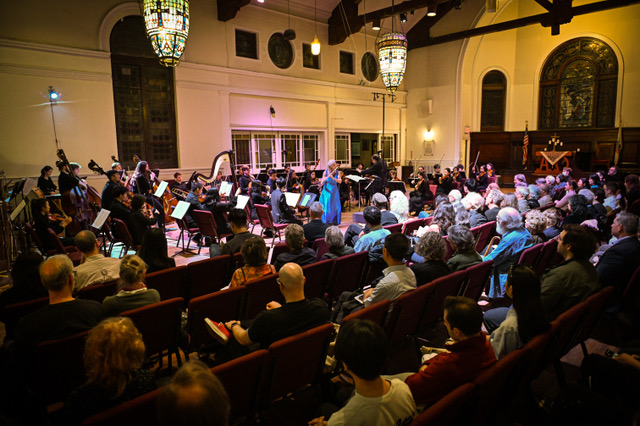
WA Sinfonietta presents American Icons in Review
WA Sinfonietta
Charles Neidich, Music Director/Conductor
Carol Wincenc, flute
Good Shepherd-Faith Presbyterian Church, New York, NY
May 10, 2026
The WA Sinfonietta, under the baton of the world-renowned clarinetist Charles Neidich, gave its second 2026 performance on May 10th at the Good Shepherd-Faith Presbyterian Church, with works by Charles Ives, Lukas Foss, and Elliott Carter. The previous three concerts of this ensemble (the inaugural concert on March 23, 2025, May 13, 2025, and March 15, 2026) have been covered in these pages. (Interested readers can click on the following links to read about those concerts: WA Sinfonietta in Review March 23, 2025 , WA Sinfonietta in Review May 15, 2025, and WA Sinfonietta in Review March 15, 2026 .) Programming seems to follow a plan of alternating between concerts of “historically mainstream” pieces and then concerts of “modern/contemporary/20th century” works. Both formats feature the idea of a unifying theme and/or a lesser-played alternative version of an established work . Sunday’s concert was also livestreamed (Wa Sinfonietta – “American Icons” Livestream) for those persons who chose Mother’s Day over attending this excellent performance.
Mr. Neidich spoke about the program, and happily he has taken the advice to use a microphone to be heard clearly by all in the audience. The prior complaints were never intended to offend – Mr. Neidich simply has many interesting things to say, and it is a shame for his wealth of knowledge to be lost in inaudibility. As always, there were excellent program notes, with a QR code included for extra points of interest about the composers and their works.
Three Places in New England by Charles Ives opened the concert. For those unfamiliar with the piece or without access to the QR notes, the three movements are I. The “St. Gaudens” in Boston Common (Col. Shaw and his Colored Regiment), II. Putnam’s Camp, Redding, Connecticut, and III. The Housatonic at Stockbridge. Each piece is intended to evoke its respective place for the listener. It is one of the most frequently performed of all of Ives’s works, probably because of the use of folk tunes and Americana giving the listener reference points within the highly chromatic writing. Mr. Neidich mentioned Civil War songs, however, the list of actual quotations could easily fill this page.
Mr. Neidich is a musician with a deep, probing intellectual bent, so one would think that Ives’s complexity would be right up his (Neidich’s) street, and would expect a highly polished and well-thought-out approach. It almost goes without saying that this was the case this evening. Mr. Neidich had everything under control (which is no easy task in Ives), and his strong sense of conception was brilliantly brought to life by the WA Sinfonietta. I have something of an uneasy relationship with Ives’s music, but this made me sit up and take notice. The following were highlights – The “St. Gaudens” in Boston Common (Col. Shaw and his Colored Regiment) had a truly atmospheric feel, as if apparitions of soldiers were slowly marching across the South in a haze of memories. It was incredibly effective in its eeriness. Putnam’s Camp, with the dual marching bands had the right amount of amateur clumsiness without exaggerating the parody. If this was one’s first exposure to Ives, then they were treated to a first-class performance.
Lukas Foss’s Renaissance Concerto for flute and orchestra was the final work on the first half, with flute soloist Carol Wincenc (who premiered the work, which was written for her). While many of the names of early music make “guest appearances” (viz. Byrd, Rameau, Monteverdi, and Gesualdo), modern devices abound, such as extended techniques from the soloist. The work is looking forward and backwards simultaneously – vintage Foss. The composer himself described this work as “ an homage to something I love, a handshake across the centuries.”
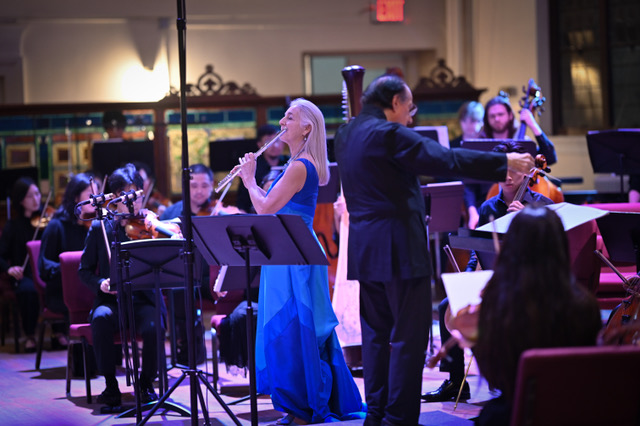
Ms. Wincenc spoke briefly about the work, mentioning that the acoustic of the venue was ideal (making special mention of the third movement Recitative) and telling the audience that Foss himself conducted the premiere forty years ago. Ms. Wincenc is not called the “Queen of the Flute” without reason – her tone is pristine in its beauty, and she has technique to burn, making the most intricate passages sound effortless. She was also spot-on about the acoustic – the smaller venue lent an immediacy that was missing for me in larger halls.
The Jouissance finale was the showstopper, with brilliant passagework, a courtly duet between the flute and percussion, some tapping on keys, and aggressive blowing, culminating in Ms. Wincenc’s slow exit from the stage while still tapping keys and making a “click” sound as she got farther from the stage. The audience reacted enthusiastically, calling Ms. Wincenc back to the stage three times.
After intermission, Symphony No.1 (1942, revised 1954) by Elliot Carter was to be the sole piece on the second half. Mr. Neidich spoke of Carter’s intent to write something optimistic and uplifting to buoy the nation’s mood in the midst of World War II. One might say it was “Carter before Carter became Carter”- it bears no resemblance to his highly complex later works. The program notes hint that the seeds of his later “complex greatness” are to be found in this work, which is open to debate (I disagree). This work has hints of Aaron Copland, Roy Harris, David Diamond, Samuel Barber, and William Schuman (amongst others), which are all terrific influences. As a side note, this listener could not help thinking what an amazing time for the American Symphony the late thirties and forties were!
This three-movement, thirty-minute work deserves more attention, not just the occasional playing merely as a curiosity. The WA Sinfonietta played with a robust sense of optimism and steady resolve. There were a few instances where the balance between the upper winds and the strings were problematic, probably due to the hall acoustics, but also some overexuberance.
The audience responded with an extended standing ovation, long enough to allow Mr. Neidich to wend his way through the entire ensemble and shake hands with every musician. It is something I never tire of seeing, a world-class musician who truly loves what he is doing, sharing his gratitude with not only the audience, but his very talented ensemble. It was another triumph for the WA Sinfonietta, and one looks forward to future performances.
