
The Italian Academy and Carnegie Hall present David Witten in Review
David Witten, pianist;
Grace Renée Pfleger, mezzo-soprano;
Italian Academy, Columbia University, New York, NY
April 16, 2026
Among the exciting celebrations of America’s musical heritage this year so far (the Semiquincentennial of the USA, as some call it), was an April recital entitled “From Sea to Shining Sea: Music to Celebrate America’s 250th Birthday,” given by respected pianist and professor David Witten. Listed under the aegis of Carnegie Hall as part of their festival “United in Sound: America at 250,” the concert took place at the Italian Academy for Advanced Studies in America at Columbia University (also listed as presenter). For the record, this listener was not at the live concert itself, but an excellent video of the complete event (by Asaf Blasberg) was provided for review.
It has been fascinating to see how many kaleidoscopic programs have already been built this year on American music – many with completely different repertoire, reflecting the nation’s great musical diversity. Several works on Mr. Witten’s program were in fact unfamiliar to this reviewer. Rather than simply featuring traditional favorites, his selections included some by composers whose births preceded the nation’s founding and on through the twentieth century. The program moved from works of Francis Hopkinson (1737-1791), Alexander Reinagle (1756-1809), and Louis Moreau Gottschalk (1829-1869) up to Charles Ives (1874-1954), Mario Castelnuovo-Tedesco (1895-1968), and Judith Lang Zaimont (b. 1945). The result was historically illuminating, as well as moving and entertaining.
The entertainment aspect appears to be a special gift of this pianist, who excels as a curator and raconteur, radiating warmth and humor as he invites us into the musical equivalent of a curiosity shop. Not to understate his credentials as a pianist, which are substantial (see his website- David Witten), his gifts beyond the piano are what made the occasion especially memorable.
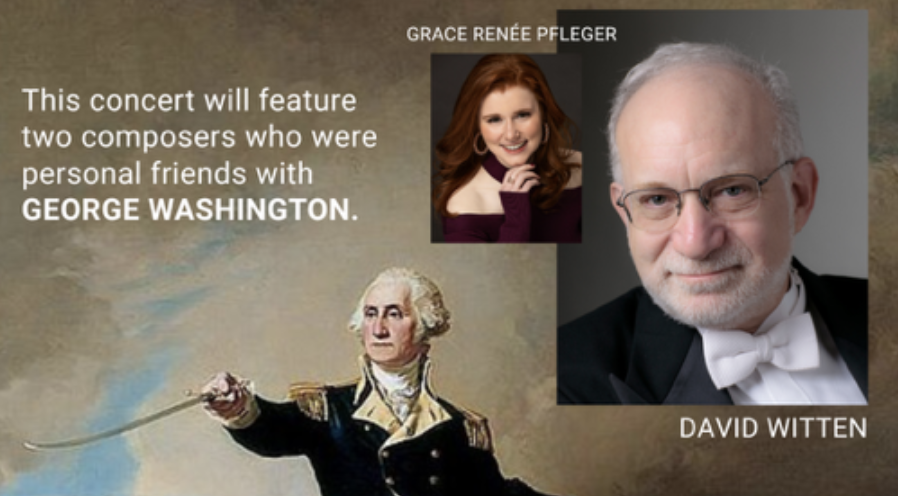
The concert opened with the Sonata No. 2 in E major (1790) (from The Philadelphia Sonatas) by Alexander Reinagle. Mr. Witten introduced the work with some background about Reinagle’s life in Philadelphia (where George Washington and his family lived), and set the scene for the piece, speculating that Washington may have attended one of the many concerts at which such pieces were presented.
While Reinagle certainly is interesting from a historical perspective, filling in some blanks for those early American years when most masterpieces were coming from Europe, the Sonata No. 2 is hard to embrace. Bearing signs of the influence of C. P. E. Bach, it blends the latter’s mercurial, improvisatory keyboard style with more rigid formulaic elements, so that moments of high drama move to facile resolutions in puzzling ways – as if heated disagreements are being followed by the words “have a nice day” and the like. The first movement in particular is not easy to pull off convincingly and seems in some ways to be in search of itself, just as America was in its formative years. Some have handled the structure of it by facing its capriciousness head-on, with strong dynamic differentiation and very decisive and deliberate transitions between otherwise strict tempi. This was not so much the case here, but overall Mr. Witten handled it well, leaving out repeats to good effect and omitting some ornaments that would have weighed things down. In particular, he handled the second movement Adagio well, with strong conviction. The lively final Allegro benefited from his brisk tempo, crisp articulation, and what one guesses was his own tasteful extemporizing where needed.
Mr. Witten then introduced several works by Mario Castelnuovo-Tedesco, a composer known for having written scores for some 200 films among his many works. It seems only fitting to have included the work of an Italian-American composer, given the Italian venue and presenting organization, but Castelnuovo-Tedesco was an especially welcome choice, as his work is still relatively underplayed compared to that of some of his contemporaries. It is highly evocative, as we might expect from a prolific film composer, and it deserves to be heard. We were fortunate here to hear his Autunno (Autumn) from Le Stagioni (The Seasons), Op. 33 composed in 1924, Two Film Studies, Op. 67 composed in 1931, and a selection entitled Deanna Durbin from a set entitled Stars: Four Sketches for Piano, Op. 104 composed in 1940.
The Autunno selection was a discovery for this reviewer, and Mr. Witten’s performance of it was enchanting, with gentleness in the right hand’s fluid streams and remarkable sensitivity to its harmonic colors. The Two Film Studies brought a welcome note of lightness. The first one, Charlie, was named after Charlie Chaplin, and its dissonant repeating patterns evoked the title character’s famous walk, along with his trademark mixture of the serious with the comedic. The second of the Film Studies, entitled Mickey Mouse (Topolino), needs little explanation – Mr. Witten captured the antics with a mischievous elasticity of tempo and delivered (with a perfect poker face) the composer’s playful references to the Toreador Song from Bizet’s Carmen and bits of Vissi d’arte of Puccini. The sketch Deanna Durbin from Op. 104 capped off the set with easy ebullience (though it certainly would not be called “easy” as a piece) and a flair worthy of its Hollywood honoree. One could hear audience members’ delight in response.
Moving the program back in time to 1788, Mr. Witten introduced mezzo-soprano Grace Renée Pfleger, with whom he would collaborate on selections from Songs for Harpsichord or Fortepiano by Francis Hopkinson. Additionally, he offered some of the history of Hopkinson, whom he described as not only a composer but an artist (who designed one of the first flags of the US), poet, and lawyer. Most remarkably, he was one of the founding fathers who signed the Declaration of Independence. Frankly, simply knowing the very history of this composer made hearing these pieces an engaging experience, though purely musically they all seemed to owe a heavy debt to Handel and other earlier masters. We heard the first, Come, Fair Rosina, the second, My Love is Gone to Sea, and the sixth, Over the Hills. It was a refreshing choice to throw some vocal music into the mix.
Ms. Pfleger – described in her promotional materials as “an opera singer, music therapist, and community advocate” – brought a charming stage presence and sincere expressiveness to these songs. Particularly winsome was the innocence and sorrow she conveyed in My Love is Gone to Sea. She is currently pursuing her Artist Diploma on full scholarship at the Cali School of Music at Montclair State University. Mr. Witten accompanied her ably, as one would expect, reclaiming his solo role afterwards for the program’s final offerings, selections from A Calendar Set (1972-78) by Judith Lang Zaimont, Variations on ‘America’ (1891) for Organ by Charles Ives, and The Banjo (1853) by Louis Moreau Gottschalk.
There were just two selections chosen from Ms. Zaimont’s twelve-month set – November and July in that order. As Mr. Witten explained, he included July – “of course” – as, even with all its dissonance, there are three patriotic songs in it. As for the rationale behind November, Mr. Witten shared that, when pianists play only selections from the set Ms. Zaimont requests that they include the month of their birth, and Mr. Witten was born in November. At any rate, both were fine additions to the program, November for its austere beauty (prefaced by the quotation “November’s sky is chill and drear” of Sir Walter Scott) and July (“The Glorious Fourth!”) for its references to The Stars and Stripes Forever along with snippets of Columbia, the Gem of the Ocean and Yankee Doodle. Well done!
The penultimate work of the program was Variations on ‘America’ for Organ (1891), composed by Charles Ives at age seventeen and arranged for piano by Mr. Witten. Based on the anthem that is also called My Country ‘Tis of Thee, it was a good choice to project a mixture of national spirit and Ives’s own brand of individualism and trademark cacophony. Mr. Witten played it with panache.
The program closed with a spirited rendition of The Banjo (1853), Gottschalk’s once ubiquitous showstopper. It was great to hear again after years of not encountering it on recitals, and Mr. Witten conveyed well its carefree innocence and joyous spirit. Kudos go to him for including it, and for the whole memorable recital. I’ll just conclude by saying, “Encore!”
