
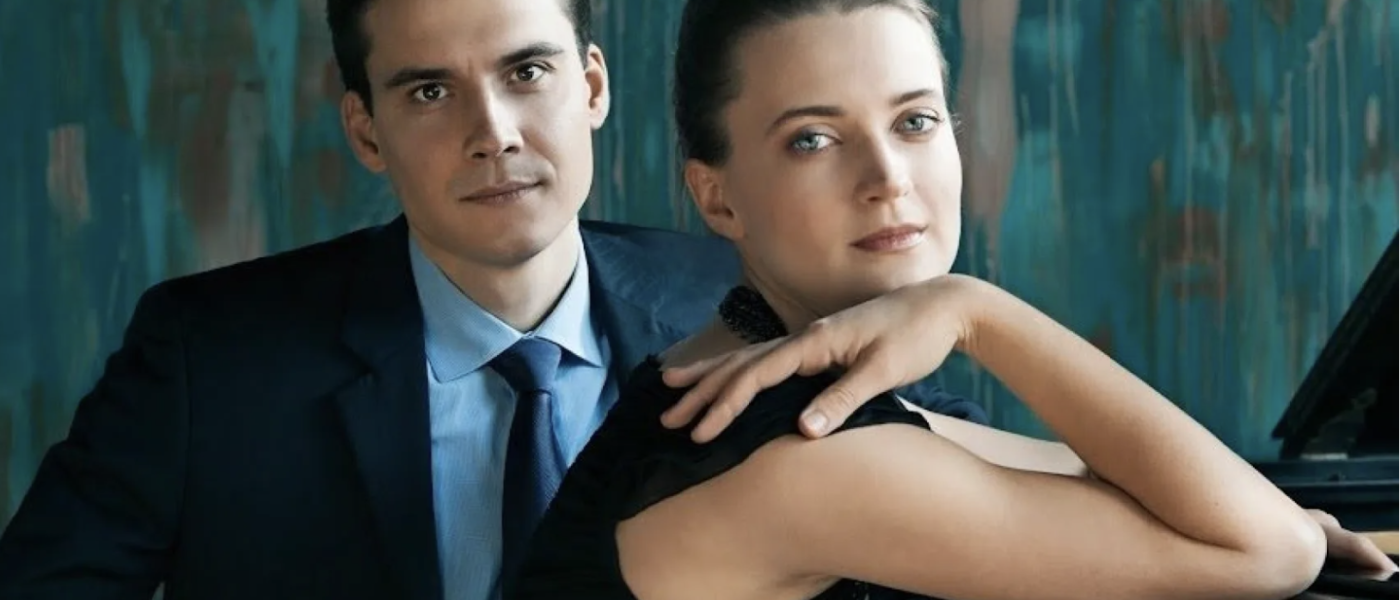
The Alexander and Buono Foundation presents the Shelest Piano Duo with the Brandywine Valley Symphonic Chamber Orchestra in Review
Anna Shelest and Dmitri Shelest, piano
The Brandywine Valley Symphony Chamber Orchestra
Michael Hall, Artistic Director
Weill Recital Hall at Carnegie Hall, New York, NY
October 18, 2026
It is rare that a concert surpasses all of a reviewer’s expectations, but such a program took place this past Sunday before a large audience at Weill Hall. The duo-piano team of Anna and Dmitri Shelest, joined by the Brandywine Valley Symphony Chamber Orchestra (Brandywine Valley Symphony) under Michael Hall, played a program of all 20th- and 21st-century music from the US and Ukraine in what was the first event of New York’s fourth Ukrainian Cultural Festival (October 18-Nov 6, 2026). Not surprisingly for such a fine-tuned event, this concert was presented by the Alexander & Buono Foundation, Inc., which, based on other concerts presented by them, never misses a trick. From their helpful program notes to their seamless organization, it was beautifully conceived in every detail – and in conjunction with Razom for Ukraine and C. Bechstein Pianos. The program had a thoughtful balance of music by Valentin Silvestrov, Philip Glass, Samuel Barber, and Oleh Bezborodko, with the Ukrainian compositions bookending the American ones.
The excellent pianist Anna Shelest opened the program, joining the orchestra for a work entitled The Messenger (1996) by Ukrainian composer Valentin Silvestrov (b. 1937). The rather small stage at Weill Hall was occupied by Ms. Shelest, a Bechstein grand piano, nineteen members of the Brandywine Valley Symphony Chamber Orchestra, and the podium for conductor Michael Hall. What could have been an imposing mass of sonorities turned out to be beautifully intimate, as Mr. Silvestrov’s gentle, ethereal sounds were realized delicately by both pianist and string players alike. Written shortly after the death of the composer’s wife, it was inspired by the notion that a “messenger” (as imagined by the philosopher Yakov Druskin) may move between worlds. Faint fragments borrowed from Mozart wafted through the piece amid a haunting, elegiac haze of sound, with some unresolved lines conveying a searching quality. The air of mystery was increased by the visual uncertainty of when exactly the pianist was actually playing versus merely touching or depressing the keys silently, as one could not quite tell. The required pedal also blurred distinctions. Curiously too, the piano lid was resting on the half-stick, though the composer’s notes (included in the program itself) specified that it should be completely closed. One assumes this was not an oversight, rather a well-considered decision in the context of this performance – but whatever the case, it seemed not to interfere. Together, piano and orchestra made a poignant opening to a concert of enormous emotional range.
The Silvestrov piece led with a feeling of inevitability to the next work, the Piano Concerto No. 1 Tirol Concerto (2000) by Philip Glass (also born in 1937). Apart from sharing a birth year – and the latter’s vocal support of Ukraine – there are quite a few bonds between the two composers. There is a strong affinity, for example, between the minimalist style that Mr. Glass pioneered and the post-minimalist “meta-music” of Mr. Silvestrov – except that, where the Silvestrov piece gave the effect of suspended time, Mr. Glass was working here within a somewhat more conventional form and style, with an energy in the final movements that resembled jazz as it drove to a rip-roaring close.
Ms. Shelest was again the superb soloist, taking on the opening piano section with a decisive energy that carried her through the entire movement. Impressively, she managed to keep the myriad repeated patterns and their slight changes well demarcated, always projecting a sense of the work’s shape and direction. For full disclosure, this reviewer has never been a huge fan of this piece, but that started to change over the course of this performance – a sure tribute to the performers. Ms. Shelest, together with Mr. Hall and the orchestra, showed passionate commitment in their advocacy for it, and it was quite persuasive. The central movement, built upon harmonic progressions from Mr. Glass’s earlier soundtrack to The Truman Show (1998) was engrossing throughout, an impressive feat especially considering there are some stretches where the only changes to a harmony are minimal – through inversion, voicing, or instrumentation.
It may seem trivial or obvious to point out that Ms. Shelest was technically reliable the entire time – since that is almost a given in such a venue and with a respected professional – but it is a comment one can better appreciate if one has ever tried to play the same arpeggiation consecutively sixteen times or more, aware that any slight difference will stick out like a sore thumb. This mastery was especially important in the last movement, full of high-speed syncopations and cross-rhythms, at times enjoying an almost “boogie-woogie”-type bass and at others, relentless right-hand octaves, never letting up on the energy. Ms. Shelest was absolutely brilliant.
It seems only appropriate that the Brandywine Valley Symphony Chamber Orchestra would play something on their own, since it was, after all, the Carnegie Hall debut of this orchestra (founded in 1940). After intermission, Michael Hall led them in Samuel Barber’s Adagio for Strings (arranged in 1936 from the String Quartet Op. 11). It couldn’t have been a better choice for this concert, program-wise. The ensemble happens to be based where Barber was born, in West Chester, Pennsylvania – and this beloved work has come to be known as a balm in the face of tremendous loss, such as that which was felt in several works on this program. Naturally, such a piece is easier with a large string section (even given the work’s roots as a quartet) – but Mr. Hall and the ensemble handled it admirably, establishing a reflective mood from the start. Of course, there were moments when matters of intonation or evenness were more exposed than they would have been with a larger ensemble, but these were minor in the grand scheme of things.
As the final work on the program, both Anna and her husband Dmitri Shelest – known through recordings and concerts as the Shelest Piano Duo – returned to the stage to join the orchestra in Concerto for Piano Four Hands and String Orchestra by Ukrainian composer Oleg Bezborodko (b. 1973). It was a US Premiere, and the composer was present to take a bow and to join a Q&A session afterwards.
Mr. Bezborodko has written here one of the rare concerti pairing four-hand piano with string orchestra, and it has a storied past already. The premiere in Kyiv, scheduled for September of 2025, was prevented by an air raid alert sending the already-present audience to a shelter for several hours, after which the concert had to be canceled. Three months later, the Kyiv Piano Duo and Kyiv Camerata under Kerri-Lynn Wilson finally gave it its premiere, December 2, 2025. Now, ten months later (and with one afternoon’s orchestra rehearsal, we were told), the Shelest duo would blow their Carnegie audience away with it.
About the piece itself, the concerto is subtitled steel violet rage, describing its three movements. The first movement -“steel”- evokes the Azovstal steelworks of Mariupol, Ukraine during the Russian siege of 2022. The movement is fittingly brutal and percussive, in sounds produced both inside the piano and out. The “violet” movement, next, then makes reference to the final poem by poet and soldier Maksym Kryvtsov, shortly before he was killed in action. (It was almost unbearable to type that sentence.) As he thought of his body dispersed through the battlefield, he imagined his severed hands on the ground, sprouting violets in the springtime. In moments of great delicacy, this movement was, as one would expect, simply heartbreaking. In sum, the whole piece was devastating, but one could hope that “rage” at the end, with its strong forward propulsion, had perhaps as an imagined outcome some kind of acceptable resolution.
The Shelest Duo seems to have been made for the piece – its challenges and its extremes. They played with perfect synchronization and even seemingly that special telepathy that married couples can have (also demonstrated in the page-turning for Anna by husband Dmitry in the first works – not an easy thing to do before performing). They handled with ease the awkward extended techniques – including sweeping, plucking, and percussive effects inside the piano by one player, who had to stand while encircled by the arms of the other who needed to reach both extremes of the keyboard at once. Lest it seem as if it were all yet another exercise in the noise of extended techniques, it should be noted that the sounds produced through it all were unique, and in service to the work’s themes. One can only hope, after such monumental work for the musicians, that there will be future performances of it for them all.
One ray of hope in all the violence and devastation projected musically was the affirmation that music can still bring people together, still inspire impassioned performances like what we heard, and still impel the audience to help those suffering – facing a winter ahead with no electricity, no heat, and no warnings about imminent attacks. It was quite powerful in every way. As the tumultuous applause wound down, one could hear shouts of “Slava Ukraini!” from the back of the hall.
