
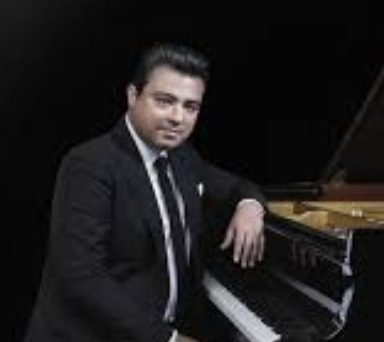
The Cziffra Festival presents János Balázs in Review
János Balázs, piano
Zankel Hall at Carnegie Hall, New York, NY
November 16, 2026
It is a privilege to write a review for the recent New York concert of János Balázs, not because of anything one can easily verbalize (credentials, impressive repertoire, accolades – though yes, yes, and yes), but rather because of what is harder to verbalize. His Monday evening recital at Carnegie’s Zankel Hall proved to have much of what the classical music world needs more of today, the kind of spontaneous artistic expression that breathes life into the music we are hearing.
Mr. Balázs, who is founder and artistic director of the Cziffra Festival in his native Hungary, planned this concert (as he has many others) to honor the legacy of the great pianist György Cziffra, described in the program notes as “known for his technical brilliance, improvisational freedom, and expressive range.” (For an interview from 2025 with Mr. Balász, the reader can visit this page: A conversation with János Balázs .) Cziffra was indeed one of the great master pianists of the 20th century, and this reviewer has long been a devotee of his. It can be a risky proposition, though, to align one’s name with such a legend, and this reviewer did have some initial skepticism. Compounding that skepticism, one noticed that the opening and closing works (Schumann-Liszt Widmung and Ravel’s La Valse) were not even known to be in Cziffra’s repertoire, so the homage idea seemed to be growing a bit more nebulous. Nonetheless, this reviewer awaited the first notes with an open mind.
The Liszt transcription of Schumann’s Widmung started with devout expression and the kind of tone and phrasing that lets the music truly sing – a beautiful start. This listener was drawn in. Then the first great ritardando came. To say that there was an elasticity about this pianist’s playing would be an enormous understatement. Here was the kind of stretching that might even provoke sarcasm from certain mainstream conservatory coaches (“it says ritard, not coffee break!”), and yet it worked from the sheer sincerity of the outpouring. In what amounted to an expansion of the term rubato to apply well beyond a phrase, these fluctuations natural and were offset by what followed in ways that ultimately balanced. What’s more, one was so carried away by the spirit and beautifully tapered phrases that one lost all sense of time (metronome who?). It was like being back in the great Golden Age of pianists.
Without allowing for any applause to break the spell, Mr. Balázs launched next into Schumann’s Carnaval, and I do mean launched, as it was a ride to remember. After hearing too many performances that have sounded duty-bound or worse, this reviewer had come practically to cringe on seeing it programmed, but Mr. Balázs offered a much-needed antidote with his interpretation. From the very first declamatory gesture of the Préambule, the music leapt brilliantly off the stage as if the pianist had improvised it right then. All was still quite faithful to Schumann’s score – and it was accurate in nearly all details – but there was simply no whiff of the formaldehyde that one catches in the interpretations of many young performers these days. There was no dull moment.
We heard the humor in Pierrot, the mischief in Arlequin, the grace in the Valse Noble, and the tenderness in Eusebius – and they all flowed seamlessly from one to the next, as if Mr. Balázs were a great storyteller or guide through Schumann’s imagination. The butterflies’ brief appearance in Florestan was enchanting, though not nearly as breathtaking as in the Papillons movement to come. The bursts in Coquette were more hilarious than this reviewer recalls ever hearing them, and the Lettres dansantes truly danced, as did the effortless repeated notes in Reconnaissance. Yes, there was some exaggerating, but Schumann was, after all, a man of extremes.
Mr. Balázs is a performer who reacts intensely to what he loves and what moves him and possesses every kind of tool of communication to share that experience with his listeners. That shouldn’t be so rare these days with so many technical wizards out there – and yet it is. By the time he reached the finale of Carnaval, the Marche des “Davidsbündler” contre les Philistins, he was projecting pure exultation, and this reviewer was ready to stand up and cheer. That feeling doesn’t arise at every concert – especially after a horrific day and the fourth week of a cough – but it did here.
What could possibly follow such a triumph? Liszt’s Spanish Rhapsody came next to end the first half, and it did not disappoint. Mr. Balázs stepped up the drama, with blazing fingerwork throughout, and his liberties extended not merely to matters of tempo and phrasing, but to his own additions in the jota aragonesa section. He added lowered basses for emphasis, for example, and some octaves in lieu of single notes (particularly on one repeated dominant “A”), and the resulting percussive drive was perfect. He brought the house down. There may always be some who find Mr. Balász’s brand of exuberance excessive, but – especially in this Romantic repertoire – it is vital. Such free and communicative spirits are the ones who will help keep live music alive in these times of artificial everything. The connection between his art and Cziffra’s was growing clearer.
The second half opened with Chopin’s Andante spianato and Grande Polonaise Brillante, Op. 22. Here we heard the more refined side of the pianist’s artistry, though still with considerable robustness. The Andante had a melting lyricism, and the Polonaise was fittingly majestic. Among Chopin’s works, this was a good choice for a pianist with a penchant for big sounds and heroicism. The highpoint of the second half, though, was Liszt’s Hungarian Rhapsody No. 12 in C-sharp Minor. From its moody declamatory opening on, the pianist’s flair for the improvisatory served him well. The flow was beautifully paced as he moved from the more ad libitum sections to glittering trills, storming bass octaves, and finally to its boisterous conclusion.
The final work on the program was Ravel’s La Valse, and though this listener did not think it reflected the pianist’s best work, it still made for a grand close. Ravel’s own piano transcription leaves a fair amount for the pianist to fill in – and one would think that therefore it would be a great match for a pianist inclined to the improvisatory – yet, given the particular harmonies of Ravel’s orchestral score, which are so precisely ingrained in the hearts and minds of those who love that piece (including this listener), some slight approximations or changes can feel amiss. It did, however, build well to the big frenzy for which it is known, and the audience seemed to devour it, giving it a huge round of applause.
An encore of Liszt’s Hungarian Rhapsody No. 6 capped off the evening absolutely dazzlingly, reaffirming a sense of triumph about it all. Bravo!
