
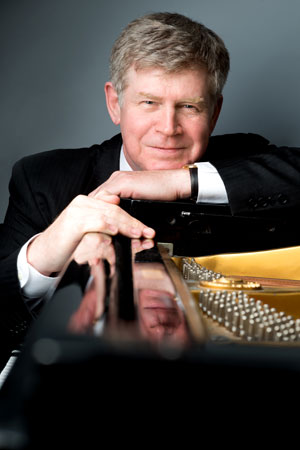
Hemsing Associates presents Ian Hobson in Review
Ian Hobson, piano
St. Peter’s Church, New York, NY
November 13, 2026
Friday the 13th was a day of exceptionally good luck for music-loving New Yorkers this November, as Ian Hobson gave the first concert of a five-year cycle devoted to the music of Schubert and Rachmaninoff. It is not every pianist who can take on both composers well, as their music runs the gamut from the most delicate statements to massive, complex textures – so concerts pairing them (let alone cycles) are not that common; combined, though, the two offer great balance, contrast, and also a certain unity through their shared vocal and symphonic leanings. This inaugural recital was entitled “Sonatas, Small and Great” and consisted of Schubert’s Sonatas in A major, D. 664, and A minor, D. 784, alternating with Rachmaninoff’s Sonatas No. 1 in D minor and No. 2 in B-flat minor (original 1913 version).
This reviewer has had the privilege of hearing not only vast cycles of repertoire played in concerts by Mr. Hobson over the past decade, but also many of his recordings from as far back as the 1980’s, when complete sets of composers’ works were harder to find than now. His were often heard as “reference” recordings and were greatly appreciated and admired. The very fact of his having absorbed such an encyclopedic repertoire is impressive in itself, but for more about Mr. Hobson’s remarkable career the reader can visit his page: Ian Hobson.
For this concert, a capacity crowd gathered eagerly in the sanctuary of St. Peter’s Church (on 54th Street and Lexington Avenue). Having heard Mr. Hobson most recently in a smaller hall with an overwhelmingly bright sound, this listener anticipated a more favorable acoustic experience here, and sure enough, overall, it was. From the very first gentle notes of Schubert’s Sonata in A major (or “the little A major” – as it is rather deceptively nicknamed), it seemed that this venue would allow him to explore the full range of his tonal palette – with particular nuance in softer dynamics – without any sense of constraint. The piano sound reached to the far corners of the room even at the softest levels, and the forte dynamics were never harsh. His phrases were beautifully voiced and mellow, with a glow that drew the listener into Schubert’s world. As ever, Mr. Hobson also showed an architect’s overview and grasp of the music’s structure, playing with the clarity of one who has not only has lived at least half a century with this music but has also taught it. He gave extra inflection and care at special moments and elucidated compositional high points.
Throughout this Schubert opening, one heard not only more tonal contrast than one recalled hearing in this pianist’s other recitals – but also a greater sense of ease. There was just a bit more time to breathe here and there, seeming to reflect Mr. Hobson’s special affinity for this music. The moments of “stopping to smell the roses” were quite welcome. The prayerful second movement was especially moving, without being self-indulgent. There were no repeats taken, and that seemed a wise decision given the rest of the program.
Rachmaninoff’s Sonata No. 1 was next, and it ultimately built up to quite a peak before intermission. What a luxury to hear two such works performed in a row – and live. Many pianists would find one such piece sufficient for a half of a program with some shorter works thrown in, but here, in typically generous and fearless Hobson style, were two very substantial works before intermission. He played with an impressive grasp, strong technique, and sure memory throughout.
For full disclosure, this listener – despite being quite devoted to Rachmaninoff – has always had trouble embracing this particular sonata. It somehow misses the directness and immediacy of the Sonata No. 2 and can lose the listener in its meandering. The program notes by Paul Griffiths were well-written, as ever, to guide the layperson through its Faustian themes (and one could certainly follow these throughout the piece), but it still felt hard to engage with the sprawling and zigzagging. It is challenging not merely technically (though that element goes without saying), but unwieldy dramatically. Though Mr. Hobson can surely navigate whatever music he undertakes, it is possible that what this work requires is not a navigator so much as a magic carpet. On a separate note, there was some muddling of the thick textures of sound, not from any fault of the pianist, but from a combination of the necessary pedaling and the excessive reverberation from the acoustics (yes, a sole reservation about the venue – and one that will not be likely to detract from other repertoire in the rest of the cycle). Acoustical issues aside, the performance did offer an epic journey, and the last notes of its fiery finale found the audience bursting into resounding applause.
After intermission came Schubert’s Sonata in A minor, D. 784, and it was the highlight of the program for this listener. Mr. Hobson showed consummate control in the first movement, while breathing life into its phrases and conveying its fluctuating moods with mastery. Especially beautiful was its soulful E-major theme.
Occasionally, perhaps in contrast with this listener’s desire to savor the music, the pianist conveyed a bit of impatience with the pulse he had established – was it the specter of the immense Rachmaninoff work to come? Also, apart from that, one question of tempo arose in the third movement, which was taken at such a clip that to play the work’s final octaves in the same tempo or even similar would have been impossible – so there was a resultant broadening there that felt out of place. It is a notoriously difficult finish, and few manage it without some adjusting of the tempo. András Schiff is one of the few who maintain a fairly strict pulse throughout the movement, but then again Schiff’s opening tempo is far slower than most would consider, given the marking Allegro vivace. Other pianists pull back in increments before the final octaves, somewhat camouflaging the slowing. Lest there be any misunderstanding, there is, of course, room for bending of the tempo in such a piece; the question, though, is one of how much and how sudden.
The program ended with the massive original version of Rachmaninoff’s Sonata No. 2. As with the earlier sonata, the sense of being flooded – both acoustically and thematically – grew a bit overwhelming, but such is almost always the case with the original version of this work. (This reviewer feels that the revised version from 1931 holds together far more easily and prefers it greatly.) That said, hats off to those who can handle the original as well as Mr. Hobson does. The beauty of the central movement shone through, again without any trace of self-indulgence, and the finale followed with tremendous firepower.
It was a herculean program, and Mr. Hobson handled it all like a titan, as ever. The audience sprang into a well-deserved standing ovation, which was rewarded with an encore of the Schubert song Wohin? in Rachmaninoff’s transcription. As Mr. Hobson pointed out, this piece is the only example of Rachmaninoff and Schubert intersecting compositionally – and it has long been a favorite of this reviewer’s. It was taken at quite a brisk tempo here, in which perhaps some of its tenderness was lost, but it did have that “tossed off” charm.
Later in the season, on March 5, 2027, at 7 pm, this series will continue with a program entitled “Fantasies Great and Small”- also at St. Peter’s Church. Mr. Hobson will be joined by fellow pianist Muen Wei and violinist Andrés Cárdenes. The Rachmaninoff portion will include the five gems from Morceaux de Fantaisie, Op. 3, followed by Schubert’s beautiful Fantasy in F minor for piano four hands, D. 940, with pianist Muen Wei. The program will continue with the Fantasie in C major, D. 934, with violinist Andrés Cárdenes, after which Mr. Hobson will close with the mighty Fantasy, Op. 15 (the “Wanderer”). It promises to be an evening to mark on one’s calendars – and one suspects that tickets will disappear quickly!
