
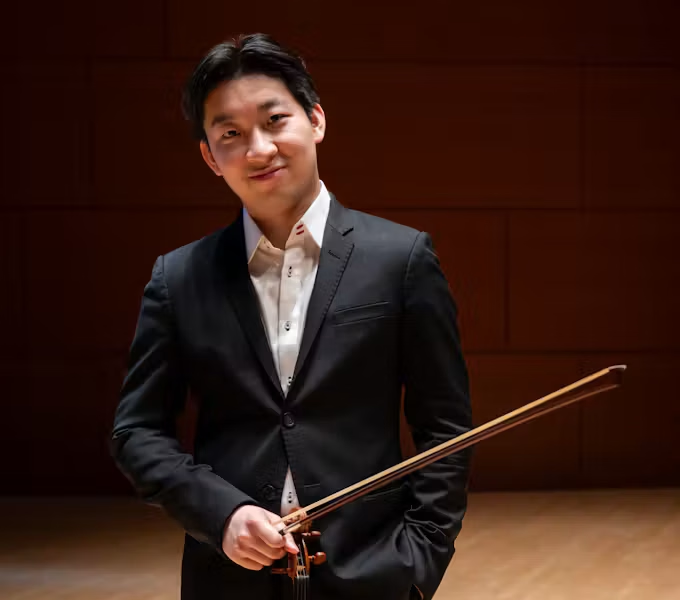
Meadowmount School of Music presents Hiu Sing Fan in Review
Hiu Sing Fan, violin; Cameron Akioka, piano
Weill Recital Hall at Carnegie Hall, New York, NY
November 15, 2026
When the Meadowmount School of Music presents one of its outstanding violinists in a debut at Weill Recital Hall at Carnegie Hall as a recipient of a special fellowship, one can be fairly sure that an impressive evening of music is ahead. That turned out to be exactly the case this Sunday as Hiu Sing Fan and his collaborative pianist Cameron Akioka played before a packed hall that included many Meadowmount alumni, administrators, friends, and dignitaries.
The Meadowmount School of Music needs little introduction to most in the music world, as it has had a long tradition of attracting talent since its founding in 1944 by the legendary violin pedagogue Ivan Galamian. Among its alumni have been Itzhak Perlman, Yo-Yo Ma, Pinchas Zukerman, Kyung-Wha Chung, Joshua Bell, Jaime Laredo, Lynn Harrell, and many more. Some decades ago, in fact, so many of this reviewer’s stellar Juilliard colleagues attended their summer string program that the fantasy of switching from piano to strings occasionally arose – but, alas, they only accept violinists, violists, and cellists (age 10 to 30).
Their featured artist this year, Hiu Sing Fan, hails from Hong Kong and has already amassed quite a number of awards and accolades, including being ranked among the top six at both the Premio Paganini and the George Enescu international violin competitions. As soloist, he has performed with the Camerata Salzburg, the Hong Kong Sinfonietta, and the Dallas Chamber Symphony, and has served as Guest Concertmaster of the Cologne Chamber Orchestra in Germany. He has worked with Leonidas Kavakos, Aaron Rosand, and the Emerson String Quartet, among other musicians, and at Juilliard with I-Hao Lee and Hyo Kang, as recipient of scholarships there. He received his master’s degree and Artist Diploma at the Hochschule für Musik und Theater München, studying with Julia Fischer, Christoph Poppen, and Lena Neudauer, and is currently pursuing a D.M.A. at Northwestern University with Gerardo Ribeiro. He has performed at numerous festivals, including the Verbier Festival and, of course, Meadowmount. If his credentials seem ample already, they are, but the Gurrena Fellowship, which made this evening possible, was designed to give that extra boost to “exceptionally talented students to become abundantly successful in their professional journey.” The Meadowmount Artistic Director, Janet Sung, spoke to introduce the concert, expressing pride and excitement over the fact that next year will mark Meadowmount’s 83rd year. The audience joined in her celebrating and gave a hearty ovation as she welcomed Mr. Fan and his pianist Ms. Akioka. About Ms. Akioka, there is also much to say for her illustrious accomplishments, but for brevity’s sake, we refer the reader to her website- Cameron Akioka.
The opening work, Olivier Messiaen’s Theme and Variations for violin and piano (1932) was an unusual but well-chosen opening. A gift from Messiaen to his future (first) wife, the violinist Claire Delbos, there is a tenderness in its dreamlike atmosphere, which draws the audience in from the start. The duo’s focus was laser-like from its ethereal beginnings to its piercing peaks, as bell-like sounds, especially in the first variation, cast a spell (bringing to mind Messiaen’s earlier prélude, Les sons impalpables du rêve and also his later Noël from his Vingt Regards). Young Mr. Fan showed a strong command and sure intonation through the otherworldly chromaticism. Let there be no unsung heroes, though, as the pianist Cameron Akioka handled its tricky chord changes and crossings deftly and discreetly, without ever disrupting the seamless flow (bringing to mind that quote about Ginger Rogers, doing roughly what Fred Astaire did but “backwards and in high heels”). Both performers were more than up to the substantial technical challenges of the variations that followed, building to an impassioned peak in the fifth one, before leading us it to the work’s ponderous close. It was a striking performance, after which the audience seemed frozen with awe for a spell before applauding.
The Divertimento from Le Baiser de la Fée (The Fairy’s Kiss) by Igor Stravinsky occupied the rest of the first half before intermission. Originally composed in 1928 as a ballet in tribute to Tchaikovsky (on the 35th anniversary of his death), it was transcribed later as this Divertimento by the composer, in collaboration with Samuel Dushkin. The ballet itself connects the sorrow of Tchaikovsky’s life with a Hans Christian Andersen fairy tale about an ice maiden’s kiss of doom – and thus the music combines some themes from Tchaikovsky himself with increasingly sinister forces. Mr. Fan and Ms. Akioka established just the right neoclassical veneer of narrative calm at the start, before the eerie incursions began, introducing the musical equivalent of shivers, struggles, and storms. The performers’ unity of conception was superb as they projected the mounting drama. Most memorable for this listener was the second movement, Danses Suisses, which brought back flashes – and sometimes more – of Tchaikovsky’s Humoresque, Op. 10, No. 2. Here one felt the violinist was ready to spring into dance (and some in the audience might have joined him), but Fate, the Fairy, and Stravinsky himself had other plans. The audience applauded even before the jazzy Scherzo was played next. The final Pas de Deux found the piano in balletic staccato passages as the violin lines soared, and all built, with washes of piano glissandi and chromatic octaves in the violin – to a bravura finish. Bravo!
After intermission, Mr. Fan came out by himself to tackle Paganiniana, a seven-minute tour de force by the legendary violinist Nathan Milstein. Based mostly on Paganini’s famous 24th Caprice, the piece is an exhaustive – and exhausting – test of pyrotechnics. Mr. Fan made short work of its relentless blitz of arpeggios, harmonics, and double stops. It perhaps didn’t hurt to be playing what we later learned was a 1706 Antonio Stradivarius violin (on loan), but then again, the violin did not play itself. Mr. Fan was the dragon-slayer.
Slaying the “showpiece” dragons is de rigueur at music competitions (possibly of more interest in niche violin circles than to musicians as a whole) but ultimately the musical spirit is paramount. The doleful tremolos stood out as expressive in Variation IV as did the spirit of adventure in the fiendishly difficult Variation V. Still, one waited patiently for what was arguably the heft of the program, Schumann ‘s Violin Sonata No. 2 in D minor (1851), which came next.
Not surprisingly, Mr. Fan and Ms. Akioka handled the Schumann at a standard where all the basic boxes were checked (accuracy, intonation, basic ensemble, and a general sense of style). At the same time, though, what this reviewer was listening for – a truly organic partnership – was not so apparent. There are several kinds of oneness, of course. There is the oneness of a squadron where perfect synchronization under a sergeant (or even, say, a metronome) is commanded, and then there is the oneness that comes organically from the hearts and minds of the players, where the interplay of the two or more instruments is the glue that binds. In the latter, even seemingly minor voices arise to sing out their theme, and the work as a whole springs to life. While this duo’s performance approached unity through a kind of responsiveness from the pianist that verged on telepathy, there was also something of an air of obedient dispatch about it rather than a true exchange of musical expression. Interestingly, among many fine recordings of this sonata, there is one with just such a sense of exchange, and it is by Leonidas Kavakos – one of Mr. Fan’s listed mentors – with the pianist Yuja Wang. Such unity comes with time, of course, so one wishes the luxury of time and reflection for these younger players.
A more vibrant and spontaneous performance came at the close of the concert with Pablo de Sarasate’s Caprice Basque, Op. 24. There were not only lots of showy elements – from the harmonics and double and triple stops to the fleet fingerwork (including fast left-hand pizzicato) – but more importantly, there was a spirit of communication. This duo left “no stone unturned” (or as violinists quip, “no tone un-Sterned”). It was a joy. The audience gave a standing ovation, and after Mr. Fan thanked everyone, he joined Ms. Akioka for an encore of what he announced as a Chinese piece from his hometown, called Fisherman’s Song. It was touchingly played.
All in all, this was a highly auspicious Weill Hall debut. The future looks very bright for Hiu Sing Fan and Cameron Akioka.
