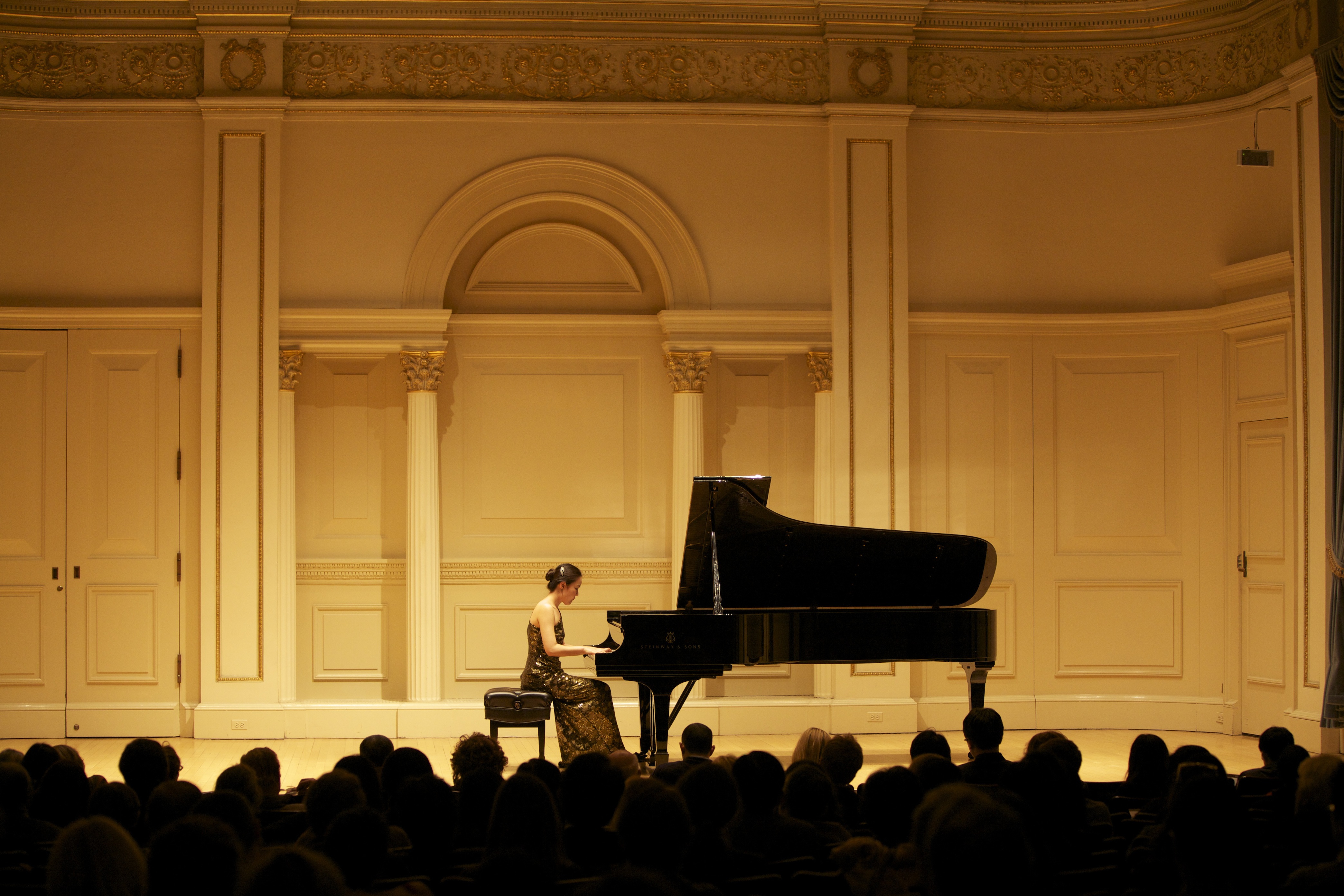
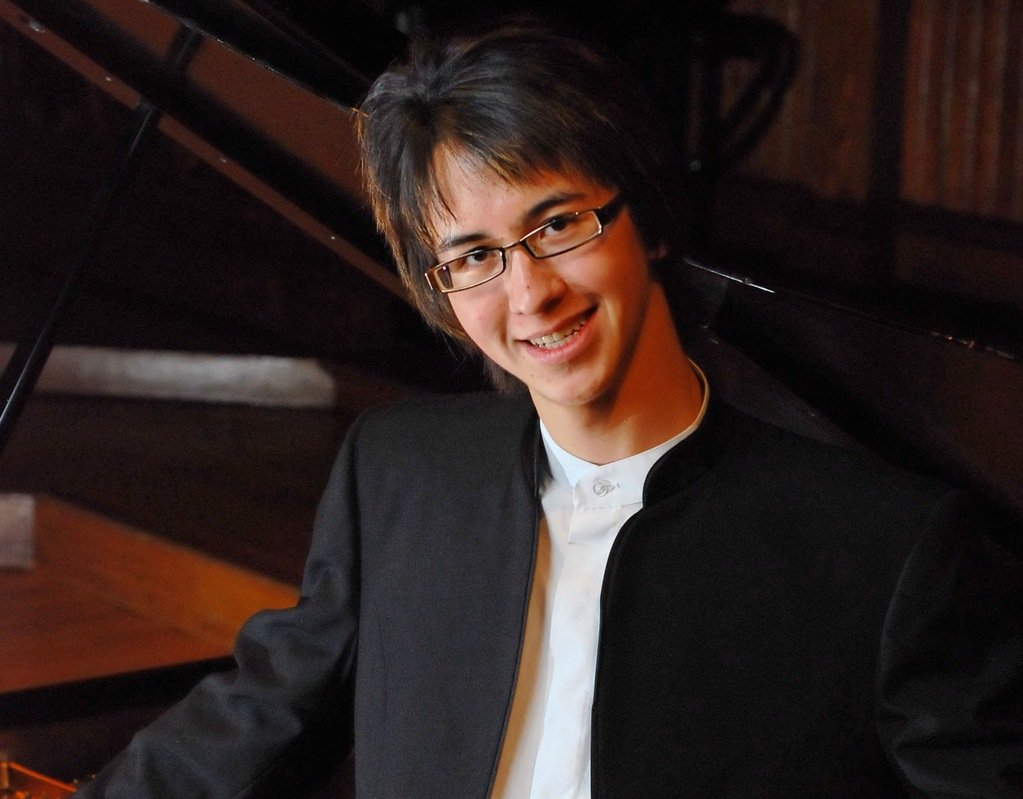
Stecher and Horowitz Foundation Presents Charlie Albright in Review

Stecher and Horowitz Foundation Presents Charlie Albright in Review

 
Charlie Albright, Piano
Subculture, Arts Underground, New York, NY
November 20, 2014
 

Charlie Albright is a pianist whose name music-lovers will be hearing more and more. Winner of a slew of awards, most prominently a 2014 Avery Fisher Career Grant, Mr. Albright is now in the company of classical musicians who have become household names (given a classically oriented household anyway) – Ursula Oppens, Richard Stoltzman, Joshua Bell, Hillary Hahn, Yuja Wang, and many others who have made their marks. Mr. Albright will undoubtedly lend his own additional distinction to this already illustrious group.

As there are no applications for the Avery Fisher Career Grant (only recommendation by a board), the awardees must naturally have sufficient careers to be noticed, so some view the award as more of an honorary plum than an early boost. For the early boost, big kudos are due to the Stecher and Horowitz Foundation’s New York International Piano Competition (NYIPC), which awarded their First Prize in 2006 to the then seventeen-year-old Mr. Albright; they are a rare competition that follows up on their laureates, and eight years later they presented him in this concert, an evening not to be forgotten.

The program was, as Mr. Albright described from the stage, made of “familiar and less familiar” works. The more familiar included Beethoven’s Sonata in C-sharp minor, Op. 27, No. 2, Quasi una fantasia (the “Moonlight”), though, as the pianist noted in his informal comments from the stage, it is so famous that it has become almost “infamous” and is relatively underperformed today. It was good to hear this work in its entirety, live, and not massacred by a teenager as it so often is. Mr. Albright took a sprawling, leisurely tempo for the first movement, a challenge to sustain, but he held the audience’s unwavering attention. I was initially concerned about the casual feel of this rather trendy venue (with a bar adjoining and listeners quickly finishing drinks before start time), but I was quickly reassured. Blue lighting set a peaceful atmosphere for the capacity audience of avid listeners, and one could hear the proverbial pin drop. I began to see “what the fuss is all about” with this venue. Classical concert life is evolving in interesting directions, and the attempts to modernize it are interestingly bringing it back to the warm intimacy one associates with nineteenth century salons. What was old is new again. Beethoven, for one, felt new, because as casual as Mr. Albright was in his stage style and commentary, he was equally intense in his high-powered performances. The finale of this 1801 work took on the fire of the master’s Op. 57 or 111. It was brilliant, precise, and powerful.

Janácek’s Piano Sonata 1.X.1905 (“From the Street”) may have been meant to be among the “less familiar” but has been programmed increasingly in the last decade or so, so I’ve heard it no fewer than six times live in the past few years; it is always, however, a revelation. Mr. Albright chose to take dynamic markings to extremes more than I’ve heard in the first movement (especially left hand phrases, even though marked in the score as strong). The exaggeration was striking, although not always completely convincing to me.

The despair inherent in the Janácek was dispelled by Chopin’s well-known Andante Spianato and Grande Polonaise Brillante, Op. 22. Mr. Albright projected the opening phrases with limpid delicacy and took the ensuing Polonaise by storm. It was a joyous romp, untroubled by petty concerns, free and full of whimsy and yet cohesive, which it often is not. The way Chopin dovetails delicate cadences with bursts of virtuoso energy is enough to cause a good musician the emotional equivalent of whiplash, but Mr. Albright steered things gracefully always, appearing to have fun all the way. In fact, throughout the entire evening, he displayed a joy in playing that was utterly infectious. He disarms jaded concertgoers with an openness and humility that for some reason we are not prepared to expect of one who earned simultaneous degrees in Economics (Harvard), and Pre-Med (Harvard), while studying for a Master of Music degree the following year (New England Conservatory). Clearly not wanting for “gray matter” Mr. Albright brings a vibrant spirit and limitless range to his performances. He possesses the kind of intellect that doesn’t stop growing and will no doubt continue to surprise as his career progresses. I’ll be looking forward to following him.

The second half consisted of the twelve Chopin Etudes, Op. 25, continuing to exploit this pianist’s nearly effortless technique while reflecting sensitivity and imagination. Mr. Albright offered a thumbnail description of each Etude (a nice touch along with the fine program notes), adding a healthy dose of humor. He peppered his comments on the first one (“Aeolian Harp”) with references to “that thingy” the harpist does and drew appreciative laughter, but then played it with sincerity and mastery. He described Chopin’s F Major Etude as resembling galloping horses (though adding, “not quite ‘Gangnam Style'”) and his playing followed through with tremendous spirit and interesting voicing surprises. The A Minor Etude, Op. 25, No. 4 he likened to “target practice” – and anyone who has played it would have to agree – but Mr. Albright is an able marksman and fared well. The E minor (which he likened to a “drunk guy” in the opening section) included some of his most inspired playing, replete with playful pauses, creative accentuations, and interesting voicing (if some vanishing right hand passagework in its central section). The B minor Etude in octaves (No. 10) was too fast and rough for my liking but it was certainly effective in building blizzard-like effects, and the central B Major section was ethereal. The Etude No. 11 (“Winter Wind”), was, as they say, “as good as it gets” – and so was No. 12 (“The Ocean”), which started more softly than one usually hears, a good decision (despite markings) when pacing so many Etudes in a row.

A highlight of the evening was the first encore, Mr. Albright’s own improvisation on notes provided by the audience – in this case, B-flat, C, E-flat and A. He looked unfazed by the first three suggested notes, but the fourth offering was apparently bad news, prompting a grimace and an “oh, boy … we’ll talk after the concert.” The improvisation was nonetheless spectacular, and the spontaneity, even with stylistic similarity to Chopin and Rachmaninoff, kept one on the edge of one’s seat. If the music world is worried about the widening chasm between audience and performer, Mr. Albright is just the answer, especially with this improvisatory element. While I can’t say I agreed with every interpretation by this pianist, especially the occasional roughness that sometimes comes with “going for broke,” the improvisation alone was worth the trip, and the program offered much to love.

A second encore, the Mozart-Volodos Rondo alla Turca (with some Albright additions?) was perhaps a bit “too much of a good thing” but one must allow a mid-twenties artist his exuberance. It seemed that a broken string was adding to the clangor, the Steinway’s own contribution to the Turkish Janissary band. Bravo – and encore!

 

Share

Sang Woo Kang, Pianist in Review

Sang Woo Kang, Pianist in Review

Sang Woo Kang, Piano
Lang Recital Hall, Hunter College, New York, NY
October 16, 2014

Pianist Sang Woo Kang, Chair of the Music Department and Associate Professor of Piano at Providence College, was invited by Hunter College to perform a recital last February (preceded by a master class), but the powers that be had the good sense to postpone it to October due to a blizzard. Having just heard Dr. Kang’s recital, this reviewer can safely say it would have been a shame to limit the audience to one or two intrepid Arctic explorers; in fact, one wished for a still larger audience than there was this month. As hard as such postponements can be, Dr. Kang was razor-sharp in his performances.

On the program were two highly rigorous works of the twentieth-century repertoire, John Corigliano’s Etude Fantasy (1976) and the same composer’s Beethoven-inspired Fantasia on an Ostinato (1985). The latter, commissioned by the Van Cliburn International Piano Competition, opened the program. As Mr. Corigliano notes at his website, “I decided that I could investigate the performers’ imagination and musicality … And so I constructed the beginning and end of Fantasia on an Ostinato precisely– the work was a giant arch built upon these foundations– but I made the large central section a series of interlocking repeated patterns: the performer decided the number and, to a certain extent, the character of these repetitions. In other words, the shape was his/hers to build. Interestingly, the duration of this piece varied from 7 minutes to over 20 in the Cliburn performances!”

This reviewer apologizes for not timing Dr. Kang’s version, but it is a good sign that all mindfulness of time was lost in his atmospheric, poetic rendition. Musical material from the second movement of Beethoven’s Seventh Symphony was heard from a twentieth-century viewpoint that was haunting, almost post-apocalyptic in feeling. Dr. Kang made sensitive choices in repetition and dynamics in the middle section to maximize this quality.

The choice of Mozart’s Sonata in C Major, K. 330 to follow was a dramatic and effective one – transitioning from later classical material in a modern, somewhat minimalist, vein to an earlier classicism in which Mozart’s clarity and symmetry stood out in bright contrast. Despite this contrast, Dr. Kang’s Mozart projected an almost Beethovenian style at crucial junctures (surely part of the intended point), and all was more robust in tone than what I normally hear. While I’m not a fan of the porcelain doll delicacy one sometimes hears in Mozart keyboard works, moments were a bit too muscular even for my taste, but there was never any question of Dr. Kang’s pianistic abilities. He has recorded Mozart recently for Naxos, for those wishing to sample his interpretations.

Corigliano’s Etude Fantasy -really five etudes rolled into one- followed. Five sections are devoted respectively to Left Hand, Legato, Fifths to Thirds, Ornaments, and Melody – and they all present formidable challenges. Dr. Kang made child’s play of them, even the first, which exploited his sledgehammer-strong left-hand technique. As a strong admirer of Corigliano, I’ve been very familiar with these works, but I must say, they still need to be performed more, and Dr. Kang has just the kind of strong pianism and keen analytical abilities to do it. He was fearless and solid in his approach. As director of the Piano Institute and Seminar at the Atlantic Music Festival at Colby College, a series focused on the promotion and performance of new music, he has made a substantial commitment in this area, so thanks to him there will be some very fortunate composers out there.

I was puzzled by a few interpretive decisions, including the opting for such a full sound at the close of the Etude No. 3 contrary to markings, but, then again, good contrast was established for the successive movement, entitled Ornaments. The entire work was performed from memory, a challenge in and of itself (in contrast with the Fantasia). Clearly, aside from what seemed a minor omission in the fifth movement, Dr. Kang has absorbed and internalized these complex works in meaningful ways. One wished there had been some chance to hear more of his thoughts on the works, as there were no program notes (or even dates of works on the program), but his comments were cursory. I would love to have heard, for example, any thoughts behind this interesting programming itself.

What I appreciated about the program itself was that, with two substantial Corigliano works opening each half, the standard repertoire that followed felt utterly transformed by what preceded. The lacerating dissonance of Corigliano’s Etude Fantasy lent an even more consoling quality than usual to what followed, Chopin’s D-flat Nocturne, Op. 27, No. 2. The effect was deeply stirring. The playing of Chopin itself was not to me as persuasive as Dr. Kang’s Corigliano, as momentum sometimes supplanted the dreaming quality, leaving some ornaments sounding slightly regimented and the tone less than transcendent, but the overall feeling was there. Chopin’s Polonaise-Fantaisie in A-flat major, Op. 61 concluded the program with sweep.


Share

The Seventh New York International Piano Competition in Review

The Seventh New York International Piano Competition in Review

The Seventh New York International Piano Competition (NYIPC), under the auspices of The Stecher and Horowitz Foundation
Greenfield Hall, Manhattan School of Music, New York, NY
June 22, 2014

Music competitions today seem to sprout up practically anywhere that there are instruments, such that the array of contest names in winners’ biographies rapidly becomes a blur, from the first annual This prize to second national That award. I must confess that, because of this blur, it took me a while to take notice of the Stecher and Horowitz Foundation’s New York International Piano Competition (NYIPC), which started in 2002. Naturally I had known the names of duo-pianists Melvin Stecher and Norman Horowitz (no, not that Horowitz!), as the duo had enjoyed decades as a performing team since 1951, including being the dedicatees of Walter Piston’s Concerto for Two Pianos and Orchestra and giving it its premiere. In addition, the duo had created a school, a foundation, teaching publications, and more. What I had not realized, though, was that these two musicians, along with their distinguished colleagues and friends, were on a mission to do something very big for the future piano world. They have done just that with the NYIPC.

Unbeknownst to me (as I sometimes only briefly scan the biographies of young artists I review), I had already reviewed or heard some of this foundation’s prior winners, several of whom are now firmly ensconced in their young careers or appearing as finalists and winners of competitions around the world (click here for a list of past winners- New York International Piano Competition Winners List). Clearly this competition has become a magnet for some of the best young pianists today, and the reasons are many. Naturally the total of $50,000 in prizes is one reason (the First Prize winner taking home at least $10,000). Exposure is another, with leaders in the field hearing these winners, learning about them in glossy brochures, and even reading personal statements on music written by the contestants themselves. This year’s brochure incidentally featured letters from our governor, mayor, and others, with a cover illustration of an official Competition Egg created by none other than Theo Fabergé (late grandson of the legendary Peter Carl Fabergé)!

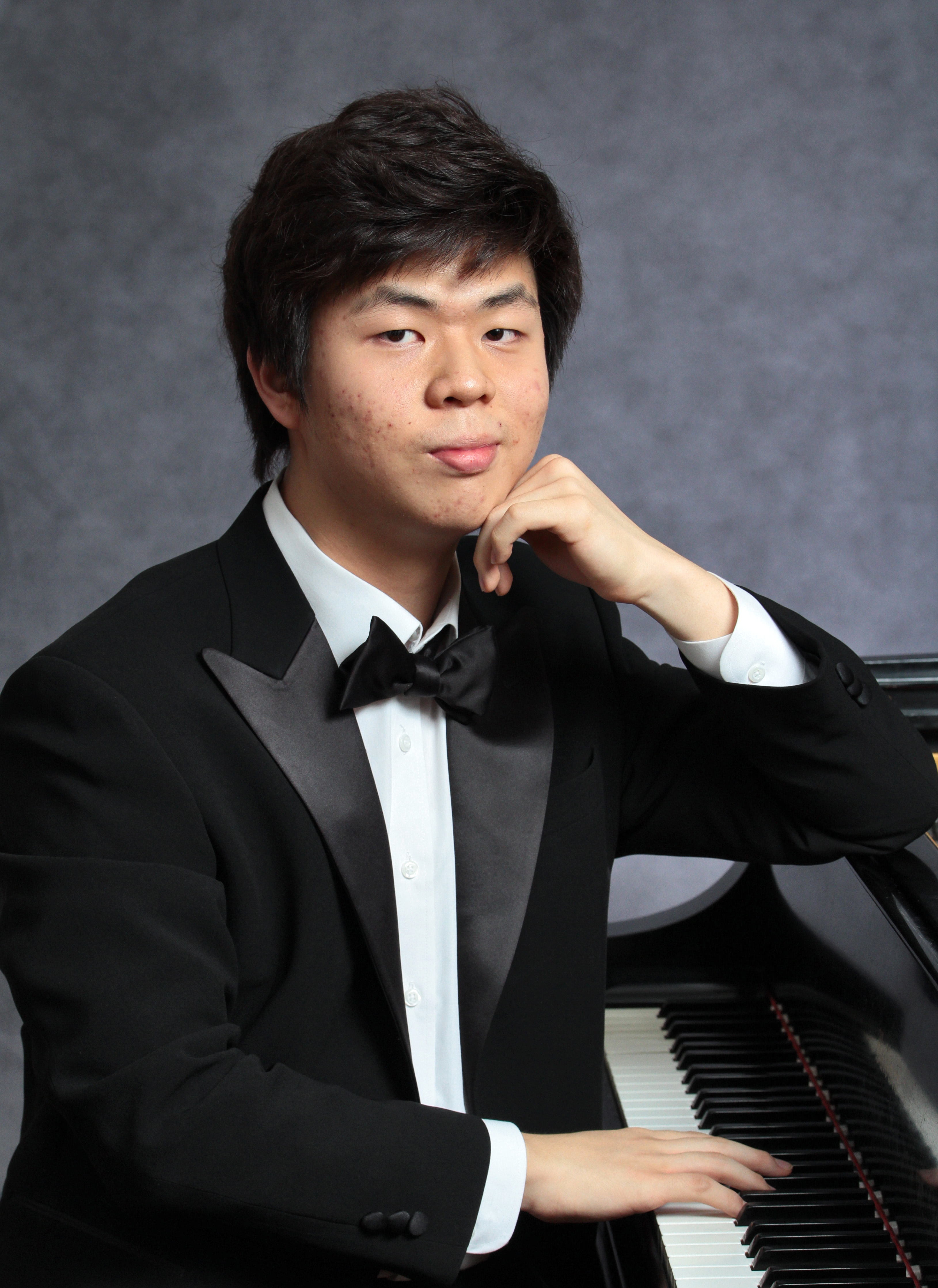
JOYCE B. COWIN FIRST PRIZE Jun Hwi Cho, Age 18 Country of Birth: South Korea Residence: Flushing, New York Cash Award of $10,000 Concert and Recital Appearances

JOYCE B. COWIN FIRST PRIZE
Jun Hwi Cho, Age 18
Country of Birth: South Korea
Residence: Flushing, New York
Cash Award of $10,000
Concert and Recital Appearances

Apart from ever-growing prestige, an additional draw of the NYIPC is the care shown for each contestant, evident in the humane contest rules whereby no contestant is eliminated from round to round – every contestant gets to play every round. Muffing a passage in an etude does not render one unheard in one’s stronger offerings, say, a sonata or a concerto. Such rules evolve when musicians are running things! Beyond these considerations, each of twenty-something participants, not just the top winner, leaves with enough cash to compensate for the effort (even for those travelling from China, Russia, the Republic of Georgia, and the United Kingdom), while also gaining a lasting relationship with this foundation through concerts, mentoring, and more. Oh, that I were twenty-one again (the age range is 16-21)!

If it seems that I have acquired a case of Stockholm Syndrome on behalf of the NYIPC, I did sit through an hour-long set of speeches detailing these strengths, prior to hearing this year’s winners all too briefly – necessary pomp, one supposes, given the considerable fundraising behind it all. Fortunately, all was enlivened by the witty commentary of renowned radio personality Robert Sherman, who also briefly interviewed each of the four performing winners; one wished, nonetheless, for more music.

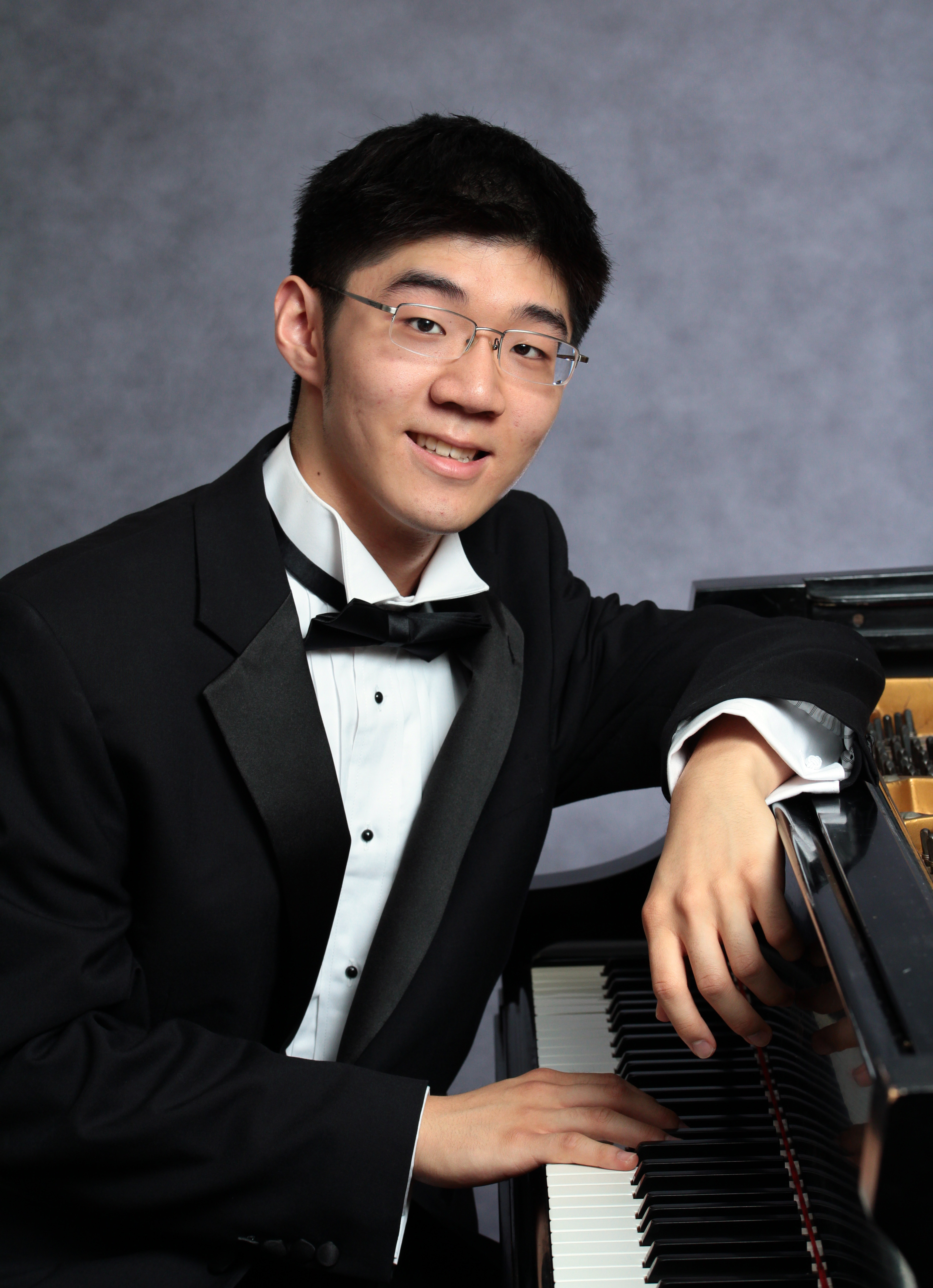
SECOND PRIZE Daniel Kim, Age 17 Country of Birth: United States Residence: Lexington, MA Cash Award of $6,000 Concert and Recital Appearances

SECOND PRIZE
Daniel Kim, Age 17
Country of Birth: United States
Residence: Lexington, MA
Cash Award of $6,000
Concert and Recital Appearances

The first performer up was Daniel Kim, as winner of the Best Performance of Commissioned Work, Nocturno Nazqueño, by Gabriela Lena Frank. Ms. Frank, a brilliant composer of multicultural background (Chinese, Peruvian, Lithuanian, Jewish) seems to favor her Latin American side, in a style evocative of South American landscapes and folklore. Seventeen-year-old Mr. Kim projected the musical imagery sensitively and convincingly, a remarkable feat considering the scant few months he had to get to know this music. On being asked by Robert Sherman how he felt when first looking at the score, he replied with candor, “the first thing that went through my head was probably panic.” Indeed there were considerable challenges, interpretively and technically, including the need for nuances in timbre, rapid repeated notes, wide stretches, and, as one was led to understand, some aleatoric elements to reveal each player’s uniqueness. Mr. Kim went on to say, though, how he enjoyed it as he started to embrace the elements of mystery and dance and the feeling of the lives of the rancheros. All of these were very much present in his performance, and if they were half as present in the twenty-odd performances of other contestants, then Ms. Frank is quite fortunate – as well as the young pianists. The commissioning of such a work to be disseminated throughout the world is a win-win enterprise.

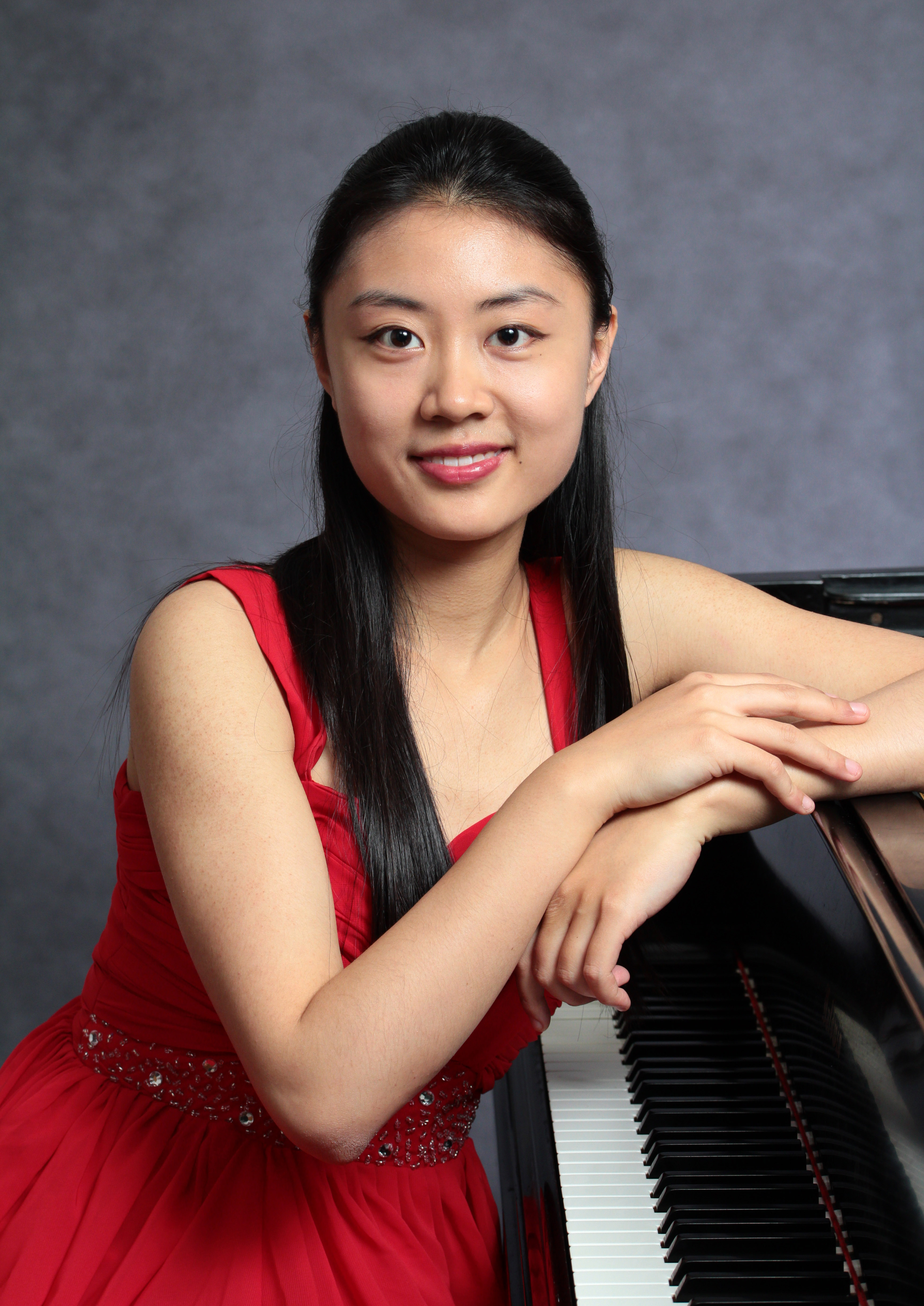
THIRD PRIZE Yilin Liu, Age 19 Country of Birth: China Residence: San Francisco, CA Cash Award of $3,000 Concert and Recital Appearances

THIRD PRIZE
Yilin Liu, Age 19
Country of Birth: China
Residence: San Francisco, CA
Cash Award of $3,000
Concert and Recital Appearances

The next performance was of a four-hand piece by Franz Schubert, Rondeau in D Major, subtitled “Notre amitié est invariable” (“our friendship is unchanging”) and performed by the First Prize winners of The Melvin Stecher and Norman Horowitz Prize for one-piano, four hands, Thomas Steigerwald (21) and Max Ma (17). A touching reminder of the years of performing together for Stecher and Horowitz, the piece seemed also to allude to the friendships that are inevitably launched as these young performers team up with their ostensible “rivals” – a beautiful element to include in a competition. Mr. Steigerwald and Mr. Ma, after just a week of rehearsal, seemed already to have forged a collegial bond and performed with good mutual sensitivity. What was perhaps not quite there in terms of unity of conception was more than compensated for by hair-trigger reflexes and acute listening.


MELVIN STECHER AND NORMAN HOROWITZ FIRST PRIZE ONE-PIANO, FOUR HANDS ENSEMBLE  Max Ma, Age 17 Country of Birth: United States Residence: Newcastle, Washington

MELVIN STECHER AND NORMAN HOROWITZ FIRST PRIZE
ONE-PIANO, FOUR HANDS ENSEMBLE
Max Ma, Age 17
Country of Birth: United States
Residence: Newcastle, Washington


Thomas-Steigerwald-1

Thomas Steigerwald, Age 21 Country of Birth: United States Residence: Uvalde, Texas Cash Award of $3,500 Divided between the winning team


Daniel Kim returned to the stage to perform as soloist winner of the Second Prize, this time playing the first movement of Schumann’s G Minor Sonata, Op. 22. With a good sense of the drive that suits this work so well, Mr. Kim gave the movement a good solid delivery, no small achievement in such a challenging environment. One could see tremendous potential in this performance, and the fact that it was subject to the slightly “on edge” feeling that comes from an awards concert was in fact an advantage, as an impetuous spirit is an asset here. One looks forward, nonetheless, to hearing Mr. Kim in more extensive performance and in a more controlled setting.

Last of the performers was First Prize Winner (Joyce B. Cowin Prize), Jun Hwi Cho, age 18, performing Chopin’s Polonaise in A-flat Major, Op. 53 (the “Heroic”). Speaking beforehand about having hurt his right hand, Mr. Cho was jokingly reminded by Robert Sherman that in his accompanying statement he had written, “I will overcome any hardship I have in order to become a great pianist.” Overcome he did, and there was power and speed enough in his left hand to more than compensate for whatever might have affected his right hand – and frankly the right hand sounded quite capable as well. Mr. Cho showed a good deal of the firepower one expects to hear in a prizewinner, and one looks forward to hearing much more from him with the coming years.


FOURTH PRIZE Seol-Hwa Kim, Age 21 Country of Birth: South Korea Residence: Goyang-Si, South Korea Cash Award of $2,000 Concert and Recital Appearances

FOURTH PRIZE
Seol-Hwa Kim, Age 21
Country of Birth: South Korea
Residence: Goyang-Si, South Korea
Cash Award of $2,000
Concert and Recital Appearances

One would have loved to hear in addition the prizewinners Yilin Liu (19), Seol Hwa Kim (21), Ning Yuen Li (20), Ling-Yu Lee (20), and all the others, but alas, there are limits. For that matter, one might have wanted to hear members of the jury, which included Tong-Il Han, Jane Coop, Jon Nakamatsu, Thomas Schumacher, Orli Shaham, Jeffrey Swann, and a screening jury of Francis Brancaleone and Anthony LaMagra – perhaps another time. Meanwhile, one eagerly awaits the festivities of 2016!

Share

Music and More presents Jean Muller in Review

Music and More presents Jean Muller in Review

Jean Muller, piano
Weill Hall at Carnegie Hall, New York, NY
June 22, 2014


Assigned to review Luxembourgian pianist Jean Muller in an all-Liszt recital last weekend, I purposely avoided rereading my earlier review of him beforehand (Jean Muller all-Chopin recital January 18, 2013). A yearlong blitz of music, work, and stress had left a slight haze over my first impressions of him anyway, so I would be able to hear his artistry afresh, as I prefer.

As it turned out, this pianist emerged as quite a different artist to me. Having now (after the recital) reread last year’s review, I am reminded that I had wanted a less cautious approach, but I had no such reservations in that regard this time. Part of this difference, of course, could be attributed to the current repertoire, all Liszt, but beyond that, there was an all-around extroversion and comfort onstage that I hadn’t recalled seeing or hearing from this artist before. From the Mephistophelian intensity of his flyer portrait to the confident projection of high drama in his declamatory phrasing, Mr. Muller seems now to be savoring a more commanding role all around. He still offers introductory comments from the keyboard with a refreshingly soft-spoken humility, but his music now seizes the listener with “no holds barred” immediacy. Perhaps one can credit the reinforcing effect of his recent world tours, but in any case it appears that Mr. Muller’s star is on the rise. There was drama without histrionics, power without excess, and always an overriding musical sense.

The program was in itself a statement in boldness, featuring Liszt’s complete Études d’exécution transcendante (or Transcendental Études, played from the third edition, 1852) and concluding with the Mephisto Waltz No. 1 (in the Busoni/Horowitz version). The performances were superb. The twelve Études encompass nearly every element of virtuosity that one could dream up for a pianist, from the rapid delicacy of Feux Follets to the treacherous leaps of Mazeppa and Wilde Jagd, the pining trills and filigree of the tender Ricordanza, and the thundering bombast of Eroica. All challenges were handled expertly “and then some.” Mazeppa (sometimes comically referred to as “Mess-uppa”) was extraordinarily successful considering its ferocious demands, while Eroica retained to the end the mock-epic humor that is only possible when the pianist himself has not been destroyed in the effort. Wilde Jagd left little to be desired, although some repeated chords might have benefited from crisper rhythm – and, at the risk of sounding greedy, I still wanted the ending just a bit wilder. Ricordanza, perhaps most challenging in terms of sustaining a listener’s attention through the long daydream, was judiciously paced and elegant, avoiding the mawkishness from which it sometimes suffers. In the same vein, Harmonies du Soir gave a beautiful sense of meditation and space after the urgency of the ubiquitous F minor Étude (No. 10, Allegro Agitato Molto), also played well. Vision was harrowing in its drama, as were the chilling chromatic runs of Chasse-neige, building to terrors worthy of Yeti. Not to be underestimated, the gentle, pastoral Paysage also presents its own challenges of pedaling and timing, and it was beautifully done as well, if not completely transcendent due to the concerns just mentioned. Even the shorter Études, Nos. 1 and 2 (Preludio and Molto vivace, respectively), the two perhaps least often singled out for individual performance, were elevated to stand as important pillars of entry to the set. All in all, it was an outstanding triumph.

Each live performance of this set has been fixed in my mind as a somewhat unusual event, and part of the reason is that, despite innumerable firebrands out there, the complete set is still not that often played live. Perhaps the reason is that the challenges still daunt many pianists, especially cumulatively, or perhaps it is that such programming itself has been criticized too often as unmusical or taxing on an audience. Though each Etude may fare well when featured alone, like the diamond against black velvet, when lined up in successive performances, they compete to outshine each other. If a pianist sets the standards high at the start, his audience’s ears get spoiled and saturated, setting up a grim case of diminishing returns. Those who do perform the entire set often convey the impression of a “stunt” or worse, and the bludgeoning of the keyboard makes a listener wish to fall through a secret trap door. One pianist who performed them all gave me a headache that lasted for the entire next day – individual Études had been good, but one wondered why the pianist had determined to torment himself with this Faustian goal.

By contrast, what stood out most in Mr. Muller’s recital was that, despite some residual awareness of the “stunt” – inevitable with this unbroken chain of hurdles – there was an artistic continuity and integrity throughout. The dynamic pacing was such that the Fortissimo playing never felt relentless, and by the time No. 6, Vision, was played there was still, despite earlier outbursts, further room for building. The house piano’s beautiful bass resonance helped the pianist achieve a power here that outdid all earlier sonorities, and the roar evoked the opening up of the earth. Like a well-told story, there evolved a shape to the entire set. The sheer variety of Liszt’s imagination came to the fore, thanks to such prodigious pianistic skills and sensitivity, and another point was chalked up in favor of this kind of programming. At times Mr. Muller displayed the range of an orchestra, and one could almost recycle Heinrich Heine’s own comment about Liszt, that “the piano disappeared and the music alone was revealed” if it were not for a glassy treble register on the instrument, reminded one that there was indeed just a piano there, needing of a bit of extra help.

As a side note, Mr. Muller also planned the program well, performing 1-8 in a row as the first half (Preludio and Wilde Jagd being good bookends) and following the last four on the second half with the Mephisto Waltz No. 1. His Mephisto Waltz was almost as exciting as that of Horowitz, who had augmented sections of Busoni’s version – although Mr. Muller’s performance was quite a bit neater. A standing ovation was repaid with an encore, the pianist’s own spin on Billy Joel’s Root Beer Rag.

Share

Aldo Parisot presents Larry Weng in Review

Aldo Parisot presents Larry Weng in Review

Larry Weng, piano
Weill Hall at Carnegie Hall, New York, NY
March 12, 2014


In an age where solo debuts compete for attention like so many “selfie” portraits, it is not easy to stand out. It helps if one comes with the endorsement of a master in the field, as did Chinese-born 26-year-old pianist Larry Weng, presented by Professor Aldo Parisot of the Yale School of Music where Mr. Weng is currently a graduate student. What also “helps” (and this is much deeper than mere career advice, hence the quotation marks) is the attendance of even more powerful luminaries – in this case Schubert, Chopin, and Ravel – with the kind of playing that invites the composers in as the guests of honor, rather than mere facilitators. It happens less often than one would like, but Mr. Weng is an extremely sensitive musician and mature interpreter who did just that. He brought great music new life in one of the outstanding debut recitals of the season.

Mr. Weng’s program opened with Chopin’s Polonaise-Fantasie Op. 61, a masterpiece from late in Chopin’s life. One doesn’t normally think of this work as an opener, partly because it has such autumnal, ruminative qualities that lend themselves to the post-intermission lull – and partly because of its interpretive difficulties; Mr. Weng, however, made me a believer in this programming. The sprawling improvisatory opening became a perfect prelude to lure the listener into Mr. Weng’s musical world. Instead of fighting its meandering tendencies as some do in effort to keep it from falling apart at the seams, he followed its dreaming lines wherever they seemed to lead. It had spontaneity and inevitability, along with convincing cohesion – quite a feat! Contrary to popular musical advice, yielding to each moment can at times unify the whole better than straitjacketing a creation into some perceived planned structure. In any case, Mr. Weng’s expressive phrasing and tonal beauty carried the listener effortlessly to its brilliant ending. His technique was more than ample, a few smudges towards the end notwithstanding.

Oiseaux tristes followed – in beautiful sequence – bringing us into the world of Ravel’s Miroirs, of which Mr. Weng also included the movements Alborada del gracioso and La vallée des cloches. While I’ve usually preferred to hear (and play) these as a complete set, I confess that I barely missed the omitted ones (Noctuelles and Une Barque sur l’océan). Also, after the expansive approach that Mr. Weng took to the Chopin (giving it a somewhat longer duration than the average), the shortened group was welcome. Undiluted and undistracted by Noctuelles, the delicate Oiseaux Tristes was particularly poignant in isolation. Only the fiery Alborada couldsnap one out of the trance, and it certainly did the trick with this pianist’s crisp rhythms and fine finger-work. Mr. Weng handled its formidable repeated-note passages expertly. The breathtaking musical colors of La vallée des cloches closed this set, leaving only the same composer’s La Valse for the first half. La Valse is a rousing closer to a half – and it was given a rousing rendition here. Most performances of this work leave one wanting just a bit more tweaking from the multiple editions available (printed and other), as Ravel left some problematic sketchiness in his transcription from orchestra to piano. Often the orchestral textures are either thickened to excess or left sounding bare or skeletal, so rarely is every listener happy in each section of it; all in all, though, Mr. Weng’s sense of flair for this French-Viennese flavored Waltz carried the day, and the overall sweep was wonderful.

The entire second half was devoted to Schubert’s Piano Sonata in A Major, D. 959, among the composer’s great late masterpieces. Here, perhaps most in the entire recital, one could hear the extent of Mr. Weng’s artistry, mature beyond his young years. He sustained enormously long lines and sections while never forgetting Schubert, the lieder composer, and Schubert, the chamber music composer. One could quibble here and there, for example over a bit of rushing in the last movement (arguably justifiable in the name of momentum), but overall it was one of the finest live performances of this work that I’ve heard. Hearty ovations were rewarded with an encore of more Schubert, the Impromptu in G-flat, Op. 90, No. 3 (D. 899/3). It was sublime, again with surprising little turns of phrase that gave it life without tearing at the fabric of the piece. Mr. Weng should have a very bright future, and I join his audience in looking forward to hearing more from him.


Share

Korea Music Foundation presents Allant Piano Trio in Review

Korea Music Foundation presents Allant Piano Trio in Review

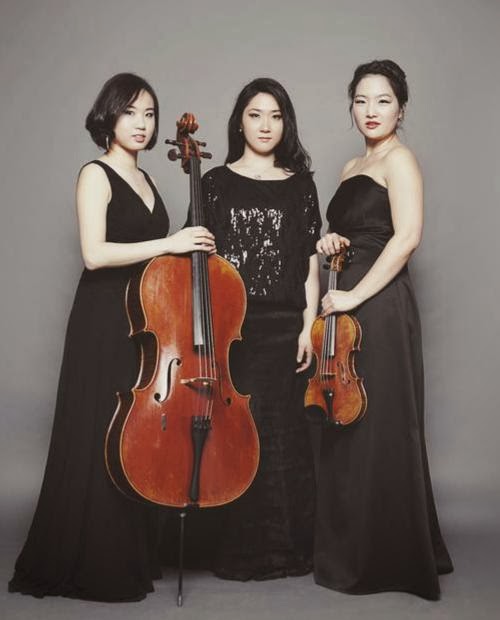
Korea Music Foundation presents: Allant Piano Trio
Anna Park, violin; Alina Lim, cello; Hyo Kyoung Beth Nam, pianist
Weill Recital Hall at Carnegie Hall, New York, N.Y.
February18, 2014


Firepower was present in each work from music of Beethoven and Mendelssohn to that of living composers Kelly-Marie Murphy (b. 1964) and Sun-Young Park (b. 1988), at the Allant Trio’s New York debut recital. Recipients of numerous accolades individually, the three are recent awardees of the John Madrigano Entrepreneurship grant at the Juilliard School, where their instrumental teachers have included Martin Canin, Robert McDonald, Hyo Kang, Naoko Tanaka, and Richard Aaron, plus coaches Toby Appel, Rohan DeSilva, Jonathan Feldman, Nicholas Mann and Vivian Weilerstein. In addition to such illustrious guidance, each member of the trio reflects the will and determination of a lifetime of passionate commitment to performing. True to the needs of today’s classical performers to reach out in musical mission, they are also versatile, spreading their gifts from major concert venues to soup kitchens and senior centers, and from innovative teaching projects to commissioning and performing new compositions. If there were a checklist for the musician of today, theirs would leave nothing blank.

Of course all checklists are meaningless without the performance itself, and I am happy to say that the performances were riveting.  In fact, I would defy even the most exhausted and jaded listener to experience even a moment of boredom in this group’s high-voltage evening.  The rocketing opening of Beethoven’s Trio in D minor, Op. 70, No. 1 (Ghost) caught me off guard as faster than what I’m accustomed to, but it lost nothing in clarity and was perfectly synchronized. There was throughout an almost microscopic attention to detail, and the result was a performance as close to perfectly polished as one will find; unlike some instances of this hyper-vigilance, however, theirs never interfered with the sense of overall structure. This trio had clearly done its homework and looked at the work from inside and out – with undoubtedly expert coaching. Ms. Nam, the pianist, showed extraordinary dynamic range with precision and clarity. There were even moments (especially in the central Largo) when one might have actually wanted less clarity (for example in its awkwardly exposed tremolos) but the same crisp articulation was again a joy in the finale. The ensemble work was outstanding. Physical unity was demonstrative without histrionics, and attacks and cut-offs were arresting and razor-sharp.

If one wanted more a bit more presence from violinist, Anna Park, the next work gave her more of a showcase along with the cellist, Alina Lim. Both were passionate and projective. “Give Me Phoenix Wings to Fly,” by Kelly-Marie Murphy, found the violin in a leadership role (in fact standing) through three highly expressive movements that evoked (as the Ms. Murphy describes) “fire, bleak devastation, and rebuilding.” In confrontational exchange of jagged virtuosic gestures one could easily envision the violent darting of flames, and the trio played up the drama to the hilt, as was fit. The dark second movement was haunting and beautifully connected in spirit to the Ghost Trio (ingenious programming), but all finished brilliantly with resurgence of energy in the third, as the phoenix began its rise. Ms. Murphy is an exciting and imaginative composer, much in demand especially in her native Canada and deservedly so. Of strong personality, she posts her occasional negative press on a webpage entitled “They hate me … they really hate me” – a cheeky feature that I almost regret to say will not be including my comments!

After intermission came music slightly lighter in spirit, along with a brightening of wardrobe from largely black to glimmering and golden hues (an optional item on the checklist – visual excitement!). First was the New York premiere of a work entitled HEEM by Sun-Young Park and commissioned by the performers. The title, according to Ms. Park’s notes is a Korean word with “a multitude of meanings: energy, strength, force, potency, effort” with the central premise being “intensity”, an aptly chosen word for this trio. A seven-minute showpiece with “everything but the kitchen sink” in terms of technical wizardry, and glissandi galore, it will surely be a regular vehicle for the Allant Trio and probably many others.

More of this group’s superb playing shone in Mendelssohn’s Trio No. 1 in D Minor, Op. 49, and, though it lacked nothing in intensity, I was glad to see that there were some more moments of the slightly more relaxed, intimate music making that I usually look for in chamber music. The cello lines breathed beautifully and the violin projected more individually than in the rest of the program. The one or two moments where not everything meshed perfectly I actually took as wholesome sign that each line was living a bit more independently. As a minor reservation, the Andante con moto tranquillo in my opinion could have enjoyed a more straightforward quality in the phrasing. Its very simplicity tends to invite self-consciousness in the opening piano melody, with some left-before-right-hand emoting, but its purity usually speaks for itself (even if it sometimes takes years to capture). The Scherzo that followed was all one could want, quintessential Mendelssohn, with his sparkling writing given a high polish. The Finale capped off the evening in triumph.

Nothing prepared one for the cyclone of this group’s energy, not even their chosen title of “Allant,” a musical term loosely translated as “going” or moving forward. While I don’t quite agree with their definition as listed in the (uncredited) program notes as “driving” and “energetic”, their name still seems appropriate – they are definitely “going” places!

Share

Javor Bračić, Pianist in Review

New York Concert Artists and Associates presents: Javor Bračić, piano
Weill Recital Hall at Carnegie Hall, New York, NY
October 22, 2013

Recital debuts can be a dicey proposition in New York, depending on what other concerts and events are scheduled. Learning that a young Croatian pianist would be giving his New York debut in Weill Hall the same night as the much-heralded and fashionable Yuja Wang would play next door at Stern Auditorium, I imagined that a half-empty hall might await him. How wrong I was! Mr. Bračić’s sold-out house left a virtual mob swarming around the box office, hoping for tickets from last-minute cancellations. As the evening progressed, it became clear why: Javor Bračić is a pianist who possesses a deep, genuine musicianship and an outstanding technique that serves the great music he chooses. He honors both listener and composer with his intelligent, committed interpretations, and he offers a thoughtfully constructed program with elegance and humility. It was heartening to be reminded that such an artist is still a draw and that the “competition” for listeners is not always a zero-sum game.

Mr. Bračić began with Bach’s Prelude and Fugue in C Major, WTC II (BWV 870), which was at once noble and sensitive, with not a note out of place. Moving on to Haydn’s Sonata in D Major, Hob. XVI: 42, he sustained musical tension and interest through its rather long Andante con espressione, right through to the last note of the Vivace assai. Occasionally I wanted ornaments to be more singing in the first movement, and less subservient to the meter, but that was about the only quibble one could have – and a very personal one at that. The delicacy and precision were outstanding.

Moving to later style periods, Mr. Bračić tied his first half together to the Bach and Haydn by performing Debussy’s underplayed Hommage à Haydn (1909) and the even less well known Hommage à Bach (2001) by Croatian composer Davorin Kempf (b. 1947). In between old masters and homages came a World premiere of a work entitled Entwined, Disquiet  (2013) by Rosalie Burrell (b. 1988). At times searching and at others explosive, the two movements explored a tonal world that verged on orchestral, bearing hints of Messiaen and even Scriabin, though without being derivative. Ms. Burrell is still quite young, but already emerging as quite a colorist. I would have enjoyed some information on the piece, but Mr. Bračić, playing from score, appeared to meet this new work’s challenges beautifully, with considerable expressiveness.

As far as the homages go, I’ve never completely grasped the Haydn connection in the ever so brief Debussy work, apart from some tenuous structural likenesses and passing elements of humor and surprise, but it is immediately appealing and was played convincingly by Mr. Bračić. The Bach tribute by Mr. Kempf is far less elusive. Crisp mordents, preceding impassioned scalar writing, hearkened back to Bach’s Toccatas (notable the BWV 565 Organ Toccata in D minor), while quieter counterpoint and sequential episodes were set ingeniously amid some highly adventurous, clearly twentieth-and-twenty-first-century composition. Virtuosity abounded, and Mr. Bračić was on top of it all with dash and drama. Hints of the B -A-C-H theme by Bach himself (based on the tones B-flat, A, C, and B-natural) emerged amid dissonant writing that at times resembled a Bach festival recalled through a dream, all brought to an end with a nod to Bach’s characteristic Picardy close. It is a work I’d like to hear again, especially thanks to Mr. Bračić’s superb performance.

The program’s second half consisted of the Brahms Piano Sonata No. 3 in F Minor, Op. 5, a feast of some of the noblest, warmest, richest piano writing in history, and Mr. Bračić was well suited to it all. Some minor glitches arose – as happen to almost all pianists – but most seemed here to stem from over-straining for power against the piano’s somewhat resistant treble register at climaxes. If those moments can be conquered with the majesty shown elsewhere, Mr. Bračić will have one of the best Brahms F Minor Sonata performances around. As it is, I would hear him again in a heartbeat. His audience seemed to agree, earning an encore of a small Ravel work – you guessed it!- Hommage à Haydn.

Share

Sarah Chan, Pianist in Review

Sarah Chan, piano
Merkin Concert Hall at the Kaufman Music Center, New York, NY
October 17, 2013

Having reviewed pianist Sarah Chan in Schumann’s A Minor Concerto just this May (hers being just one of several concerti in a packed program), I wondered how the same pianist would fare in a calmer setting; five months later, Ms. Chan’s own intimate solo recital this week gave this listener (and the pianist herself) just that opportunity. Holding the reins firmly, she emerged as a confident young soloist, with solidity, strong projection, and a winning stage presence.

In a program of essentially Spanish and French music (if France is allowed to claim the Polish-born Chopin for the occasion), Ms. Chan chose mostly short works, the longest lasting from seven to nine minutes. It was an appealing array seemingly designed not to tax the layperson’s attention, so to this veteran listener it seemed to be over in a flash. I liked, though, that Ms. Chan resisted the gargantuan programming that so many young pianists’ recitals display. I also liked that Chan followed her preferences and did not feel compelled to offer a survey course on each style of the piano literature from Bach onward. There was still plenty of contrast.

Enjoying the sheer variety among works, one almost missed the fact that there was sometimes not quite as much variety within a work as one might want. The opening work, Claude Debussy’s “Bruyères” (Prélude No. 5 from Book II), was louder throughout than what I’ve usually heard, and I missed the nuance that makes small dynamic ranges colorful (the composer’s own markings for this piece ranging only from pianissimo up to mezzo-forte, aside from effects of timbre, register, and pedaling).

In Debussy’s “La Soirée dans Grenade” from Estampes, the range was greater, but I still wanted more nuance in the melodic inflection, without which the singing Spanish lines sound stiff. More rhythmic bending could also have helped to convey the feeling marked as nonchalamment gracieux. While Debussy was known as a pianist who avoided histrionics, he would still enjoy pushing and pulling a phrase, as demonstrated in his 1913 piano roll recording of this very work.

Maurice Ravel’s “Alborada del Gracioso” from Miroirs, made a great pairing with the Debussy, and served as a virtuosic backdrop for the Spanish music to come. Ms. Chan expertly handled Ravel’s many challenges, among them her admirably rapid repeated notes. More of a final burst would have capped the piece off perfectly (and perhaps planning the earlier dynamic pacing accordingly), but maximizing each thrill seemed a lower priority than momentum throughout the evening.

Closing the first half were Joaquín Turina’s “Seguiriya” from Danzas Gitanas, Op. 84, Isaac Albéniz’s “Asturias” (“Leyenda”) from Suite Española, Op. 47, and Albeniz’s “El Albaicin” from Iberia, Book III. All three showed Ms. Chan to be a pianist of ample technique and solid command. She also has the resources to achieve a large palette of colors, which I hope she will exploit more and more. Her Iberia selection has markings ranging from ppppp through fff, so moderation can be checked at the door. For some reason the middle register of the concert grand seemed unusually heavy, eclipsing important chords in the outer registers, but Ms. Chan was unruffled.

The entire second half of the concert consisted of the music of Frédéric Chopin.  Opening with his Barcarolle, Op. 60, the pianist seemed much more comfortable than in the first half. Clearly this pianist knew the repertoire inside and out.  There was also more of the savoring of harmonic resolutions that I had been craving earlier.  A string of six Études (from both the twelve op. 25 and the twelve Op. 10) followed. The Étude in A-flat major, Op. 25 No. 1 (“Harp”) opened the group, a gentle choice, though still too fast for my taste and again at the mercy of a dominant middle register. The best was yet to come in the Étude in G-sharp minor, Op. 25, No. 6 (“Thirds”): it sparkled brilliantly as one of the gems of the recital. There ought to be a special award for a performer who can make this devilishly difficult Étude a highlight, as it is the nemesis of so many pianists! Also quite well executed was the Étude in C-sharp minor, Op. 25, No. 7 (sometimes called the “Cello” Étude). Though it is a slower, more melodic Étude, it should not be considered any sort of “breather” – it is tremendously difficult to pull off the pacing and balance, and Ms. Chan did extremely well. In the Étude in B minor, Op. 25, No. 10 (“Octaves”), the pianist surprised us with a ferocity that had been largely hidden up to this point. At moments where many pianists grab a chance to relax, she stormed ahead, and her fearless finale was refreshing. She should keep playing these pieces to the hilt.

The Étude in C minor Op. 10, No. 12 (“Revolutionary” – mistakenly listed on the program as C-sharp minor), came off as a bit glib for this listener. Heroic gesture became efficiency and dispatch, as if the end of the recital loomed too closely to resist racing. Also, by following it (without pause) with the buoyant Étude in G-flat major, Op. 10, No. 5 (“Black Keys”), its dramatic impact was further undercut. These pieces cease being mere “Études” the minute they are played in concert, so they need to be treated as any delicate works of art.

All ended with the much-loved Ballade No. 3 in A-flat major, Op. 47. Despite a not-quite-ready left hand at the start, it closed the program overall with warmth and triumph, boding very well for things to come for Ms. Chan. She already holds an impressive list of accomplishments, academically and musically, and one expects similar achievements in her continued career. A good-sized audience gave warm ovations and received Debussy’s Doctor Gradus ad Parnassum as a parting lagniappe.

Share

Jeff Lankov, piano, in “Music of Robert Xavier Rodríguez” in Review

Jeff Lankov, piano, in “Music of Robert Xavier Rodríguez”
Presented by The University of Texas at Dallas
Weill Recital Hall at Carnegie Hall, New York, N.Y.
October 6, 2013
 
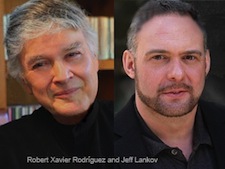
Robert Xavier Rodríguez and Jeff Lankov

Robert Xavier Rodríguez and Jeff Lankov

The name Robert Xavier Rodriguez (b. 1946) is hardly unknown in the music world, with an imposing list of worldwide commissions, performances, and other successes filling his biography, but a recent recital of his piano works had this listener convinced that his musical reach is destined to grow far greater still. Currently Professor at The University of Texas at Dallas (among other career demands), he has amassed commissions and residencies with many of the world’s most renowned symphonies and opera organizations, awards galore (Guggenheim, ASCAP, NEA, American Academy and Institute of Arts and Letters, etc.), a long string of record labels and artists presenting his music, and exclusive publication by G. Schirmer. Such biographical information generally serves to “sell” an artist, but in Mr. Rodriguez’s case his music speaks for itself; moreover, the organizations mentioned among his credits may be the ones basking in reflected glory. Listening to this gifted composer, who has been outstanding in his field for decades now, one even begins wondering why certain accolades are missing – Pulitzer committee, where are you?

Part of what sets Mr. Rodriguez’s musical voice apart from others is its directness of expression, vibrant, unpretentious, lyrical, and often humorous, without sacrificing substance or craft. Though there was a liberal sprinkling of modern ragtime throughout the recital, that style predilection did not limit the emotional range (any more than with William Bolcom and others drawn to the genre) – and certainly all was not based on rags. The balance between accessibility and exploration was just right. In darker inspirations, such as the closing work “Caprichos” (2012), based on some rather unsettling Goya artworks, the tonal language was uniquely chilling and nightmarish, yet always with a life-affirming joy in the storytelling itself. Given its World Premiere here, it is a fascinating, thorny, and demanding work, which I look forward to hearing again. Drawing from a variety of musical resources (including fitting references to Scarlatti and Mozart), it is unquestionably fresh and new, a valuable addition to the piano literature (and for pianists, a natural to pair with “Goyescas” of Granados as a bonus).

Bringing the musical storytelling and imagery to life was pianist Jeff Lankov, who sustained musical interest from the recital’s first notes to its last in performances of brilliance and dedication. To open, he teamed up with the composer in Semi-Suite (1980) for piano, four-hands, an appealing work as full of fun as its punning title. Its four movements (the first one repeated as a fifth) include “The All-Purpose Rag” and “Limerick” (ingenious pieces after which the audience had to laugh out loud), plus a delightful Jig and Tango.  The players projected the tongue-in-cheek references and musical “punch lines” with wonderful deadpan delivery, as Lankov continued to do in “Estampie” (1981), which also contained several ragtime-inspired movements. Lest one underestimate the substance of the latter (with titles including “The Slow Sleazy Rag”, “The Couple Action Rag”, and “Reversible Rag”), the seven-movement work is actually a wide ranging set of variations with considerable lyrical beauty as well as stimulating formal challenges. As the Program Notes for one movement state: “In a complex Scherzo, the regular rhythm of the estampie is sharply juxtaposed with disjunct atonal writing. Ragtime rhythms appear, treated with Ars Nova discant and isorhythm techniques in a synthesis of widely disparate styles, after which the estampie reappears.” All of this intricacy made for challenging listening as well as playing, and Mr. Lankov was the man for the job. A veteran of new music performance whose repertoire includes the complete works of John Adams, plus Michael Finnissy, Messiaen, Piazzolla, Radiohead, and more, he embraces it all. There seems to be nothing that eludes his grasp.  His performance of Rodriguez’s tour de force “Fantasia Lussuriosa” (1989) was particularly compelling, with its seductive lines, decadent melodic embroidery, and all-encompassing virtuosity. It is hard to believe there are not more young pianists pouncing on this piece as a “vehicle.” Mr. Lankov played it to the hilt, yet there seems to be enough flexibility in it to elicit many additional interpretations.

In another note of levity, the second half opened with a selection entitled “Hot Buttered Rumba” from Aspen Sketches (1992).  The title as well as the infectious rhythms had many smiling. Despite prodigious skill, Mr. Rodriguez’s sense of humility and humor are never far. We may credit some of Rodriguez’s humor to the encouragement of his great teachers, Nadia Boulanger. In his words, “Boulanger told me that I would only be half a composer until I also learned to express in my music the same love of laughter that she knew I enjoyed as a person.” She would be proud.

In a possible nod to another of Rodriguez’s teachers, Jacob Druckman, the recital also included Rodriguez’s “Seven Deadly Sequences” (1990), an imaginative and highly pianistic set, which should keep pianists enthralled for years to come. Though not mentioned in the program notes on the piece, Druckman’s own piano set entitled “The Seven Deadly Sins” is similarly vivid and evocative. They would make an interesting pairing, perhaps on disc.

On the subject of discs, one reads in Jeff Lankov’s biographical notes that a recording of this recital’s music is in the works. One can only rejoice. Look out for it.

Share

Hyojung Huh CD in Review

Hyojung Huh, piano
Weill Recital Hall at Carnegie Hall, New York, N.Y.
March 13, 2013
 
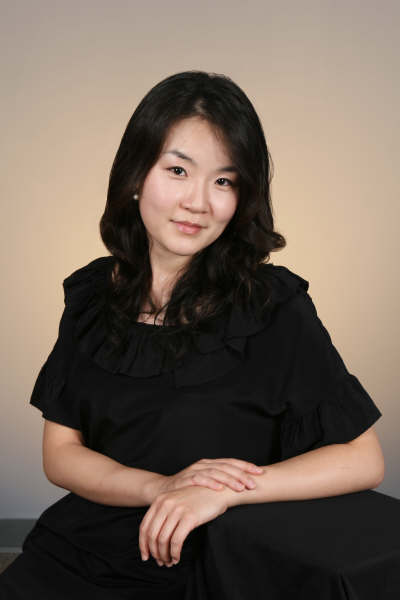
Hyojung Huh ,Pianist

Hyojung Huh ,Pianist


Korean pianist Hyojung Huh gave a debut in New York this Spring that introduced not only herself as a performer, but also, in the second half, the ten-movement, forty-five-minute Chorale Fantasy of contemporary Korean composer, Shinuh Lee, entitled “Comfort, comfort my people.”  While I missed the concert itself, I was assigned to review an unedited CD of it and found much to admire. While CD recordings almost inevitably miss the energy of a live performance itself, they do enable the multiple hearings one usually needs with new works. Ms. Huh holds an impressive array of degrees as a pianist, including B.M. and M.M. from Seoul National University, M.M. from Westminster Choir College, and P.D. (Performer Diploma) from Indiana University-Bloomington, in addition to an imminent D.M.A. from the University of Wisconsin where she is a doctoral candidate; in addition, though, Ms. Huh has earned degrees in aesthetics, sacred music, and choral conducting, all of which seem to make her a natural fit for the New York Premiere of Ms. Lee’s imposing,  Biblically-inspired Chorale Fantasy.  Drawn by musical and theological interests (having already done Masters studies on Messiaen in relation to Catholic ontology, liturgy and Biblical language), Ms. Huh is currently working on a dissertation offering a metaphysical and theological perspective on the Shinuh Lee composition performed in this recital, a work which does bear some kinship with works of Messiaen himself.  So, rarely will one see a confluence of such well-matched forces – the pianist, the composer, and the central inspiration of the work all in perfect synch.

Hyojung Huh ,Pianist

Hyojung Huh ,Pianist

In laic terms, the work is an intensely dramatic one, alternating evocations of fire and brimstone with those of ethereal peace, created brilliantly by Ms. Lee and conveyed sympathetically and passionately by Ms. Huh. The first movement is entitled “A brimful living chalice of despair and horror and astonishment.” The movement lived up to its title. Vivid in its thunderous and dissonant virtuoso writing, it alternated bass chants against smoldering trills and tremolos with nightmarishly unrelenting rhythms that were sometimes reminiscent of Ligeti’s “L’escalier du diable” to this listener. Comparisons are for expedience – not to suggest that the work is derivative – so I’ll also be forgiven for comparing some of Ms. Lee’s stomping martial accompaniments to Prokofiev’s “Montagues and Capulets” in their savagery. The overall effect was harrowing. Sheer terror yielded wonderfully in the second movement to a feeling of post-apocalyptic quiet. Entitled “Lord Have Mercy”, this prayerfully simple A-flat major Chorale (towards the end reappearing in A major) developed over a pulsating pedal point into a Brahmsian meditation that might make a jaded listener flinch at such sweetness, were it not in juxtaposition to the ferocious first movement.  Ms. Huh also gave it a pacing which prevented any feeling of glibness. Limitless emotional range, here and in the rest of the work, was matched by an arsenal of several centuries of musical techniques and styles, from early chant, to Bach, through the moderns (even hints of Einojuhani Rautavaara), all integrated organically. The work is quite a journey, and Ms. Huh was up to the task of guiding us through it – performing from memory, no less! Undoubtedly she will bring this work to many venues. Some choices in text will be challenging and controversial to many – and they frankly could prevent widespread acceptance of it – but the music itself could be imagined to depict numerous stirring but more widely applicable Bible verses, should changes be made at some point. Universal acceptance, however, does not appear to be the goal here. Remaining open-minded about new music can be one of the big challenges in reviewing, but the same applies to new interpretations of “old” music, which one also encountered in this recital. Ms. Huh’s first half, consisting of the oft-heard “Jeux D’eau” of Ravel and ubiquitous Symphonic Etudes of Schumann, was unconventionally played. Jeux d’eau (translated sometimes as “Fountains” or “Playings of Water”) was not the sort of sweeping, watery interpretation to which I’m accustomed.  My first reaction was that it needed more flow, flexibility, and the qualities that one associates with water; instead, this performance struck one as a bit stolid, on the slow side, and rather careful; on rethinking it, however, Ms. Huh’s was an interpretation that may have simply been focused more on the individual droplets, each in imagined crystalline perfection. Having not heard the concert live, but catching the tonal beauty of individual notes nonetheless, I’m inclined to give the performer the benefit of the doubt! Schumann’s Symphonic Etudes similarly seemed overly cautious.  In this case, due to some weak spots where tempi fluctuated and some messiness ensued, one imagines that there is simply a need to live with the piece longer. The additional Posthumous Etudes (Nos. II and V) were much appreciated, as they are often omitted, but suffice it to say that the Shinuh Lee work will be what is best remembered of this recital.  That is no small achievement.

Share