
Duo Atlantis in Review
Rachel Youngberg Payne, Mezzo-Soprano, Jack Tyndale-Biscoe, Piano
Weill Hall at Carnegie Hall, New York, NY
October 26, 2025
A completely delightful concert took place this Sunday, the New York Debut at Weill Hall of Duo Atlantis, a collaboration between mezzo-soprano Rachel Payne and pianist Jack Tyndale-Biscoe. The program, entitled “Echoes Across the Atlantic” blended British and American art song, including music of Edward Elgar, Ralph Vaughan Williams, Benjamin Britten, Muriel Herbert, and Bear McCreary (b. 1979) from the UK, plus selections by Samuel Barber and Aaron Copland representing the US. This duo connected much more than the two already-related cultures. Drawing inspiration from the ocean between the two, plus the shared human experiences of “travel, love, memory, and humanitarian stories” (as their Carnegie summary states), they communicated with each note, connecting with their audience and reminding us how deeply we all are connected. It was a thoughtfully conceived program to make us laugh, cry, dream, and wish. All of that would mean little, though, if they had not performed it superbly as musicians – and they did indeed.
Opening with two selections from Elgar’s Sea Pictures, Op. 37, the duo set a haunting tone first in Sea Slumber Song, starting with Mr. Tyndale-Biscoe’s atmospheric piano introduction. It is usually a matter of just a minute or less before this reviewer finds a nit to pick with singers, but Ms. Payne started off beautifully and continued so, with a pure and rich tone, true and focused intonation, and thoughtful and communicative phrasing. Any vocal imperfections were transmuted by the alchemy of her expressiveness. She clearly shared in the intensity of the piano part as well, “living” each entire piece, not just her part – which ought to be the norm, but one sees the opposite all too often! Mr. Tyndale-Biscoe, showing consistent mastery, drew no attention to himself, simply serving the music and realizing it expertly. His piano introduction to the next Elgar selection, Where Corals Lie, picked up the pace and captured just the right restlessness.
The next pieces were a wonderful surprise, which this reviewer can’t recall ever hearing in concert: selections from Children’s Songs by Muriel Herbert (1897-1984). Ms. Payne announced them as “charming and disarming” – and they were just that. Mr. Tyndale-Biscoe didn’t miss a trick in setting the tone for – and punctuating – these miniatures, each one finishing in a wink. We enjoyed the whimsy of Merry-go-Round,the acrobatics in the growing of The Tadpole, the happy affirmation of differences in Jack Spratt and finally The Bunny, which was simply adorable. At one point in the concert Ms. Payne mentioned from the stage that she has children to whom she sings, and it does seem that such basic musical directness is an integral part of her magic onstage.
Mr. Tyndale-Biscoe spoke eloquently to introduce the next works and he more than lived up to his tantalizing descriptions with his playing. The duo gave a dreamy reading of Samuel Barber’s Nocturne from Four Songs for Voice and Piano, Op. 13, and then crossed the musical ocean to perform two selections by Ralph Vaughan Williams, his Let Beauty Awake from Songs of Travel and Silent Noon from The House of Life. The “poetry and philosophy” that Mr. Tyndale-Biscoe had spoken about in these songs were both evident to a poignant degree, with both musicians savoring the warm and wistful creations.
Not a duo to avoid humor, they delighted next in Benjamin Britten’s Calypso from Cabaret Songs, a musical “race” to get to a train station, appropriately here, Grand Central. It was all that Mr. Tyndale-Biscoe had described it to be- “playful, ironic, and theatrical.” Lest we grow too lighthearted, two of Copland’s Old American Songs followed to bring us to tears, The Little Horses and At the River, closing the first half with further reminders of children and community – both themes at the center of the premiere after intermission.
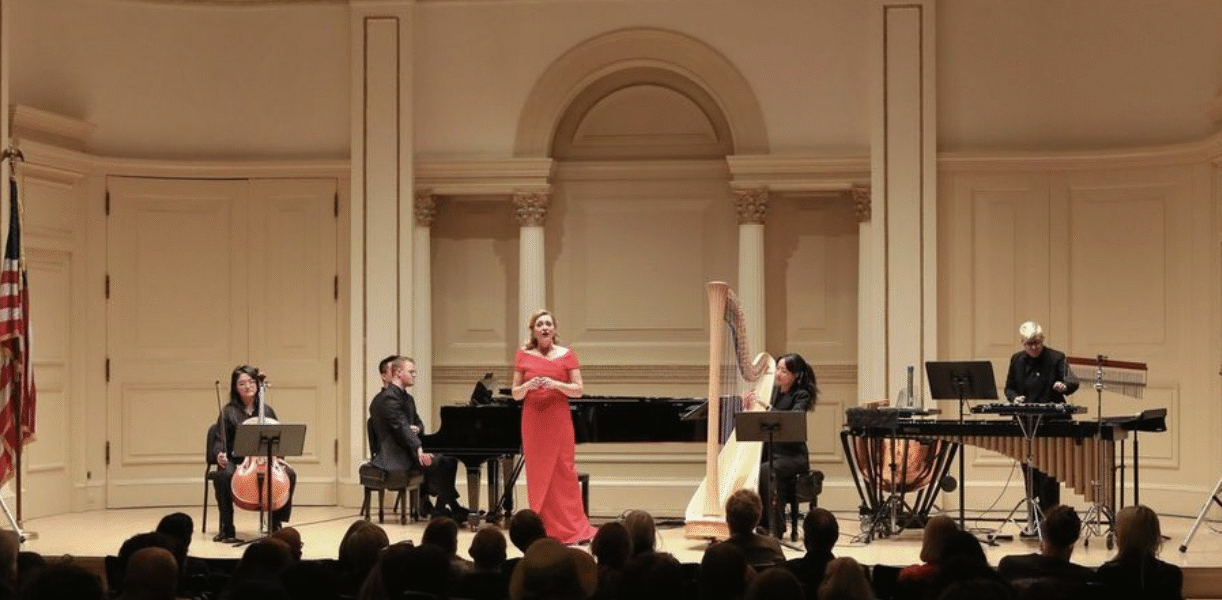
The second half of the program was devoted to the world premiere of Dragon’s Blood: A Four-Part Song Cycle for Voice, Piano, Harp, Cello, and Percussion composed by Emmy-winning (and, in the UK, BAFTA-winning) composer Bear McCreary. Set to a heartbreaking text by screenwriter J.D. Payne, the song cycle spotlights the impact on children of cobalt mining in Congo, using a “dragon” in a cave as a metaphor for the harm that can come to children from such work. Incidentally, the concert was co-sponsored by Floodlight, an organization involved in promoting ethical industry practices, and the performance of this song cycle certainly made a powerful statement towards that end.
It was not as radical a shift as one might think from the first half’s music to this troubling story, as thoughts of children were already in the air. In fact, for an audience immersed just moments before in Herbert’s carousels and Copland’s “little horses” lullaby, the descriptions of an innocent young Congolese boy with dreams of sunlight and warm bread were simply devastating. Mr. McCreary’s score, an immediately accessible and colorful one, was conveyed with all the agony of the situation, but also with some hope in the final rallying cry to the community. The Atlantis Duo was as powerfully communicative as ever, responding to the text and music with just the right sensitivity and drama.
Credit to the cellist, harpist, and percussionist should not be omitted. The harpist Karen Tay helped evoke the beauty of childhood, while the cellist Wangshu Xiang created the ferocious growls of the titular dragon. Grace Goss on percussion added intensity throughout. If any of these names are incorrect, that is from a hasty search to find out who they were, as they were not listed on the program (with surely some administrative glitch responsible). Anyway, the overall effect was potent, and undoubtedly the audience was moved to learn more and to do more. An encore of Mahler’s Urlicht capped off the recital, with a panel discussion on the Dragon cycle to follow, to delve into it all further. Sadly this reviewer could not attend, but it did seem that no further words were needed after such a moving afternoon of music.
