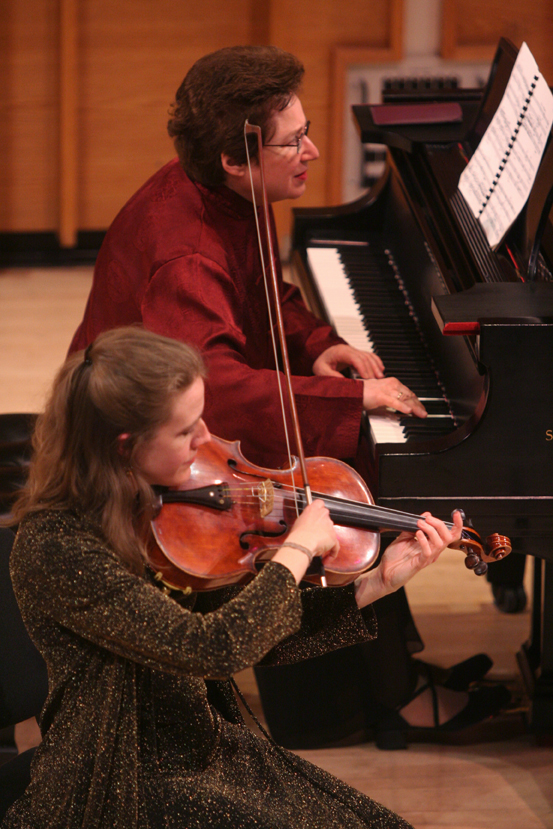
Stephanie Griffin and Cheryl Seltzer; Photo Credit: Hiroyuki Ito
Stephanie Griffin, violist and founding member of the Momenta Quartet, and Cheryl Seltzer, pianist, founder, and co-director of the internationally renowned group Continuum, joined forces recently in recital at the Americas Society. This pairing of two intelligent and sensitive musicians led to dynamic and thought-provoking performances. Billed as featuring an homage to Milton Babbitt, I found the concept of the entire program to be an homage by performers and composers to those who touched their lives. In the extensive program notes, Ms. Seltzer writes of her friendship and admiration for Babbitt, her teacher Milhaud, and the honor of having premiering a Pärt work with the composer present. Ms. Griffin writes of her close friendship with Greenbaum, and Shostakovich’s tribute to Beethoven. This information gave the performances special meaning, and the performers demonstrated the sincerity of their words by their passionate playing of the works.
“Three or Four Days After the Death of Kurt Cobain” by Canadian composer Tim Brady (b. 1956) opened the program. This work brought to this listener’s mind the “Love-Death” music of George Crumb’s “Makrokosmos”, with “Smells like Teen Spirit” taking the place of Chopin’s Fantasie-Impromptu. The passing of the thematic material between the two players was done seamlessly and made what might have seemed an odd idea very effective. “Double Song for Viola Sola: In memoriam Milton Babbitt” from Matthew Greenbaum (b.1950) followed. This work could be described as two voices speaking simultaneously, one voice quiet and the other much more assertive. Ms. Griffin took this ingenious concept and gave an assured performance, capturing clearly the distinctive voices and making child’s play of the technical demands. I’m sure Babbitt would have heartily approved of the piece and the performance.
Written in 1950, eight years before his famous (and controversial) article “Who Cares if You Listen?”in High Fidelity magazine, Milton Babbitt’s “Composition for Viola and Piano” is a piece very much worth hearing. Babbitt (1916-2011), the mathematician, used permutations of various intervals in a colorful manner, with mercurial interplay of ideas between the viola and the piano. This is a work of equals, and the performers were outstanding–both as individuals and as a duo. Played with energy and commitment, this performance was a highlight of the evening and should serve as an impetus for the audience members to explore further Babbitt works.
“Quatre Visages”, written in 1943 by Darius Milhaud (1892-1974), is a musical depiction of four imaginary ladies in different locales. Ms. Griffin and Ms. Seltzer captured the jazzy charm of “La Californienne” (which one should note had a distinct French flavor), the mournful outlook of the time in “La Bruxelloise”, and the jaunty optimism of “La Parisienne”. I found “The Wisconsonian” to be more frenetic than the “bustling” that the program notes suggested, but this was my only reservation in an otherwise delightful performance.
After intermission, Ms. Seltzer played Arvo Pärt’s “For Alina”, a short piece written for a young Estonian girl. Pärt (b.1935), after abandoning serial and other modern techniques, adopted an approach that he refers to as “tintinnabuli”. “For Alina” was one of his first works in this new style. While not technically demanding in a virtuosic sense, it nonetheless requires considerable skill for the performer to produce the bell-like sound without a harsh percussiveness. Ms. Seltzer gave a brief performance (the performer often repeats the 15 bars of written music ad lib.) that showed her complete involvement and attentiveness to the finest of details.
Dmitri Shostakovich (1906-1975), like Mahler before him, wrote music with strong autobiographical meaning and content. His final work, the Sonata for Viola and Piano, Op. 147–written in the last year of his life–is no exception. This masterpiece could be considered Shostakovich’s final ‘letter’ to the world, which was only ‘read’ in its entirety after his death. Ms. Griffin and Ms. Seltzer gave a performance to remember; one could sense that the aura of Shostakovich himself was in the room guiding the players. The biting, sarcastic, and grotesque were all there, along with the quiet despair and the poignant. The finale, which has elements of Beethoven’s “Moonlight Sonata”, was said by Shostakovich himself to be in memory of Beethoven. Ms. Griffin’s and Ms. Seltzer’s persuasive playing did honor to the final musical words of a great composer. The audience responded with well-deserved and extended applause, calling the performers back for multiple bows. One trusts that Ms. Griffin and Ms. Seltzer will pair up often in the future; both are wonderful musicians and make a dynamic duo.