
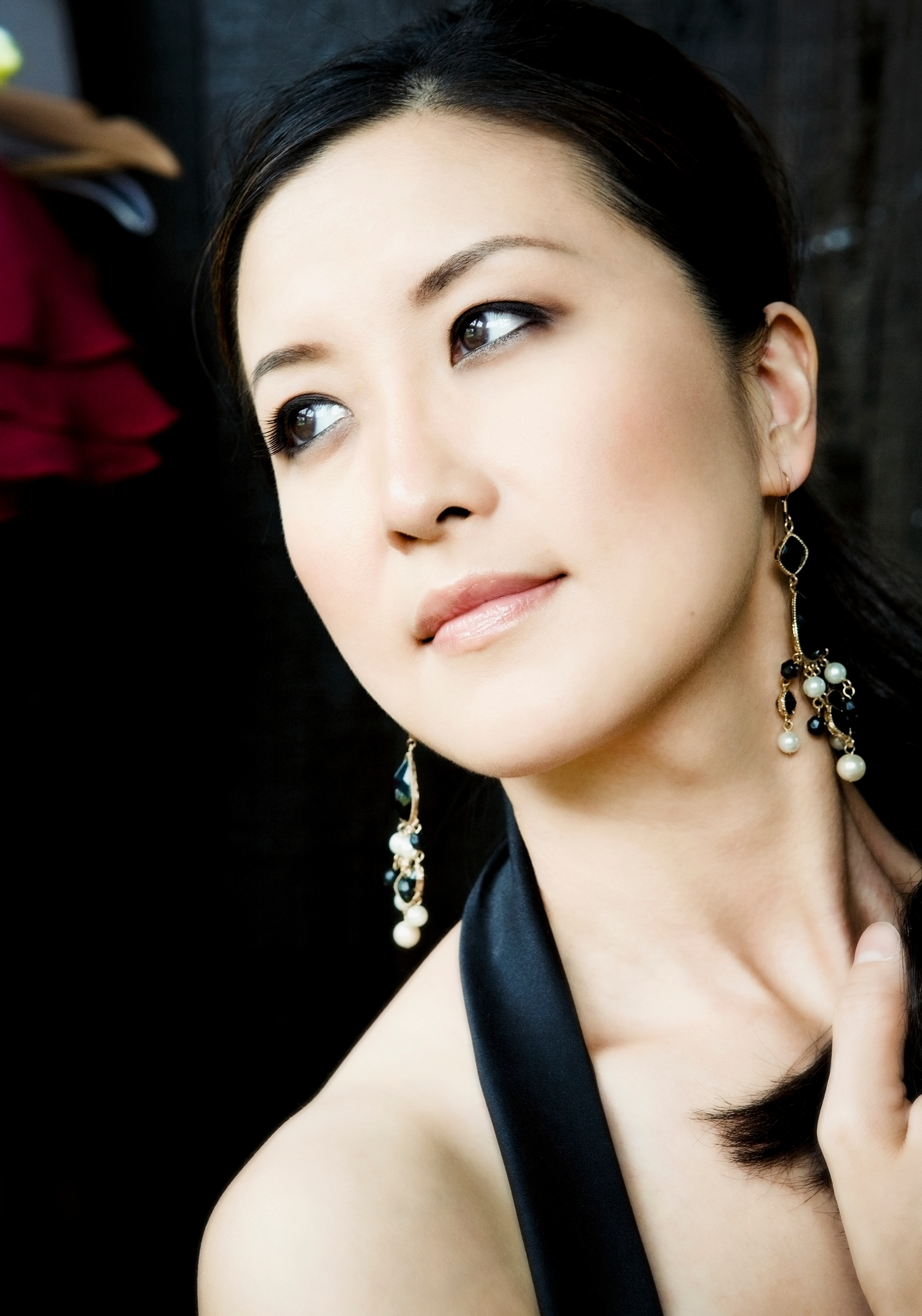
The Center for Musical Excellence Presents Winter Benefit Concert and Silent Auction in Review

Featuring Min Kwon, Alexander Beridze, Ming Xie, Heegan Lee Shzen, Diyi Tang, Miao Hou, Sydney Lazar, Lachlan Glen, and Erickson Rojas
Steinway Hall; New York, NY
December 18, 2012
 

Min Kwon

The Center for Musical Excellence (CME) is dedicated to the ideal of helping gifted artists of all nationalities realize their potential by providing them not only with top-notch training and mentoring, but with practical assistance in areas such as housing, language, and securing necessary documents.  Originally conceived to assist pianists, CME has now branched out to also accept players of all instruments and vocalists as well. Founder, Artistic and Executive Director Min Kwon headlined a group of talented artists in a benefit concert to raise money for this fine organization.  A silent auction with a variety of items, from the expected (a private concert from Ms Kwon) to the unexpected (an opportunity to watch an open-heart surgery!) awaited the highest bidders.

Such group concerts are always great fun for the audience members, who get to enjoy a variety of talented performers in crowd-pleasing works; it is a lot more stressful for the artists, however, who have to come in “cold” and be ready to go immediately.  To be judged on a few short minutes where anything can happen can be a frightening prospect. It is also difficult for the reviewer, who must make snap judgments and avoid the temptation to compare performers. If all goes well – and it did – the festive nature of the occasion rules the day.

Min Kwon and Alexander Beridze opened the concert with Variations on a Theme of Paganini for Two Pianos by Witold Lutosławski (1913-1994). Played with panache and style, this much-loved work got the night off to a great start.  Ming Xie followed with the “Alborado del Gracioso” from Miroirs of Maurice Ravel (1875-1937). At only eighteen years of age, he played with involvement and mastery far beyond his years. This is a young man who bears watching.  Heegan Lee Shzen followed with Etude –Tableaux in E-flat Minor, Op. 39, No. 5 by Sergei Rachmaninoff (1873-1943, not 1891-1953 as the printed program stated twice– those dates are Sergei Prokofiev’s!).  Mr. Lee did not begin serious studies until age fifteen. This late start makes his achievement all the more remarkable when one considers that most players of his caliber usually began at the age of four or five. He seemed to gain confidence as he played and finished strongly.  He is a diamond in the rough who will be a pleasure to follow.  Closing the first half, Diyi Tang treated the audience to Ce qu’a vu le Vent d’Ouest (What the West Wind Has Seen) from the Préludes, Book I from Claude Debussy (1862-1918). This virtuosic tribute to Percy Shelley’s Ode on the West Wind was played with fiery intensity – a stormy wind full of raging aggressiveness.  This I believe to be the most effective approach and not the understated interpretation that I have heard from many others.  It was an exciting close to the half.

Miao Hou joined Diyi Tang to open the second half with two selections of two-piano works. The first included “Meng Songs” and “Miao Dances” from China West Suite by Chinese composer Chen Yi (b. 1953). These two movements could be described as Béla Bartók and Prokofiev mingling with the sounds of China; the Meng Songs being poignant in simplicity and the Miao Dances infectious in their energy. The pianists then swapped pianos and offered the Valse from the Second Suite for Two Pianos of Rachmaninoff. It sparkled with optimism and brightness in the hands of these two very sensitive musicians.  The youngest performer of the evening, soprano Sydney Lazar followed. Ms. Kwon told of how Ms. Lazar won the hearts of the Viennese when she was a participant in CME’s ConcertoFest in Vienna.  Her performance of “Bel Piacere” from Rinaldo by George Frederic Handel (1685-1759) showcased her lovely voice, but it was her performance as Adele singing the “Mein Herr Marquis” aria (probably much better known as “Adele’s Laughing Song”) from Die Fledermaus by Johann Strauss II (1825-1899) that made it completely obvious how she won over the Viennese.  Projected with coquettish charm, it was a winning performance from start to finish. Ms. Lazar is personality plus and should have a bright future.  Her accompanist, Lachlan Glen was a star in his own right; any singer would be happy to have him as a collaborator. Erikson Rojas followed and proved to be an impressive performer in his own right. Playing Ante el Escorial by Ernesto Lecuona (1895-1963), Mr. Rojas gave an impassioned and intensely committed performance; the intensity of his performance made me forget that I am not especially fond of this piece – no small achievement! To cap off the night, Ms. Kwon joined Mr. Rojas for Libertango of Astor Piazzolla (1921-1992), played with Piazzolla’s characteristic fire.  All the performers came back for a group bow before the enthusiastic audience. Congratulations are due to all the performers and especially Ms. Kwon, whose energy and dedication has made the difference in the musical lives of so many through CME.

Share

Distinguished Concerts International New York (DCINY) in Review

“Messiah…Refreshed!”
Distinguished Concerts International New York (DCINY): Distinguished Concerts Orchestra, Distinguished Concerts Singers International, Jonathan Griffith, Music Director; Penelope Shumate, soprano; Doris Brunatti, contralto;
Jorge Garza, tenor; Liam Moran, bass.
Avery Fisher Hall; Lincoln Center, New York, NY
November 25, 2012

Written in the space of 24 days in 1741, George Frideric Handel’s Messiah is a work with a storied performance history.  Premiered in Dublin in 1742, it has been a mainstay of the repertoire since. Using a libretto from Charles Jennens, Messiah is the story of Christ’s incarnation, death, and resurrection.

Messiah is no stranger to reworking and revision. Handel himself rearranged and rewrote sections to suit his needs; selections could be added or deleted based on the talents available. Mozart produced a version in 1789 that is still in use today, although nineteenth-century critic Moritz Hauptmann caustically remarked that Mozart’s revisions were “stucco ornaments on a marble temple.”  The controversy has not abated. There have been “sing-a-long” editions and even a rock version performed and recorded. The version performed at today’s concert is generally attributed to Sir Thomas Beecham and Eugene Goossens, although Beecham’s contribution was overstated for many years by his widow.  It was not until the 1990s that Lady Beecham’s claims were refuted; the score was completely Goossens’s work.

Beecham commissioned fellow conductor and composer Goossens to re-orchestrate Messiah to utilize the full forces of the Royal Philharmonic Orchestra. He felt that larger forces were needed to project the sound in increasingly large venues.  Beecham recorded this version in 1959; it is still available on CD today, and it continues to be controversial.  Purists who believe that Handel’s conception should remain true to the original find the Goossens version to be vulgar, while its defenders argue that the greater forces enhance the grandeur of the work.

Make no mistake; this is not your great-grandfather’s Messiah. It is brash, extroverted, and at times bombastic.  It is not Messiah – it is MESSIAH, with double the sound, new and improved, with cymbals and triangle! It is Messiah on steroids, the epitome of the saying “Go big or go home.”  This version is tailor-made for DCINY; an organization that never fails to pull out all the stops in putting on a big show.

Conductor Jonathan Griffith led the orchestra and 200-plus chorus with a sure hand. It would have been easy to lose control of these large forces, but Griffith was up to challenge of delivering the big sound without losing focus on the music itself.  The playing was excellent throughout and the exuberance of the percussionists was a special joy to see and hear. The trumpet playing in Behold, I tell you a mystery was particularly striking in its clarity and beauty of tone.  The chorus was well balanced and strong in its supporting role.

The four soloists had the biggest challenge, to sing their demanding parts while having to project enough to be heard over the large forces behind them. There were moments when each singer was in peril of being drowned out, but happily, they all overcame the dangers and delivered fine performances.  I believe each soloist became stronger and more confident as the performance progressed, as they made adjustments to project their voices.  Soprano Penelope Shumate was confident and assured; There were shepherds abiding in the field was a highlight of her performance. Contralto Doris Brunatti was compelling in her role; Behold, a virgin shall conceive was her best of several excellent solos. Tenor Jorge Garza sang his role with total involvement; one could feel the venom in the word “rebuke” in his solo, Thy rebuke hath broken his heart.  It was his He that dwelleth in heaven, though, that was the highlight of his performance to this listener. Finally, the talented Bass Liam Moran was not to be overshadowed by his fellow soloists. His solo, Why do the nations so furiously rage together?, was the high point of his outstanding singing.

One would be remiss if not making special mention of the Hallelujah chorus. It did not disappoint, delivered in a manner that could be described as over-the-top, complete with young members of the Distinguished Concerts Singers International joining in from the second tier in the audience (in what is becoming a signature feature of DCINY concerts). The audience stood spontaneously as they often do for the Hallelujah, and many could be seen singing along.  At the close, the audience roared its approval for several minutes.  The closing chorus, Worthy is the lamb that was slain, was performed with similar spirit. The excitement built to such a fever pitch that one bass in the chorus jumped in a moment early after a dramatic pause. The work was brought to a rousing close, and the audience responded with five minutes of thunderous applause, eliciting several curtain calls for the soloists and conductor Griffith. It was a well-deserved ovation to a memorable concert. Congratulations to DCINY for yet another winning performance.

Share

Musica de Camara Orchestra in Review

Musica de Camara 33rd Anniversary Concert
Roselin Pabón, guest conductor; The Virtuosi Percussion Ensemble, guest artists
Merkin Concert Hall; New York, New York
November 20, 2012

Celebrating its 33rd anniversary, the Musica de Camara orchestra presented a concert playing the works of Latin composers and featuring a commissioned work having its World Premiere. A very large and enthusiastic audience was in attendance. There was an air of excitement throughout the hall as the reunion of friends and families took place. Indeed, it was already 25 minutes past the 8pm starting time before everyone had found a seat.

In her pre-concert remarks, founder Eva de La O recounted a story from 33 years ago.  She had just given her debut as a singer and was being interviewed on radio. Ms. de La O was asked how she was able to generate interest in her career without a manager, to which she replied that she reached out the Puerto Rican community as a resource. The interviewer responded with, “I didn’t know Puerto Ricans liked classical music!” Ms. de La O was aghast and took this comment as a call to arms. The creation of Musica de Camara was her answer. Musica de Camara’s mission is both to preserve the traditions of Puerto Rican, Hispanic, and African American classical music and to commission works from contemporary composers, particularly from these ethnic groups.  We should probably thank this nameless interviewer for his ignorant statement; who knows what wonderful music might have gone unheard over these 33 years had he not uttered these words!

Fuga con Pajarillo by Venezuelan composer Aldemaro Romero (1928-2007) opened the concert.  Pajarillo is a Venezuelan folk song, which Romero used as thematic material. Purists might argue about the fugue designation, but there were certainly fugal elements. This is an engaging piece that evokes some of the spirit of Padre Soler with the musical spices of Venezuela. There was the occasional imprecise articulation in the violins that muddied sections, but overall, this was an excellent performance.  Abre Los Ojos, Cierra Los Ojos (Open your eyes, Close your eyes) from Columbian composer Hector Martignon (b. 1972) was next. This dreamy piece, with highly chromatic writing and impressionistic elements, was played beautifully from the opening viola solo to the final “closing of the eyes.” Next followed La Bella Cubana by Cuban José Silvestre White (1835-1918), in an arrangement by Dominican Alberto Hernandez (b. 1961). It is a melancholic work tinged with nostalgia and was played with sensitivity without being maudlin. It was a lovely performance. The crowd-pleasing Cañambu by Mexican composer Eduardo Gamboa (b. 1951)  followed; the ebullient finale of this work brought loud cheers from the audience. Ending the first half with the Argentinian master of the tango, Astor Piazzolla (1911-1992), Michelangelo 70 was scintillating from start to finish. The audience roared its approval and gave the orchestra a standing ovation.

Maestro Roselin Pabón started the second half by sharing some insights about Jack Delano (1914-1997) and his work Sinfonieta para cuerdas (Sinfonietta for Strings), even having one of the bass players demonstrate the Seis Mapeye motif on which the movement of the same name was built. Delano, born Jacob Ovcharov in what was then in the Russian empire, moved with his family to the United States in 1923 and eventually settled in Puerto Rico in 1946. Two movements of the Sinfonieta were played, the inventive Seis Mapeye, and the optimistic Allegretto giocoso. The Allegretto showed the influence of Ginastera; specifically Estancia. The Camara continued demonstrating their masterful playing; it was another dynamic performance of a gem of a piece.

Tres Secretos en Plena; Encantos de Puerto Rico (Three Secrets in Plena; Charms of Puerto Rico) by the gifted Puerto Rican composer Manuel Calzada (b. 1975),  was commissioned by Musica de Camara and given its World Premiere. The Virtuosi Percussion joined the Camara in the role of Pleneros, traditional folk singers who also play tambourines and the guicharo. The charismatic Maestro Pabón gave a brief explanation of the three movements; Dos Misterios en la Ventana (Two Mysteries in the Window), Navegando Sobre la Luz (Sailing over the light), and Camino al Cielo (The Road to Heaven). This work was the high point of the evening to this listener. The brilliant writing, which brought to mind Bartok’s masterpiece Music for Strings, Percussion and Celesta (but not in the derivative sense) and the use of the Virtuosi Percussion in a way that honored Puerto Rican tradition joined together to create a magical effect. When the Virtuosi Percussion came to the front of the stage for the final movement and sang, it brought the house down. A long, loud standing ovation was the result; the composer came to the stage to take his well-deserved bows. The entire movement was repeated as an encore to an even louder ovation. It was a great ending to a great concert.

I must express two reservations:  First, the lack of biographical information about the composers is a serious omission. While some of these composers may be well known in their native countries, they cannot be considered “household names” to the music world at large (with the exception of Piazzolla). To omit even the most basic biographical information could make the layperson feel like an outsider. Secondly, while the core audience might understand Spanish titles, idiomatic translations would help those who do not. The door swings both ways; one cannot be indignant about one’s ethnicity being marginalized, while excluding others in a similar way. I am sure this was not the intent, but it is something to consider in the future.

The Musica de Camara orchestra is a “can’t miss” group. Thank you, Eva de La O for your continuing commitment to this wonderful organization.  I hope to be present for the 66th anniversary!

Share

The Schulman-Zito Duo in Review

The Schulman-Zito Duo
Louise Schulman, viola; Bill Zito, guitar
An Italian in Vienna- Duos by Mauro Giuliani
WMP Concert Hall, New York, New York
August 21, 2012

Violist Louise Schulman and Guitarist Bill Zito, both critically acclaimed musicians as soloists, joined forces in 2001. The Schulman-Zito duo has taken advantage of the unique timbres of their respective instruments to produce a very rich and singing combined sound. They have made the duos of the Italian composer Mauro Giuliani a particular specialty of their collaboration, having recorded four duos on their Compact Disc “An Italian in Vienna- Duos by Mauro Giuliani” (Sono Luminus DSL-92138 –http://www.naxos.com/catalogue/item.asp?item_code=DSL-92138).

Mauro Giuliani (1781-1829) was considered one of the leading guitar virtuosi of his time. Giuliani counted among his friends and colleagues Beethoven (who called him “the divine Giuliani”) and Rossini. Composer of over 150 guitar works that now are considered the core of the 19th century guitar repertoire, he also wrote three guitar concerti and numerous duos for Guitar-Violin and Guitar-Flute. Naturally, the viola was used in place of the violin for this program.

The WMP Concert Hall was the perfect venue for this music. The intimate setting had the feel and look of the 19th century salon, complete with writing desk adorned with a framed portrait on the stage. One could easily imagine being transported back in time hearing Giuliani himself playing his own works for his admirers.

From the opening notes of the Serenade in G major, Opus 127, it was immediately apparent that Ms. Schulman and Mr. Zito have a special rapport, something that is missing from many duos. Played with great sensitivity and delicate balance, the interplay of the melodic material was projected seamlessly and with sparkling clarity. It takes great ability to make what is deceptively complex sound effortless and organic- Ms. Schulman and Mr. Zito have this in abundance. Indeed, this was a recurring theme throughout the entire performance. A humorous moment took place at the end of the third movement, when the audience began to applaud as if the work had been completed. After the applause had faded, Ms. Schulman smiled and said to the audience, “I always think that is the end too!” The duo then played the final movement and finished in fine style.

The Grand Duo Concertante in A major, Opus 85, is another example of Giuliani’s seemingly endless melodic inventiveness. Using a favorite harmonic modulation of his countryman Rossini, this “Viennese” work has an undeniably Italian flavor. Ms. Schulman continued her display of mastery of the material in an unpretentious and restrained fashion. The lovely opening of the second movement, which in the hands of a lesser player could have sounded hackneyed, was played by Mr. Zito with breathtaking beauty. It did seem that some phrases were hurried and cut a bit short (especially in the first movement), but each instance took place at a page turn, a minor quibble that could be easily remedied.

The second half began with the Grand Overture for Solo Guitar, Opus 61. This work gives the modern listener an idea of Giuliani’s brilliance as a performer. Filled with virtuosic flair, this work requires a player with tremendous technique to navigate its many challenges. Mr. Zito gave a confident and inspired performance. It was striking how easy he made it all seem. Ending the concert with the Grande Serenade in D major, Opus 82, afforded yet another opportunity for this duo to demonstrate their excellence. The appreciative audience gave the performers extended and well-deserved applause at the performance’s end.

The Schulman-Zito duo has done honor to Mauro Giuliani by their first-rate performances. I hope they continue to explore the repertoire and delight audiences with their musical gifts.

Share

Chamber Music Society of Kumho Art Hall in Review

KMF Virtuoso Concert Series
Music of Poulenc, Françaix, and Dvořák
Alice Tully Hall, Lincoln Center; New York, NY
June 7, 2012
 
Chamber Music Society of  Kumho Art Hall

Chamber Music Society of Kumho Art Hall


The Chamber Music Society of Kumho Art Hall (CMS) was founded in 2007 and is presently a group of sixteen distinguished artists whose mission is to broaden the horizons of chamber music in Korea by performing and mentoring talented young players. Each season, the CMS performs with CMS Junior Members, giving these young talents the opportunity to learn and play with esteemed musicians. Tonight’s program had the Junior Members playing Francis Poulenc’s famous Sextet for Wind Quintet and Piano and the rarely played Dixtuor of Jean Françaix. The Senior Members took on Antonín Dvořák’s Piano Quintet in A Major, Op. 81.

Francis Poulenc (1899-1963) demonstrated his gift for wit, whimsy, and magic in his brilliant Sextet. The light-hearted nature of this work belies its fiendish difficulty; every player must be up to the mark or disaster ensues. There were no worries, as these young players were technically accomplished to a high degree. It seemed that the piece was child’s play for them. The notes were all there, passagework was clear, and the ensemble playing was excellent; a few intonation issues crept in, but these were few and far between. What was missing was the feeling of Poulenc as jaunty raconteur. I suspect this element will come with more experience and performance; the foundation is there in abundance, but it still needs developing. Once this is done, I am sure this ensemble will give an unforgettable performance of this mainstay of the repertoire.

Jean Françaix (1912-1997) is an unfamiliar name to many, which is regrettable given his tremendous output and sparkling style of composition.  Being a staunch and unrepentant Neo-Classicist in the time of serialism and atonalism probably has contributed to this. Dixtuor pour quintette à vent et quintette à cordes (Dectet for Wind and String Quintet) was composed in 1987. Scored for two violins, viola, cello, double bass, flute, oboe, clarinet, bassoon, and horn, it is a work full of youthful optimism. While not as technically demanding as the Poulenc, it still requires top-notch players and has the additional challenge of ensemble and balance issues among ten musicians.  Perhaps to highlight the idea of yesteryear, the players performed while standing; in my opinion this neither added nor subtracted anything from the performance. The ensemble captured the essence of this charming work in a way that was lacking in the Poulenc.  There was whimsy without being cloying, the lyrical second movement was beautifully played, and the articulation was rendered with laser-like clarity throughout, especially the triplets in the third movement. The final movement built up such momentum that the double bass player inadvertently hit his stand with his bow, underscoring his enthusiasm. My only reservation was at times the strings were somewhat timid and overshadowed by the winds, but all in all it was an inspired performance of an unjustly neglected work.

After intermission, the senior members took to the stage. Music Director Daejin Kim led a bold performance of Dvořák’s Piano Quintet in A Major, Op. 81. Antonín Dvořák (1841-1904) showed his devotion to his native land in this masterpiece, using Bohemian folk idiom throughout and the CMS gave it a high-voltage performance. They showed their great understanding of Dvořák’s ideas and projected them with vigor. Other than a small slip where one violin was a fraction of a second early in an exposed section, the playing was extremely polished. The last measures of the finale were played with brio, bringing the work to an exciting close. The large audience responded with loud and prolonged applause, calling the performers back to the stage three times.

As much as I would like to name each and every player for their performance, I will simply congratulate CMS as a whole on a highly successful evening. I hope I have the pleasure of hearing them again in the future.

Share

The Profile The Life And The Faith Across The Notes in Review

The Profile The Life And The Faith Across The Notes
A Symphonic Poem written for piano, orchestra, and chorus
Mario Jazzetti, composer
The Chelsea Symphony Orchestra; New York Choral Society
Francesco Libetta, piano; Donata Cucinotta, soprano; Matt Morgan, tenor
Avery Fisher Hall, Lincoln Center; New York, NY
May 12, 2012

In a pre-concert address, Maurico Jazzetti shared remembrances of his father, Mario Jazzetti. It was obvious that he had great esteem and love for his father, and this concert was his way of sharing that with the world. Mario Jazzetti’s The Profile The Life And The Faith Across The Notes was presented. Having remarked on his dream that “this work must be played at Lincoln Center,” the younger Jazzetti must have felt great joy at making this dream a reality.

Mario Jazzetti (1915-1986) began his piano studies at age five and gave his first concert at age nine. He earned his diploma in piano in Naples and had a successful performing career in Italy in the pre- and post- World War II years.  He immigrated to the United States in 1951, where he continued his career as a teacher and performer, including concerts at Town Hall and Carnegie Hall. The Profile The Life And The Faith Across The Notes was first performed in a two-piano version in 1983.  A planned orchestral version was cancelled due to Mr. Jazetti’s ill health in 1984.

Billed in the program as a symphonic poem, in the program notes as a symphony concerto, and on the Internet as a piano concerto, it is apparent that the presenter is undecided on a final designation. Despite its titles’ far-reaching ambitions, this work seems ultimately to be none of the above. One might call it a suite, but it is really a pastiche of six works, composed at different times in Mr. Jazzetti’s life and placed together. Split into two sections (four movements, followed after intermission by the last two), the six movements are meant to represent the life journey, from birth to the end of life. They are titled Ninna Nanna (Lullaby), La bicicletta (The Bicycle), Tristezza d’amore (The Sadness of Love), Gioia di una Promozione (Joy of Graduation)– La Farfalla (The Butterfly), Tragica Realta’ Della Vita (The Tragic Reality of Life, also called the War Concerto), and Ave Maria.

With one movement written in his teens (Ave Maria), another conceived during World War Two (The Tragic Reality of Life), and the rest at other times not detailed in the program notes, the work has an uneven quality as one might expect. The influences of Grieg (especially the Piano Concerto), Tchaikovsky, Chopin, Liszt, and other romantic composers were prominent throughout in an overtly derivative manner, yet without these composers’ individual formal clarity, the effect was that of a collage. Thus, despite the organization into phases of life, there was an amorphous quality to the set. Conventional cadenza-like passagework was frequently used as thematic material, so that melodic lines become almost undistinguishable as such, while harmonic progressions bordered on the formulaic. There were, to be sure, poignant moments, but the surrounding material overwhelmed them.

Pianist Francesco Libetta was the star of the evening. Playing with great abandon, he broke a string on the Fazioli piano during The Tragic Reality of Life movement, much to the amazement of the audience. Soprano Donata Cucinotta and tenor Matt Morgan gave strong performances as well. The New York Choral Society was solid in their role – though what precisely that role was meant to be might have been clearer had there been a printed text, either in the original Italian or in translation (which was missing for the solo singers as well), a considerable omission in this case. Last, but not least, the Chelsea Symphony Orchestra was excellent from start to finish in a performance that completely outclassed another orchestra’s earlier performance of the work, as recorded in Italy (since removed from YouTube). The audience gave the performers a prolonged standing ovation at concert’s end.

Share

Chinese Hua Xia Chamber Ensemble in Review

Chinese Hua Xia Chamber Ensemble
“Dialogue Between the Traditional and the Modern”
Alice Tully Hall, Lincoln Center; New York, NY
May 7, 2012

In a program entitled “Dialogue Between the Traditional and the Modern”, the Chinese Hua Xia Chamber Ensemble presented a program of Ancient and Modern Chinese music, pairing traditional Chinese instruments with “Western” instruments in commissioned works. Featuring six (!) World Premieres, it was a concert that bridged the musical heritages of the East and the West.

The Chinese Hua Xia Chamber Ensemble was founded in 1995. The members are mostly award-winning, young conservatory teachers who are considered the “best of the best” in China.  The ensemble requires members not only to master traditional folk music, but to explore and seek innovations in modern styles as well.  Conducted by Tsung Yeh, they have recorded several albums and have performed throughout the world.

Wanting a closer look at the various Chinese instruments, such as the zheng, the ruan, and the yangqin, among others, and to observe the players “up close” made me abandon my usual strategy of sitting in the back rows.  It was fascinating to see these wonderful instruments being played with such mastery.

Six members of the ensemble opened the concert with traditional Chaozhou music entitled “Lang Tao Sha”. In this arrangement, the erxian, zheng, pipa, flute, yangqin, and the ruan were used.  The playing and balance among the six players was outstanding; the six instruments sounded as one. Following this piece was the first premiere of the evening, “Feng Qiu Huang” (a male phoenix sparks a female phoenix). Written by Liu Qing for cello, Chinese percussion, and the guqin (a small, seven-string zither-like instrument, played by plucking the strings), it uses an ancient Hainan love song that depicts the story of a male phoenix (“Feng”) courting a female phoenix (“Huang”). Beginning with quiet low tones in the cello, followed by responses from the guqin, it built in intensity until it reached a climax, then released the tension and came to a quiet conclusion. There were moments where it was difficult to hear the guqin, but this did not spoil the net effect.  The second premiere, “Five Impressions” by composer Gao Ping, was given in partial form (stated in the program as “Part of Movements”). The conductor Tsung Yeh showed admirable concentration and restraint even before the first note by patiently waiting for the incessant picture taking to cease. Once these distractions passed, an inspired performance took place. With haunting flute lines paired with the cello, then pipa with marimba, then all players joining together, each “Impression” had reminders of one previously played. Culminating in rapid passagework that had me thinking of Prokofiev, this imaginative piece was brought to a crackling close. After this excitement, it was a good choice to pull back to an ancient work called “Wild Geese in the Sandbank”. Played on the xiao, a vertical end-blown flute that is roughly the size of the western Alto flute, this work has a pastoral quality, both in the beautiful lento and the joyful allegro sections. Zheng Weiliang gave an enchanting performance and was rewarded with thunderous applause from the audience; he returned to the stage for a well-deserved second bow. Ending the first half was the third premiere, “Graceful”, from composer Wang Danhong. Described as the emotional journey to Dunhuang Caves, and the graceful dancing of flying fairies, the work mesmerized this listener from start to finish. The erhu melody had Ravel-like moments, the flute playing was increasingly virtuosic, and the work continued to gather momentum to a fever pitch. Finally, there was an unforeseen twist – what seemed to be a final explosion of energy was a false ending. Indeed, conductor Tsung Yeh turned to the audience with a quick wave and smile that said “Don’t clap just yet! We’re not done!” Winding it down to a conclusion, he finished with clasped hands and a bowed head, and then turned to the audience. I found this amazing work to be the highlight of the concert, and I would like to hear it again and again!

After intermission, the first work by a Western composer and the fourth premiere, “Nodes”, by John Mallia was presented. In his notes, Mr. Mallia states, ”‘Nodes’ is composed from several discrete strains of material that are alternately exposed and hidden as thresholds positioned throughout the formal structure are crossed.” Combining violin, cello, bass clarinet, and percussion with the zheng, pipa, flute, and erhu, this interesting piece was played skillfully and showed expert blending of Western and Chinese instruments. As Mr. Yeh said in his charming remarks, “open your mind and let the music fill you”. After the piece was finished, zheng player Qui Ji discreetly pulled out a tuning wrench to re-tune the zheng, which she did very quickly, no doubt to bring it back to traditional Chinese tempering. The last traditional Chinese work, from Peking Opera, was “Dark Night”.  Mr. Yeh told the audience the story behind the piece, which I suspect a majority already knew, to judge by the roar of approval. The story is of a great warrior King’s wife saying good-bye to him on the eve of a great battle from which they both know he will not return. It was played with deep reverence, capturing the martial qualities with vigor. The audience was clearly delighted and expressed their approval with the loudest and longest ovation of the evening; this piece was clearly the audience favorite. Chai Shuai, playing Beijing erhu (a smaller version of the standard erhu), was called back on-stage by the audience for his incredible performance. The fifth premiere, “Less, but More” was next on the program, composed by recent Cincinnati Conservatory graduate Xie Wenhui. Ms. Xie writes in her notes that “the inspiration of this piece is taken from the concept of Wang Wei’s works, who is a well-known Chinese poet in Tang Dynasty (8th century). He affirms the world’s beauty, while questioning its ultimate reality in his works. In this piece, I want to draw a comparison between the deceptive simplicity and the Zen path to enlightenment, which is built on careful preparation but is achieved without conscious effort”. The program omitted the mention of the clarinet, pipa, and zheng. The work was given a thoughtful performance by the talented players, making what was quite complex seem simple. The final work (and premiere) was the ingenious “Bridges”. Composer Victoria Bond has written a work with a double meaning; inspired by bridges in both the United States and China, and the concept of ‘”bridging” Western and Eastern influences. It included a train-like rhythm (“Railroad Trestle Bridge in Galax, Virginia”), a traditional Chinese song “Moli Hua” (Jasmine Flower), shades of Joan Baez, and finally, George Gershwin (in the “Brooklyn Bridge”). I suspect this work is as fun to play as it was to hear, and the ensemble really took to the spirit in all the various tributes. East joined West in a jubilant finale and brought the evening to a close with a bang.

Some final thoughts on this most enjoyable evening- The Chinese Hua Xua Ensemble is a first-rate group and their conductor Tsung Yeh is a charismatic leader. It is truly a privilege to see and hear musicians who are all about the music, who play with such passion and such skill, and are keeping the thousands-year old traditions alive. Bravo!

Share

Kyunghun Kim, Conductor in Review

Kyunghun Kim, conductor
The Doctors Orchestral Society of New York
Michael Katz, Cello soloist
Norman Thomas High School Auditorium; New York, NY
May 3, 2012

Kyunghun Kim is a musician with impressive credentials. Recently graduated from the Juilliard School with a Masters degree in conducting under the tutelage of James DePriest (with a full scholarship from the Bruno Walter Memorial Foundation), he also has a diploma in Conducting from the Curtis Institute of Music.  He has also had studies with other renowned conductors, such as Alan Gilbert, Marin Alsop, and Michael Tilson Thomas.  Mr. Kim is the resident conductor of the Chelsea Symphony, the New York Humanitarian Orchestra, and the orchestra he led tonight, The Doctors Orchestral Society of New York.

The Doctors Orchestra was founded in 1938 by physicians interested in performing symphonic music. Now in its 74th season, the ensemble is no longer comprised solely of physicians, but open to musicians of all professions.  As orchestra manager and cellist Charles Ippolito stated in a pre-concert address, the members of the orchestra are all volunteers who do it for the love of music.

This writer is always enthusiastic about attending concerts with non-professional players. At times the playing has been excellent and as memorable as any “professional” group, and other times, to be perfectly frank, downright appalling; no matter the end result, however, the players invest themselves with all their abilities and passion- there is never a “phone it in” attitude that I have experienced with even some of the most famous orchestras in the world.

Leading a non-professional orchestra is a big challenge. The careful selection of repertoire, limited rehearsal time, often changing personnel, wide diversity in playing abilities, and the need to be a patient teacher are all issues that must be considered. Mr. Kim appears to be the man for the job.

The Cello Concerto in B Minor, op. 104 of Antonín Dvořák, with soloist Michael Katz, opened the concert.  Mr. Kim is a hard-working conductor who strove to bring out the best from the orchestra, but the opening measures were played timidly, instead of with quiet intensity, and were marred by intonation problems. Once these issues settled a bit, the playing steadied, with Mr. Kim giving strong direction with broad gestures and a baton technique that clearly defined the beat.  Mr. Katz gave a polished performance; his tone was singing in the lyrical second movement and the bravura sections of the first and third movements were played with brio. Mr. Kim was a worthy collaborator, keeping the needs of the soloist in mind while keeping the orchestra on track.  Although there were a few instances of the orchestra overpowering the soloist and some excessive exuberance in the trumpet section in tuttis (played very well, I must admit, even if much too loudly!), the end result was a commendable performance.

After intermission, Mr. Kim offered his interpretation of Johannes Brahms’s Symphony No. 2 in D major, Op. 73. Completed in the space of a few months in 1877, this work is Brahms’s most optimistic and idyllic of his four symphonies.  Mr. Kim led with confidence, showing he had carefully thought out his approach and knew exactly where he was going and how to get there. The orchestra took his lead and for the most part, responded with a like confidence. The intonation problems were still an issue, and there were struggles with exposed sections, but there was some excellent playing as well; the French horn section, the lower brasses, and those loud trumpets were uniformly good.  Orchestra and conductor were at their best in the ebullient finale which ended the concert in a joyful mood. I must digress here for a moment to comment on a puzzling statement in the program notes about the finale-“Brahms’ influence from Mozart, Haydn, and Mahler can see seen in the structure and tonal progression…”. Mozart and Haydn, yes, but Mahler? Mahler was 17 years old in 1877, had only begun composing, and did not even meet Brahms until the 1890s!

Mr. Kim is a talented conductor, whose poise and clear communicative style makes him a good fit for this orchestra. Anyone can look good in front of a world-class orchestra, but it takes a special personality to work and succeed with non-professional ensembles.  I wish him good luck and continued success.

Share

Gordon Getty’s “The White Election”: A Song Cycle on Poems by Emily Dickinson

Gordon Getty’s “The White Election”: A Song Cycle on Poems by Emily Dickinson
Presented by PentaTone Classics  
Lisa Delan, soprano, Kristin Pankonin, pianist
Cynthia Nixon, actress and special guest
The Stanley H. Kaplan Penthouse, Lincoln Center; New York, NY
April 19, 2012

The poems of Emily Dickinson have proven to be fertile ground for musical settings by many composers.  Vincent Persichetti, George Perle, and Aaron Copland in his brilliant “12 Poems of Emily Dickinson” (which is probably the most well-known), among others, have all composed works using her verses.  Gordon Getty (b. 1933) has thrown his hat in the ring with his song cycle “The White Election” (written in 1981), using 32 of Dickinson’s poems in four sections of eight each.

Mr. Getty carefully chose the poems and arranged them in nearly chronological order, taking the listener on a journey through the life of Dickinson. One could make the case that Dickinson’s poems are more autobiographical than those of other noted poets. In his excellent and extensive program notes, Mr. Getty quotes Dickinson: “Mine, by the right of the White Election!…Mine, by the Grave’s Repeal! Title Confirmed! Delirious Charter! Mine, as long as ages steal!”, signifying Dickinson’s renunciation of the world, but also her idea of the perfect marriage at death.

Mr. Getty has stated his composer’s credo as follows: “My style is undoubtedly tonal, though with hints of atonality, such as any composer would likely use to suggest a degree of disorientation. But I’m strictly tonal in my approach. I represent a viewpoint that stands somewhat apart from the 20th century, which was in large measure a repudiation of the 19th, and a sock in the nose to sentimentality. Whatever it was the great Victorian composers and poets were trying to achieve, that’s what I am trying to achieve.” How true to this ideal is Mr. Getty in “The White Election”?  For the most part, he is. The work has the flavor of the 19th century salon. The writing is strictly tonal, with the occasional dissonance. Mr. Getty has a definite talent for setting text to music in a fluent, natural way, but his skeletal writing for the piano accompaniment lent a monochromatic element to many of the songs. One might call this an astute choice by the composer, in keeping with the style of Dickinson (which a Dickinson-loving colleague calls “close to the bone”). Also, there was a heavy reliance on recitative, which could give the listener the impression that there is not enough melodic material for the great number of poems chosen. One would have to admit, though, that some of the songs were quite striking and effective and could be done independently of the entire cycle.  “I Taste a Liquor Never Brewed” had a saucy, playful quality; “My First Well Day, Since Many Ill” had the soprano and pianist in perfect union; and “I Like to See it Lap the Miles” had delicate beauty in the piano writing (which proves that Mr. Getty has the ability to write effectively for the piano). Finally, “There Came a Wind like a Bugle” can hold its own with Copland’s setting of the same poem. To this listener, it was the highlight of the entire cycle. “The White Election” is at once sublime, primitive, clever, repetitive, innocent, morose, and compelling—just like Emily Dickinson herself.

Soprano Lisa Delan gave a moving performance. It is obvious that she loves these songs and sings them with the conviction of a true believer. Indeed, she has performed “The White Election” extensively and has recorded the cycle on the PentaTone Classics Label (PTC 5186 054). Her diction is superb (for once, I did not have my head buried in the text to understand the words!), and her voice captured the essence of these songs. She was a joy to hear and watch. Pianist Kristin Pankonin was an able accompanist, playing with sensitivity, even though this work leaves little for the pianist to do. To prelude each section, stage and screen actress Cynthia Nixon lent her talents to the evening with engaging readings of Emily Dickinson’s letters (passages were selected and arranged by Judith Farr, Professor Emerita of English and American Literature at Georgetown University). At the conclusion, Mr. Getty joined the performers on stage for bows in front of an appreciative audience.

Share

Pro Musicis Concert Series 2012 in Review

Pro Musicis Concert Series 2012
Andrew Staupe, piano, Alexandria Le, piano
Weill Recital Hall at Carnegie Hall;  New York, NY
April 11, 2012
 
Alexandria Le

Alexandria Le

Pro Musicis award winners Andrew Staupe and Alexandria Le appeared in a shared recital that also was each pianist’s New York debut.  With three world premiere pieces and some of the great works in the piano repertoire, it had the makings of a fascinating evening.  Happily, this was the case, as both performers brought brilliance, poetry, and a deep understanding of their respective selections.

Andrew Staupe

Andrew Staupe

Mr. Staupe took the first half of the recital and opened with the Fantasy in F-sharp Minor, Op. 28, by Felix Mendelssohn (1809-1847). Commonly called “Scottish Fantasy”, this work is Mendelssohn’s musical impression of Scotland, imbued with the spirit of the ancient poet Ossian. Mr. Staupe demonstrated a good sense of drama, with a confident manner, never allowing the stormy moments to be muddied or the lyrical sections to become overly sentimental, ending this work with a driven passion.  Two world premiere works followed without break between them. As Mr. Staupe informed the audience, these works were written especially for him by composers who are his close friends. The first by Christopher Walczak (b.1970), “Dark Blue Etude”, is in the words of the composer, “a hyper-compressed sonata form with a disproportionate coda”.  Indeed, it was over almost as soon as it began, but was played with subtlety.  I’d like to hear this work again, but at a much slower tempo! “Delusion” by Karl Blench (b. 1981) relies on the performer to choose the pace (“play the notes as fast as comfortably possible”), which makes each performance unique, but highly dependent on the ability of the performer. Mr. Staupe’s technical prowess made it a success.  Following these premieres was “La terrasse des audiences du clair de lune”, from the Préludes, Book II, of Claude Debussy (1862-1918). Awash in exoticism, this work requires a nuanced touch, which Mr. Staupe provided in a delicate and crystalline performance. The pianissimo final measures were stunningly rendered with a clarity I have rarely heard.  “Rudepoêma” by Brazilian composer Heitor Villa-Lobos (1887-1959) ended Mr. Staupe’s half. This massive work, with elements of savagery is not for the faint of heart (listener and performer alike!).  Described by some as a Brazilian “Le Sacre du Printemps”, I disagree; this work is the essence of Villa-Lobos – raw genius overflowing with ideas and passion. Mr. Staupe gave a brilliant performance, handling the virtuosic demands with apparent ease, capturing the savage without ever resorting to pounding, and maintaining a tremendous level of stamina and power. After the four final fist-driven hammer blows, the audience responded with what appeared to be bewildered applause.  I was stunned- this was one of the most incredible performances of this masterpiece I have ever heard, live or recorded. I wanted to shout out to the audience, “Wake up! Don’t you realize you have had the privilege of hearing a once-in-a-lifetime performance!”  Almost as an apology, Mr. Staupe played a Scarlatti sonata as an encore (stating “let me play something without my fist”), which he did with grace.

Ms. Le began her half with the Fantasy in G minor, Op. 77 of Ludwig van Beethoven (1770-1827).  Written in an improvisational style, this work shows the influence of C.P.E. Bach, whom Beethoven admired greatly. Ms. Le is a passionate and involved player; she invests herself entirely in her performance, which is ideal for a work of this nature.  Playing with fiery abandon, Ms. Lee gave a reading filled with impulsive pathos, but also longing and beauty.  “Competing Demands” by Ryan Carter (b.1981) was given its world premiere by Ms. Le. Mr. Carter is a close friend and former classmate of Ms. Le and he wrote this piece especially for her. Ms. Le shared with the audience that Mr. Carter is a great fan of the hall and wrote the piece with the hall in mind – an interesting concept.  Requiring a delicate, quicksilver touch in the right hand and a loud, insistent left hand, Ms. Le showed that she was up to the challenge.  There might have been a moment when something in the treble lost traction, but all in all, it was an exciting performance. To finish her half, Ms. Le took on “Pictures at an Exhibition” by Modest Mussorgsky (1839-1881). This work suits Ms Le completely – the concept of musical realizations of art works by a pianist who is so adept at painting tonal pictures.  “The Gnome” was played with sinister grotesqueness that was spot on.  “Tuileries” had the light and delicate touch of children at play, while “Bydlo” was powerfully played, as if the depicted wagon were passing through the hall, fading as it exited.  “The Ballet of the Chicks in Their Shells” had all the humor one could imagine, and “Catacombs”, “Roman Tombs”, and “Cum Mortuis in Lingua Mortua” were simply fantastic. “The Hut on Fowl’s Legs” was played by Ms. Le with demonic flair. She brought this tour-de-force to a close with a majestic “Great Gate of Kiev”, which ended a memorable performance in triumphal style. The audience responded with waves of applause. For an encore, Ms. Le gave a poetic reading of “Danza de la moza donosa” from the “Danzas Argentinas” of Argentine composer Alberto Ginastera. As a final send off, the two pianists paired to play the Hungarian Melody, D.817 of Franz Schubert, as arranged by Mr. Staupe for four hands.

Share