Musica de Camara in Review

Musica de Camara in Review

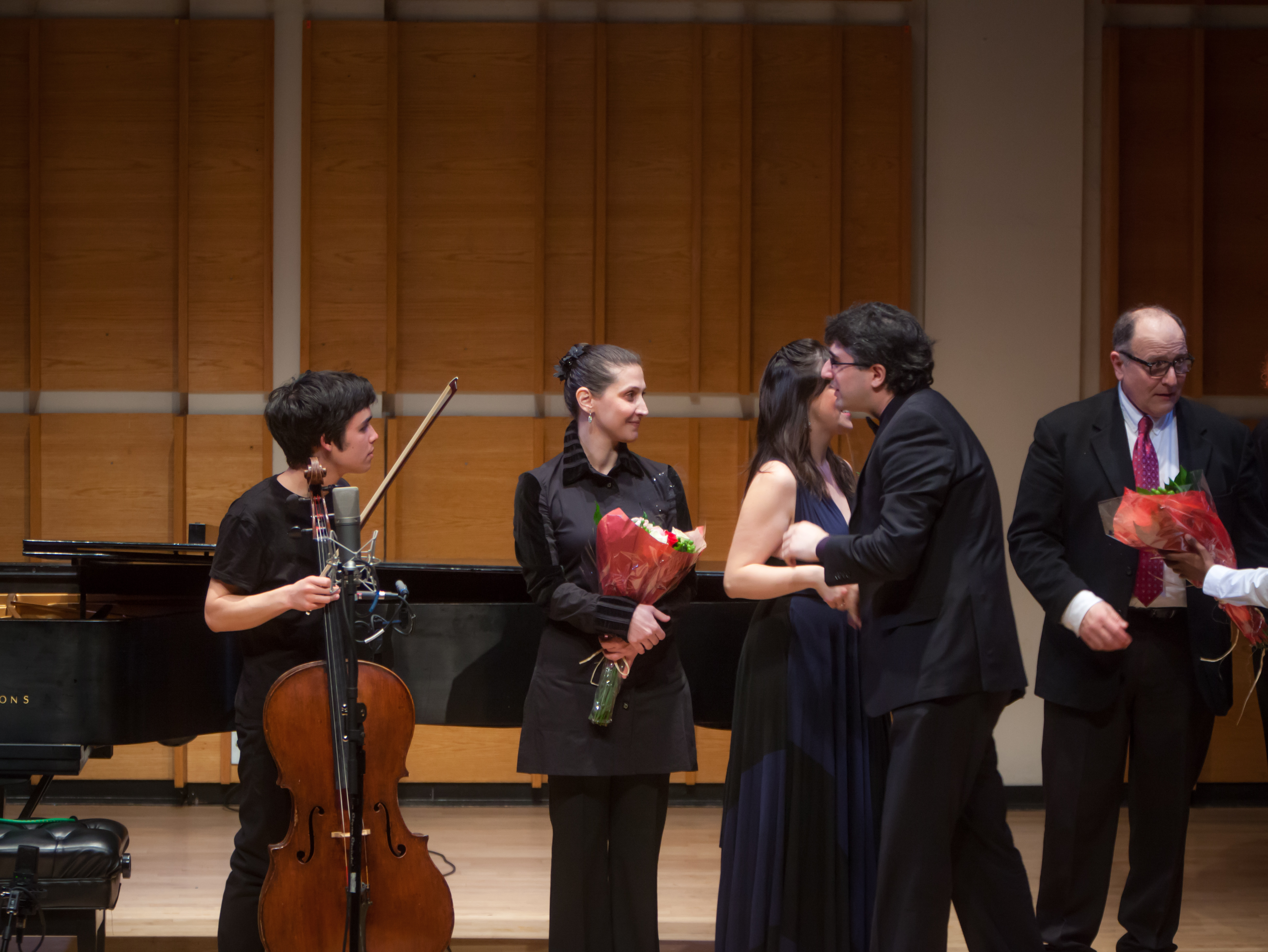
Musica de Camara:“La Passione” A Saint Valentine’s Celebration
Romantic works by Bach, Chopin, Mozart, Schubert, Montsalvatge, Schumann
Byron Marc Sean, piano; Brian Sanders, cello; Camille Ortiz-Lafont, soprano
Christ and St Stephens Church; New York, NY
February 14, 2014


Musica de Camara is a thirty-four year old organization with the valuable mission of increasing performance opportunities and audience awareness in minority communities, especially, but not exclusively, among Hispanics and Latinos. An enthusiastic audience turned out for the concert, a respite from the relentless February weather. The founder of Musica de Camara, Eva de la O, was the personification of charm in her pre-concert greeting, in which she shared her dismay at a radio interview when she was a performer (soprano), during which the interviewer said that he didn’t know there were any Puerto Rican classical musicians, or any appreciation of the repertoire.

All the selections were from the standard repertoire, appropriate for a lighter “Valentine’s Day” event, although I would have welcomed some contemporary Latin classical music, to bolster the mission statement. I understand this will occur on their next concert. Again, in keeping with the spirit of the occasion, I can report that all the performances were heartfelt, even when details slid by the board. In a program of such standard repertoire, the pressure on the musicians is much higher, because of inevitable comparison with all who have gone before. Each of the three musicians was very sensitive, but at their young stage of development, they may need further technical refinement to take their rightful place among the very best.

The discovery of the evening for me was the cellist Brian Sanders, who opened the program with two movements from Bach’s Suite for Solo Cello No. 3 in C Major, BWV 1009, played with flawless intonation, and natural phrasing, despite his unusual bow hold. It made me wish to hear the entire suite, which was probably considered too heavy for the occasion. Perhaps the tie-in with “Valentine’s” is that the only extant manuscript copy of the cello suites is in the hand of Bach’s second wife, Maria Magdalena.

Pianist Byron Marc Sean followed with a rendition of Chopin’s Berceuse, Op 57. One critic compared the colors of the piece to the “shifting hues of an eggshell,” and for the performer the piece can be like walking on those same shells, so exposed and delicate is the writing. The tempo and lyricism were appealing, but it lacked the ultimate intimacy, delicacy, and repose to make it a convincing lullaby. Perhaps some of this was due to opening nerves and a strident piano heard on a tile floor with no absorbing textiles.

Soprano Camille Ortiz-Lafont then performed two art songs by Mozart. The wistful Abendempfindung (Evening Mood) was charming, if somewhat forced. An Chloë (To Chloe) was performed too slowly for this impetuous, adolescent “study” for the character of Cherubino. Both were marred by peculiarities in the German diction.

Mr. Sean found a better match in his rendition of Chopin’s Barcarolle, Op 60, where the tempo and big line were nicely managed, even when certain passages were a bit approximate. However, in the magical “kiss in the gondola” moment, marked dolce sfogato (gently expressed) by Chopin, Mr. Sean’s moment was expressed none too gently. After intermission, Mr. Sean found his stride with his best performance: Chopin’s B Flat Minor Nocturne, Op 9, No. 1. Here his lyricism was heard to advantage, and he handled the repetitive middle section with much more color than is often heard.

Ms. Ortiz-Lafont sang two of Schubert’s best-known songs: Die Forelle (The Trout) and Gretchen am Spinnrade (Gretchen at the Spinning Wheel). In both, the tempi were pushed, depriving the music of charm in the first song, and cumulative passion in the second. I don’t imagine that any of today’s young people have ever seen a spinning wheel, let alone operated one, to understand the “tempo” at which it performs its work. Again, the German diction was so peculiar that it undermined Ms. Ortiz-Lafont’s emotional involvement with the music. Her high notes tend to stick out from the rest of her tone, rather than integrate into her pleasing general sound. Then, as if from heaven, she followed with two songs by the Spanish Catalan composer Xavier Montsalvatge from his Cinco Canciones Negras. Singing in her native language released a flood of effortless musicality and charm that I knew she possessed. Mr. Sean rose to the occasion with fine collaborative pianism.

The concert concluded with the return of cellist Sanders and pianist Sean in the Three Fantasy Pieces by Schumann, Op 73. These were performed with beautiful soaring cello tone, perfect intonation and vibrato, and really fine piano colors underneath. Romantic ardor was entirely present and given realization by both performers. The audience was duly thrilled.

Ms. Ortiz-Lafont favored the room with the delicious encore Del Cabello mas sutil by Fernando Obradors.

Share

Distinguished Concerts International New York (DCINY) Artists Series presents Nordic Voices in Review

Distinguished Concerts International New York (DCINY) Artists Series presents Nordic Voices in Review

Distinguished Concerts International New York (DCINY) Artists Series presents Nordic Voices
Nordic Voices- Tone Braaten and Ingrid Hanken, soprano; Ebba Rydh, mezzo-soprano; Per Kristian Amundrøy, tenor; Frank Havrøy, baritone; Trond Olav Reinholdsten, bass
Weill Recital Hall at Carnegie Hall; New York, NY
February 2, 2014

Scheduled the same evening as the Super Bowl, Nordic Voices appeared in concert at Weill Recital Hall. It was gratifying to see a packed house- an indication that there are people besides me who couldn’t care less about the other event taking place at the same time. Before I get to my review proper, I have an admission to make – I arrived at the concert late and missed the first four pieces. Although I do feel that my discussion of the remaining ten works will give a valid appraisal of the concert, my responsibility to the performers, presenters and other readers of this review impels me to let them know why I will not be discussing these works. I am reminded of a music critic whose “review” of a concert which he failed to attend was published in a major New York newspaper. Unfortunately for him, the concert never took place, having been cancelled at the very last moment.

I arrived during spoken commentary from the stage introducing two works from György Ligeti’s “Nonsense Madrigals,” a collection of settings from “Alice in Wonderland.” As no printed texts and translations were distributed, many of the tonight’s works were introduced in this manner. Although readers of my reviews know that I like to follow the texts/translations word by word, Nordic Voices and many other performers have begun to realize that very few people do. Tonight’s introductions couldn’t have been better – they were enunciated well enough to be heard in the back row of the hall, were informative and witty, and helped to create a warm relationship between the performers and their audience. The performances were all one could ask for, as the extended vocal techniques and rhythmic complexities were handled with consummate skill and ease. This was the case in all of the more experimental works which were to follow. I am confident this was so in the works by Lasse Thorsten and Bjarne Sløgedal which opened the program.

The first half ended with a spirited rendition of “Les chants des oiseaux,” a chanson by the Renaissance composer Clément Janequin. Nordic Voices also performed this work on a 2004 concert which I reviewed for this publication. In that review, I chided them for not following “the rules of musica ficta [which] dictate that leading tones in cadences are always sung a half step below the tonic, even when they appear otherwise in the printed score.”  I am sorry to say that they did not take this to heart and made the same error on tonight’s concert. Saddened might be a better word than sorry, for this is not a matter of interpretation, and is similar to singing the same wrong note each time a passage is repeated in the course of a composition.

The second half began with an exquisite performance of the motet “Ecclesie militantis” by the Early Renaissance composer Guillaume Dufay. The pure non-vibrato sound of the female singers, the perfect intonation, the rhythmic clarity, and the beautifully shaped polyphonic lines all made me wish I had heard their performance of the two Renaissance motets by Thomás Luis de Victoria which I missed on the first half. What is more, Nordic Voices did follow the rules of musica ficta during the Dufay motet, even singing the wild double-leading-tone cadence at the end. I wonder what did they do with the Victoria?

A series of contrasting works followed. First the ethereal simplicity of “Predicasti,” a Medieval chant. Then the fiendishly difficult “O Magnum mysterium” by Henrick Ødegaard, during which Nordic Voices “pulled out all the stops” and gave us a demonstration of extended vocal techniques which boggled the mind. One is just amazed that the human voice can create all those sounds. This serious work was followed by three movements from Goffredo Petrassi’s whimsical “Nonsense,” settings of limericks by Edward Lear. The lighthearted subject matter and matching theatrical performance tend to hide that fact that these also very difficult pieces which Nordic Singers performed with consummate skill and ease. During Maurice Ravel’s chanson “Trois beaux oiseaux du Paradis,” we all could luxuriate in Nordic Voices’ beautiful sound.

A work by Frank Havrøy, Nordic Voices’ baritone, concluded the concert. “Bysjan, bysjan lite bån” (“Hush, hush, little child”) showcases two qualities which make Nordic Voices a unique ensemble – their skill with extended vocal techniques and their beautiful ensemble sound.  Without spoken comment, the singers moved off the stage, the women to the aisle on the audience’s left, the men to the aisle on the right. The work’s long, soft wordless opening featured extended vocal techniques. It was followed by a most beautiful setting of what I took to be a Norwegian folk song and another beautiful folksong setting served as the concert’s gentle encore.

Share

International Performing Artists presents Xiayin Wang, Piano in Review

International Performing Artists presents Xiayin Wang, Piano in Review

International Performing Artists presents Xiayin Wang, Piano
Escher Quartet: Adam Barnett-Hart and Aaron Boyd, violin; Pierre Lapointe, viola; Dane Johansen, cello
Merkin Concert Hall, Kaufman Music Center; New York, NY
January 27, 2014


In a concert presented by International Performing Artists, pianist Xiayin Wang joined with the Escher Quartet in works by Fauré, Piazzolla, and Schumann. Both Ms. Wang and the Escher Quartet are much in-demand performers who have appeared in venues around the world and enjoy countless accolades. This pairing of highly accomplished artists had the promise of being an evening filled with masterful music making.

The Piano Quartet No. 1 in C minor, Op. 15 by Gabriel Fauré (a last minute change from the scheduled Piano Quartet No.2 in G minor, Op. 45 by the same composer) opened the program. There were intonation issues at the beginning of the Allegro molto moderato that got things off to a problematic start, especially in contrast to the pristine piano work. Eventually, this all came under control.  The excellent solos from the string players were highlights of the opening movement.  The Scherzo sparkled, and the sorrowful Adagio was beautifully played. It is said this movement was influenced by Fauré’s heartache about his broken engagement to Marieanne Viardot, and one can feel it.  The ending impression was mixed – the notes were there, and the playing (other than the intonation issues) was polished, but the feeling of a true ensemble was not altogether present. It did seem like a case of three plus one, instead of a true quartet. Ms. Wang is a fine pianist, and her playing in this demanding work was truly exceptional, but her laser-like focus on the virtuosic aspects of her part gave the impression of a mini-concerto performance as opposed to chamber music.  One can speculate why this was – perhaps the last minute change of program? In any case, it was a solid, if less than completely satisfying, performance.

Three works from Astor Piazzolla, Otono Porteño, Oblivion, and Libertango, in arrangements by the composer-pianist Clint Edwards, followed the Fauré.  Mr. Edwards captured the essence of these pieces in his effective arrangements.  From the pizzicato opening of Otono Porteño, through the poignant laments of Oblivion, and finally the tease of a lugubrious opening of the Libertango that finally burst into the saucy tango style that Piazzolla was so famous for, it was played with a perfect mix of spice and substance. It was an enjoyable end to the first half that showed both Ms. Wang and the Escher to great advantage.

After intermission, the Piano Quintet in E-flat major, Op. 44 from Robert Schumann was the only work on the second half. Written for and dedicated to Schumann’s wife, Clara, during a period when the composer had finally won his battle to marry his beloved, this work is the product of a musician at the height of his powers and with seemingly limitless creative energy. The history of this 1842 work is highly interesting in many ways. The idea of combining a piano part with a standard string quartet had never be done prior to this work; the excellent program notes state that this was the first piano quintet written, but that is technically not entirely accurate, because other composers, notably Schubert in the Trout Quintet, wrote for quintet using the double bass in place of the second violin. In any case, one must credit Schumann with the invention of a new form of chamber music. Incidentally, during a private performance prior to the public premiere, Clara was too ill to play, so Felix Mendelssohn stepped in and sight-read the piano part! Mendelssohn also suggested an addition of a second trio in the scherzo, which Schumann added.

Whatever reservations I had about the interaction of Ms. Wang with the Escher were not an issue during the Schumann.  Ms. Wang was fully engaged with her partners at all times in a performance that was worthy of this great composition. Ms. Wang made short work of the difficult piano part with ease, as one would expect from a player of her caliber, but with the added dimension of a true collaborator instead of soloist in an ad hoc role. This was the synthesis of dynamic forces that I had been hoping for earlier. It was “all-for-one, and one-for-all” playing that I would normally associate with players who have an extensive history together.  The end result was a performance that was well conceived in its bold, joyful, and optimistic outlook. I am still basking in its afterglow.

Share

Distinguished Concerts International New York (DCINY) presents: The Music of Karl Jenkins 70th Birthday Celebration

Distinguished Concerts International New York (DCINY) presents: The Music of Karl Jenkins 70th Birthday Celebration

Distinguished Concerts International New York (DCINY) presents: The Music of Karl Jenkins 70th Birthday Celebration
Distinguished Concerts Orchestra, Distinguished Concerts Singers International
Jonathan Griffith, conductor; Rhys Meirion, tenor; Darik Knutsen, baritone; Charlotte Daw Paulsen mezzo-soprano; Samuel Smith, bass-baritone; Belinda Sykes, ethnic vocals and mey; Karl Jenkins, composer-in-residence/conductor
Stern Auditorium, Carnegie Hall, New York, NY
January 20, 2014

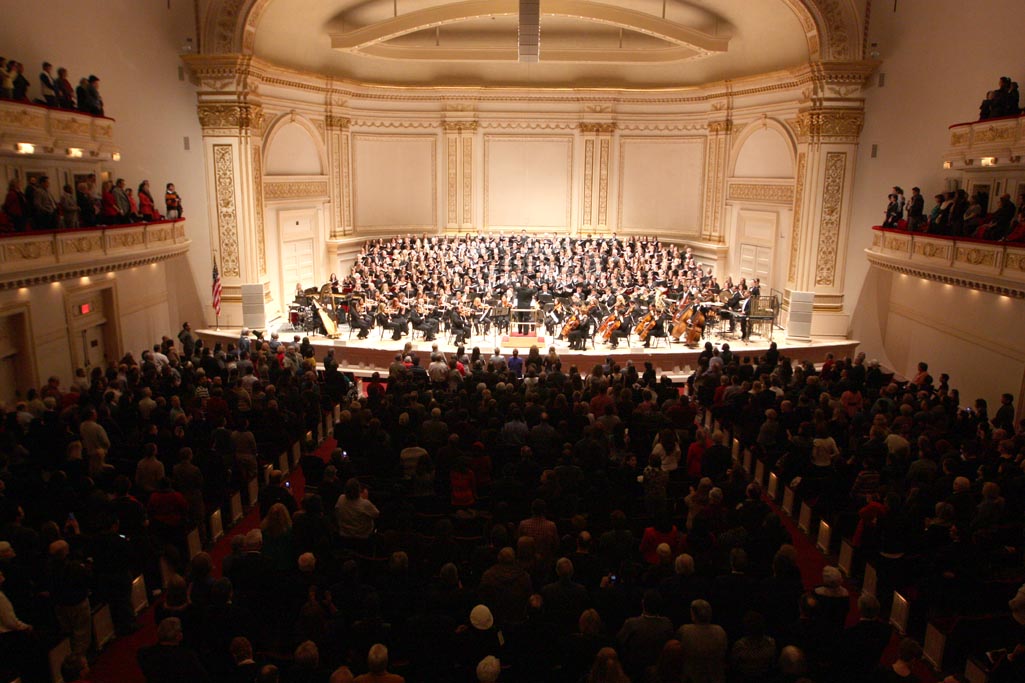
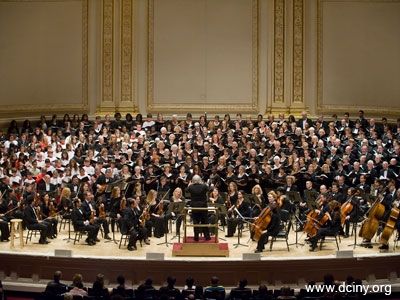
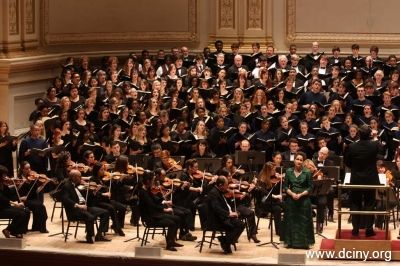
In what has become a tradition on the celebration of Martin Luther King, Jr. Day, Distinguished Concerts International New York (DCINY) presented a concert featuring the music of Karl Jenkins. This year’s event had the added dimension of being a 70th birthday celebration for the Welsh composer. Arguably one of the most popular living composers and indisputably one of the most frequently performed, Karl Jenkins and DCINY have a special relationship. DCINY has given countless premieres of his newest compositions and continues to give top-notch performances of his works to enormous public response.  As one watched the singers fill the back of the stage, overflowing onto the right wing, one could not help sharing in the eager anticipation. The program included The Bards of Wales (United States Premiere), the Benedictus from The Armed Man: A Mass for Peace, and the Stabat Mater. With performers from California, Georgia, Minnesota, North Carolina, Argentina, Canada, France, Hungary, New Zealand, The Netherlands, and “individuals from around the globe” (the program listing 579 singers!), the stage was set for what was to be a spectacular evening.

The concert opened with the cantata, The Bards of Wales. What could be more natural for a Welsh composer than to use as a text than a poem entitled “The Bards of Wales”? Interestingly enough, this poem was not written by a Welshman, but by the Hungarian poet Janós Arany (1817-1882). Asked to write a poem of praise for the occasion of a visit to Budapest by Emperor Franz Joseph (only eight years after the Hapsburg empire crushed Hungary’s War of Independence), Arany chose to compose a ballad based on the ancient Welsh legend of how King Edward I of England had 500 Welsh bards executed for failing to sing his praises at a banquet in 1277. The message was unmistakable: the truth must be told, at whatever sacrifice.  The Bards of Wales is a nine-movement work scored for orchestra, chorus, and tenor, baritone, bass-baritone, and mezzo-soprano soloists that can be sung in Hungarian, Welsh, or English. On this occasion, the English version, as translated by Peter Zollman (1931-2013), was used. Tenor Rhys Meirion was cast as King Edward I. Baritone Darik Knutsen had a double role as a minstrel and bard, while bass-baritone Samuel Smith and mezzo-soprano Charlotte Daw Paulsen also took roles as bards.


What strikes the experienced Jenkins listener as singular about The Bards of Wales is the complete absence of any of the multi-ethnic influences that Karl Jenkins is so well known for using in his works (answering any naysayers who carp about so-called multicultural “gimmicks” for effect).  The sound is uniquely his own, and I would easily know this is a Jenkins work without being told. That is not to say that there is anything formulaic in it, as only fragments resembled earlier compositions (the movement “His Men went forth” resembling a hybrid of material from L’homme Armé or Charge! movements of The Armed Man).

Rhys Meirion sang and acted his role with gusto in a performance that bespoke the haughty arrogance of Edward, his vanity, cruelty, and in the end, his torment. He definitely has charisma in spades! Not to be overlooked, Darik Knutsen, Samuel Smith, and Charlotte Daw Paulsen projected the brave stand of the bards with great skill, the defiant tone coming to the fore with strength and dignity. Conductor Jonathan Griffith led the huge forces with his customary skill.  The Bards of Wales is filled with dramatic effect, from the cannon shots of the first movement to the martyrdom of the fallen bards in the last. This is a work I very much wish to hear again, and I am hoping it will be recorded (in English, that is  – there is already a recording in Hungarian on CMI Records). Are you listening, Deutsche Grammophon? I will be the first to buy it!

After the last notes were sounded, the audience leapt to their feet in appreciation. Mr. Jenkins came to the front of the stage to accept the standing ovation. After the applause died away, he took to the podium to conduct the Benedictus from his work The Armed Man: A Mass for Peace. The seven-and-a-half minute twelfth movement of The Armed Man, the Benedictus is often played as a stand-alone piece and has been arranged for numerous combinations of instruments (notably a version with the brilliant euphonium player David Childs). Here it was given in its original form with orchestra and chorus.  The Benedictus is a beatific work, extremely moving in its simplicity. One holds one’s breath as an ethereal cello solo floats over hushed orchestral accompaniment before the chorus seamlessly enters, leading to an ecstatic explosion of percussion to the words Hosanna in excelsis – a supremely moving inspiration. I wish I knew the name of the solo cellist; her playing was quite beautiful and she deserves mention. Mr. Jenkins is an able conductor and his understated approach was perfect. It was a magical end to the first half.

After intermission, Mr. Jenkins was brought to the stage before the performance of the Stabat Mater. A letter of congratulations and birthday greetings from New York City mayor Bill de Blasio was read. Jonathan Griffith led the audience in singing “Happy Birthday” (for the purists, Jenkins’ actual birthday is February 17). A jumbo-sized card that was signed by hundreds of people was presented to Mr. Jenkins. A bashful-looking Jenkins nodded his thanks to all before leaving the stage.

Maestro Griffith then took to the podium to conduct the Stabat Mater. I have something of a special relationship with this work. I was in attendance when DCINY gave the US Premiere on January 19, 2009 at Avery Fisher Hall. I confess that I was initially reluctant to attend, as my impression of Karl Jenkins and his music was based solely on a DeBeers diamond advertising campaign that I absolutely despised! After hearing the Stabat Mater, I realized how shortsighted and wrong that preconception was. I was moved in a way that I have rarely experienced on the first hearing of a musical work. I went from skeptic to believer in the space of the twelve movements of this piece and rushed out the next day to purchase the recording. My musical life was changed, as I became a great admirer of Karl Jenkins and his works.  It has been a mounting source of irritation to me that snobbish musical circles often look askance at a composer because he is “popular” and his work is “tonal”. It is not a zero-sum proposition: one can love the music of Karl Jenkins and still love the most ultra-modern works without having to apologize for either.

Now, back to the Stabat Mater.  This twelve-movement work uses the text of the 13th century poem Stabat Mater Dolorosa for six of the movements. The other movements uses material from the Epic of Gilgamesh, lines from the 13th century Persian poet, Rumi, and original materials in a variety of languages, including  English, Arabic, Hebrew, Greek, Aramaic, and of course Latin. Scored for orchestra, including Middle Eastern percussion, chorus, mezzo-soprano and “ethnic vocals” soloists, this hour-long work is a powerful and profound piece that still continues to move me, even after countless hearings.

Mezzo-soprano Charlotte Daw Paulsen was radiant in the achingly beautiful Lament and the despairing Are you lost out in darkness?  Special mention must be made of the incredible Belinda Sykes. Her playing of the double-reed mey and her amazing passion-filled vocals floored me in 2009 (especially in the Incantations and Are you lost out in darkness? movements), and they did so again in 2014. I simply cannot imagine any other performer in her role in this work! Highlights are too numerous to list individually, but I will mention the Cantus lacrimosus, Sancta Mater, and And the Mother did weep as personal favorites for the night.


The final movement, the Paradisi Gloria, starts as a smoldering flame that bursts into a full-blown inferno, bringing this work to a close. I was slightly disappointed that there were no chorus members in the balcony as there were in 2009, but nonetheless it was a powerful conclusion to a first-rate performance. Maestro Griffith is simply masterful at how he handles such gargantuan forces with such apparent ease. The Distinguished Concerts Orchestra and the Distinguished Concerts Singers International must be congratulated for their excellent work as well. The thunderous ovation was every bit deserved.

Pen-blwydd Hapus, Karl Jenkins!  May your next seventy years be filled with good health so you can continue to write more wonderful music for the world to enjoy!

Share

Distinguished Concerts International New York (DCINY) presents: Of Life and Liberty in Review

Distinguished Concerts International New York (DCINY) presents: Of Life and Liberty in Review

Distinguished Concerts International New York (DCINY) presents: Of Life and Liberty
Distinguished Concerts Orchestra, Distinguished Concerts Singers International
Matt Oltman, conductor; James M. Meaders, conductor; Viola Dacus, mezzo-soprano
Stern Auditorium, Carnegie Hall, New York, NY
January 19, 2014

A Distinguished Concerts International New York (DCINY) concert is always a memorable experience. As I ran the gauntlet of massed chorus members from Mississippi assembled in the back area as I went to pick up my tickets, I was reminded of what the DCINY experience is all about. The excitement and nervousness of men and women of all ages in what was likely the thrill of a lifetime filled that very cramped space in such a way as to overwhelm me with a similar feeling. Any irritation I might have felt at that moment washed away when a smiling chorus member offered to sing the program if I were unable to retrieve my tickets! At last, the way was cleared, and I wished them all the best of luck.

The World Premiere of The Gettysburg Address in a new arrangement for men’s voices from Mark Hayes (b. 1953) opened the concert.  In my review in this journal from May 27, 2013 (“Requiems for the Brave”), when this work was performed in its original version for mixed voices and orchestra, I wrote the following:

“About The Gettysburg Address [the music], Mr. Hayes in his program notes writes, ‘…the challenge of creating something musically profound was overwhelming.’ These ten sentences [the address itself] are filled with sadness, hope, challenge, and triumph in what is probably the most famous speech in American History. Mr. Hayes’ conception captures all of these elements, from the bold opening, played with a brash exuberance, to the somber colors of the sorrows of war, to the final build-up in a martial style culminating with repeated declarations of “for the people” from the chorus.  It is a powerful work that does justice to Lincoln’s immortal words.”

In this revised version I find my initial thoughts to be unchanged. If anything, the effect is deepened by the use of men’s voices alone.  The Testament of Freedom, from underappreciated composer Randall Thompson (1899-1984), followed. Commissioned in 1943 to celebrate the bicentennial of the birth of Thomas Jefferson, this work has become a favorite for men’s choruses. When one hears the work, it is easy to see why this is the case: hymn-like melodies, stirring text, and expert vocal writing.  Thompson used the writings of Jefferson for the text of the four movements, with a strong focus on Jefferson’s unwavering belief in the unalienable rights of man. The chorus, consisting of members from Minnesota, Illinois, Idaho, Indiana, South Carolina, Florida, Massachusetts, and Alberta, Canada sang with strength, clear diction, and fine balance throughout. The third movement, “We fight not for glory,” was the highlight to this listener, but the whole performance was excellent. The animated Matt Oltman was a dynamic conductor who coaxed every last ounce of dramatic energy from both the chorus and the Distinguished Concerts Orchestra in both works.

The second half consisted of the New York premiere of Requiem for the Living from composer Dan Forrest (b. 1978). About the title Mr. Forrest writes, “the five movements form a narrative just as much for the living, and their own struggle with pain and sorrow, as for the dead.” Mr. Forrest freely used the standard mass as a model, with the substitution of a movement he entitled Vanitas Vanitatum (quoting from the Book of Job and Ecclesiastes) in place of the Dies Irae. This work is by no means complex in the vocal writing or the harmonic language, but the net effect is one of great import. Requiem for the Living is one of the most moving works I have heard in a very long while. It is truly a case of the maximum effect from the minimum of means, the mark of a highly skilled composer. It was a performance to remember, from the quiet opening of the Introit and Kyrie, the driving energy of the sinister Vanitas Vanitatum, and the serene Agnus Dei, to the celestial influenced magic of the Sanctus and hauntingly beautiful Lux Aeterna, which slowly faded away to nothing. In the Agnus Dei and Lux Aeterna, Mezzo-soprano soloist Viola Dacus sang with a pure, radiant voice that captured the essence of child-like innocence. Conductor James M. Meaders led the Distinguished Concerts Orchestra and the chorus with meticulous restraint and close attention to detail. When he lowered his baton after the sound died away, the audience erupted into a prolonged ovation. Congratulations, my new friends from Mississippi, you were all stars today.

Share

Suzanna Klintcharova: La Belle Époque de la Harpe, Volume #1:  CD in Review

Suzanna Klintcharova: La Belle Époque de la Harpe, Volume #1: CD in Review

Suzanna Klintcharova: La Belle Époque de la Harpe, Volume #1
Suzanna Klintcharova, harp
VMS Zappel Music: VMS 231
www.zappelmusic.com


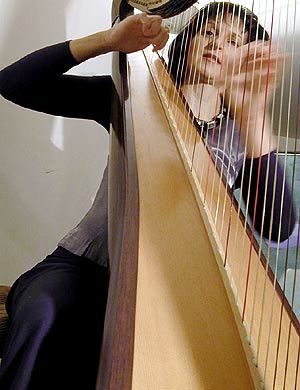
The first of Suzanna Klintcharova’s trio of discs, La Belle Époque de la Harpe, is devoted exclusively to solo compositions for the harp by French composers, from the end of the 19th century through the first decades of the 20th.  It is a twofold revelation to hear this intelligent artist at work, and to encounter the wealth of delights this specific repertoire offers.

The selections presented in this compilation cover a variety of compositional styles, chosen from a relatively short historical period. In them one can almost trace the development of both French music and of harp technique in this era.  The Gallic fascination with Spanish rhythm, the use of ancient modes, and an adherence to triple meter are woven throughout these diverse works.

Ms. Klintcharova chose two giants of French music, Gabriel Fauré and Camille Saint-Saëns, to initiate this collection.  Fauré’s voice is endearingly familiar, yet what makes his Impromptu, Op. 86, distinctive are the extreme contrasts in his writing.  He exploits the full range of the instrument, ventures slightly off- center harmonically, and alternates between passages of great elegance and ones of stark drama.  By comparison, Saint-Saëns’s Fantasie, Op. 95, is attractive, but tamer in overall scope.  He was a gifted melodist, and in this piece there is a potpourri of beautiful tunes, from salon waltzes to troubadour chansons.  Ms. Klintcharova’s keen attention to voicing and articulation are a great asset in both works.  To round out the first part of this set, the harpist offers a charming interpretation of Gabriel Pierné’s Impromptu Caprice, Op. 9 ter, complete with musicalized birdcalls and a snappy bolero.  This would make a terrific recital encore – neat and accessible with a strong bravura finish.

With Albert Roussel’s Impromptu, Op. 21, written for the great harpist Lily Laskine, the artist takes us further along the path into modernist territory.  Roussel’s language is more dissonant and rhythmically driven, yet still maintains the hallmarks of French writing – modal melodies, Impressionistic harmonies, feathery glissandi.  Again, the harpist’s pristine technique and infallible sense of time are well suited to Roussel’s writing.  André Caplet’s Deux Divertissements, one in the French style and one in Spanish, reinforce my impression that Caplet is an underrated composer.   Based on this performance, and the one of his Conte Fantastique in the second CD of this set, Ms. Klintcharova is making a great case for his renewed popularity.    Caplet’s eccentric subtitles (i.e. ”with a graceful curve and well draped”) are worthy of Erik Satie.  His coloristic effects, including mordant metallic chords and an impressively accurate imitation of guitar strumming, are rendered perfectly by the harpist.

Ms. Klintcharova, as much an historian as an artist, scores a coup with the inclusion of Marcel Tournier’s less well-known Sonatine No. 2, Op. 45.  Tournier, a prolific performer, composer and educator, expands upon the traditions of French harp writing with fascinating results.  The Sonatine calls for a player with great facility and imagination, as it ranges from the most delicate, exotic dances, to full-blown Romanticism and exacting passagework.  Ms. Klintcharova has the stamina and talent to pull all this off.  It would be difficult to find a better introduction to the “Belle Époque” than the one provided here in this very satisfying recording.  I look forward to hearing more of Suzanna Klintcharova’s work in future ventures.

Share

Opus Two Presents the Music of George Gershwin in Review

Opus Two Presents the Music of George Gershwin in Review

Opus Two Presents the Music of George Gershwin
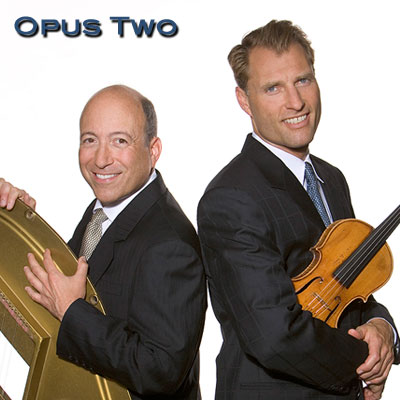
Opus Two: William Terwilliger, violin; Andrew Cooperstock, piano
Bruno Walter Auditorium, New York, NY
December 28, 2013

On an unusually warm December day, I made my way to the Bruno Walter Auditorium to hear a performance of the music of George Gershwin by the duo Opus Two. I was expecting a smaller crowd because of the holiday weekend and the early afternoon starting time. Imagine my surprise, upon arriving, at the sight of a long line of about seventy people all hoping to get in, even though the hall was already filled! Luckily, my place was reserved.  A few other lucky people in this line gained entry and were treated to what was part concert, part lecture, and part sentimental retrospective.

Opus Two boasts the combined talents of William Terwilliger, violin, and Andrew Cooperstock, piano. This well-travelled duo with performances around the globe is especially renowned for championing American music and composers. What could be more American than the works of George Gershwin? Opening with Jascha Heifetz’s arrangement of “Summertime”, from Gershwin’s masterpiece Porgy and Bess, the duo gave the audience a taste of what was to follow. The performers then introduced themselves and alternated turns at the podium as they spoke of Gershwin. They included a few well-known anecdotes, including the oft-quoted one from Maurice Ravel (when Gershwin sought composition lessons from the French genius): “Why do you want to be a second-rate Ravel when you are already a first-rate Gershwin?”  It was time for the concert proper to commence.

First up came Selections from Porgy and Bess as arranged by Jascha Heifetz. The renowned Heifetz had been quick to recognize the appeal of Gershwin’s music and was savvy enough to capitalize on that demand by making arrangements that highlighted his own virtuosic talents. Porgy and Bess is the best known of these arrangements and continues to delight listeners to this day. The playing from Opus Two was assured, from the restless “Summertime” (yes, again), to the laments of “My Man’s Gone Now”, to the joyous “Bess, You is My Woman Now’, to the biting irony of “It Ain’t Necessarily So”. Images by African-American period photographer, Richard Samuel Roberts, were projected on a large screen behind the performers and were a perfect visual accompaniment to the music.  It reminded me of the style of Ken Burns in his various documentaries and was an inspired touch. This was the sort of imaginative conception that one hopes for, even expects, when two exceptional musicians who really are of the same mind and spirit join together.  Opus Two fulfilled this expectation throughout the concert.

Short Story, for Violin and Piano, was the only work originally written for this combination by Gershwin himself. The violinist Samuel Dushkin, a friend of Gershwin and a renowned performer in his own right (Stravinsky wrote his Violin Concerto for Dushkin in 1931), offered technical advice on the violin part.  Gershwin and Dushkin premiered this three-minute work, which has all the hallmarks of Gershwin’s style- rhythmic vitality and catchy tunes (in this case laced with the blues and ragtime).  But, for whatever reason, it never caught on with other performers and disappeared in oblivion. While admittedly not up to the standards of his later mature works, it is still worthy of attention, and the fine performance from the duo made that point clear. Kudos to Opus Two, for both their sophisticated reading and for sharing this little-known gem, which should gladden the heart of any Gershwin fan.

The Three Preludes for Piano, also arranged for violin and piano by Heifetz, followed and were played with stylish assurance. While I prefer the original, this arrangement was highly effective.

Excerpts from An American in Paris, which were partially arranged by Heifetz and later expanded by Ayke Agus in 2005, were introduced by a short talk and video selection from the movie featuring Gene Kelly and Leslie Caron dancing a pas de deux (as choreographed by Kelly) to set the mood. The players’ casual commentary included the remark, “They don’t make them like that anymore!” No, they sure don’t!   Violinist William Terwilliger joked about how he would be simulating the sounds of car horns with his violin. This work shows the ever-maturing Gershwin’s progress from song plugger to “serious” composer, with French influences (Debussy and Ravel), yet in his own highly characteristic voice.  Opus Two played with appropriate elegance and wit in yet another winning performance.

Composer Eric Stern continued the Heifetz tradition with his own arrangement of Selections from Girl Crazy, written especially for Opus Two.  Another video, this time Judy Garland singing “Bidin’ My Time” from the movie version of Girl Crazy, was played and brought smiles to all as a reminder of a golden age.  Returning to their performance, Opus Two presented Stern’s arrangement with panache.  Including the unforgettable classics, “Embraceable You” and “I Got Rhythm”, this transcription was destined to be a crowd pleaser. The same energy and commitment with which the duo started the concert were still very much in effect, in even more refined playing. The lazy drawl of “Bidin’ My Time”, the enchanting “Embraceable You”, and an electric “I Got Rhythm” ended the piece and the concert in triumph. The audience demanded more, so for an encore, Opus Two offered a favorite from another one of America’s most loved composers, Aaron Copland, “Hoedown” from Rodeo.  Played with brio, it was a fitting close to a most enjoyable concert.


Share

USA-Japan Goodwill Mission Concert in Review

USA-Japan Goodwill Mission Concert in Review

USA-Japan Goodwill Mission Concert
New York Festival Orchestra, Beethoven Memorial Chorus
Hideaki Hirai, Music Director and Conductor; Hideyuki Tsuji, Choral Conductor
Naomi Satake, soprano; Francesca Lunghi, alto; Paul Williamson, tenor; Katsuji Miura, bass-baritone
Stern Auditorium at Carnegie Hall, New York, NY
December 26, 2013

In order to raise money for the victims of Typhoon Haiyan in the Philippines, a benefit concert entitled “USA-Japan Goodwill Mission Concert” was held at Stern Auditorium at Carnegie Hall on the evening of December 26, 2013. Raising money for a good cause is always a welcome activity, and I commend the organizers for this. It is thus with reluctance that I take issue with the chosen program. It seemed that there were two concerts slapped together to be one, without any thought as to the appropriateness of having Beethoven’s Symphony No. 9 in D minor, Op. 125, the Choral, paired with a motley assortment of popular songs.

I am not a music snob. I love the popular music of the 1980s and can probably identify within a few seconds any song from that era that received airplay. I love music of all genres and eras.  I also love the 9th Symphony of Beethoven. As one who does, I find the idea of “Meet the Flintstones on the same program as the Beethoven to be bizarre in the extreme. The clashing of Schiller’s “Götterfunken!” with Hanna-Barbera’s “Wilmaaaaaa!” is still filling my ears with horror, as the ghost of Kafka smiles with a knowing nod. “O Freunde, nicht diese Töne!” To have any work follow this monument of the Western music canon shows a lack of respect to the sheer magnitude of this masterpiece, but to follow it with show tunes, popular music performed in a style strongly akin to a Glee episode, and Barbershop with slapstick, was the musical equivalent of Marcel Duchamp’s treatment of La Gioconda in his L.H.O.O.Q.  I would have been perfectly content with either half standing alone, but NEVER paired together.

My programming objection in no way is meant to disparage the performers in the second half, as they were all very entertaining and gave energetic, crowd-pleasing and wholly committed performances. The No Borders Youth Chorus, an all-male a cappella chorus with young men from the United States, Canada, and China, led by Joe Cerutti, was delightful, and the barbershop quartet, Lunch Break, was hilarious in their set. It was just a shame that the net effect of each mismatched half was to nullify the value of the other through the pairing.

The program did not list the movements of the Beethoven, nor include the text of the Ode to Joy. If there was an assumption of familiarity as a reason for the omission, it proved to be completely unfounded.  Applause between the movements and ear-shattering yelling from the audience from the start of the Alla Marcia section in the finale (for a good ten seconds), were proof enough of not only a lack of familiarity with the work, but a lack of familiarity with how to behave at a classical concert. Enthusiasm is good, but yelling loudly is never appropriate. To his credit, conductor Hideaki Hirai endured these interruptions with grace and did not allow them to distract him or the orchestra.

The New York Festival Orchestra, consisting of players from throughout the United States, was specially formed for this concert. Usually one expects some roughness from groups of this nature, and while there were a few instances of this, the playing overall was polished and the ensemble remarkably unified, as if they had been together for a long period of time. From the tremolos that open the work, to the timpani bursts in the Scherzo, the sublime Adagio in the third movement, to the Prestissimo of the final bars of the epic last movement, it was a highly satisfying performance.

The Beethoven Memorial Chorus was made up of singers from Japan and the United States, all with extensive experience performing the 9th Symphony. This experience showed in their rock-solid performance. Bass-Baritone soloist Katsuji Miura projected with a powerful voice that easily filled the hall with its bold resonance. Soprano Naomi Satake’s voice soared with passion, while Tenor Paul Williamson and Alto Francesca Lunghi enriched the textures with their considerable talents.

Maestro Hirai was especially impressive. Conducting from memory, he demonstrated his deep knowledge of the score with unflagging energy and intense concentration. He was dynamic, confident, and completely engaged for the entire 75 minutes.  It was especially interesting to me that he “sang” along with the chorus with evident joy on his face.  It was among the best of the live performances I have heard of this work and justly deserving of the standing ovation it was accorded. Bravo to all!

Share

Gil Sullivan, Pianist in Review

Gil Sullivan, Pianist in Review

Gil Sullivan, Piano
MidAmerica Productions Presents: Gil Sullivan, piano
Weill Hall at Carnegie Hall, New York, NY
December 16, 2013
 
 
Gil Sullivan and Julian Cochran

Gil Sullivan and Julian Cochran


In a program presented by MidAmerica productions, Australian pianist Gil Sullivan offered a program of Mozart, Brahms, and works by his compatriot, Julian Cochran. The globetrotting Mr. Sullivan sports an impressive resume, with appearances in many of the world’s most renowned halls.

Opening with Mozart’s Sonata in F major, K. 533/494, the double Köchel number referring to the Rondo finale being composed well before the first two movements, Mr. Sullivan gave ample proof that his sterling reputation as a interpreter of Mozart is well deserved.  He offered a performance that explored the depths of one of Mozart’s most profound piano works with restrained, careful rendering and especial attention to matters of tone and phrasing. After the Mozart, Mr. Sullivan played four works (with a break for intermission after the first two) by fellow Australian Julian Cochran.

Julian Cochran (b. 1974) was born in Cambridge, England, but immigrated to Australia in 1978. Mr. Cochran is a mathematician specializing in Pure Mathematics, but has dedicated his talents more fully now towards music, as both a pianist and a composer.  When one hears mathematician and composer in the same sentence, it is not at all unreasonable to think of names like Babbitt and Xenakis, and to expect a similarity of style with a mathematical base. Such was not the case. The multi-talented Mr. Cochran is a throwback to the Romantic and Impressionistic traditions of the piano, using the musical language of Chopin, Liszt, Debussy, and Ravel, amongst others, in a highly individualistic, non-derivative manner.  On the program were two Preludes and two Mazurkas from his pen.

 Prelude No.7 (2010) is a work that has a theme that with a distinctly Romanian-inspired folk feeling. Variations on this theme are done in a similar folk style, building to a powerful climax with bell-like sounds that slowly fade into silence.  In his notes about Prelude No. 8 (2010), the composer makes reference to the nature of the ocean and the swirling opening subject.  I was reminded of Ondine from Gaspard de la Nuit, but with the additional twists hearkening back to motifs of Liszt, Debussy, and even Rachmaninoff. It is a work that is alternately serene and unsettled, glistening and turbulent. It builds to a brilliant climax, and then recedes into a quiet ending.  Much like Ondine, this work requires a formidable technique, which Mr. Sullivan possesses. It was an outstanding performance of a striking work and a fine ending to the first half.

 After intermission, next up were Mazurkas Nos.4 and 5. Mazurka No. 4 (2009) is a work that could be called Chopin’s Nightmare.  It has the qualities of an unsettled dream with the harmonic language almost mockingly omitting the fifth tone of the minor scale at all turns, while augmenting the fourth and diminishing the sixth. This Mazurka becomes a wild, dervish-like dance bordering on the grotesque before returning to the original theme.  About Mazurka No. 5 (2009, revised 2010), the composer writes that this work “may remind us of Ravel”. Indeed, one can detect hints of Ravel’s La Valse in this work. The writing is highly virtuosic, and in the hands of Mr. Sullivan it was given a masterful performance that accentuated its brilliance. Mr. Cochran was in attendance and joined Mr. Sullivan for bows on stage.  This is a composer who has learned his lessons well from the old masters while leaving his own distinctive mark. I would like to hear more from Mr. Cochran in the future.

 Ending the program with Brahms’s Sonata No. 2 in F-sharp minor, Op.2, Mr. Sullivan showed himself to be as comfortable in this massive structure as he was in the sparseness of the Mozart.   This work of a young Brahms is packed with bold ideas, virtuosic demands, and symphonic qualities that owe much to Robert Schumann’s influence. It is brash and designed to impress, and in this respect Mr. Sullivan delivered a power-packed performance. It was an exciting close to the concert by a pianist possessed of intelligence and technical prowess in equal measure.

As an encore, Mr. Sullivan offered the A-flat Polonaise, Op. 53 of Chopin, the Heroic, which he played in an exciting and highly individualistic manner (with liberties and additions to the score). The full-house audience loved it and roared their collective approval in a raucous ovation.

Share

The Second Coming in Review

The Second Coming in Review

The Second Coming
Ensemble du Monde, Marlon Daniel, Music Director and Conductor
Gwendolyn Howard, violin
Special guest: Hampson Sisler, composer
Society for Ethical Culture, New York, NY
December 14, 2013
 
World Premiere of the Oratorio The Second Coming by H. Sisler

World Premiere of the Oratorio The Second Coming by H. Sisler


In a concert to celebrate the release of the CD recording of The Second Coming by Hampson Sisler (b. 1932) on the MSR Classics label (MSR 1489: www.msrcd.com), Ensemble du Monde, with forces fifty strong under the direction of Marlon Daniel, gave a promotional performance of this new work. Those hearty souls who braved a snowstorm to get to the Ethical Culture concert hall were rewarded with not only the concert, but a reception afterwards to meet the performers.

Gwendolyn Howard, violin and Ensemble du Monde

Gwendolyn Howard, violin and Ensemble du Monde


Also on the program was Max Bruch’s Scottish Fantasy, featuring fifteen-year-old violin soloist Gwendolyn Howard, First Prize winner of the Ensemble du Monde Young Artists Concerto Competition. The modest and self-effacing Ms. Howard shyly took to the stage, giving no hint to the miraculous transformation that was about to take place. Once the music began, Ms. Howard reflected the assurance of the professional that she is. She plays with a beautiful tone and pairs that with the technique to toss off virtuosic passages with the greatest of ease. Make no mistake: this young lady is a force to be reckoned with! It was winning from start to finish.

Gwendolyn Howard, violin, Marlond Daniel, conductor and Ensemble du Monde

Gwendolyn Howard, violin, Marlond Daniel, conductor and Ensemble du Monde


Clocking in at nearly one hour, the three-part oratorio The Second Coming is a music depiction of both the foreshadowing of Judgment Day (freely quoting the New International Version Bible: Matthew 24: 1-51), and the Apocalypse, as written in the Book of Revelation (freely quoting the NIV Bible: Revelation 6:1-17, 7: 6-13, and 16: 2-21). The three parts are entitled Prologue, The Seven Seals, and Bowls of Wrath. The composer was inspired by a conversation with Marlon Daniel about what was expected by some to be the Second Coming on October 20, 2012, along with Mayan prophecy’s End of Days, December 21,2012. *Spoiler alert*- Both dates were wrong.

World Premiere of the Oratorio The Second Coming by H. Sisler (the composer is congratulating the conductor)

World Premiere of the Oratorio The Second Coming by H. Sisler (the composer is congratulating the conductor)


All joking aside, the subject matter is powerful and worthy of musical depiction. Mr. Sisler originally composed an orchestral work based on The Four Horseman of the Apocalypse. He took further inspiration from the subject matter and not only expanded the original work to include all seven seals, but also added the Prologue and Bowls of Wrath, both which include chorus, to form the complete oratorio. Mr. Sisler, having conceived the work in a modular fashion, has made it possible for the work to be performed in a number of different ways. The program notes make reference to five possibilities, increasing performance opportunities depending on the available forces. The modular aspect of the work, on the other hand, has the net effect of leaving uneven quality between the sections. It is natural to expect some of that in a work of this magnitude, but I did feel that the sections added later were more compelling and stronger in their conception than the earlier part. The addition of the chorus was partly responsible.


Hampson Sisler and the conductor Maron Daniel after the performance

Hampson Sisler and the conductor Maron Daniel after the performance

In terms of style, one would expect a work using such terrifying imagery to be full of fire and brimstone – the Verdi Requiem comes to mind as an example. Even the artwork on the CD cover, with the Four Horsemen of the Apocalypse and the opening of the Heavens, suggests terror. Mr. Sisler has a different interpretation, that while he incorporates moments of strife, his rendering is largely a philosophical examination of the causes and effects of events rather than a dramatic rendering of the events themselves. While I did not find this approach to be immediately compelling, it was nonetheless an interesting conception that did give one pause to reflect.

World Premiere of the Oratorio The Second Coming by H. Sisler (The Cake for the party!)

World Premiere of the Oratorio The Second Coming by H. Sisler (The Cake for the party!)


The writing is highly chromatic, and while there are moments of stridency and dissonance, it is always tonally accessible. The choral writing is simple in form, with large amounts of recitativo throughout. The first section, Prologue, has stylistic similarities to Copland (especially Lincoln Portrait) and in my opinion is the strongest section of the work.  My objections are strictly on stylistic preference; Mr. Sisler is a composer of skill and craftsmanship, whose music appeals to a wide audience.

Hampson Sisler is signing CDs after the World Premiere of the Oratorio The Second Coming .

Hampson Sisler is signing CDs after the World Premiere of the Oratorio The Second Coming .


Conductor Marlon Daniel was an attentive and steady guiding force. The Ensemble du Monde, with the exception of a few mishaps, most notably some cracked notes in the brass, gave The Second Coming an excellent performance. The composer joined the performers at the end for well-deserved congratulations.

Share