Kent Sangster’s Obsessions Octet in Review

Kent Sangster’s Obsessions Octet
Presented by MidAmerica Productions
Weill Recital Hall at Carnegie Hall
October 6, 2012
 

Kent Sangster’s Obsessions Octet


Kent Sangster’s Obsessions Octet gave us a lot to obsess about during the concert—mainly how good they are. Sangster is an excellent saxophonist, and moreover, the group he assembled performed with both an infectious energy and a spicy rhythmical precision throughout the evening. The hall was jam-packed. At one point, Sangster told the audience that the concert was a once-in-a-lifetime opportunity. One certainly hopes not, and that they appear in Weill Hall (or Zankel Hall) at Carnegie–and certainly in New York—more often.

The compositions crossed over from Jazz to Latin music to Classical, and each piece had its own appeal. There was a great deal of variety on the program: from Piazzolla to Cole Porter to excellent new material from Allan Gilliland and Sangster himself. Piazzolla’s “Oblivion”, “Melodia in A Minor”, “Preludio 9” and “Fuga 9” are in a class by themselves. These are also virtuosic pieces, and the intricacies of the off beats were handled with confidence and finesse.

A string quartet comprised of violinists Joanna Ciapka-Sangster and Neda Yamach, violist Rhonda Henshaw, and cellist Ronda Metszies swayed together with a unity of coordination and passion. Bassist Jeff Johnson and drummer Jamie Cooper were rock-solid, and pianist Chris Andrew has plenty of chops, but he also displayed a good deal of sensitivity.

Sangster performed with both warmth of expression and a suave detachment when needed. He played each of his saxophones with its own unique expressive voice and showed a very impressive technique to boot. A prominent member of Canada’s jazz scene for almost twenty years, Sangster and the group are based in Edmonton. He has released five original jazz albums; his CD “Melodia”, the second recording by the octet, was nominated for a 2010 Western Canadian Music Award for Best Jazz Recording.

Sangster is a full-time faculty member at Grant MacEwan University and the Executive Director and Producer of the Edmonton International Jazz Festival. There are plans for an Obsessions Octet tour to Europe; international—as well as national—exposure is what this group deserves to have.

Share

The Schulman-Zito Duo in Review

The Schulman-Zito Duo
Louise Schulman, viola; Bill Zito, guitar
An Italian in Vienna- Duos by Mauro Giuliani
WMP Concert Hall, New York, New York
August 21, 2012

Violist Louise Schulman and Guitarist Bill Zito, both critically acclaimed musicians as soloists, joined forces in 2001. The Schulman-Zito duo has taken advantage of the unique timbres of their respective instruments to produce a very rich and singing combined sound. They have made the duos of the Italian composer Mauro Giuliani a particular specialty of their collaboration, having recorded four duos on their Compact Disc “An Italian in Vienna- Duos by Mauro Giuliani” (Sono Luminus DSL-92138 –http://www.naxos.com/catalogue/item.asp?item_code=DSL-92138).

Mauro Giuliani (1781-1829) was considered one of the leading guitar virtuosi of his time. Giuliani counted among his friends and colleagues Beethoven (who called him “the divine Giuliani”) and Rossini. Composer of over 150 guitar works that now are considered the core of the 19th century guitar repertoire, he also wrote three guitar concerti and numerous duos for Guitar-Violin and Guitar-Flute. Naturally, the viola was used in place of the violin for this program.

The WMP Concert Hall was the perfect venue for this music. The intimate setting had the feel and look of the 19th century salon, complete with writing desk adorned with a framed portrait on the stage. One could easily imagine being transported back in time hearing Giuliani himself playing his own works for his admirers.

From the opening notes of the Serenade in G major, Opus 127, it was immediately apparent that Ms. Schulman and Mr. Zito have a special rapport, something that is missing from many duos. Played with great sensitivity and delicate balance, the interplay of the melodic material was projected seamlessly and with sparkling clarity. It takes great ability to make what is deceptively complex sound effortless and organic- Ms. Schulman and Mr. Zito have this in abundance. Indeed, this was a recurring theme throughout the entire performance. A humorous moment took place at the end of the third movement, when the audience began to applaud as if the work had been completed. After the applause had faded, Ms. Schulman smiled and said to the audience, “I always think that is the end too!” The duo then played the final movement and finished in fine style.

The Grand Duo Concertante in A major, Opus 85, is another example of Giuliani’s seemingly endless melodic inventiveness. Using a favorite harmonic modulation of his countryman Rossini, this “Viennese” work has an undeniably Italian flavor. Ms. Schulman continued her display of mastery of the material in an unpretentious and restrained fashion. The lovely opening of the second movement, which in the hands of a lesser player could have sounded hackneyed, was played by Mr. Zito with breathtaking beauty. It did seem that some phrases were hurried and cut a bit short (especially in the first movement), but each instance took place at a page turn, a minor quibble that could be easily remedied.

The second half began with the Grand Overture for Solo Guitar, Opus 61. This work gives the modern listener an idea of Giuliani’s brilliance as a performer. Filled with virtuosic flair, this work requires a player with tremendous technique to navigate its many challenges. Mr. Zito gave a confident and inspired performance. It was striking how easy he made it all seem. Ending the concert with the Grande Serenade in D major, Opus 82, afforded yet another opportunity for this duo to demonstrate their excellence. The appreciative audience gave the performers extended and well-deserved applause at the performance’s end.

The Schulman-Zito duo has done honor to Mauro Giuliani by their first-rate performances. I hope they continue to explore the repertoire and delight audiences with their musical gifts.

Share

CD in Review- Sophia Agranovich, piano

Liszt: Un Sospiro; La Campanella (arr. Busoni);
Rhapsodie Espagnole; Sonata in B Minor
Sophia Agranovich, piano
Armonioso ($25.24)
www.sophiagranovich.com
61 minutes
Engineer: Sean Swinney
Recording Dates: October 13 and 22, 2011

Sophia Agranovich

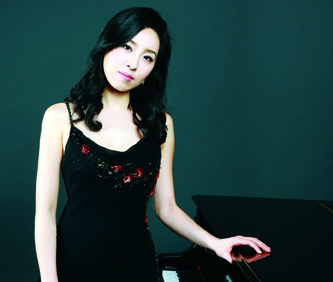
Franz Liszt needs few plugs to keep his name alive. Arguably the most comprehensive virtuoso performer, composer, charismatic stage personality, career strategist, and altruistic pedagogue to have shared our planet, Liszt the pianist represents the historical development of our genre, and a bit of him persists in the daily keyboard regimen of each of us whether we like to pay tribute to him or not. Tribute is paid, however, with full-scale explanation of the artist’s pedagogical pedigree for those willing to read the fine print, by the Ukrainian pianist Sophia Agranovich in her 2011 Liszt bicentennial CD, self-released on the Armonioso label. (There is no identifying number on the cover or spine.)

The CD’s packaging states: “Recorded on Franz Liszt’s birthday, this dedication to his Bicentennial features his most profound and virtuosic compositions.” Ms. Agranovich chooses conservatively from the plethora of possible recitals, opting for the tried-and-true “Un Sospiro” and B-Minor Sonata, with additional vorspeisen including the “Rhapsodie Espagnole” and piano transcription of Paganini’s violin caprice “La Campanella.” The latter is heard not in Liszt’s most virtuosic edition but in Busoni’s re-transcription.

Requisite athleticism notwithstanding, Ms. Agranovich displays finesse in the recurrent, introspective sighs of high treble filigree and chromatic runs throughout her program (she might have considered “Un Sospiro” a befitting title for the release). Coy pacing in the “Follia” variations of the “Spanish Rhapsody” and crisp articulation in the Sonata add supportive touches to her ardent portrayal of the sentimental-irascible “soul divided against itself.” To be sure, Ms. Agranovich possesses capable hands, facility, and authentic schooling, as documented, and her affinity for double notes and octaves takes us through landscapes of occasionally cautious, sometimes all-out exciting, and predominantly incident-free Liszt. At the far end of the spectrum, however, Ms. Agranovich’s instincts have led her to intersperse sour chords in moments of climactic import (homage to the one-take masters?) as well as extravagantly distorted phrases which give fresh meaning to the concept of rhetoric. “La Campanella” never loses itself in zigeuner-caprice but does lose pulse and thunder in a veritable collage of outtakes. Not working in the pianist’s favor is a studio sound deprived of nine-foot bass resonance. The curiously boxy quality necessitates sweep and strength from the performer for satisfactory fulfillment of Liszt’s larger-than-life message, and Ms. Agranovich’s transcendental attitude does help her break even, yet the volume controls still need adjustment mid-Sonata to avoid obscuring the end of the piece altogether. This recording could use some attention in order to be made suitable for broadcast, but the attention should probably include a few more tries at difficult passages.

Is the chaff inseparable from the wheat by design? One can see the exhilarated artist rushing to complete a marathon production on Liszt’s special day, cutting corners for expediency, budget rapidly dwindling with the setting sun. Recordings do outlive their occasions, and an overdue commemoration with a producer (and copy editor) on board would have been preferable to a flawed, prematurely delivered one. Ms. Agranovich deserves a more strategic spotlight.

Share

Chamber Music Society of Kumho Art Hall in Review

KMF Virtuoso Concert Series
Music of Poulenc, Françaix, and Dvořák
Alice Tully Hall, Lincoln Center; New York, NY
June 7, 2012
 
Chamber Music Society of  Kumho Art Hall

Chamber Music Society of Kumho Art Hall


The Chamber Music Society of Kumho Art Hall (CMS) was founded in 2007 and is presently a group of sixteen distinguished artists whose mission is to broaden the horizons of chamber music in Korea by performing and mentoring talented young players. Each season, the CMS performs with CMS Junior Members, giving these young talents the opportunity to learn and play with esteemed musicians. Tonight’s program had the Junior Members playing Francis Poulenc’s famous Sextet for Wind Quintet and Piano and the rarely played Dixtuor of Jean Françaix. The Senior Members took on Antonín Dvořák’s Piano Quintet in A Major, Op. 81.

Francis Poulenc (1899-1963) demonstrated his gift for wit, whimsy, and magic in his brilliant Sextet. The light-hearted nature of this work belies its fiendish difficulty; every player must be up to the mark or disaster ensues. There were no worries, as these young players were technically accomplished to a high degree. It seemed that the piece was child’s play for them. The notes were all there, passagework was clear, and the ensemble playing was excellent; a few intonation issues crept in, but these were few and far between. What was missing was the feeling of Poulenc as jaunty raconteur. I suspect this element will come with more experience and performance; the foundation is there in abundance, but it still needs developing. Once this is done, I am sure this ensemble will give an unforgettable performance of this mainstay of the repertoire.

Jean Françaix (1912-1997) is an unfamiliar name to many, which is regrettable given his tremendous output and sparkling style of composition.  Being a staunch and unrepentant Neo-Classicist in the time of serialism and atonalism probably has contributed to this. Dixtuor pour quintette à vent et quintette à cordes (Dectet for Wind and String Quintet) was composed in 1987. Scored for two violins, viola, cello, double bass, flute, oboe, clarinet, bassoon, and horn, it is a work full of youthful optimism. While not as technically demanding as the Poulenc, it still requires top-notch players and has the additional challenge of ensemble and balance issues among ten musicians.  Perhaps to highlight the idea of yesteryear, the players performed while standing; in my opinion this neither added nor subtracted anything from the performance. The ensemble captured the essence of this charming work in a way that was lacking in the Poulenc.  There was whimsy without being cloying, the lyrical second movement was beautifully played, and the articulation was rendered with laser-like clarity throughout, especially the triplets in the third movement. The final movement built up such momentum that the double bass player inadvertently hit his stand with his bow, underscoring his enthusiasm. My only reservation was at times the strings were somewhat timid and overshadowed by the winds, but all in all it was an inspired performance of an unjustly neglected work.

After intermission, the senior members took to the stage. Music Director Daejin Kim led a bold performance of Dvořák’s Piano Quintet in A Major, Op. 81. Antonín Dvořák (1841-1904) showed his devotion to his native land in this masterpiece, using Bohemian folk idiom throughout and the CMS gave it a high-voltage performance. They showed their great understanding of Dvořák’s ideas and projected them with vigor. Other than a small slip where one violin was a fraction of a second early in an exposed section, the playing was extremely polished. The last measures of the finale were played with brio, bringing the work to an exciting close. The large audience responded with loud and prolonged applause, calling the performers back to the stage three times.

As much as I would like to name each and every player for their performance, I will simply congratulate CMS as a whole on a highly successful evening. I hope I have the pleasure of hearing them again in the future.

Share

New York Concert Artists Associates: Rising Artists Evening II in Review

New York Concert Artists Associates: Rising Artists Evening II
Jayoung Hong, piano; Jiaxin Tian, piano; Mariko Miyazaki, piano; Kazuo Kanemaki, conductor
Good Shepherd-Faith Presbyterian Church
June 2, 2012

What could be a better way to spend an evening than to hear – after Tchaikovsky’s Serenade for Strings (Waltz) – four accomplished pianists playing four favorites of the piano concerto literature? Two concerti by Mozart (K. 466 and K. 503, followed by Schumann’s A Minor Concerto and Mendelssohn’s G Minor Concerto, made for a jam-packed evening. One couldn’t help thinking that such an evening should be required listening for young New York music students. Here are four pieces (K503 perhaps less so) that young players frequently attempt, though the playing requires the mastery of veterans, and the venue offers good vantage points from which to compare and study the different pianists’ approaches. It is also not every day that one hears so many piano concerti in a row played with such considerable polish.

The programming was a dream, starting with pianist Jayoung Hong playing Mozart’s glorious Piano Concerto No. 25 in C Major, K.503. A relatively large work from an extremely fertile period in Mozart’s composing, it requires a grasp of large structure as well as sensitivity to its wealth of surprises – along with complete technical control, of course. Jayoung Hong played it with seeming ease and, except for one minor mishap attributable to ensemble distractions, delivered a fine performance. If one could sum up in a word one of the loveliest qualities in her performance it might be seamlessness. She demonstrated a fluidity that carried her effortlessly from section to section, harmony to harmony, without a note of hesitancy or roughness. On the other hand it was this very quality that left me wanting more delineation. One sometimes wanted more rhythmic differentiation (for example between triplet-eighths and sixteenths, even in the opening main theme) and later, in the flurry of third movement passagework one wanted more demarcation at points of melodic return. There are several schools of thought on this, but all in all, Ms. Hong played with a grace that suits Mozart’s style. She seemed truly to enjoy the music most by the third movement. Occasionally there was some sketchiness in the strings, and the winds were sometimes overpowering (especially where marked pianissimo at the Andante’s close), but conductor Kazuo Kanemaki held things together well.

Going in reverse chronology, Mozart’s Piano Concerto No. 20 in D Minor K.466, came next, with Jiaxin Tian as soloist. While I am not a fan of “listening with one’s eyes” it was hard not to notice this pianist’s musical responses transporting her even during the opening tutti, before she played a note. This oneness with the orchestra and the music is a gift and pervaded her playing. Certainly she had all the technical nuts and bolts in order, but what brought her playing to a higher level was her unwavering passion and commitment to the work. Yet again, though, at times an asset can be a drawback, and I occasionally thought the piano should be less “one” with the orchestra and more soloistic. Particularly in the first movement’s opening theme, which could stand being more full-bodied, the melody was a bit wan at the peaks. The consistently receding tops of melodies had me wondering whether perhaps there might have been a pinky injury – but this pianist seemed quite purposeful in her performance. She lacked for nothing in the dramatic crescendo passages, and that “oneness” came in handy in some beautifully Beethovenian sweeps where she meshed perfectly with the orchestra. This concerto is often thought of as one of the most Beethovenian of Mozart’s works, and it is not surprising that Beethoven left cadenzas for it (one which she performed in the first movement). Her nicely ornamented Romanza led to an extremely fast final movement, which brought the audience to its feet.

In a change from the printed program Jin Kyung Park played Schumann’s Piano Concerto in A Minor right after intermission, instead of last, as programmed, but this reviewer is not assigned to review that performance. The program closed with Mariko Miyazaki playing Mendelssohn’s Piano Concerto No. 1 in G Minor. If some imagined this work to be too lightweight to conclude a concerto program (especially after Schumann’s A Minor masterpiece), a surprise was in store. Ms. Miyazaki played this oft-maligned work with fresh intensity and extreme brilliance. Bold and assured, she took the reins, leading the orchestra with ultra-clear downbeats and clean and precise pianism. Curmudgeons have often criticized this work for lacking depth or substance (a viewpoint I don’t happen to share), but Ms. Miyazaki treated it as a great work, and it repaid her. Even naysayers would have to concede that the sheer beauty of the piano writing, when perfectly executed, is a thrill akin to looking at a multitude of glistening chandeliers – call that a guilty pleasure, pianistically speaking. Ms. Miyazaki’s nearly flawless rendition was a pleasure indeed. She stormed and sparkled, and with equal poise and artistry projected the piece’s soulful slow movement. The final movement was a romp that concluded the program on a definite high, and again the audience was brought to its feet.

Share

New York Concert Artists and Associates Winners Evening: Evenings of Piano Concerti in Review

 New York Concert Artists and Associates Winners Evening: Evenings of Piano Concerti
Wael Farouk, piano; Alexei Tartakovski, piano; Vince Lee, conductor, NYCA Orchestra
Good Shepherd-Faith Presbyterian Church, New York, N.Y.
May 19, 2012


Anyone looking only to the larger musical venues of New York is missing out on some once-in-a-lifetime concerts at the “little church behind Juilliard.”  The Good Shepherd Church, which has held many exciting concerts over the years, is in its fourth year now as home to NYCA’s Evenings of Piano Concerti, which introduces concerto soloists, stars of the future, to adventurous audiences. Their May 19 concert was not to be forgotten.

Most memorable on this occasion was the performance of Rachmaninoff’s Third Concerto by Egyptian pianist Wael Farouk. The term “star of the future” is not quite apt here, as Mr. Farouk is something of a star already, with a career that has included innumerable concerto appearances, including the Egyptian premieres of Rachmaninoff Concerto No. 3, Brahms Piano Concerto No. 2, and Prokofiev Concertos Nos. 1, 2, and 3. Imagining Egyptian audiences hearing the Rachmaninoff 3rd Piano Concerto for the first time is exciting indeed, but those who heard Mr. Farouk play it in New York may feel they heard it for the first time as well.

Contrasting with the many hulking pianists who treat this piece as an Olympic hurdle (yawn), Mr. Farouk simply lived and breathed the music with the poetry of a born artist. Incidentally, this pianist is not of hulking build, and anyone brainwashed by the “size matters” crowd might have expected a less-than-powerful performance; they would have been proven wrong (as they might have, if Josef Hoffman, the great but diminutive dedicatee, had given the piece a chance!). Mr. Farouk’s technique is unquestionably great, despite apparently small hands, though this listener didn’t think of the word “technique” once during the entire performance (rare for this piece). The performance lacked nothing, but the way Mr. Farouk sailed through the piece, as if daydreaming out loud, made masses of notes seem merely incidental. That is how it should be, but only when one hears it does one realize how rare it is. Soulful melodic inflection, growling outbursts, coruscating passagework, and powerful peaks all combined with the unity of a master to bring the piece the unique life it deserves. Mr. Farouk also seemed to inspire the orchestra to glorious new heights, not by brute force, but by force of musical spirit. I am now officially a fan of this extraordinary musician.

Coming down to earth for a few moments, one should mention that some of the tempi were faster than one is accustomed to hearing, particularly in the last movement, where just a bit of “holding the reins” can make for more dramatic surges; it was so exciting, nonetheless, that one hesitates to suggest even the slightest tweaking. Conductor Vince Lee was a skillful and sympathetic collaborator throughout.

Prior to intermission, the audience was treated to Beethoven’s Fourth Piano Concerto played by Alexei Tartakovski, and Chopin’s Piano Concerto No. 2 in F Minor, played by Yoonie Han. This reviewer is assigned to discuss the Beethoven but would be remiss in not mentioning Ms. Han’s excellent performance.

Alexei Tartakovski, Winner of the 2011 Rising Artists Concerto Presentation, has won several other awards as well and has fine credentials for one in his early twenties (his bio stating that he was born in 1989). He has performed in numerous cities in the US, Russia, Canada, Holland, Greece, and England, and is currently completing his Master of Music degree at the Peabody Institute. One competition jury member called him “a monumental talent” and another a “first-rate player.” Not surprisingly for one in the throes of a young competitor’s life, he offered a committed and solid performance of Beethoven’s Op. 58, one of the masterpieces of Beethoven’s Middle Period and a pillar of the piano repertoire in general. Mr. Tartakovski had the formidable challenge of starting the concert with this work’s contemplative opening – positioned on the program where one might find a light overture – but he was up to that challenge. He achieved a sense of spaciousness amid the settling of the audience and orchestra and delivered the music as a thoughtful and serious musician. Unassuming in demeanor, he also appeared to approach the work as chamber music, a goal which was not quite possible on this occasion (as undoubtedly there was limited rehearsal time). Unfazed by various ensemble glitches, Mr. Tartakovski showed intense concentration and resilience – qualities he will need in a busy performing career.

Tempo-wise, things were again a shade faster than I like. The last movement especially verged towards a light early classical romp rather than to a meaningful release from the preceding Andante’s depths. It nevertheless posed little challenge for Mr. Tartakovski, and he handled the movement comfortably and delivered its tricky trills with clarity and alacrity.

The task of a reviewer is presumably to review what one has heard and not what one could imagine given a different instrument or situation, but I can’t resist commenting that I would like to hear Mr. Tartakovski on a piano with a less strident treble for this work. While the instrument’s top register had cut through nicely for the previously heard Rachmaninoff (buffered by the rich underlying and surrounding harmonies), the leaner textures of the Beethoven left harsh upper octaves exposed, so one needs a mellower sounding instrument for it. Undoubtedly there will be future chances to hear this pianist, as he surely has many successes ahead of him.

Share

The Profile The Life And The Faith Across The Notes in Review

The Profile The Life And The Faith Across The Notes
A Symphonic Poem written for piano, orchestra, and chorus
Mario Jazzetti, composer
The Chelsea Symphony Orchestra; New York Choral Society
Francesco Libetta, piano; Donata Cucinotta, soprano; Matt Morgan, tenor
Avery Fisher Hall, Lincoln Center; New York, NY
May 12, 2012

In a pre-concert address, Maurico Jazzetti shared remembrances of his father, Mario Jazzetti. It was obvious that he had great esteem and love for his father, and this concert was his way of sharing that with the world. Mario Jazzetti’s The Profile The Life And The Faith Across The Notes was presented. Having remarked on his dream that “this work must be played at Lincoln Center,” the younger Jazzetti must have felt great joy at making this dream a reality.

Mario Jazzetti (1915-1986) began his piano studies at age five and gave his first concert at age nine. He earned his diploma in piano in Naples and had a successful performing career in Italy in the pre- and post- World War II years.  He immigrated to the United States in 1951, where he continued his career as a teacher and performer, including concerts at Town Hall and Carnegie Hall. The Profile The Life And The Faith Across The Notes was first performed in a two-piano version in 1983.  A planned orchestral version was cancelled due to Mr. Jazetti’s ill health in 1984.

Billed in the program as a symphonic poem, in the program notes as a symphony concerto, and on the Internet as a piano concerto, it is apparent that the presenter is undecided on a final designation. Despite its titles’ far-reaching ambitions, this work seems ultimately to be none of the above. One might call it a suite, but it is really a pastiche of six works, composed at different times in Mr. Jazzetti’s life and placed together. Split into two sections (four movements, followed after intermission by the last two), the six movements are meant to represent the life journey, from birth to the end of life. They are titled Ninna Nanna (Lullaby), La bicicletta (The Bicycle), Tristezza d’amore (The Sadness of Love), Gioia di una Promozione (Joy of Graduation)– La Farfalla (The Butterfly), Tragica Realta’ Della Vita (The Tragic Reality of Life, also called the War Concerto), and Ave Maria.

With one movement written in his teens (Ave Maria), another conceived during World War Two (The Tragic Reality of Life), and the rest at other times not detailed in the program notes, the work has an uneven quality as one might expect. The influences of Grieg (especially the Piano Concerto), Tchaikovsky, Chopin, Liszt, and other romantic composers were prominent throughout in an overtly derivative manner, yet without these composers’ individual formal clarity, the effect was that of a collage. Thus, despite the organization into phases of life, there was an amorphous quality to the set. Conventional cadenza-like passagework was frequently used as thematic material, so that melodic lines become almost undistinguishable as such, while harmonic progressions bordered on the formulaic. There were, to be sure, poignant moments, but the surrounding material overwhelmed them.

Pianist Francesco Libetta was the star of the evening. Playing with great abandon, he broke a string on the Fazioli piano during The Tragic Reality of Life movement, much to the amazement of the audience. Soprano Donata Cucinotta and tenor Matt Morgan gave strong performances as well. The New York Choral Society was solid in their role – though what precisely that role was meant to be might have been clearer had there been a printed text, either in the original Italian or in translation (which was missing for the solo singers as well), a considerable omission in this case. Last, but not least, the Chelsea Symphony Orchestra was excellent from start to finish in a performance that completely outclassed another orchestra’s earlier performance of the work, as recorded in Italy (since removed from YouTube). The audience gave the performers a prolonged standing ovation at concert’s end.

Share

Chinese Hua Xia Chamber Ensemble in Review

Chinese Hua Xia Chamber Ensemble
“Dialogue Between the Traditional and the Modern”
Alice Tully Hall, Lincoln Center; New York, NY
May 7, 2012

In a program entitled “Dialogue Between the Traditional and the Modern”, the Chinese Hua Xia Chamber Ensemble presented a program of Ancient and Modern Chinese music, pairing traditional Chinese instruments with “Western” instruments in commissioned works. Featuring six (!) World Premieres, it was a concert that bridged the musical heritages of the East and the West.

The Chinese Hua Xia Chamber Ensemble was founded in 1995. The members are mostly award-winning, young conservatory teachers who are considered the “best of the best” in China.  The ensemble requires members not only to master traditional folk music, but to explore and seek innovations in modern styles as well.  Conducted by Tsung Yeh, they have recorded several albums and have performed throughout the world.

Wanting a closer look at the various Chinese instruments, such as the zheng, the ruan, and the yangqin, among others, and to observe the players “up close” made me abandon my usual strategy of sitting in the back rows.  It was fascinating to see these wonderful instruments being played with such mastery.

Six members of the ensemble opened the concert with traditional Chaozhou music entitled “Lang Tao Sha”. In this arrangement, the erxian, zheng, pipa, flute, yangqin, and the ruan were used.  The playing and balance among the six players was outstanding; the six instruments sounded as one. Following this piece was the first premiere of the evening, “Feng Qiu Huang” (a male phoenix sparks a female phoenix). Written by Liu Qing for cello, Chinese percussion, and the guqin (a small, seven-string zither-like instrument, played by plucking the strings), it uses an ancient Hainan love song that depicts the story of a male phoenix (“Feng”) courting a female phoenix (“Huang”). Beginning with quiet low tones in the cello, followed by responses from the guqin, it built in intensity until it reached a climax, then released the tension and came to a quiet conclusion. There were moments where it was difficult to hear the guqin, but this did not spoil the net effect.  The second premiere, “Five Impressions” by composer Gao Ping, was given in partial form (stated in the program as “Part of Movements”). The conductor Tsung Yeh showed admirable concentration and restraint even before the first note by patiently waiting for the incessant picture taking to cease. Once these distractions passed, an inspired performance took place. With haunting flute lines paired with the cello, then pipa with marimba, then all players joining together, each “Impression” had reminders of one previously played. Culminating in rapid passagework that had me thinking of Prokofiev, this imaginative piece was brought to a crackling close. After this excitement, it was a good choice to pull back to an ancient work called “Wild Geese in the Sandbank”. Played on the xiao, a vertical end-blown flute that is roughly the size of the western Alto flute, this work has a pastoral quality, both in the beautiful lento and the joyful allegro sections. Zheng Weiliang gave an enchanting performance and was rewarded with thunderous applause from the audience; he returned to the stage for a well-deserved second bow. Ending the first half was the third premiere, “Graceful”, from composer Wang Danhong. Described as the emotional journey to Dunhuang Caves, and the graceful dancing of flying fairies, the work mesmerized this listener from start to finish. The erhu melody had Ravel-like moments, the flute playing was increasingly virtuosic, and the work continued to gather momentum to a fever pitch. Finally, there was an unforeseen twist – what seemed to be a final explosion of energy was a false ending. Indeed, conductor Tsung Yeh turned to the audience with a quick wave and smile that said “Don’t clap just yet! We’re not done!” Winding it down to a conclusion, he finished with clasped hands and a bowed head, and then turned to the audience. I found this amazing work to be the highlight of the concert, and I would like to hear it again and again!

After intermission, the first work by a Western composer and the fourth premiere, “Nodes”, by John Mallia was presented. In his notes, Mr. Mallia states, ”‘Nodes’ is composed from several discrete strains of material that are alternately exposed and hidden as thresholds positioned throughout the formal structure are crossed.” Combining violin, cello, bass clarinet, and percussion with the zheng, pipa, flute, and erhu, this interesting piece was played skillfully and showed expert blending of Western and Chinese instruments. As Mr. Yeh said in his charming remarks, “open your mind and let the music fill you”. After the piece was finished, zheng player Qui Ji discreetly pulled out a tuning wrench to re-tune the zheng, which she did very quickly, no doubt to bring it back to traditional Chinese tempering. The last traditional Chinese work, from Peking Opera, was “Dark Night”.  Mr. Yeh told the audience the story behind the piece, which I suspect a majority already knew, to judge by the roar of approval. The story is of a great warrior King’s wife saying good-bye to him on the eve of a great battle from which they both know he will not return. It was played with deep reverence, capturing the martial qualities with vigor. The audience was clearly delighted and expressed their approval with the loudest and longest ovation of the evening; this piece was clearly the audience favorite. Chai Shuai, playing Beijing erhu (a smaller version of the standard erhu), was called back on-stage by the audience for his incredible performance. The fifth premiere, “Less, but More” was next on the program, composed by recent Cincinnati Conservatory graduate Xie Wenhui. Ms. Xie writes in her notes that “the inspiration of this piece is taken from the concept of Wang Wei’s works, who is a well-known Chinese poet in Tang Dynasty (8th century). He affirms the world’s beauty, while questioning its ultimate reality in his works. In this piece, I want to draw a comparison between the deceptive simplicity and the Zen path to enlightenment, which is built on careful preparation but is achieved without conscious effort”. The program omitted the mention of the clarinet, pipa, and zheng. The work was given a thoughtful performance by the talented players, making what was quite complex seem simple. The final work (and premiere) was the ingenious “Bridges”. Composer Victoria Bond has written a work with a double meaning; inspired by bridges in both the United States and China, and the concept of ‘”bridging” Western and Eastern influences. It included a train-like rhythm (“Railroad Trestle Bridge in Galax, Virginia”), a traditional Chinese song “Moli Hua” (Jasmine Flower), shades of Joan Baez, and finally, George Gershwin (in the “Brooklyn Bridge”). I suspect this work is as fun to play as it was to hear, and the ensemble really took to the spirit in all the various tributes. East joined West in a jubilant finale and brought the evening to a close with a bang.

Some final thoughts on this most enjoyable evening- The Chinese Hua Xua Ensemble is a first-rate group and their conductor Tsung Yeh is a charismatic leader. It is truly a privilege to see and hear musicians who are all about the music, who play with such passion and such skill, and are keeping the thousands-year old traditions alive. Bravo!

Share

The Park Avenue Chamber Symphony in Review

The Park Avenue Chamber Symphony in Review
“Majestic Finale”
David Bernard, Music Director
All Saints Church, New York, NY
May 6, 2012
 
David Bernard and the Park Avenue Chamber Symphony

David Bernard and the Park Avenue Chamber Symphony


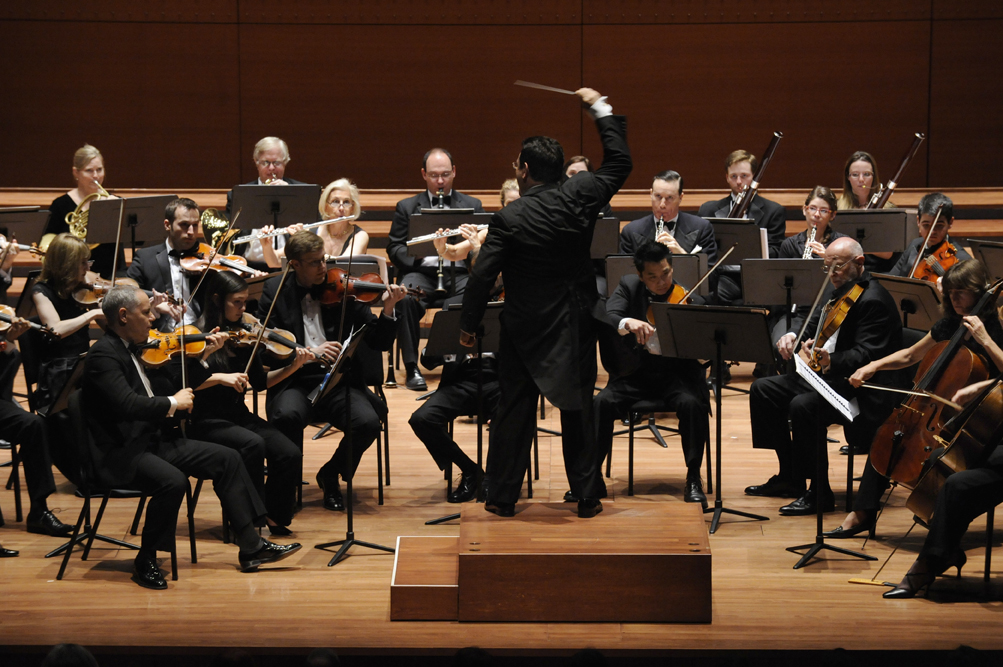
A large and very enthusiastic audience was on hand for this, the final concert of the Park Avenue Chamber Symphony’s 2011/12 season. They were treated to an exemplary performance of Beethoven’s Symphony No.4 in B flat major, Opus 60, and were thrilled by the visceral climaxes of Mahler’s Symphony No 1 in D major (“Titan”.) One might ask what a Mahler symphony is doing on a program by a performing organization which has “chamber symphony” in its name. My answer is that one of the glories of Mahler’s use of the orchestra is that no matter how large a performing group he writes for, the scoring is often that of a chamber orchestra, with long quiet passages for solo instruments interspersed between passages for very, very full orchestra. In addition, this Beethoven/Mahler combination was an inspired pairing; as both works have similarly mysterious pianissimo openings.

Conducting without a score, Maestro Bernard led his players in an assured, beautifully shaped and well-paced performance of the Beethoven. The tempi he chose allowed the music to unfold naturally. We heard none of the very, very fast or very, very slow tempi which so many conductors now choose perhaps to show us an “original” interpretation of a well-known work. Readers of the New York Concert Review might remember that I am very insistent that performers obey the composer’s instructions and observe all of the indicated repeats.  I am happy to report that this afternoon all of Beethoven’s repeats were performed. And so were those in the Mahler!

The very live acoustics of All Saints Church caused a problem which persisted throughout the concert; the solo winds, when playing passages marked piano, all sounded too loud. I’m sure that the players were following Beethoven’s dynamic marking, but the contrast between loud and soft didn’t come across. As this was not the case with the strings, the tutti crescendi, so crucial in a work by Beethoven, were handled beautifully.

After intermission came the Mahler. Again conducting without a score, Maestro Bernard led the huge orchestra with discrete, clear and concise gestures. The orchestral playing was of the same high quality we heard on the program’s first half. The strings were especially impressive – the wild opening of the last movement was played with confident abandon. The horns, all seven of them, had a very high batting average. It was a very impressive performance. But for this listener, during the lyrical passages there was something missing, and it is hard to put it into words without sounding too negative, something I do not wish to do as it would seem to contradict the statement which precedes this sentence. So with that disclaimer, I’ll try. I found the lyrical section somewhat stiff and careful, with little of the warmth and disciplined freedom I look for in a Mahler symphony. A bit more use of portamento in the strings would have also been welcome. But when the orchestra was going at full tilt, all was well. And when it was over, the audience rose to their feet and thanked the performers with heartfelt applause and cheers.

Share

Kyunghun Kim, Conductor in Review

Kyunghun Kim, conductor
The Doctors Orchestral Society of New York
Michael Katz, Cello soloist
Norman Thomas High School Auditorium; New York, NY
May 3, 2012

Kyunghun Kim is a musician with impressive credentials. Recently graduated from the Juilliard School with a Masters degree in conducting under the tutelage of James DePriest (with a full scholarship from the Bruno Walter Memorial Foundation), he also has a diploma in Conducting from the Curtis Institute of Music.  He has also had studies with other renowned conductors, such as Alan Gilbert, Marin Alsop, and Michael Tilson Thomas.  Mr. Kim is the resident conductor of the Chelsea Symphony, the New York Humanitarian Orchestra, and the orchestra he led tonight, The Doctors Orchestral Society of New York.

The Doctors Orchestra was founded in 1938 by physicians interested in performing symphonic music. Now in its 74th season, the ensemble is no longer comprised solely of physicians, but open to musicians of all professions.  As orchestra manager and cellist Charles Ippolito stated in a pre-concert address, the members of the orchestra are all volunteers who do it for the love of music.

This writer is always enthusiastic about attending concerts with non-professional players. At times the playing has been excellent and as memorable as any “professional” group, and other times, to be perfectly frank, downright appalling; no matter the end result, however, the players invest themselves with all their abilities and passion- there is never a “phone it in” attitude that I have experienced with even some of the most famous orchestras in the world.

Leading a non-professional orchestra is a big challenge. The careful selection of repertoire, limited rehearsal time, often changing personnel, wide diversity in playing abilities, and the need to be a patient teacher are all issues that must be considered. Mr. Kim appears to be the man for the job.

The Cello Concerto in B Minor, op. 104 of Antonín Dvořák, with soloist Michael Katz, opened the concert.  Mr. Kim is a hard-working conductor who strove to bring out the best from the orchestra, but the opening measures were played timidly, instead of with quiet intensity, and were marred by intonation problems. Once these issues settled a bit, the playing steadied, with Mr. Kim giving strong direction with broad gestures and a baton technique that clearly defined the beat.  Mr. Katz gave a polished performance; his tone was singing in the lyrical second movement and the bravura sections of the first and third movements were played with brio. Mr. Kim was a worthy collaborator, keeping the needs of the soloist in mind while keeping the orchestra on track.  Although there were a few instances of the orchestra overpowering the soloist and some excessive exuberance in the trumpet section in tuttis (played very well, I must admit, even if much too loudly!), the end result was a commendable performance.

After intermission, Mr. Kim offered his interpretation of Johannes Brahms’s Symphony No. 2 in D major, Op. 73. Completed in the space of a few months in 1877, this work is Brahms’s most optimistic and idyllic of his four symphonies.  Mr. Kim led with confidence, showing he had carefully thought out his approach and knew exactly where he was going and how to get there. The orchestra took his lead and for the most part, responded with a like confidence. The intonation problems were still an issue, and there were struggles with exposed sections, but there was some excellent playing as well; the French horn section, the lower brasses, and those loud trumpets were uniformly good.  Orchestra and conductor were at their best in the ebullient finale which ended the concert in a joyful mood. I must digress here for a moment to comment on a puzzling statement in the program notes about the finale-“Brahms’ influence from Mozart, Haydn, and Mahler can see seen in the structure and tonal progression…”. Mozart and Haydn, yes, but Mahler? Mahler was 17 years old in 1877, had only begun composing, and did not even meet Brahms until the 1890s!

Mr. Kim is a talented conductor, whose poise and clear communicative style makes him a good fit for this orchestra. Anyone can look good in front of a world-class orchestra, but it takes a special personality to work and succeed with non-professional ensembles.  I wish him good luck and continued success.

Share