Ensemble du Monde

Ensemble du Monde
Marlon Daniel, conductor
Merkin Concert Hall, New York, NY
August 13, 2009

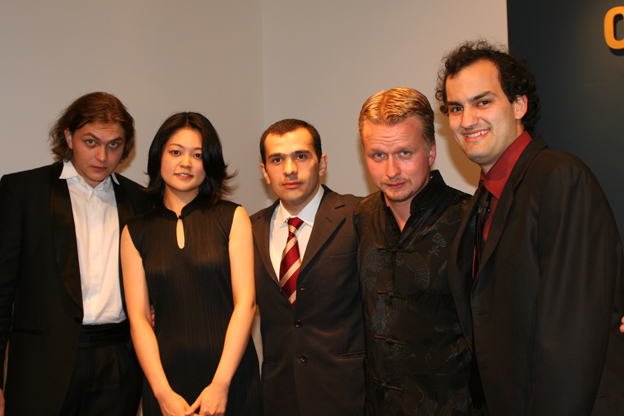
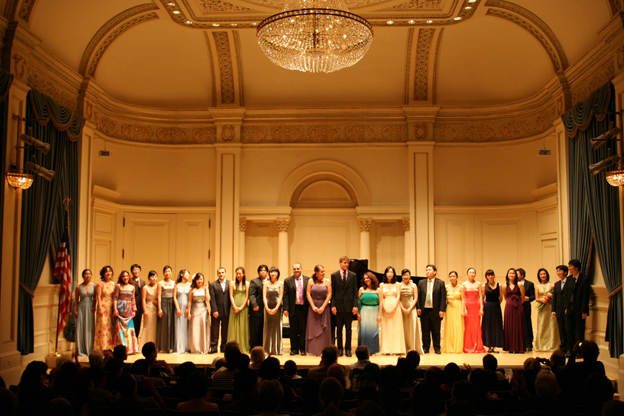
On August 13th at Merkin Hall, conductor Marlon Daniel and his “Ensemble du Monde” performed Beethoven’s third, fourth and fifth piano concerti. I heard through the grapevine that all five concerti were originally planned. That would have provided more contrast because the first two concertos (especially the second in B-flat) are lighter than the final three, which—when heard together—tend to overdose us with Beethoven’s middle-period drama and heftiness of orchestration. In other words, if you’re going to do several Beethoven Piano Concertos, do the second, first (in correct composing order) and third on one program, and the fourth and fifth on another.

The fine pianist in the third concerto, Richard Dowling, played very well. He occasionally tossed off a bland phrase or two, but that may be my own predisposition to preferring dramatic “Sturm und Drang” performances of this C Minor composition. In the fourth concerto, Kimball Gallagher played with a pleasant tone throughout (although I thought the opening solo phrase was too loud). Sometimes, she needed more invention of shading and dynamics in this work’s tender more tender passages. It was enjoyable nonetheless.

The pianist in the “Emperor” Concerto, Beatrice Long, has a bravura temperament and technique suitable for this large-scale, heroic work, and she displayed musical excellence by bringing out nuances and important harmonic changes in the score. Her phrasing showed admirable shape and contrast; when, for example, a scale passage ascended, there was a slight crescendo to show the direction of the musical line, and vice versa with descending phrases. I wish she had taken the Adagio un poco mosso movement slower; Adagio un poco mosso, after all, means slow with a little forward movement. It should not sound like a Beethoven Andante, which translates to a walking, moderate pace.

Conductor Marlon Daniel has talent and great energy. He does need to watch his concentration; in the Largo of the third concerto, he gave a cue two bars too soon (luckily, the orchestra didn’t come in), and there were some shaky entrances and small lapses of ensemble. I recommend that he keep the volume of the trumpets and timpani down at Merkin Hall, as there was consistent blaring in the concerti’s outer movements.  Still, Daniel and his orchestra have potential, and I would like to hear them again.

Share

Alexander Beridze, Piano

Alexander Beridze, piano
New York Piano Festival,
Bechstein Centre, New York, NY
June 14, 2009

As the finale of the New York Piano Festival, Alexander Beridze, founder and artistic director of the budding series, performed his own demanding solo recital. Not surprisingly, he is up to the task of wearing numerous hats, having earned degrees in both journalism (Tbilisi State University) and music (Tbilisi State Conservatory and Mannes). He is currently working towards his doctorate from Rutgers, while maintaining teaching, administrative and performing lives. Counting Vladimir Feltsman and John O’Conor among his teachers, he has won several competitions and has performed both in the U.S. and in his native Georgia.

Opening with Beethoven’s Sonata Op. 7, Mr. Beridze impressed with his laser-sharp focus, each phrase honed with intelligence.  This opus (one of this reviewer’s favorites) has subtleties that require perhaps more mature mastery than some of the sonatas heard more frequently, and in Beridze’s hands it projected as the great work that it is. He sustained intensity throughout, and, while one might have wanted more breathing at some points, it was admirable that he could keep it feeling “charged,” especially in such a casual venue.

Ravel’s Gaspard de la Nuit followed a drastic change of tonal worlds, well handled.

Ondine was awash in color and excellent overall, even if occasionally the melodic glimmers felt overwhelmed by the brilliant splashes. Le Gibet benefited from Mr. Beridze’s knack for shifting the spotlight from one voice to another, and Scarbo was brilliant, although not quite “over the top” with nightmarish surges as it can be (and as this listener likes).

Brahms Sonata Op. 1 in C Major suited this pianist well. High points were a heavenly close to the second movement and some almost swashbuckling moments in the third movement. The fourth movement was a bit hectic for this listener, but exciting nonetheless.

Stravinsky’s Three Movements from Petrushka, which finished the program, showed much more of the electricity that would have further enlivened Scarbo, with bright, vibrant contrasts and an imaginative dramatic sense. After what has amounted to an epidemic of Petrushka this spring, Mr. Beridze’s emerged as one of the best, steely, precise, and bristling with life.

Share

New York Piano Festival

Alexander Beridze (Founder and Artistic Director),
Ilya Kazantsev, Ilya Yakushev, and Mai Kagaya,Pianists
Theo Lebow, tenor
Bechstein Centre
June 7, 2009

New York has a new piano consortium. It is called New York Piano Festival and was founded by Alexander Beridze, a pianist eager to expand the city’s concert life. When the Bechstein Company offered him the use of the performance space in its newly established showroom, he was able to “realize his dream.” Inviting some of his friends to join him, he planned a four-concert series for June 7, 9, 12 and 14; they include a master class of his students, a recital of his own and a two-piano program with Mai Kagaya.

The Opening Concert was shared by four pianists and a tenor, all of them young, enthusiastic and very good. It began with Rachmaninoff’s Piano Sonata No. 2, Op. 36 in B-flat minor, played by Ilya Kazantsev. A big, three-movement work, it could have been written only by a pianist intimately acquainted with his instrument’s technical and tonal resources and not afraid to make full use of them. Mr. Kazantsev reveled in the fireworks and the big, crashing chords with unbridled abandon. Later in the program, he had a chance to show his lyrical side in Schubert’s Sonata in A major Op. 120, but seemed less comfortable with its simple expressiveness than with Rachmaninoff’s boisterous vigor.


Tenor Theo Lebow sang the famous aria “Una furtiva lagrima” from Donizetti’s opera “L’elisir d’amore,” and five songs by Hugo Wolf on poems by Eduard Mörike. He displayed a lovely, light voice with a sweet top; the low register was somewhat dry and he tended to swell long notes. His diction in both Italian and German was excellent, and he brought out the mood and character of each song. He was empathetically partnered by Mr. Beridze, who also played a four-hand version of the Scherzo from Mendelssohn’s “Midsummer Night’s Dream” with Mai Kagaya.

Finally, Ilya Yakushev played Prokofiev’s Piano Sonata No. 7, Op. 83, a fiercely percussive piece full of banging and crashing. The slow movement, however, is beautiful, with big, sonorous chords across the keyboard ringing out like bells. Unfortunately, Mr. Yakushev played them so aggressively that they lost this magical quality. The Finale is a relentlessly driving marathon in 7/8 time.

The Bechstein Center is a welcome addition to the city’s performing venues, but it may not be wise to let exuberant, powerful pianists play very loud music on an extremely bright-sounding nine-foot concert grand in that intimate space.  

Share

Mendelssohn 200th Anniversary Gala

Rutgers University
May 26, 2009
Weill Recital Hall at Carnegie Hall

To honor the bicentenary of Felix Mendelssohn’s birth, the Mason Gross School of the Arts, Rutgers University’s Boyd Foundation (under the direction of piano Professor Min Kwon) mounted an extravaganza presenting practically all of the composer’s Songs Without Words as played by the piano department’s artists—most of them graduate students there; a few undergraduates; and for a final flourish, the Scherzo from A Midsummer  Night’s Dream Music in a four hand piano version (source unspecified; not the ubiquitous Rachmaninoff solo arrangement) with two faculty members, Min Kwon and Daniel Epstein doing the honors.

A similar concert fielded by Rutgers “et al” was built around the Grieg Lyric Pieces in tribute to the hundredth anniversary of the Norwegian Minor Master’s death on December 14, 2007. That event at Steinway Hall was favorably reviewed by Edith Eisler in Volume 15 No.2 of this journal. Assessing diverse performances of short pieces can be a temptation for a critic to make comparisons and pass subjective value judgments (and my compliments to my colleague Ms. Eisler for elegantly avoiding potential but unwarranted opinion!). With so many pianist involved there are of course variations  in interpretations, tone, temperamental style and technique to be conjured with; but Mendelssohn ’s Songs Without Words, diverse as they are, do not offer amazing leeway that (say) Chopin’s Mazurkas can potentially bring to the fore. Mendelssohn’s idiom, in keeping with Grieg, calls for a similar German Romanticism whereas Chopin is particularly prone to many “specialists” who will never agree about ways to apply or shape a rubato and the result will often bombard the listener with “authentic” interpreters who are—well—Poles apart!

The protagonists offered an intriguing array of artists harking from Australia, Tbilisi, South Korea, Costa Rica, Japan, Taiwan, Poland and Brazil. And before coming to Rutgers, many of the players graduated from Mannes College, the Manhattan School of Music, Juilliard, Boston University and Toronto (New England Conservatory, University of Toronto) in America.

One particularly gratifying aspect of this marathon was the wonderful; sense of camaraderie. Ms. Eisler comment about the aforementioned Grieg concert deserves to be quoted appreciatively:

“In today’s competitive musical world, the concert was remarkable for its freedom from egotism and rivalry; in a true spirit of homage to the composer, the performers and never called attention to themselves of to their technical and musical gifts, but focused entirely on the music.”

In retrospective, this was a heartwarming and satisfying evening of music. Bravo to everyone connected with it!

Share

Xiayin Wang, Piano

Alice Tully Hall, New York, NY
May 18, 2009

Dear Reader: It gives me great pleasure to report that Xiayin Wang’s magnificent recital on May 18th was a milestone; a true rite of passage! As they say, nothing succeeds like success and before Ms. Wang even played a note, a large upbeat audience roared its approval as she took her place on stage. The ensuing opening chords of Haydn’s great last Sonata in E flat, Hob. XV1/52 (actually 62), played Maestoso, at once served notice that Ms. Wang’s appealingly reticent musical persona familiar to this writer from her several previous recitals and her compact disc (Marquis 81369) had metamorphosized into a bigger, bolder, confident and more interesting artiste. Rarely have I heard such an outstanding transformation (just for comparison, try Ms. Wang’s small scaled, shapeless performance of Mozart’s K. 330 Sonata on the cited recording). The Haydn was heroically revealed; the subito fortissimos at the ends of the first movement exposition and recapitulation had just the startling impact Haydn specified; the Adagio had remarkable gravitas and the movement’s imperious forte interjections and audacious juxtapositions of unexpected key relationships all enhanced the work’s harmonic tensions. The Finale too burst forth with a blistering Presto. Ms. Wang, you might say, made the Haydn sound like early Beethoven, and I think she was stylistically right on the money.

Chopin’s Ballade No. 2 in F Major, Op. 38 (some musicians like Brahms and Murray Perahia insist that the composition ends and should be identified as being “in A minor”) began liltingly, its opening melody lovingly shaped with subtle, unobtrusive rubato. The fierce ensuing second part came as an avalanche and the forward-thrusting phrasing slashed forward with unfailing direction and purpose. The potentially terrifying coda was rendered with note perfect confidence and accuracy: A great performance.

There were two World Premieres on Ms. Wang’s program. Richard Danielpour’s Preludes Book II, “The Enchanted Garden”, proved accessible and appealing. The first piece, “Persepolis” was rather suggestive of Poulenc. The second, “Surrounded by Idiots” scampered about engagingly; the Third was an “Elegy”; the Fourth “Lean Kat Stride” a jazzy free for all. And inevitably, for a suite called “The Enchanted Garden” Mr. Danilepour turned his sights to Ravel’s Mother Goose Suite. The pleasingly derivative music was beautifully written for the piano and evidently tailor-made for its dedicatee who played it to the hilt. The other World Premiere, Sean Hickey’s Cursive was a bit harder for this reviewer to absorb in one hearing, but it, too, was demandingly and effectively written for the piano (Hickey, according to his bio was trained as a jazz guitarist). His piece was also handsomely played by Ms. Wang.

Everyone these days seems to be fielding Ravel’s Gaspard de la nuit and Ms. Wang’s account of Scarbo was unusually robust and large scaled (with all its fearsome repeated notes and virtuoso obstacles magnificently under control.

Scriabin’s 1903 Valse, Op. 38 was elegantly bittersweet. (Ms. Wang has always shown special affinity for the short-lived Russian composer’s slightly demented music and, as this review is written, a new all-Scriabin Naxos recording from Ms. Wang is imminently awaiting release.)

The formal portion of the concert ended with one of the fastest, fleetest accounts of Liszt’s Mephisto Waltz No. 1 with all its swashbuckling glissandos (which we heard earlier in the Danielpour), and leaps brilliantly nailed.

For an encore, the pianist beguiled us with one of those Chinese Picture Postcards, “The Autumn Mood over the Calm Lake” from the Dvorak dynasty (you might say that pentatonic scales were as typical of the Czech composer’s music as any quintessential Chinese or  Japanese stereotype).

Share

2009 CONCERT SEASON

If there is a general complaint about manyof today’s performers, it is that they reverse the ancient dictum “Nothing to excess” by doingeverything to excess. Tempi keep getting faster, dynamics louder and softer, contrasts more vio­lent; brass and percussion dominate the orches­tral texture and ruin the balance. Nevertheless, there was much to enjoy and admire in this sea­son’s concerts, which honored the anniversaries of Mendelssohn’s birth and Haydn’s death, and also prominently featured Mahler and Brahms; here are some highlights and celebrations.

The year’s biggest news was the passing ofthe baton from Lorin Maazel to Alan Gilbert at the New York Philharmonic. Amid a flurry off are well concerts, Maazel conducted one of his favorite works: Britten’s War Requiem. Despite the excellent performance, the impact of the music seemed to have diminished over the years, but the poetry and the aching memories of the work’s creation are still deeply affecting.

For his tenure’s grand finale, Maazel led amemorable performance of Mahler’s Eighth Symphony. Its monumental length had coher­ence, its massive score remarkable transparency; there was time to savor the lyrical moments and echoes of other works. It was a triumphant farewell, rewarded by an outpouring of respectand appreciation.

The Philharmonic’s Opening Gala included the Premiere of “EXPO,” commissioned from Magnus Lindberg, the Orchestra’s Resident Composer, and an elusive, impressionist cycle of love ­songs by Messiaen, which the wonderful soprano Renée Fleming had learned for the occasion. It was the most ambitious Gala pro­gram ever devised, and immediately demonstrat­ed the adventurousness of Gilbert’s ideas and his ability to carry them out.

The Philadelphia Orchestra under Christoph Eschenbach gave Mahler’s SeventhSymphony a splendid performance, distin­guished by its combination of sweep and atten­tion to detail, its unusual clarity, and especiallits meticulous balance between sections and within the orchestral texture.

Mostly Mozart paid homage to Mendelssohn with his “Italian” Symphony, played very fast under Yannick Nézet ­Séguin; the Violin Concerto, played brilliantly by the golden ­toned Joshua Bell under Music Director Louis Langré, and the first Piano Trio with the fine Trio con Brio. Haydn was honored with symphonies, piano concertos, and the rarelheard Sinfonia Concertante, played splendidl by concertmistress Krista Bennion ­Feeney, cel­list Ilya Finkelsteyn, oboist Randall Ellis, and bassoonist Marc Goldberg. Brahms’ Variationson a Theme by Haydn were also featured, pre­ceded by an impressive performance by Jon Manasse and Jon Nakamatsu of Brahms’ first Clarinet Sonata, and followed by his Fourth  Symphony. Langré closed the Festival with a lovely performance of Haydn’s “Creation,” sunin English, probably for greater accessibility. The “Creation” and “The Seasons were sung in German by the Monteverdi Choir withthe period instrument group Orchestre Révolutionnaire et Romantique under John Eliot Gardiner. The performances were clear, brisk and enthusiastic, but suffered from all the excesses mentioned above; indeed, the pace was so hectic that Gardiner never even paused between movements, and the balance so lop­sided that the strings and the crucial harmoniesin the inner voices were almost obliterated. All four Brahms symphonies were presentedby the Berlin Philharmonic under Simon Rattle, paired with four works by Schoenberg. The combination was supposedly justified by the series’ opening work, Schoenberg’s misguided, blown­up orchestration of Brahms’ first Piano Quartet ­a transcription some chamber musi­cians dislike. The rest of the programs, however,made up for it. Schoenberg’s mono­drama, “Erwartung” (Expectation) was riveting, with soprano Evelyn Herlitzius as a woman who stumbles through a dark forest searching for her faithless lover, only to find his corpse. Reality ornightmare? No one knows. The orchestra was terrific; the soloists were wonderful, the sound was gorgeous. Rattle, deeply involved, alternated between standing still and erupting into violent action; the players, themselves physically very engaged, responded to his slightest motion. The performances were grandly conceived and exe­cuted, but intonation and attacks were often imperfect; the texture was murky, everything was so loud that the climaxes became deafening. All concerts ended with a joyful noise; the audi­ences loved it. Rattle also conducted the Philadelphia Orchestra and Chorale in Berlioz’ “Damnation of Faust.” With mezzo ­soprano Magdalena Kozena, tenor Gregory Kunde, basses Thomas Quasthoff and Eric Owens, the performance was fabulous and captured both the music’s sim­plicity and sophistication.With the New York Philharmonic under Gilbert, Frank Peter Zimmermann gave Brahms’ Violin Concerto a robust, extroverted performance, very prosaic despite many juicy slides. It was paired – again – with Schoenberg: the symphonic poem “Pelleas et Melisande,” anearly, tonal, romantic work; players and conduc­tor reveled in its luxurious, colorful orchestra­tion. The Zukerman Chamber Players, with Zukerman on viola, opened their series with adelightful, heart­warming mostly Brahms pro­gram. It featured his ingratiating first Sextet and the songs for mezzo ­soprano and viola, sung superbly by Michelle DeYoung with pianist Kevin Murphy, along with songs by Dvorak and  Strauss. The Pacifica Quartet, a young but alreadhighly acclaimed group, has taken over the Guarneri Quartet’s residency at the Metropolitan Museum. This requires self ­confi­dence and courage, but perhaps also more intro­spection than was evident at its opening pro­gram. The players’ involvement seemed physical rather than emotional; the playing was compe­tent but too fast and driven for real expressive­ness; the sound was good but unvaried; the cello was under­ balanced. Their Mozart lacked graceand repose, their Brahms depth and passion; they broke up Janácek’s “Intimate Letters” withlong pauses.The Kalichstein ­Laredo ­Robinson Trio gave both Schubert Trios a solid, expressive perform­ance; the Emerson Quartet’s Schubert was disci­plined and polished, but too extroverted; the American Quartet’s “Death and the Maiden” was brilliant, full of drama and anguished plead­ing. Violinist Christian Tetzlaff performed one of his specialties, Bach’s unaccompanied works, in one day ­a remarkable feat. He has recorded them twice, and, claiming that they tell a contin­uous story, always presents them chronological­ly. His interpretation continues to gain depth and freedom; unfortunately, the fast movements also gain speed: the performance left listeners breathless, though marveling at his technical control, his pure, beautiful tone, his clear struc­ture and counterpoint. Two great pianists performed Beethoven’s last three sonatas. Mitsuko Uchida projected dramatic intensity and expressive lyricism; András Schiff, concluding his Beethoven cycle, displayed his usual beautiful singing tone and perfect legato, and gave pristine clarity to usual­ly blurred, muddy passages. James Levine, Music Director of the Boston Symphony (and the Metropolitan Opera), had tocancel several appearances due to a back opera­tion. At Carnegie Hall’s Opening Night, he was replaced by Daniele Gatti; the program included Chopin’s second Piano Concerto with the incomparable Evgeny Kissin and the premiere of John Williams’ Harp Concerto, written forthe Orchestra’s harpist Ann Hobson Pilot. There were also other unusual offerings. Leon Kirchner’s four string quartets were played splendidly by the Orion Quartet, to whom one isdedicated. Zemlinsky’s Lyric Symphony, per­formed by the New York Philharmonic under Neeme Järvi with soprano Hillevi Martinpelto and baritone Thomas Hampson, was very inter­esting. Set to poems by Rabindranath Tagore, it is romantic, tonal but dissonant; the orchestra­tion is kaleidoscopic, but too heavy for the singers.

Share