
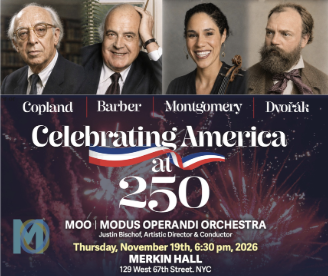
Modus Operandi Orchestra (MOO): Modus@Merkin-Celebrating America’s 250th
Modus Operandi Orchestra
Justin Bischof, conductor
Katherine Whyte, soprano
Merkin Hall at Kaufman Music Center, New York, NY
November 19, 2026
The Modus Operandi Orchestra (MOO) returned to Merkin Hall at Kaufman Music Center this past Thursday in a program commemorating the United States’ 250th anniversary, featuring works by Aaron Copland, Jessie Montgomery, Samuel Barber and Antonín Dvořák (the only “non-American” on the program). Founded by conductor and artistic director Justin Bischof, the Modus Operandi Orchestra comprises some of New York’s finest freelance musicians, whose talents were on full display tonight.
The program began with Fanfare for the Common Man by Aaron Copland (1900-1990). Composed in 1942 from a commission by the Cincinnati Symphony Orchestra music director Eugene Goossens, Copland conceived this work as a tribute to ordinary citizens and their contributions during World War II. The work is scored for brass and percussion, which communicated this ethos brilliantly and evocatively. The brass from the Modus Operandi Orchestra were powerful in their first statements, and the open harmonies soared through the space beautifully. Aside from its more patriotic associations, the antiphonal dialogue of the brass evoked an almost ancient and spiritual quality through its ceremonial gestures giving the work a sense of dignity and reverence.
Coincident Dances (2017) by native New York composer Jessie Montgomery (b. 1981) captures the eclectic sounds of the unique neighborhoods of New York City, where seemingly disparate musical traditions coexist. The work opened with an expressive bass solo which, to this reviewer, suggested Eastern European Jewish music through its rhetorical, almost klezmer-like inflections. The piece then builds through intricate rhythmic layering where one can hear the energy of a bustling city. Midway through, a trumpet solo emerged with a distinctly Bernstein-esque character, reminiscent of West Side Story, making way for infectious, dance rhythms with an Afro-Caribbean flavor. Maestro Bischof and MOO brought to life the vivid and colorful sounds of the city evoked by Ms. Montgomery, but at times the balance and preciseness of the interlocking rhythms could have been handled better. In general, the percussion tended to overpower the ensemble, though this was more forgivable in the Copland, given the prominent role of percussion in the work. This imbalance in sound may partly be attributed to the acoustics of the space, which perhaps is not ideally suited for an orchestral sound of this size. This reviewer’s vantage point on the left side of the hall, directly in front of the percussion section, may also have contributed to this impression.
From the commotion of New York City to the tranquility of Tennessee, MOO then transitioned to a seminal work of Samuel Barber (1910-1981), one of the United States’ most respected composers. Here they were joined by soprano Katherine Whyte in the 1947 work Knoxville: Summer 1915, with text by James Agee. Recounting a summer evening in Tennessee through the eyes of a child, the work explores nostalgia and innocence. Ms. Whyte’s rich voice was glorious and quite appropriate for the tone of this work. The almost speech-like vocal writing was handled expertly, and Ms. Whyte’s beautifully sustained tones carried effortlessly above the expressive orchestration. Only occasionally was her voice obscured by the richness of MOO’s sound, particularly in her lower register. In this reviewer’s opinion, the work might also have benefited from a slightly brisker tempo, allowing the text to unfold more naturally.
The final work on the first half of the program was also by Samuel Barber, his beloved Adagio for Strings. In the context of a program celebrating the 250th anniversary of the United States, the poignant simplicity of its musical language and the thoughtfulness of its orchestration invited reflection on how far the country has come, but also on how much remains to be achieved. The members of MOO poured their hearts into this deeply moving work with careful listening for balance and intonation, hearing the sometimes-clashing dissonant harmonies that resolve into serenity once again. It was a beautiful end to this celebratory first half.
The second half of the program dealt with only one work, Symphony No. 9 in E minor, Op. 95, “From the New World” (1893), by Antonín Dvořák (1841-1904). This work is Dvořák’s own tribute to his time spent in the “New World” with inspiration from African American spirituals and Native American musical traditions while keeping his own Bohemian voice. Of course, all these themes are original as he did not directly quote existing melodies, rather he wanted to capture the spirit of these traditions, weaving them into the symphonic form. Here, in the first movement, we recall the fanfares from the opening of the concert, creating a continuity which is satisfying in programming.
In the capable hands of Maestro Bischof, MOO maintained a sense of cohesion throughout the symphony’s extended movements, playing with expansiveness but also with vigor and directness. Particularly successful were the beautifully played solos in the second movement by the English horn and other woodwinds. The third movement Scherzo had a wonderful sense of pulse and energy, capturing the extroverted, Beethovenian drama characteristic of the movement. The interplay among the instruments was precise, and the orchestra moved as a cohesive unit. Bravo! Of course, one cannot overlook the bombastic fourth movement, which once again brings the brass and percussion sections to the forefront. MOO approached the finale with continued energy and commitment, bringing the symphony to a triumphant conclusion. The overall pacing of the symphony was admirable, and this reviewer looks forward to hearing MOO perform again!
