Distinguished Concerts International New York (DCINY) presents Total Vocal in Review

Distinguished Concerts International New York (DCINY) presents Total Vocal in Review

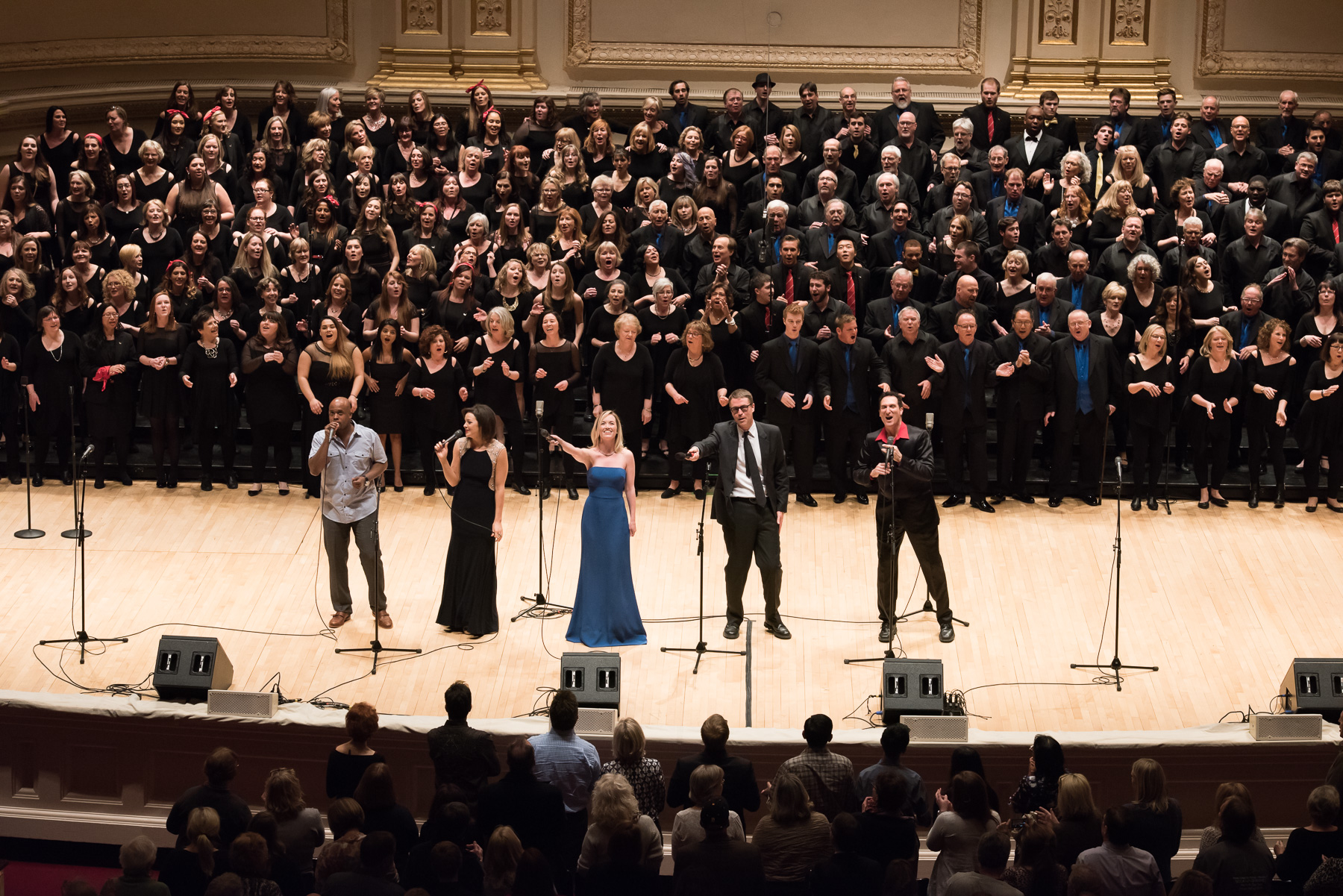
Distinguished Concerts International New York (DCINY) presents Total Vocal, a celebration of contemporary a cappella music featuring arrangements from Pitch Perfect, The Sing-Off, and the American pop lexicon
Deke Sharon, conductor/arranger
Kelley Jakle, Shelley Regner, Sean Altman, guest soloists; Chesney Snow, vocal percussion
Distinguished Concerts Singers International
Stern Auditorium, Carnegie Hall, New York, NY
March 29, 2015

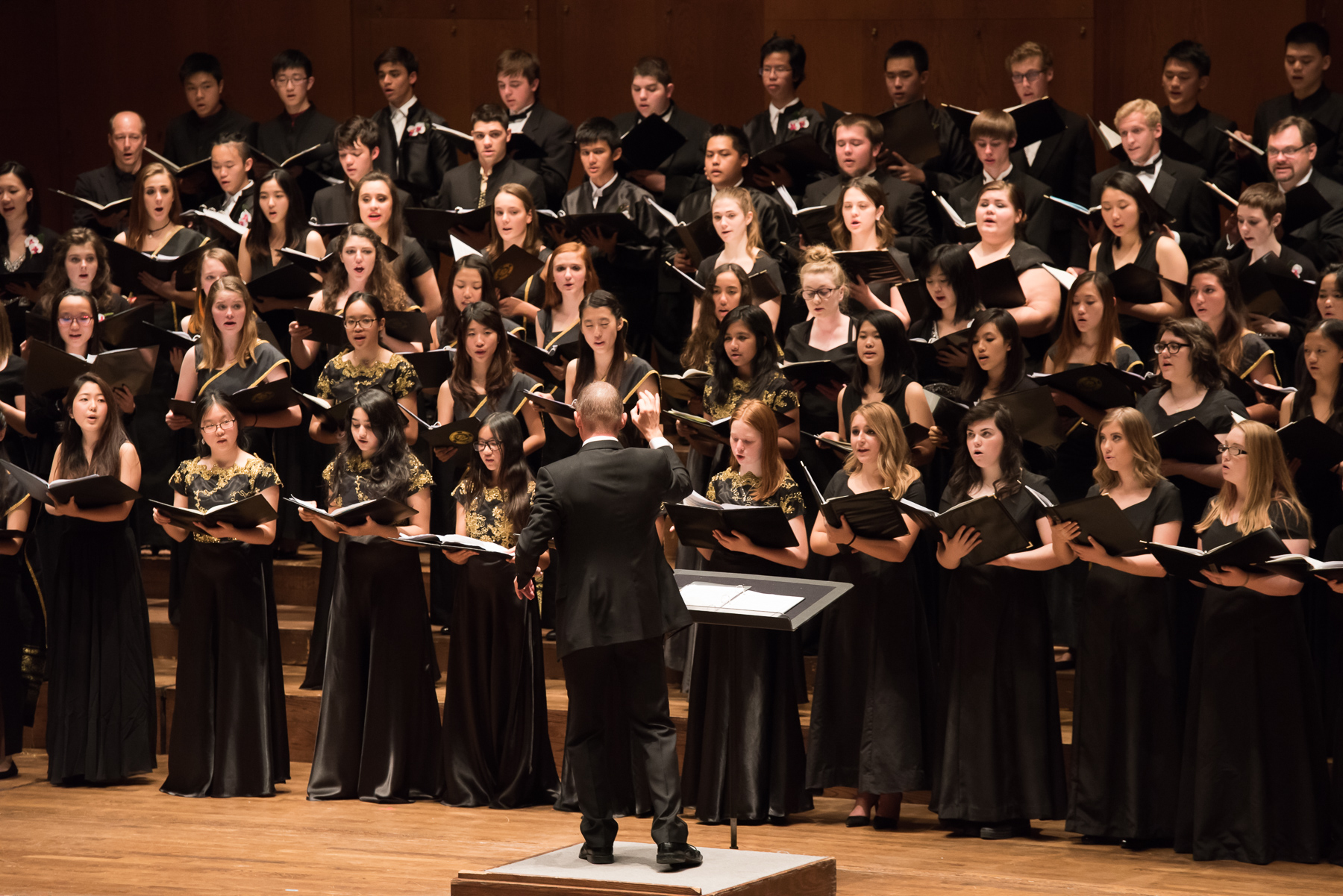
Two of the most desired syllables in the entertainment world are “sold out.” Follow those by the five syllables of “standing ovation” and you get a clear idea of the exciting program that was delivered in “pitch perfect” fashion on Sunday afternoon, by a large assembly of contemporary a cappella choirs from across the country, Canada, and Australia, under the superb and enthusiastic direction of conductor/arranger Deke Sharon.

He explained how only twenty to twenty-five years ago, a cappella choirs were few, mainly centering on eastern seaboard colleges. Today, there are over 3000 in the U.S. alone. Television shows like Glee and The Sing-Off competition, for which Mr. Sharon is music director, have fueled their popularity. The Sing-Off is now expanding to its fourth continent, Africa. Mr. Sharon also did all the music for the 2012 sleeper hit movie Pitch Perfect, about the a cappella competition world; the sequel, Pitch Perfect 2, is slated for release on May 15, 2015. The movie and the competition show provided the overarching theme for the day’s offerings, everything from Gershwin to Sondheim to Louis Prima and the Beatles.

Two hundred singers at high school level occupied the first half of the program, and they really showed how fine their training is, first with their own individual conductors in their hometowns; then coming to New York to combine with other groups and Maestro Sharon.

A cappella is an Italian musical indication (literally “in the chapel”). Since instruments were forbidden in the Sistine Chapel (many centuries ago, as well as today), the unaccompanied vocal singing style took that name. The human voice is the only instrument that is not man-made; it is already “in” everyone’s bodies. Every single sound that was made on Sunday came from the breath, lips, mouths, and throats of these musicians, including the new designation “vocal percussion,” also known as “beat box,” and all the complex arrangements were performed completely from memory.

From the first number, “I Got the Music In Me,” there was no doubt that was a true statement. Everything was precise, polished, beautiful, joyful, yet never sounding anything but spontaneous. Other highlights of the first half included Gill and Wade’s “Heartbreaker,” with Shelley Regner as soloist; she was in the Pitch Perfect movie, and will be in the sequel. An all-female version of Leonard Cohen’s moving “Hallelujah” by the group Bare Rhythm from Calabasas, California, earned a rousing standing ovation, one of many. Another was given to the massed choirs’ Benny Goodman homage: Louis Prima’s “Sing Sing Sing,” with the vibrant vocal percussion of Chesney Snow.

There were dozens and dozens of worthy solos all drawn from the choir members, as well as their own beat boxing; all their movements while feeling the music were natural and contributed to the great joy that pervaded the entire afternoon.

The second half saw the (slightly) older groups, from college age to adult. The Plain White T’s “Rhythm of Love” was given star treatment by a traditional barbershop group from Australia, The Blenders, as was John Mayer’s “Waiting on the World to Change” by a Canadian group called newchoir [no capital N]. Gershwin’s “Summertime” contained Sharon himself as the soloist, not only singing, but imitating the wah-wah sound of a trumpet with Harmon mute uncannily.

Kelly Jakle, another star of the Pitch Perfect movie, was outstanding in the inspirational anthem “True Colors,” which banished any comparison with Cyndi Lauper. To finish, the massed choir and all three soloists (including the excellent Sean Altman) sang “I Still Haven’t Found What I’m Looking For” with energy and fire. They may not have “found what they were looking for,” but they enabled us to find just what we were looking for. Bravo.

A brief, boisterous encore of “The Lion Sleeps Tonight” reintroduced the younger singers, who entered Carnegie Hall from the back, standing, singing, and dancing in the aisles. The rafters definitely rang, as audience joined in with the 400 singers, and Sharon encouraged everyone to sing, no matter where or for whom.

Share

Multicultural Sonic Evolution (MuSE) presents Sookkyung Cho, Pianist in Review

Multicultural Sonic Evolution (MuSE) presents Sookkyung Cho, Pianist in Review

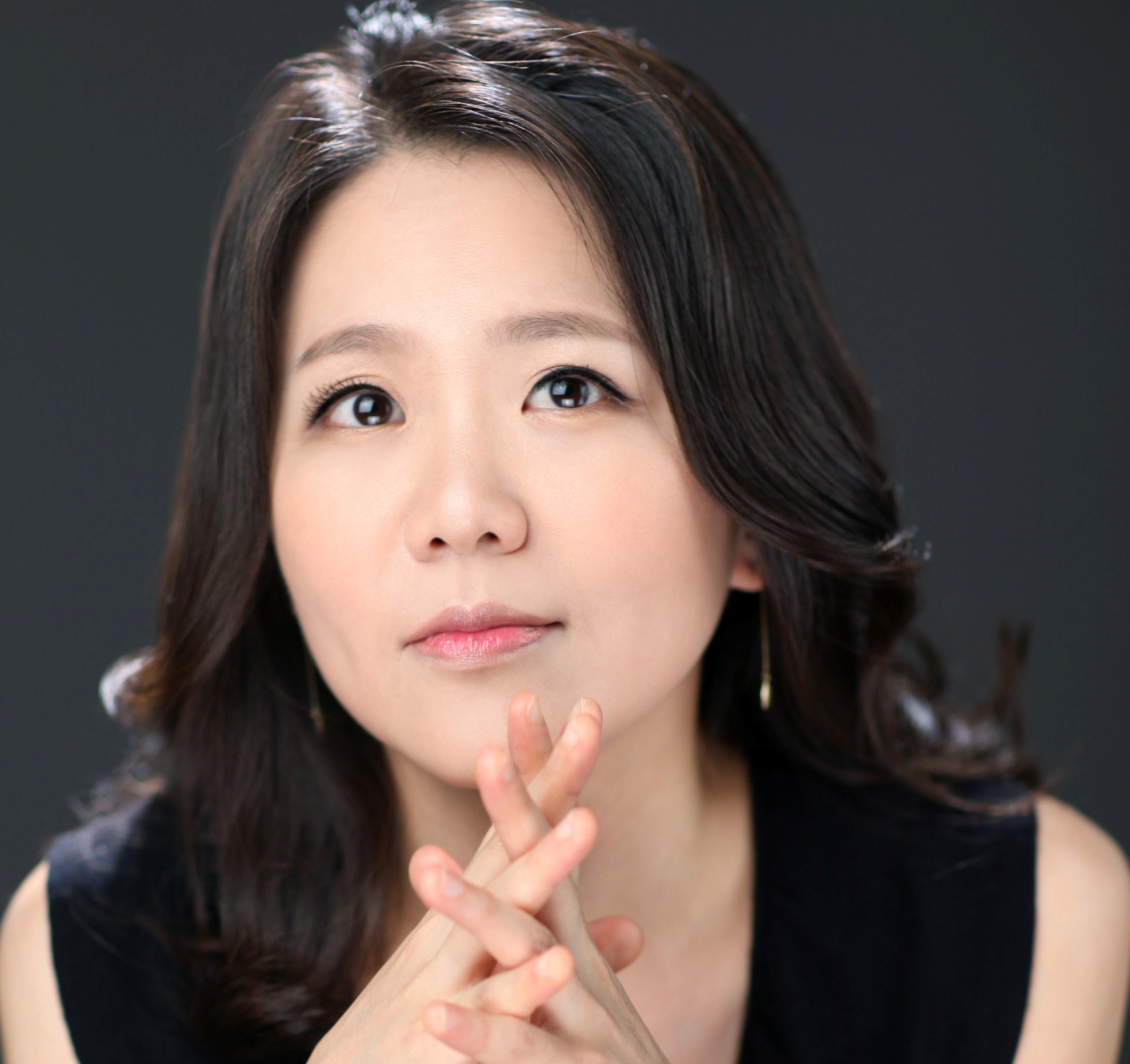
Multicultural Sonic Evolution (MuSE) presents Sookkyung Cho, Piano
Weill Recital Hall, Carnegie Hall, New York, NY
March 24, 2015

An engaging evening of piano music entitled “Two in One” started appropriately this week with an enchanting miniature entitled Snowdrop (2015) suggesting the beauty of this time of year, transitions and contrasts between winter and spring, and as the program notes describe, “despair and hope.” Written for this evening’s pianist, Sookkyung Cho, by composer Yui Kitamura (b. 1983 – also the Artistic Director of MuSE), it was given a sensitive and imaginative reading. Evoking the melting of ice under gently streaming treble figurations, the work is characterized by a winsome tonal lyricism that brought to mind the music of Norman Dello Joio, while always possessing an individual voice. It was an auspicious start to the program.

On to the weightier works, Ms. Cho proved herself to be more than up to handling the challenges in Schumann’s sprawling Davidsbündlertänze, Op. 6, and more. Ms. Cho is, not surprisingly, the winner of a slew of awards and honors, including from The Juilliard School where she received her Bachelor of Music and DMA degrees, and from The Peabody Institute (MM). She demonstrates a keen intelligence, strong technical command, and impressive stamina, with a physical approach that is strong but undemonstrative. There was much to commend about each of the eighteen character pieces, which alternately conveyed Schumann’s contrasting sides of the spirited Florestan and introverted Eusebius (both part of the “Band of David” to which the title refers – and both in keeping with this concert’s duality theme). The performances were taut, polished, and respectful to the score, with only the occasional fingerfehler. They showed almost no excess (except the rare overly resonant bass line, perhaps due to the piano) and virtually no self-indulgence, so there was not an instant when one would say that the performer’s ego got in the way; on the flip-side, though, one sometimes wanted more individual intimacy and abandon. After all, this set was composed while Schumann was in the throes of longing for his love, Clara, and it contains some of the most vivid and moving music of the Romantic period.

After intermission, Ms. Cho played C.P.E Bach’s Fantasia in F-sharp minor, Wq67, a rather underplayed and intriguing work, and a perfect dramatic and historical pairing with the next, Beethoven’s 32 Variations on an Original Theme in C Minor, WoO 80. In a way, the evening’s theme of duality, or as the program notes framed it, “dialectic in music,” could be plausibly applied to countless works and programs, but it did make a viable “hook” on which to hang these works for those needing more than simply an evening of great works. The best “hook” is always good playing, and we enjoyed a good measure of it, but the premise for the inclusion of this Beethoven work was that it has “an extremely regular bass line with free florid lines in his variations.” That was certainly clear in Ms. Cho’s able hands, with only small lapses.

As part of a Korean-Western duality, two selections from Three Korean Minyo (2014) by Teddy Niedermaier (b. 1983) were presented as a New York Premiere. They were a highlight of the evening. We heard the songful “Bluebird, Bluebird” and the rather jazzy “Song of the Roasted Chestnuts” – both folk song transcriptions full of character and color. Ms. Cho showed the most involvement of the evening in these, and the pieces sprung to life in winning performances.

The program concluded with Liszt’s Après une Lecture de Dante, Fantasia quasi Sonata, to adhere to the theme of the program, the quintessential Romantic battle of light and dark. For many pianists it is also a battle to navigate through torrents of octaves, but there were no such problems for Ms. Cho, who concluded the evening with brilliance.

Share

From Berlin to Broadway-Transatlantic in Review

From Berlin to Broadway-Transatlantic in Review

From Berlin to Broadway-Transatlantic
Adrienne Haan, chanteuse; Richard Danley, piano; Mike Campenni, drums; Roswitha, curtain singer
The Actors’ Temple, New York, NY
March 23, 2015

This concert was a benefit to raise money for the renovation, or could one say restoration, of Congregation Ezrath Israel’s 1923 landmark building on West 47th Street, The Actors’ Temple, which now serves as both a house of worship and a theater. Before the opening ceremonies we were entertained by Roswitha, an Austrian violinist/singer whose vocals, violin melodies and costume (ooh-la-la!) reminded us that we weren’t in a shul, thus preparing us for the evening of cabaret singing which was to follow.

During these opening ceremonies we learned about the many Broadway legends who worshiped here. The program that followed was a perfect way to conjure up the spirits of those great performers, the zeitgeist of the European countries they left, and the creative spirit which their new home encouraged.

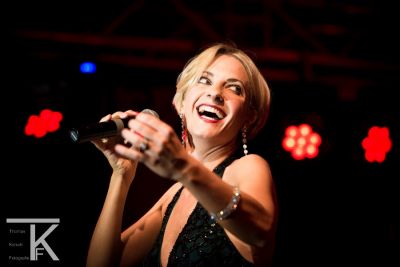
The houselights darkened and Adrienne Haan sauntered down the aisle dressed in a form fitting blue sequined gown with a white fur wrap (ooh-la-la redux!) Her first number was “Die Seeräuberjenny” (“Pirate Jenny”) from Kurt Weill and Bertolt Brecht’s The Threepenny Opera (Die Dreigroschenoper). This and the next three sets were sung in both German and English, the first two of the five languages we heard this evening. The other three were Yiddish, Hebrew, and French. For her rendition of “Pirate Jenny” and during the following German cabaret medley, Ms. Haan used the very bottom of her very wide range, singing a la Marlene Dietrich. As the concert progressed she sang higher and higher. This was first heard during one of her best numbers, the Yiddish song “Ikh Shtey Unter A Bokserboym” (“I Stand Beneath a Carob Tree”).

Ms. Haan established a close rapport with the audience through her informative, funny, and often moving commentary between sets. Introducing the next song, “Rikmah Enoshit Achat” (“One Human Tissue”), she said it was dedicated “to all the souls who have brutally lost their lives in the massacres of World War II,” and [she] would “sing it in memory of the Auschwitz liberation seventy years ago on January 27, 1945.” The Hebrew text of this song, whose words and music were written by Moti Hamer, was a fitting tribute, but I found the musical arrangement and performance jarringly upbeat.

Up to this point the accompanying artists, pianist Richard Danley and drummer Mike Campenni, were discreetly in the background. During the next set, a medley of American standards, the three artists shared equal prominence. I especially liked Mr. Danley’s swinging “’’S Wonderful.” More American songs followed. For me, Ms. Haan’s best performances took place during the next two sets, sung in French. She began Jacques Brel’s “Le Port D’Amsterdam” a cappella, a wonderful change of color. The instrumentalists soon joined in, and the work crescendoed to a shattering climax. An equally successful Edith Piaf medley followed. The concert proper ended with a moving performance of Ute Lemper’s “Blood and Feathers,” based on Jacques Prévert’s poem “Sang et Plumes.”

After sustained and enthusiastic applause, Ms. Haan performed an encore, “Jerusalem of Gold.” It was touching to hear the melody being softly hummed by some audience members who sat near me.


Share

Capps-Primakov-Lavrova: Passion-Romance-Fire in Review

Capps-Primakov-Lavrova: Passion-Romance-Fire in Review

Capps-Primakov-Lavrova: Passion-Romance-Fire
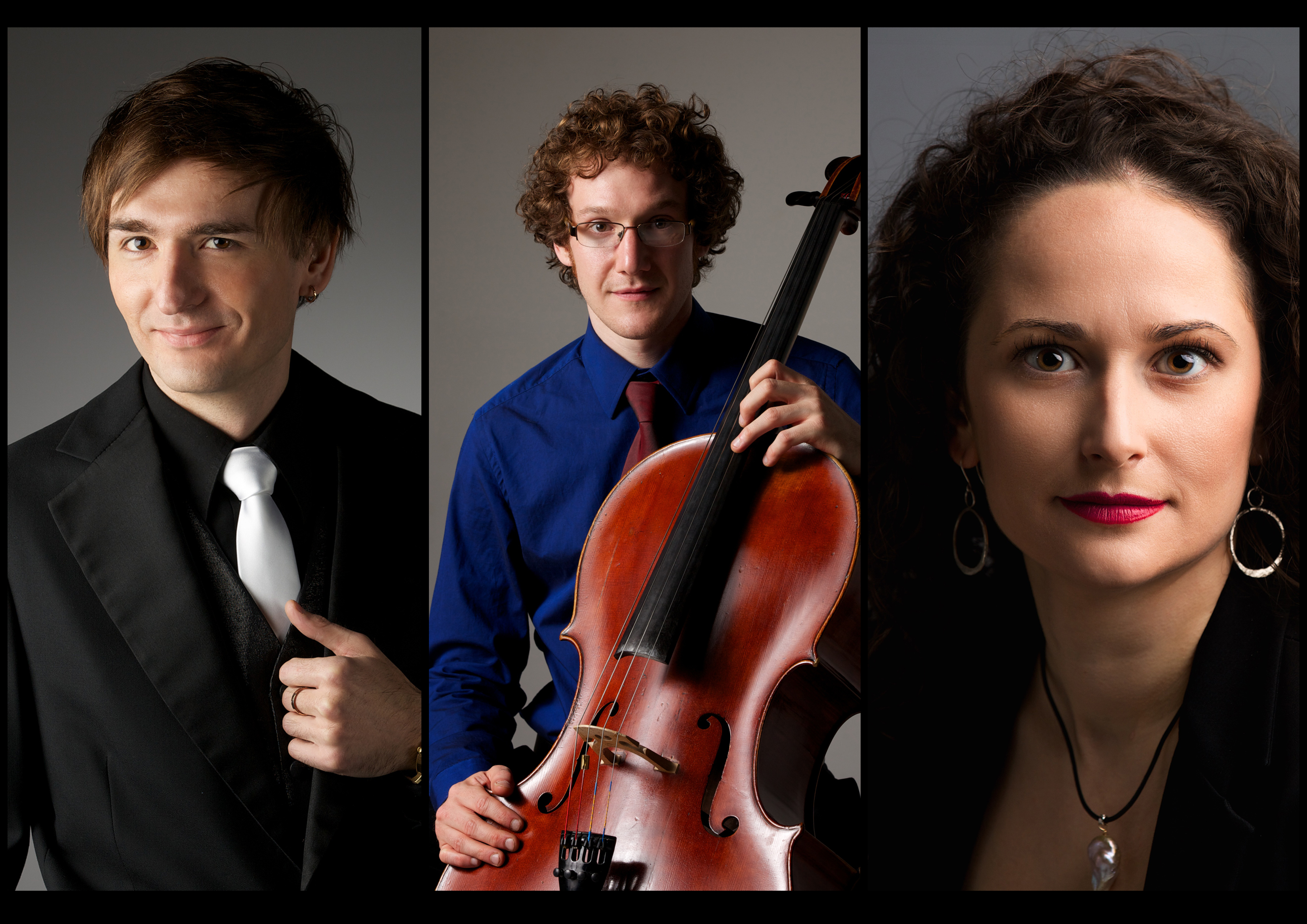
Ben Capps, cello; Vassily Primakov, piano; Natalia Lavrova, piano
Merkin Concert Hall, Kaufman Music Center, New York, NY
March 14, 2015


Take one New York cellist, two Russian pianists, and a South African composer, and you have the beginnings of a rather unusual recipe for a concert. Serve generous amounts of Rachmaninoff and Chopin, plus a premiere for zing, and one can satisfy a full house for approximately two hours. With champagne afterwards to complete the party atmosphere, this was the recipe for Passion-Romance-Fire, a concert featuring cellist Ben Capps, pianists Vassily Primakov and Natalia Lavrova, and composer Braam van Eeden, presented by the artists at Merkin Concert Hall on March 14, 2015. Unusual as the recipe was, it made perfect sense in light of the friendships among these musicians, and the rapport was quite apparent.

Mr. Primakov and Ms. Lavrova opened the evening with Sergei Rachmaninoff’s 1894 work, the Six Morceaux for piano four-hands, Op. 11. Telling native Russians the “proper” way to play Rachmaninoff may seem a bit like telling the sun how to rise, but I would like to express one reservation I had, and that was that the Barcarolle was a bit on the heavy-handed side. This minor matter notwithstanding, it was a stunning performance one would expect from two such highly accomplished pianists.

Abraham van Eeden (b. 1989), or Braam, as he prefers to be called, hails from South Africa. Mr. van Eeden is pursuing a master’s degree at the University of Pretoria in piano and compostion and theory. He is currently studying composition in New York City with one of America’s finest composers, Lowell Liebermann. It is already paying dividends, judging by the quality of the work presented at this performance. Variations on a theme by Schumann, for cello and piano four hands, written especially for Mr. Capps, Mr. Primakov, and Ms. Lavrova, was given its world premiere. The theme, Fast zu Ernst, is from Kinderszenen. There are ten variations with a closing section. Cellist Ben Capps described this work as “Shostakovich and Piazzolla had a baby,” a humorous, but apt analysis. This is a highly dramatic and effective work, filled with eerie moments and excitement, all brought to a finish that Mr. van Eeden likens to an explosion. Mr. Capps, Mr. Primakov, and Ms. Lavrova wrung out every last drop of drama in a superb performance that was the highlight of the evening for this listener. Mr. van Eeden was in attendance, and stood to acknowledge the cheers of the appreciative audience.

The unusual scoring will likely limit extensive performances. It might be a good idea for Mr. van Eeden to work out a version for cello and piano, two hands, as well.

It is indisputable that Mr. van Eeden is a natural talent with seemingly limitless potential, given his youth. What remains to be seen is if he can fully develop those gifts and grow into a composer with a truly distinctive voice. The preliminary indications are looking favorable, as the Variations on a theme by Schumann is a leap forward from some of his earlier works.

Cellist Ben Capps offered two of the warhorses of the repertoire, Chopin’s Sonata for cello and piano in G minor, Op 65, and Rachmaninoff’s Sonata for cello and piano in G minor, Op .19. Expectations are high for any cellist who programs these masterpieces. Woe be to any cellist who is not up to the mark, as these works are so well known that even the average listener will easily detect flaws. There were no worries about this, as Mr. Capps “delivered the goods” with assurance in dynamic performances, further enhanced by the technical wizardry of Mr. Primakov, who made child’s play of the ferociously difficult piano parts. This is a pairing of talents with great potential! Interested listeners would be well-advised to seek out the CD of these works that Mr. Capps and Mr. Primakov recorded, which will be released on April 15, 2015- go to LP Classics for details.

Mr. Capps is all business in his demeanor- there is none of the incessant undulating that so many performers seem to feel is necessary (note to such performers: It isn’t). Playing a 1782 cello made by William Forester, Mr. Capp produces a tone that is rich, warm, and full-bodied, without any stridency in loud passages. He makes the most difficult passagework seem effortless. The closing of the Rachmaninoff sonata was scintillating and brought the audience to their feet. It was a fine end to a fine concert. Bravo to all!

Share

Eastman School of Music presents Cahill Smith in Review

Eastman School of Music presents Cahill Smith in Review

Eastman in New York
Cahill Smith, piano
Weill Recital Hall at Carnegie Hall, New York, NY
March 14, 2015

Eastman School of Music, one of the country’s leading conservatories, under the series title “Eastman in New York” presented one of its fine doctoral graduates, Cahill Smith in a recital of standards and unusual repertoire, all enlivened by Smith’s uncommon musicality.

He is an affable young fellow, with a way of showing facially just where the music is going while he plays, what points it is making, and how his involvement fits with all that, and he does it in a non-obnoxious way, a rare talent. He also at all times gives the impression of creating “on the spot” rather than just parroting something that has been over-learned by rote. This is truly a gift.

His opening Scarlatti sonata, the F minor, K. 466, played with every advantage of the modern piano’s colors and shading, contained a lot of romantic rubato, but was nevertheless totally convincing in Mr. Smith’s hands. This segued directly into Scarlatti Cadences (1996), Sebastian Currier’s postmodern take on Scarlatti’s energy, including some direct appropriations. It was a great programming idea to have the mysterious cluster that begins the Currier follow the final note of the Scarlatti with no break. I felt as though some of Messiaen’s birds wandered into Currier’s world too. The coloring was beautiful from Mr. Smith.

Mozart’s Sonata in D Major, K. 311, finds the composer in an optimistic mood, and although we know how exposed Mozart is for the intrepid pianist, Mr. Smith illuminated every phrase affectionately and with sparkle, crisp runs, and stylish ornaments.

He then closed the first half of the recital with Liszt’s epic Vallée d’Obermann, from the “Swiss” year. In his charming verbal program notes, he said that the piece was new to him, and it sounded thus. I felt it really was best in those moments when he actually got a bit wild and almost out of control. That’s when the most fitting energy was applied, and at those times it was very exciting. Perhaps as he matures with the piece, he will find more mystery, more longing, more existential dread progressing to redemption. I suggest he re-analyze the motif as a “three-note descending” rather than the scale he mentioned. That way, he will discover just how it constantly refers to Obermann’s questioning “Que veux-je?/Que suis-je?” (What do I want? What am I?)

The entire second half was devoted to a special “cause” of Mr. Smith: the piano music of Nikolai Medtner, a Russian near-contemporary of Rachmaninoff whose music has been largely neglected in the rush to modernism (he worked in a largely tonal, conservative vein, but with great originality and touching emotion). He offered selections from Forgotten Melodies, Book 1, Op. 38 (I. Sonata Reminiscenza ,II. Danza graziosa, III. Danza festiva, VI. Canzona serenata, VII. Danza silvestra , Coda. Alla Reminiscenza). Here, Mr. Smith was in his element, revealing every twist and turn, every poignant repeat of the cyclic themes, with beautiful shimmering colors I haven’t heard since Gilels played the Sonata reminiscenza in Carnegie Hall in 1980. This was the most Medtner I’ve ever heard at one time, and I was wondering since he presented Op. 38, why did Mr. Smith leave out the fourth and fifth pieces? It would have made for a longer recital for sure, but no one was complaining.

After a rousing ovation, he did a “true” encore, and repeated the second Medtner piece, the Danza graziosa, with its hints of incipient ragtime à la Russe. It was even more finely shaded than the first time. Thanks to Eastman for providing a real program, and to Mr. Smith for writing his own program notes. Bravo.


Share

Distinguished Concerts International New York (DCINY) presents a cappella NEXT in Review

Distinguished Concerts International New York (DCINY) presents a cappella NEXT in Review

Distinguished Concerts International New York (DCINY) presents a cappella NEXT
Harmonia Chamber Singers, Robert Pacillo, director; Choeur de Chambre du Québec, Robert Ingari, director; Elore Festival Singers, Noel Edison, director
Weill Hall at Carnegie Hall, New York, NY
March 13, 2015

For the superstitious, the idea of a concert on Friday the 13th might be considered to be an ill-advised undertaking to be avoided at all costs. While those with paraskevidekatriaphobia stayed home, the hall was filled with those intrepid souls who refuse to subscribe to such beliefs, and they were rewarded with a truly outstanding concert. On March 13, 2015, Distinguished Concerts International New York (DCINY) presented a concert entitled a cappella NEXT, an evening dedicated to contemporary choral chamber music. Featuring the talents of three choruses, one from New York and two from Canada, it was a night filled with the sounds of some old classics and exciting new works.

I had the privilege of reviewing the 2014 a cappella NEXT concert ( a cappella NEXT 2014 review), so I was looking forward to this year’s edition. Without taking anything away from the talented ensembles that sang so well in 2014, the three ensembles this year not only met the high standards of their predecessors, but moved the bar up several levels.

The Harmonia Chamber singers opened the concert. Led by Robert Pacillo, this New York based ensemble got the night off to a fine start with a rock-solid performance of My Soul, There is a Country, an anthem by the composer best known for Jerusalem, Hubert Parry. Eulogy, by Rob Deemer, with text by Brian Turner, followed. Eulogy is a written account of a solider’s suicide in Iraq. With pitch bends and near bi-tonality at times, suggestive of the waves of heat on the battefield, the pause after the solider shoots himself, and the tight harmonies as the work ends in almost a whisper, Eulogy is hauntingly moving. Mr. Deemer was present in the audience and must have been pleased by the superb performance of his piece. The next work, She Walks in Beauty by Lord Byron, was skillfully set by Jeffrey Trenchard, a member of the ensemble. Mr. Trenchard was visibly moved to tears when he stepped forward to acknowledge the audience after a lovely performance. Goin’ Home, using the Largo movement from Dvořák’s Symphony No.9 “From the New World” and a playful Nelly Bly by Stephen Foster brought the Harmonia Chamber Singers’ portion of the program to a close. An appreciative audience loudly cheered for this fine ensemble.

After a short break, Choeur de Chambre du Québec took the stage. As one would expect from an ensemble from Québec, their entire portion (dix chansons) of the program was sung in French. The details of their entire set, plus translations, can be viewed by clicking the following link: a cappella NEXT program 2015. Conductor Robert Ingari not only led his ensemble with careful attention to details of timbre, but proved to be an accomplished composer as well. His settings of the poetry of Paul Verlaine in Chanson d’automne and Soleils Couchants were compelling. Not to be overshadowed by their maître, ensemble members Guillaume Boulay and Jean-Charles Côté contributed fine works as well, all performed with flawless intonation, balance, and style. French, and French-Canadian composers (Debussy, Poulenc, Lionel Daunais, and Mark Sirett) rounded out their program. Choeur de Chambre du Québec sang these works with the native flair that a non-francophone would be hard pressed to emulate. After the last sounds of Sirett’s ravishing Ce beau printemps faded away, the audience reacted with a standing ovation for this first-rate ensemble. Bien joué, Choeur de Chambre du Québec!

After another short break, the Elora Fesitval Singers took the stage for the last set. Based in Elora, Canada, they are led by the able Noel Edison. Their opening piece, Immortality, by Timothy Corlis, was for this listener, the highlight of the evening. A crowd-pleaser from start to finish, it is a work with something for everyone- driving energy, brilliance, spine-tingling moments, sublime beauty, and a build-up to a climax that explodes before fading away. It was a great lead-off work, but I believe this placement was a tactical error- it should have been the last work on their program. Two well-known and popular works from Eric Whitacre followed- Sleep and Her Spirit Soars. The close harmonies that are so characteristic of Whitacre, were delivered precisely by the ensemble, making for a truly wonderful performance. Gloria Deo per immensa Saecula, by Healey Willan, closed the concert. This motet was the product of a challenge from a colleague about the lack of new five-part works (two other examples of similar challenges readily come to mind J.S. Bach’s Musical Offering and Thomas Tallis’s Spem in alium). It is a remarkable work and was given a remarkable performance- a real tour-de-force that might be better appreciated by choral specialists than by the average lay listener. In any case, my reservations about sequence are a matter of preference, and in no way detract anything from the fine performances. The audience gave the Elora Festival Singers a well-earned standing ovation.

Congratulations to all three ensembles. It was a lucky Friday the 13th indeed!


Share

New York Concert Artists & Associates Present Sergey Kuznetsov, 2014 Carnegie Debut Recital Winner in Review

New York Concert Artists & Associates Present Sergey Kuznetsov, 2014 Carnegie Debut Recital Winner in Review

New York Concert Artists & Associates Present the 2014 Carnegie Debut Recital Winner
Sergey Kuznetsov, Piano
Weill Recital Hall at Carnegie Hall, New York, NY
Wednesday, March 11, 2015

A barn-storming firepower Russian virtuoso of the “old school” variety swept into town on Wednesday night in the person of Sergey Kuznetsov. I should qualify that by saying that in addition to absolute technical command and big line, Mr. Kuznetsov adds the virtues of a steely concentration, fierce intellect, and a great deal of lyrical intimacy. I’d say overall for me he was at his best in precisely those lyrical moments—however he generated the greatest audience excitement when giving full vent to what are his obviously huge passions about the music he is playing and what it is expressing. He took risks, and they paid off.

He began with a searching account of Schubert’s Impromptu No. 1 in C minor, D. 899, one that emphasized the implacable march-like nature of the material, but then dissolved into moments of heartbreaking lyricism, with a perfect singing legato and voicing. Mr. Kuzetsov then launched into the true curiosity of the program: his own transcription for solo piano of the great Schubert F minor Fantasie, D. 940, originally for piano four-hands. This is one of Schubert’s final compositions, and arguably the most profound work ever written for the medium of two players at one keyboard. I confess to being worried that the essential intimacy of the chamber-music genre would be lost, but my worries were unfounded. Due to Mr. Kuznetsov’s unlimited technique and total understanding of each gesture, I quickly and happily surrendered to this version. Interestingly, the unavoidable need for him to leave out at least some of the notes led to an increase in transparency for the piece as a whole. I only missed some of the massive climactic sonority in the final fugal section, which needed deeper basses.

He then turned to his fellow Russian, the deeply mystical, often misunderstood Scriabin. First he teased out the brief, evanescent mini-dramas of the Three Pieces, Op. 45, from Scriabin’s fully-formed mysterious late-style period. They progress backwards, with the final short piece called Prelude. Perfectly rendered, as they were here, their enigmas remain unsolvable. Mr. Kuznetsov then played Scriabin’s Third Sonata, which still relates to the Chopinesque romantic style of Scriabin’s youth, but expands the rhythmic ambiguity greatly, on the way to the later sonatas. Here Mr. Kuznetsov’s tempestuous emotions added immensely to the success of the work. I’d like to add also, that he understands something very important abut Scriabin: if you merely do literally what is on the page, often the music just “lies there.” Mr. Kuznetsov possesses the secret of what I call the “Scriabin rubato,” which knows when to surge forward, pull back, and group certain notes and rhythms together in a slightly (!) altered fashion, so that the true gesture emerges. An exciting performance.

After intermission, Chopin was the subject, starting with the rarely performed Rondo à la Mazur, an early work. I had only heard it once live, at a Horowitz recital. Mr. Kuznetsov brought so much authentic mazurka characterization to the main theme that it became a dancing joy. His sparkle and glitter were in abundance too. The 24 Preludes, Op. 28, followed. This work is far from rare, even though Chopin himself didn’t perform all of them at one sitting; this only became popular in the twentieth century. Mr. Kuznetsov seemed to have an overall plan to make these mostly brief character pieces into one arching statement. To that end, he de-sentimentalized many of them, not in itself a bad thing. I felt an indefinable need for less aggression though, only at times, and just when I was beginning to get uncomfortable with it, he redeemed it with a moment or two of stunning intimacy. A very individual approach, completely admirable in such an iconic, even overplayed, work. [A note to Martha Argerich . . . I’ve finally found someone who can play Chopin’s Prelude No. 16 faster than you, with no dropped notes, musically, and live!]

He favored his enthusiastic audience with two encores: the Chopin Berceuse, Op. 57, which contained all the delicacy I craved in the Preludes. Then the monstrously difficult Godowsky/Strauss: Symphonic Metamorphoses on Themes from Die Fledermaus. This piece contains enough notes for six hands, or, if you’re lucky enough to have him: one Kuznetsov.

Share

Mirror Visions Ensemble presents Journeys in Review

Mirror Visions Ensemble presents Journeys in Review

Mirror Visions Ensemble presents Journeys
Mirror Visions Ensemble- Vira Slywotzky, soprano
Scott Murphree, tenor
Jesse Blumberg, baritone
Grant Wenaus, piano
SubCulture, New York, NY
March 10, 2015


To celebrate the upcoming release of their CD entitled The Three-Paneled Mirror (Centaur Records CRC 3381/3382), comprised entirely of commissioned works, Mirror Visions Ensemble presented a program called Journeys at SubCulture in New York City. Featuring works from the standard repertoire paired with premiered commissioned works from contemporary composers (not included on their CD), it proved to be a trip filled with wonder and whimsy.

Mirror Visions Ensemble, directed by Tobé Malawista, has stated their mission as “performing and commissioning musical ‘mirror images’- multiple settings of the same text by one or more composers,” and presenting programs that are “built around themes and always include new works commissioned by the ensemble.” Each member of Mirror Visions has an impressive list of accomplishments and credentials as soloist and was featured as such in at least one work in the program.

Journeys included works about exploring the sea, islands, and forests, letters from friends, as well as visits to churches and several hotels. There were sixteen works total on the program with the earlier being songs from Hugo Wolf, Hector Berlioz, Joseph Haydn, Felice Blangini, Henri Duparc, 20th century masters Samuel Barber and Francis Poulenc, and popular composers Cole Porter and Stephen Schwartz. The newer were commissioned works by Gilda Lyons, Scott Wheeler, Deborah Fischer Teason, Tom Cipullo, and William Ryden.

As much as I would like to give a detailed account of all the songs, I will concentrate mostly on the commissioned works. For the older works, I will mention three highlights: Baritone Jesse Blumberg dynamic, full-bodied performance of Hugo Wolf’s Auf einer Wanderung, tenor Scott Murphree’s hilarious take on Cole Porter’s Tale of the Oyster, which had the audience roaring with laughter, and Samuel Barber’s setting of James Joyce in Solitary Hotel performed in Film Noir style, with soprano Vira Slywotzky taking the part of the femme fatale as she slinked to the front of the stage – it was campy to be sure, but how very effective it was!

Moving on to the commissioned works, Great Barrier Reef by Gilda Lyons, from “recent studies, adapted by the composer,” featured swirling sounds of the waves, as the music “flowed” from one performer to the next in rapid sequence, and with some added sound effects. It was an ingenious work given a polished performance.

Letters to Isabella, by Scott Wheeler, uses the texts of three letters written to art collector and museum founder Isabella Stewart Gardner. The first from Henry James (for tenor), the second from Paul Bourget (for soprano), and the last (for baritone) from Kakuzo Okakura, ostensibly written to his cat, who was “visiting” with Ms. Gardner. Mr. Wheeler expertly captured the tone of each letter, from the longing sighs of James, to the world-weary Bourget (who found Florida especially odious), and the playful teasing of Okakura, and the performers projected those qualities with consummate grace.

The Bells at Saint-Aignan by Deborah Fischer Teason, using text from Jeffrey Greene, was to this listener the highlight of the commissioned works. As told in the program, each bell at this church has three names, the first the name of a noble woman, the second after bees or wasps, and the third for the notes they sounded. This commemorative piece was conveyed with haunting tonal ambiguity in both the vocal and piano writing, never straying too far toward atonality, but remaining unsettled throughout. It was a mesmerizing effect, given an equally mesmerizing performance.

At the Windermere Hotel, by Tom Cipullo, with text from Nightmare at the Windermere Hotel by Edna St. Vincent Millay, was a sure-fire crowd pleaser. The audience was in stitches as the quest for an elusive cup of coffee from room service took an absurdly comic route. Even pianist Grant Wenaus got into the act – when he called out “Kitchen Speaking,” the audience howled in laughter. This was just pure fun and Mirror Visions played it for all it was worth.

William Ryden’s The Owl and the Pussy-Cat, using Edward Lear’s verses, was a delight and brought the program to a successful finish.

It was gratifying that all the composers of the commissioned works were in attendance and able to be acknowledged for their compositions by the appreciative audience.

The Ghost of Madame de Sévigné at the Carnavalet, by Christopher Berg, was offered as an encore, after which the Ensemble greeted the many people who wished to see them. Mirror Visions Ensemble is not only highly accomplished musically, but also pulls in their listeners with their winning personalities on both the individual and group level. Add those qualities to the great service they do for contemporary composers by their continual commissioning and performing of new works, and the end result is a win for everyone. I look forward to hearing more from and about Mirror Visions Ensemble.

Share

Cameron Carpenter in Review

Cameron Carpenter in Review

Cameron Carpenter, organ
Orchestra Hall, Detroit
February 23, 2015

Organist Cameron Carpenter walked out on the stage of a sparsely populated Orchestra Hall in Detroit Monday evening (Feb. 23rd) to play the International Touring Organ, an electronic instrument he designed to liberate himself from aging and often badly maintained pipe organs. He’s like a kid with a new toy (I use the word he used himself) and his joy in exploiting its possibilities sometimes got the better of him, but it was an infectious joy that he shared with the five hundred or so folks in the hall who responded with whistling and stomping standing ovations.

His instrument, built by Marshall & Ogletree in Massachusetts and completed last year, contains sampled stops from organs of different periods and styles all over the world — baroque, romantic, theater organs of the “mighty Wurlitzer” type, there’s probably even a Hammond in there someplace. It can all be disassembled and packed into a van, albeit a pretty big van, for transport to anyplace with an electrical outlet to plug it into. It’s a novel concept, and really the only way to allow for the career as a touring virtuoso that Carpenter has embarked upon.

Mr. Carpenter takes a good deal of abuse from the traditional-minded in the organ world, though rarely from its most accomplished players. Some of it stems from his punk-radical dress and hairstyle which, incidentally, does not interfere with his articulate and intellectual way of explaining to the audience what he does. Other criticism is directed against his taste for flashy virtuosity in performance, which drives serious practitioners of historically informed styles crazy.

What is beyond dispute is that Cameron Carpenter is a performer of nearly superhuman technical accomplishment. He does things with his hands, feet and brain that ought to be impossible, juggling five or six independent musical lines among them, sometimes playing on four keyboards at a time with his two hands and thanks to a pedal divide feature, two more with his feet, all without a flinch or a bobble. He’s the Horowitz of the present generation, and incidentally, the grand old man was criticized for historical inappropriateness and bad taste too. People with skills on that level make their own rules, as they should.

His program, announced from the stage with some good humored commentary, covered a big stretch from J. S. Bach — the Prelude in A Major and the big Toccata in F Major taken at a quick clip and with enough colorful registrations to stoke the purists ire — to an encore of Gordon Lightfoot’s If You Could Read My Mind that shimmered like a gamelan orchestra. In between there were Marcel Dupré’s Variations on a Christmas Carol, and Carpenter’s own spectacular transcriptions of Shostakovich’s Festival Overture, Leonard Bernstein’s Overture to Candide and Alexander Scriabin’s 4th Piano Sonata. Only in the last did I miss the original, the piano’s sustain pedal gives a hazy perfume that is simply not available on the organ but badly needed in this work. I also thought that throughout the program Carpenter was a little too enamored with the battery of super-low bass stops at his disposal, but then if you’ve spent a couple of million to be comprehensive, I suppose you feel like you ought to use them.

Really, it’s pointless to criticize Mr. Carpenter as a classical organist. What he’s doing with — and to — his innovative, purpose-built instrument hasn’t been done before. Love him or hate him, he’s an astonishing, and astonishingly original, artist.

Share

Musica Sacra in Review

Musica Sacra in Review

Musica Sacra
Kent Tritle, Music Director; Michael Sheetz, Assistant Music Director
Lianne Coble, soprano; John Turanno, tenor; Malcolm J. Merriweather, baritone; Arthur Fiacco, Jr., cellist; Walter Hilse and Raymond Nagem, organists
Cathedral of Saint John the Divine, New York, NY
March 4, 2015


It is not often that one hears three world premieres all in one evening, with the notable exception of sacred concert music, a sphere that continues to thrive due to the dedication of organists, choir directors, choral singers, and their supporters and patrons. This wouldn’t be the usual volunteer church choir music, rehearsed but once on a Thursday evening prior to the Sunday service; rather it is intended for professional choirs with appearances both in and out of the liturgical setting.

Continuing its commitment to expanding the choral repertoire, Musica Sacra dedicated its final concert of the season to three world premieres, including The Wisdom of the Wise Old Man by Juraj Filas, Returning by Michael Gilbertson, Lux Aeterna by Robert Paterson, as well as Parable, A Tale of Abram and Isaac by Judith Lang Zaimont. [Reviewer’s note: This review will concern itself primarily with the Juraj Filas premiere.]

Briefly stated: What is there that Kent Tritle can’t do? His presence in the New York organ and choral scene is dominant, and always excellent. Since his taking over the group Musica Sacra, its already first-rate reputation has been sharpened and focused even more. His conducting is lyrical, energetic, and, for lack of a better word, mystical. He draws forth the entire scope of dynamics and color variety from the lean choir, composed of just twenty-eight singers.

Mary B. Davidson, a board member of Musica Sacra, and Arthur Fiacco, Jr., a fine New York cellist (and long-time collaborator with Maestro Tritle), were both so moved by a recent trip to the Nazi show-camp of Terezín (better known by the German name Theresienstadt), in what today is the Czech Republic, that they commissioned the prolific Slovak composer Juraj Filas to create a suitable memorial to mark the seventieth anniversary of the liberation of the camp, and all the extermination camps (of which Terezín wasn’t one, offically), and the end of WWII in the European theater.

What do I mean by the term show-camp? Terezín was used by the Nazis as propaganda to show how they were tolerant and not cruel. Red Cross groups were regularly paraded through Terezín to see for themselves the orchestra, chamber music, theater, poets, etc. Of course, all this was but the thinnest of masks to the real horror. Most of Terezín’s inmates were transported to one of the extermination facilities, if they didn’t die of disease first.

Mr. Filas can be considered the ‘composer-grandsonʼ of one of Terezín’s inmates: Rudolf Karel, who was his teacher’s teacher.

We tend to think of horror as zombies, chainsaw massacres, and the like, but the real horror is when man inflicts humiliation, torture, and death upon his fellow-man. Mr. Filas seized upon this realization to craft a dramatic cantata for soloists, chorus, cello solo, and organ, that uses one section of Dante’s Inferno, and some lines from a fairy tale by Czech author Karel Jaromír Erben.

While the Dante dwells on the terrors of the damned as they descend to their various punishments (“Abandon hope, all ye who enter here” sung in Italian, as were all the Dante lines), the Erben urges its hearers to carry on, that “We will cross the threshold of wisdom and leave for the place, which knows no joy or sorrow, where there’s neither delight or death, where there’s eternal peace and paradise.”

Mr. Filasʼ compositional style (in this piece, anyway) tends to the portentous and bombastic, although, I must say he acheived an almost Mahler-like transcendence in the consoling words of Erben heard at the end. There are at least two ways of looking at originality: (1) is the composer creating a new vocabulary of music or adding something never before done?, and (2) is he expressing himself as only he can, thus original and authentic? Mr. Filas is certainly a (2), and if I knew more of his music, perhaps I’d be inclined to add (1).

Mr. Fiacco played his yearning cello part with all the commitment and soul one could ever wish for, and it’s only a shame that it was audible only during his solos and when he was with organ; but not when the full choir was singing. At those times he looked very busy but one wasn’t hearing his contribution. The chorus and solists were magnificent, their diction was crisp and intelligible even in the cavernous acoustic of the cathedral, with its many seconds of reverb.

“Love is the truest elixir. . . This is the wisdom of the wise old man.”


Share