The Douglas and Inyoung Boyd Foundation and The Mason Gross School of the Arts of Rutgers University present A Classical, Jazz, and Chamber Music Extravaganza in Review

The Douglas and Inyoung Boyd Foundation and The Mason Gross School of the Arts of Rutgers University present A Classical, Jazz, and Chamber Music Extravaganza in Review

The Douglas and Inyoung Boyd Foundation and The Mason Gross School of the Arts of Rutgers University present A Classical, Jazz, and Chamber Music Extravaganza
Min Kwon and Fred Hersch, piano; Yoon Kwon, violin; Jonathan Spitz, cello;
Conrad Herwig, trombone; Timothy Cobb, double bass; Choong-Jin (CJ) Chang, viola
Weill Recital Hall at Carnegie Hall, New York, NY
October 6, 2014


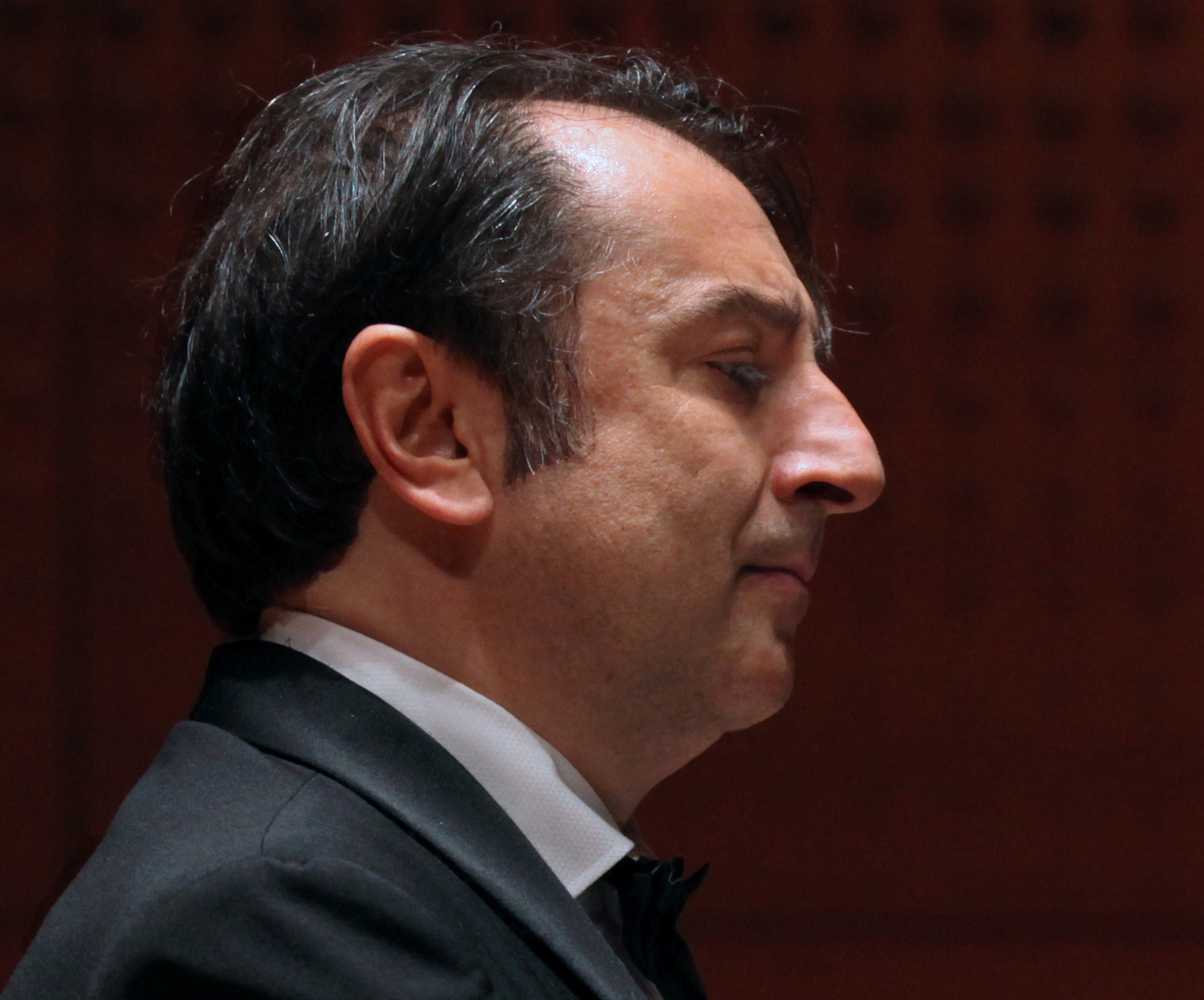
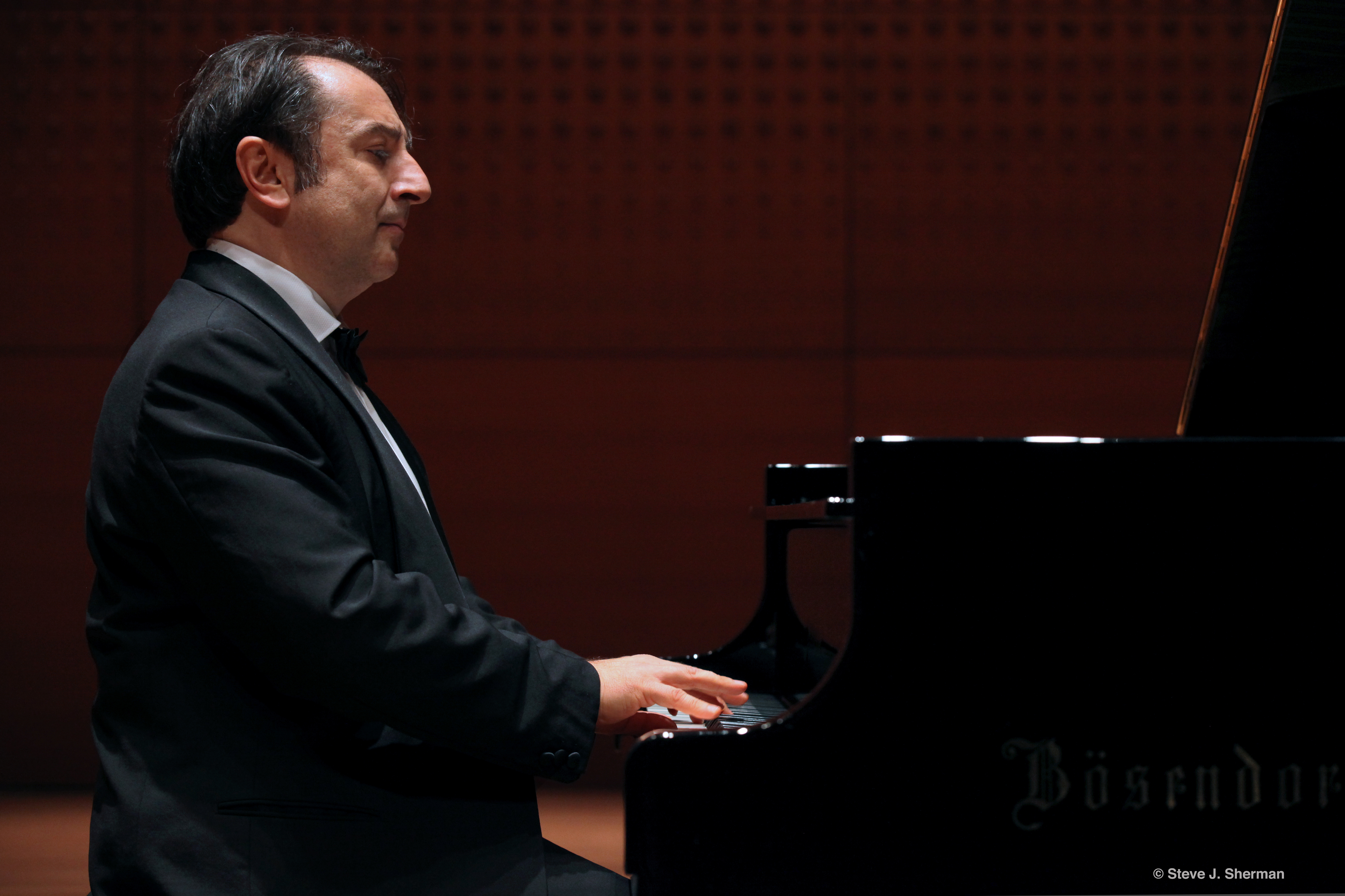
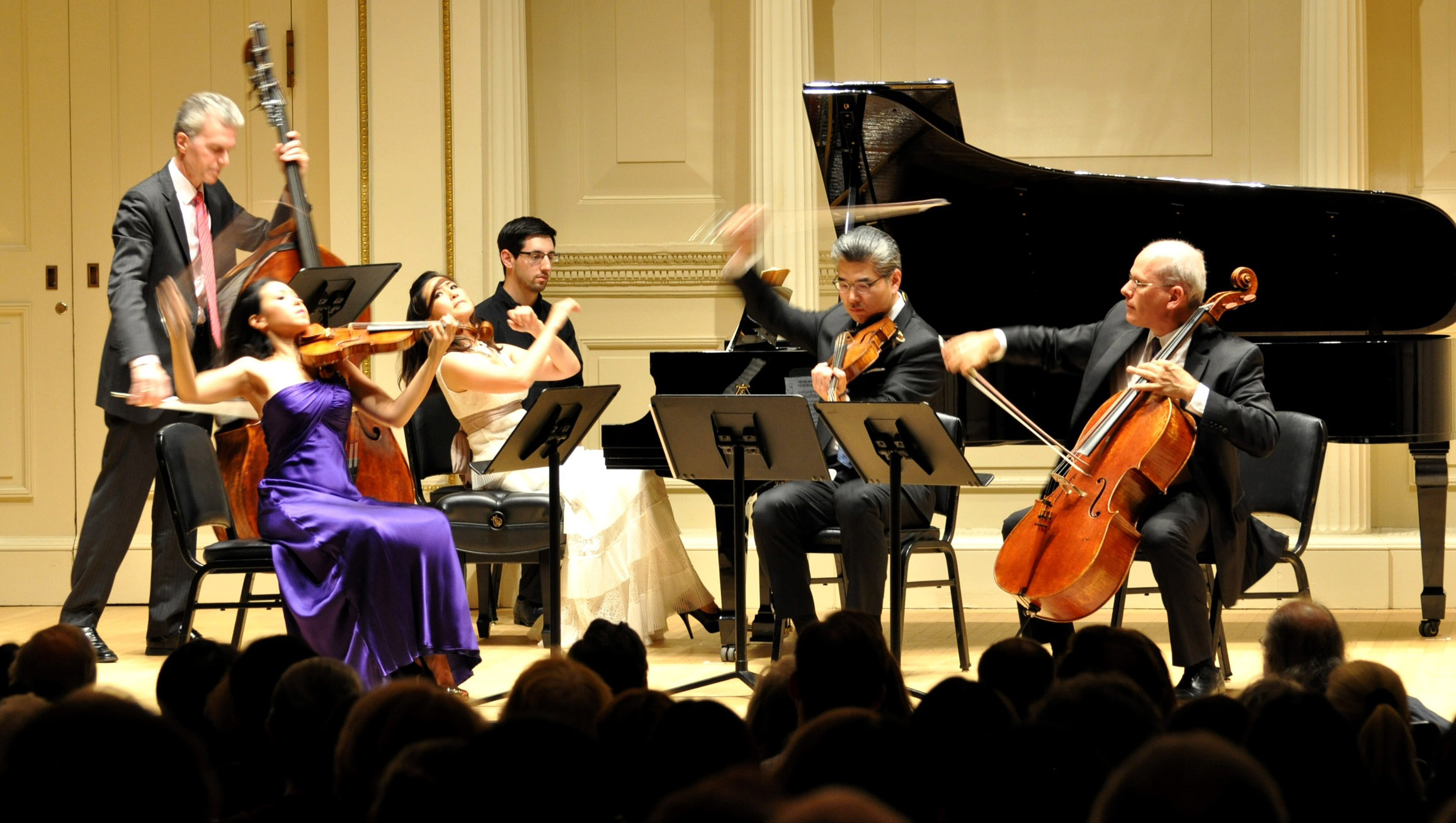
Every so often, a leading conservatory or the music department of a university will book one of the leading New York recital halls for the purpose of presenting their talented, hardworking faculty in concert. This serves the double purpose of providing reward in the form of a major public performance, and good advertising for the faculty and institution, who may attract even more students. On October 6, 2014, it was the turn of Rutgers University’s Mason Gross School of the Arts. A large, affectionate crowd traveled from New Brunswick, New Jersey, and were treated to an unusual programming idea, very well played.

The theme of the first half of the concert was mostly tango or tango-inspired, whether stylized by a classical composer, as in Samuel Barber’s Hesitation Tango from his Souvenirs suite, briskly and beautifully played by Min Kwon and Fred Hersch in its original four-hand guise, or by a jazz composer (Mr. Hersch himself) in his Tango Bittersweet, stylishly rendered for piano trio by sisters Min and Yoon Kwon and Jonathan Spitz.

Mr. Hersch’s well-known affinity for Belle Epoque French music was evident in his lush arrangement of Gabriel Fauré’s song Après un rêve (After a dream), which didn’t fit the tango theme, but whose original words are a translation of a Tuscan folk poem about a lover waking in the dark and begging the illusions of a dream of his/her beloved to return. This was gorgeously played by Mr.Hersch and Yoon Kwon, whose playing all evening had the extra measure of brilliance and star quality that so few have, and did not exclude yearning or lyricism. The pair followed with Nove de Julho (Ninth of July), a composition by Brazilian composer Ernesto Nazareth (1863-1934). The day is a holiday in Sao Paulo state, Brazil, for the constitutionalist revolution of 1932. The classically-trained Nazareth championed the “Brazilian tango,” lest everyone think the dances could only originate in neighboring Argentina. Mr. Hersch played one of his own solo compositions, Heartsong, in which clever rhythmic dislocations, cushioned in complex added-tone harmony, propel the melody to a driving climax, which then subsides.

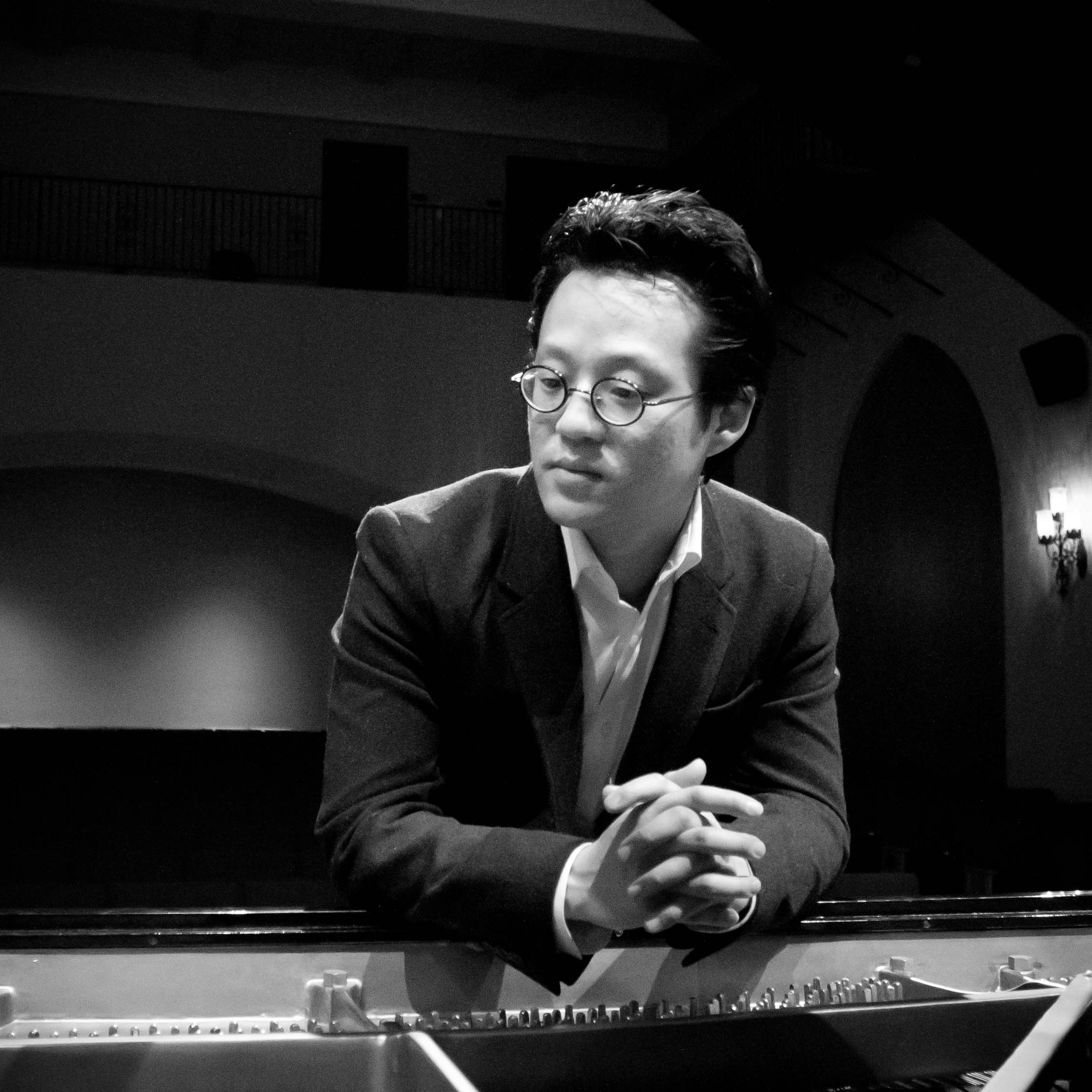
The hardest working pianist of the evening however was Min Kwon, the chair of keyboard studies at Rutgers. Her liquid tone and seamless phrasing made every piece from the arrangements to Schubert’s Trout Quintet a joy to hear. She was a poised, sometimes humorous, and always gracious colleague.

Two arrangements (Argento: Argentinian Dance #2, and Poulenc: Improvisation #15 Hommage à Edith Piaf, both originally for piano) by jazz composer Bill O’Connell (Rutgers faculty) for trombone and piano constituted perhaps the least convincing element of the program. The trombone’s intonation didn’t always match the piano, and I am not referring to intentional bent or “blue” notes or the like. The volume of this very “present” instrument didn’t accord well with the established palette of piano and strings.

Two arrangements and one composition were included by Grammy award-winning composer Robert Livingston Aldridge, who is also on the Rutgers faculty and director of the music department. He was present at the concert, apparently on his sixtieth birthday. On the first half of the program, was his Bossa-Habanera-Jig, a witty romp through the three dances. On the second half, after Schubert’s Trout Quintet, was his arrangement for the same piano quintet forces of Schubert’s epic ballad/song Erlkönig, in which a father gallops a horse swiftly through a dark forest with his young son on his lap. The son is being seductively lured by the supernatural Erlking. If he gives in, he will die. At first the father is doubtful, but he quickly realizes the seriousness of the boy’s pleas, racing even faster to reach an inn, but it is too late. In his arms, the child lies dead. If you wonder how such a story can even be told without its vocal part, all you have to do is hear this arrangement, in which the characters of the instruments all paint the story vividly. The rendition was fiery and convincing.

Prior to this Erlkönig, and constituting the majority of the second half, was indeed the so-called Trout Quintet by Schubert, whose fourth movement is a set of variations on what had been his “greatest hit song” composed two years earlier. The quintet was written for home music making in the Austrian alpine resort town of Steyr, for an amateur cellist who, according to contemporary comment could “barely negotiate” the cello part. No such worries here, however. All the players had technique to spare, and lavished it on this jovial work. I could have used a little more Gemütlichkeit, homey ease, perhaps not so driven, and with more contrast. There wasn’t enough pianissimo, but the sheer joy of their performance was convincing, and they looked collegially at each other, truly relishing their musical (and academic) partnership.

One encore, another Aldridge arrangement of Harold Arlen’s Somewhere Over the Rainbow was ecstatically played by the Kwon sisters, the violin’s final notes becoming even more ethereal, higher and higher, a perfect ending.

How very lucky are the students of such a fine music department to have these (and I’m sure many other) artists to inspire them.

Share

Distinguished Concerts International New York presents Tzu-Yi Chen in Review

Distinguished Concerts International New York presents Tzu-Yi Chen in Review

Distinguished Concerts International New York presents Tzu-Yi Chen
Tzu-Yi Chen, piano
Weill Recital Hall at Carnegie Hall, New York, NY
October 11, 2014


A magnificent recital took place on October 11 by Taipei-born pianist Tzu-Yi Chen. I am going to have to discipline myself not to use every superlative in the first paragraph. Suffice it to say that, in a wide-ranging program, she displayed not only the usual technical command one expects, but beautiful tone, total artistic involvement, deep feeling, stylistic understanding, and in an era of cookie-cutter musicians, the feeling of spontaneity, even risk, that makes an evening truly memorable, often electrifying.

The first half of the recital was devoted to “classicism/variation” and the second half to “programmatic illustration.”

Ms. Chen opened with a jewel of late Mozart, Nine Variations in D major on a Minuet by Jean-Pierre Duport, K. 573, written in 1789 to curry favor for possible employment in Potsdam, to a minuet tune by Prussian King Friedrich Wilhelm’s cellist. The theme, ninety percent of which -adheres only to notes found in the tonic triad, was presented with limpid grace, perfect phrasing, and breathing that never went overboard. Each variation unfolded with a plan, yet managed to sound as if she was improvising it on the spot. Each repeat was taken, with subtle and tasteful color differences that never overstepped the vocabulary of the period. In the heart-rending D Minor variation, Ms. Chen inhabited it as if it was a lost lament intended for Pamina in Die Zauberflöte, with the fatality of the Neapolitan sixth chord experienced deeply. Next came one of middle-period Brahms’ more massive creations, the Variations and Fugue on a Theme by Handel, Op. 24. Even from the opening notes of the original Handel, Ms. Chen presented the audience with the sound world of Brahms, an interpretation with which I agree. Every single tempo change and nuance was observed, with never a feeling of over-planning. The music simply seemed to be welling up from some secret source within her. Her sense of lyricism and rubato was beautiful. Her pedaling created sophisticated mixtures of harmony, which are specified by Brahms or at least implied by the notation. I can only single out a few highlights from this giant work: Var. VI, the misterioso was the spookiest I’ve ever heard; Var. XII, the soave was indeed suave; Var. XIV, the sciolto (literally: unbound, or non-legato) was ecstatic; Var. XXII, the Musette floated on a cloud of B-Flat; the mad whirling of Var. XXIV was hair-raising. The fugue was presented as a grand quasi-orchestral sonority, complete with majestic bell-ringing.

After intermission, Ms. Chen played the Suite Astrologique for Piano by a fellow-countryperson, Lan-In Winnie Yang (b. 1980). I’m glad the composer didn’t feel the need to follow the calendar, but arranged the twelve short vignettes, one for each sign, in an order that allows the music to flow best. Her work has many audible influences, Scriabin, Chopin, Schoenberg, Rachmaninoff, even a wink here and there to jazz or ragtime, but it manages to remain original and atmospheric, especially when confided to the rich tonal palette of Ms. Chen. If one had stripped the titles from each piece and simply called the totality “Suite,” I feel it still would have had impact. Ms. Chen closed with the titanic Pictures at an Exhibition by Mussorgsky, illustrations in music of artworks by a recently deceased friend of the composer, Victor Hartmann. From the opening notes of the first “Promenade” (Mussorgsky’s unifying device that represents walking through the gallery from picture to picture), she became a completely authoritative “Russian” pianist in tone and brilliance. She really opened up for this work’s fierce demands, but always put the emotional content first. One of my favorite sections, not the loudest or fastest, has always been “Catacombs: Con Mortuis in Lingua Mortua” (With the Dead in a Dead Language), which Ms. Chen played as though she herself had either invented the catacomb many thousands of years ago, or been trapped in one. The audience rose to award her a richly deserved standing ovation after she dispatched the octaves of the “Hut on Fowl’s Legs (Baba-Yagá)” with ferocity, and the “Great Gate of Kiev” was depicted triumphantly.

She favored us with two encores, first the final movement of the Ginastera Piano Sonata No.1, Op. 22, marked Ruvido ed ostinato (rough and obstinate), which was white-hot, and played with both total abandon and control, if that’s not too paradoxical. In the second encore, the Bach/Busoni Ich ruf zu Dir, Herr Jesu Christ emerged as a plaintive call of homesickness to her native country. She has traveled much for her training: Paris, Germany, and she now resides in Washington DC, where she must bring great joy and fine instruction to her students in the Levine School of Music. I would like to hear some of French repertoire the next time she appears and there certainly will be many, many more times.


Share

S&R Foundation presents Char Prescott and Ryo Yanagitani in Review

S&R Foundation presents Char Prescott and Ryo Yanagitani in Review

Char Prescott, cello; Ryo Yanagitani, piano
The Kennedy Center – Millennium Stage, Washington, DC
September 12, 2014


The Kennedy Center’s Millennium Stage has earned the remarkable record of having presented a free concert every afternoon at 6pm, 365 days a year (possibly minus a snow day or two), for more than fifteen years.  The concerts cover an enormous range of music and dance genres and I must say, if they’ve all been as good as Friday afternoon’s cello and piano duo, Char Prescott and Ryo Yanagitani, then as a New Yorker I’ve really been missing something.

The concert was sponsored by the S&R Foundation, a Washington, DC based charity that is the philanthropic arm of two very unusual individuals, Drs. Sachiko Kuno and Ryuji Ueno, a pair of biochemists who have plowed profits from their highly successful pharmaceutical patents into supporting the arts.  They have created an artist-in-residence program along with a concert series at Everymay, the grand Federal-Era estate in Georgetown that they purchased and renovated in 2011, and a kind of entrepreneurship academy at Halcyon House, another historic home they own nearby.  The glorious sounding 19th century Italian cello played by Char Prescott is on loan to her from the pair as well.

Ms. Prescott and Mr. Yanagitani opened their program with the second of the three Sonatas for Viola da Gamba — in D Major, BWV 1028 — by J. S. Bach.  Gambas are not too commonly found these days, so performances tend to take place on the cello, either with the original harpsichord as accompanying instrument or, in this case, piano.  The use of a modern piano can create balance problems, but in pianist Ryo Yanagitani’s hands, the complex interweaving of contrapuntal lines emerged cleanly and without overmatching his partner.  The phrasing and dynamics in the duo’s performance tilted a little towards the romantic for my taste, but that’s a quibble.  The sinuous interplay of the musical lines in this work makes a good case for some leeway in articulation, so I don’t really blame them for indulging a little.  The result was an enchanting reading.

Written in 1886, during a happy and productive summer Johannes Brahms spent in the dramatic lake and mountain scenery of Thun, Switzerland, the Sonata No. 2 for Piano and Cello in F Major, Op. 99 reflects his sunny state of mind. His exuberant score provides plenty of opportunities for virtuoso playing to both performers, particularly in the monumentally difficult piano part, perhaps why the piano is named first in the title.  There are generally two styles of performances in this piece: one in which the players hurl themselves at it full throttle in the most dramatic way, and the second which prizes charm and elegance over punch.  Prescott and Yanagitani chose the second way, and theirs was a reading that let the honey gold tone of Ms. Prescott’s cello shine through.  Mr. Yanagitani demonstrated a control of the thickly written piano part from the sometimes hushed, sometimes brilliant tremolos of the first movement to the whirling triplet chords of the scherzo to the sun-streaked finale that was really impressive.

Béla Bartók’s Six Romanian Folk Dances written in 1915 for piano solo and played in an arrangement for cello and piano closed the program.  Here Ms. Prescott got to show off her command of the instrument’s sonic possibilities and, as was the case throughout the afternoon, Mr. Yanagitani provided just the right support.  These two artists have clearly played together long enough to completely internalize this repertoire, and their absolute security and deep knowledge of the music communicates real pleasure to their audience.  I was certainly happy to have been there.


Share

The Kosciuszko Foundation presents “Musical Life of Galicia” in Review

The Kosciuszko Foundation presents “Musical Life of Galicia” in Review

The Kosciuszko Foundation presents “Musical Life of Galicia”
The Rubinstein Players
Tatiana Chulochnikova, violin; Maria Lyapkova, piano
The Kosciuszko Foundation, New York, NY
September 7, 2014


The Rubinstein Players, named for composer Anton Rubinstein, gave a well-played recital of three musical “footnotes” and one canonized master. At the outset, let me say that the two players function beautifully as a duo, with unanimity of thought and feeling. Ms. Chulochnikova has a real feel for the grammar of the Classical period. Her phrasing and intonation were true and singing. Her partner, Ms. Lyapkova, also plays with great sensitivity, although a bit too heavy at times.

Galicia, not to be confused with the province of present-day northwest Spain, was a loosely defined area, belonging to what we call today Poland, Ukraine, even Austro-Hungary.

The theme of “Galicia” was honored in unusual repertory choices. I had never heard a work by Ukrainian-born Maxim Berezovsky (1745-1777), who died at thirty-two, even younger than W.A. Mozart. His Sonata however chugged along somewhat automatically, except for more lyricism in the slow movement, never straying too far from tonic/dominant clichés. This work, for harpsichord and violin, could really have benefited from an early keyboard sound, as could the whole program. The performers’ biographies state that they are “equally at home” with period as well as modern instruments. The piano sounded heavy rather than bustling.

Next they played the Sonata for Violin and Piano, Op. 15, by the youngest son of W.A. Mozart: Franz Xaver (1791-1841, born only a few months prior to his father’s untimely death). He studied with Antonio Salieri, which should put an end to the “Amadeus” discussions of Salieri’s having poisoned W.A. Unfortunately for his well-meaning son, the father cast a long shadow. The son’s work has moments of grace, but the ideas don’t really flow inevitably and there is a certain squareness of phrase structure, which couldn’t be masked, even by the sensitive rendition the duo brought to it.

After intermission, the quality of pieces and performances lifted tremendously. First, with the Sonata by Chopin’s teacher, Jozef Elsner (1769-1854), which had Classical gestures but also a capricious harmonic novelty that seemed pre-Schubertian at times. He was born forty-one years before Chopin, and survived his famous pupil by five years. Elsner was born in Poland, but always insisted that he be identified as Silesian, not Galician. The Sonata was given a sterling performance, and there was no balance issue with the piano.

Finally, the great Sonata in G Major, Op. 30, No.3, by Ludwig van Beethoven (1770-1827), who I’m pretty certain would have bristled at being called “Galician.” Born in Bonn, he expatriated himself to Vienna by his early twenties. Again, the oneness of the two players made the most of this often hacked-through work. If anything, it could have used just the extra ounce of impetuous fire that truly wakens middle-period Beethoven. The tempi were cautious—the first movement lacked the assai (very) of the Allegro assai. The second movement, marked Tempo di Minuetto, wound up sounding strangely sleepy, largely as a result of their honoring Beethoven’s “second direction” for the movement: “but very moderate and grazioso.” The finale, which is often played way too fast, is marked Allegro vivace, and again here the initial piano figuration is marked piano (softly) and leggiero (lightly). It was far too heavy, which would not have been an issue at a faster clip. Ms. Lyapkova was excellent, however, in the first two movements, whose difficult figurations held no terrors for her.

The duo favored the audience with an encore, Romance, by their namesake Anton Rubinstein. Here, the violinist’s tone suddenly bloomed into the dark plush Russian romantic sound I associate with her Moscow training. Their ensemble was perfect in this delightful bonbon. I hope these two players will consider lavishing their immense gifts on music of greater interest, while continuing to present unusual works too.


Share

Christoph Denoth, guitar in Review

Christoph Denoth, guitar in Review

Christoph Denoth, guitar 
SubCulture, New York, NY
September 4, 2014


What better way to begin a new concert season than to attend a wonderful performance in one of New York’s new concert venues? The performer: Swiss guitarist Christoph Denoth. The music: works by the English composers John Dowland (1563-1626) and Benjamin Britten, Spaniards Manuel de Falla, Joaquin Turina, Isaac Albéniz, and the Brazilian Heitor Villa-Lobos. The venue: an intimate performance space with a bar in NoHo at 45 Bleeker Street.

A comfortable basement space, SubCulture is a perfect venue for an intimate guitar recital. (The festival of piano music scheduled for the month of September should also be a great fit.) Although Mr. Denoth was surrounded by microphones, the sound from where I sat seemed natural and unamplified. When, after the concert, I spoke to the sound engineer, he told me that the microphones were for a radio broadcast of the performance. I suggested that the audience should be forewarned when broadcast microphones appear on stage during concerts that shouldn’t have amplification. I also mentioned that even though the presence of a bar makes SubCulture more informal than a traditional “concert hall,” piped in music (cool jazz this night) right before and after the recital is not a good idea. Music such as we heard tonight needs a no-music frame of silence before and after the performance.

Christoph Denoth has performed in concert halls all over the world, as a solo artist and in collaboration with orchestras, chamber groups and singers. He is sought after as a teacher and is now on the faculty of the Royal Academy of Music in London. This evening’s performance showed why. A master of his instrument, he performed with great technical skill, spinning out well-shaped melodic lines with crystal clear, often thrilling, accompaniments. He drew from his instrument so many different colors that one often thought there was more than one guitarist on stage.

The recital began with guitar arrangements of four works for lute by John Dowland. They included a setting of the melody of a popular ballad of the times and of one by Dowland himself, a dance, and a fantasy. These delightful works, elegantly performed, were the perfect vehicle to enable the audience to “tune their ears” to the softer end of the guitar’s dynamic range. This was followed by Manuel de Falla’s Homenaje – Tombeau de Debussy. (A tombeau is a musical composition commemorating the death of a notable individual.) Although one couldn’t know it at the time, Mr. Denoth’s performance of this work marked the beginning of his ever increasing creation of more and more beautiful and interesting guitar colors.

Benjamin Britten’s Nocturnal after John Dowland, Op.70, uses as its inspiration Dowland’s lute song “Come Heavy Sleep.” Commissioned by the legendary English guitarist Julian Bream, the work makes great demands on the performer. Mr. Denoth was up to the challenge and performed with assurance and consummate musicality. Each of the eight movements utilizes tiny motives and fragments from Dowland’s song, but the complete song is not heard until the end of the work. Although I’ve conducted “Come Heavy Sleep” in Dowland’s arrangement for four voices, I had great difficulty figuring out what was going on musically. It just sounded like a series of guitar effects, beautifully played, but having little to do with Dowland’s song.

Next came what, for me, was the program’s high point: a performance of four of the Cinq Préludes by Heitor Villa-Lobos. Villa-Lobos knew what was idiomatic to the guitar and Mr. Denoth reveled in this wonderful writing. It was joyous and compelling music-making. In Prélude No.1 (Homage to Back-Country Brazil) Mr. Denoth beautifully contrasted the sound of the long melodic line and the chordal accompaniment. The melody first appeared in the bass with the chords above. When it returned, now in the soprano, the color of the melody was again quite different from that of the accompaniment. The Préludes were not performed in the published order. The next, Prélude No.4, featured mysterious harmonics; No.3 was expressive and beautifully phrased. The wild strumming at the end of No.2 brought the set to a stirring conclusion.

The recital ended with three popular works familiar to most of the audience, Joaquin Turina’s Sevillana (Fantasia) Op.29, and Isaac Albéniz’s Granada and Asturias. The program didn’t mention that the two Albéniz works were originally written for piano in 1890 and arranged for guitar after his death in 1909. I was wrong in thinking it would be difficult to maintain the excitement created by the Villa-Lobos Préludes. These last three works were a thrilling ending to the concert proper.

The Spanish aspect to the program continued with the first encore, an idiomatic performance of Joaquin Malats’s Serenata Española, another work written for piano but later transcribed for guitar. It seems that, in their nationalistic works, Spanish composers sought to have the piano imitate the most Spanish of instruments. This evening’s arrangements for guitar only bought these works closer to their roots. A final work by Dowland, Mr. Dowland’s Midnight, brought this wonderful concert to a gentle close.

Share

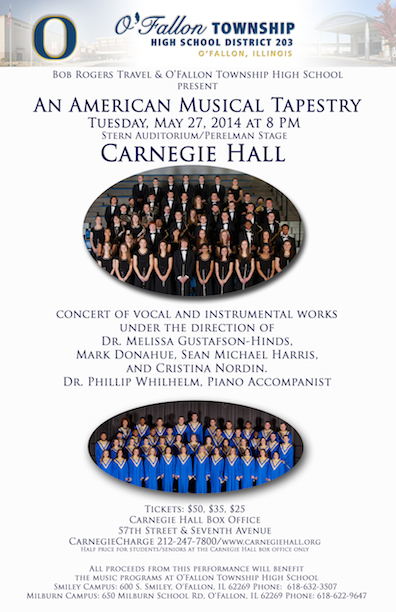
O’ Fallon Township High School, O’Fallon, Illinois, and Bob Rogers Travel present An American Musical Tapestry in Review

O’ Fallon Township High School, O’Fallon, Illinois, and Bob Rogers Travel present An American Musical Tapestry in Review

O’ Fallon Township High School, O’Fallon, Illinois, and Bob Rogers Travel present An American Musical Tapestry
O’Fallon Township High School Combined Choir. O’Fallon Township High School Select Choir; Cristina Nordin, conductor; Phillip Wilhelm, accompanist
O’ Fallon Township High School Symphonic Band, O’ Fallon Township High School Wind Ensemble; Melissa Gustafson-Hinds, Mark Donahue, Sean Michael Harris, conductors
Stern Auditorium, Carnegie Hall; New York, NY
May 27, 2014


On May 27, 2014, the O’Fallon Township High School music program, consisting of two choirs and two bands, took the stage in Stern Auditorium in Carnegie Hall with a program entitled “An American Musical Tapestry.” With selections of folk favorites, gospel, popular songs, and Americana, it was a program designed to be crowd-pleasing. For the sake of full disclosure, this reviewer was not present for the concert, but was sent a live, unedited recording of the performance. In the spirit of the live performance, I only listened to the recording a single time, which I believe is the most objective way to review this performance.

The first thing that struck me was the rather large number of selections offered. It is usually my goal to mention every work, but as there were twenty-three works performed, I will focus on the highlights for each of the groups. A second observation, after reading through the printed program, was the very clear concept of the status of the groups – one could liken it to junior varsity/varsity squads in sports. The main difference as I can tell, is that there is no limit on the numbers of players/singers at the “junior varsity” level, while the elite “varsity” numbers were much smaller.

The Combined Choir opened the performance with “Simple Gifts”, in what was a charming start to their program. They exuded energy in “Seize the Day” from the hit musical Newsies,in what the highlight of their selections to this listener. They ended with a lovely rendition of “America.” To be sure, there were issues with the intonation, mainly with the sopranos whenever the music went above the staff, and ensemble-wise in loud sections, both which are not to be unexpected for younger singers. Praise must be given to conductor Cristina Nordin for her musical selections, which were designed both to be entertaining and to showcase the emerging talents of her young singers.

The Select Choir was up next and showed their quality in another excellently chosen group of works. One could feel the languor in Gershwin’s “Summertime” and the jubilation of “Saints Bound for Heaven”, but this listener was especially taken with Billy Joel’s “And So It Goes”, in an excellent arrangement by Bob Chilcott. The intonation was mostly precise throughout, and the ensemble balance was excellent in what was a most enjoyable performance.

After intermission, it was time for the bands to take to the stage. This leads me back to an observation I made in a previous review in this journal about High School bands, specifically the challenges in regards to instrumentation. With nineteen flutes, eleven clarinets and alto saxophones, and twelve trumpets listed on the roster, it would seem the Symphonic Band is rather top-heavy, but one is also a bit surprised there are more tuba players than trombones. Normally, I would have serious reservations about this, but as I am sure it is an “everyone plays regardless of instrument” situation, I will try to refrain from making any more of this issue. Opening with Vaughan Williams’s Flourish for Wind Band, the Symphonic band showed signs of their potential intertwined with some moments of what might have been nervousness. I was pleased that William Latham’s Brighton Beach was much tighter and more focused in performance, bringing back some happy memories for this listener, who played the piece in his own band days long, long ago. The highlight of their commendable performance was the Emperata Overture, by one of the greats of band composition, Claude T. Smith. I am sure many of these talented youngsters will fill the roster of the Wind Ensemble in the near future.

The Wind Ensemble took the stage and immediately affirmed their “varsity” status in a polished performance of Bernstein’s Overture to Candide, one of the staples of the advanced band repertoire. It had the right touch of irony without ever crossing into mockery. However, their performance of David Maslanka’s Requiem was not only the highlight of their selections, but far and away the highlight of the entire concert for this listener. Regular readers of this journal are aware of my admiration for Maslanka’s works, but with that admiration come high expectations in performance. It truly was exceptional – a performance that was profoundly moving from start to finish.

To conclude the concert, the combined forces of all four groups gave a stirring performance of United We Stand, a medley of patriotic songs.

Music is alive and well in the O’Fallon Township, and all the young performers can feel justly proud. One must also acknowledge the fine work of Cristina Nordin, Mark Donahue, Sean Michael Harris, and Melissa Gustafson-Hinds in their leadership and development of a fine music program.


Share

New York Concert Artists and Associates, Inc. presents Na Young Kim in Review

New York Concert Artists and Associates, Inc. presents Na Young Kim in Review

New York Concert Artists and Associates, Inc. presents Na Young Kim
Na Young Kim, piano
Weill Recital Hall at Carnegie Hall; New York, NY
June 30, 2014


Technical standards for pianists have changed in just the thirty-some years since I graduated from conservatory. However, I’m not always certain that musical profundity has kept pace with physiological advances. This is what was brought to mind by the generally fine recital on June 30 by Na Young Kim. She is the chairman of the piano department at Sejong University in Seoul, Korea; and her New York debut was only last year.

Ms. Kim has many attractive qualities as a pianist, not the least of which is her passionate, one might say visionary, commitment to every note and piece that she plays. Her mechanism is very fluent, and she possesses great drive and color. I feel that greater attention to detail and a much wider color palette would lend her interpretations more depth.

She began with Debussy’s second set of Images. In the first, Cloches à travers les feuilles, I felt the mysterious gauzy opening to be splendid, but a closer examination of the score shows that in the first three measures alone, Debussy has composed seven different “levels” of bells. I heard only three. Some of this was due to the extremely bright nature of the top register of the house Steinway in Weill Hall, a factor which should have been mediated and softened by Ms. Kim. There are many melodic lines in voices other than the top that were not given their due and the myriad tints and tones were reduced to a few mainly glassy (though not ugly) ones. The central piece Et la lune descend sur le temple qui fut was the most atmospheric. Debussy’s lacquer goldfish, Poissons d’or, were not flirty enough. A few memory lapses and wrong notes marred this otherwise capable rendition.

Her strengths were much better suited to the second section of the program, an excerpt from Messiaen’s sacred suite Vingt Regards sur l’enfant Jésus. Ms. Kim played the eleventh piece, Première communion de la Vierge(“The Virgin’s first communion”). Here, Ms. Kim’s heavenward glances seemed entirely appropriate to summoning the combination of mysticism and notated birdsong that are essential to understanding, and feeling, Messiaen. The score says: “After the Annunciation, Mary adores Jesus within her . . .” You could almost feel the baby kicking in the more boisterous second section. This was truly stunning playing, and one hopes that she will consider learning the entire cycle.

The first half concluded with a standard repertory classic, Beethoven’s Piano Sonata No. 30 in E Major, Op. 109. This work challenges the intellectual and musical depth in everyone who encounters it, whether player or listener. Attention to detail was somewhat approximate, with contrasts between loud and soft overly exaggerated, but again, played with total commitment. No one ever voices the opening to my satisfaction, so Ms. Kim, you are in “good” company. Her Prestissimo was truly that, and the Variation finale, marked Gesangvoll, mit innigster Empfindung (Songful, with the most intense inward emotion) was quite good, barring the issues of the overly bright top register. It needed more mature mellowness to blossom into the spiritual testament that it embodies.

After intermission, Ms. Kim played a piece that seems to be making the rounds of everyone’s recitals these days (there’s always one or two every season): Rachmaninoff’s Second Piano Sonata, Op. 36, in the revised (hard as it is to believe, simplified) version. This she threw herself into with what could almost be termed aggressiveness and big, bold sound, as well as quick tempi that served to organize Rachmaninoff’s sometimes amorphous structures very well. Although the playing became clangorous at times, one could forgive the tone quality in view of what was being pursued by Ms. Kim here: a Niagara-like flow of energy. Caution would have been out-of-place, though I have heard more patrician renderings of the piece. There is certainly a wide scale of possible success in this work, and Ms. Kim definitely found her place within that scale.


Share

The Seventh New York International Piano Competition in Review

The Seventh New York International Piano Competition in Review

The Seventh New York International Piano Competition (NYIPC), under the auspices of The Stecher and Horowitz Foundation
Greenfield Hall, Manhattan School of Music, New York, NY
June 22, 2014

Music competitions today seem to sprout up practically anywhere that there are instruments, such that the array of contest names in winners’ biographies rapidly becomes a blur, from the first annual This prize to second national That award. I must confess that, because of this blur, it took me a while to take notice of the Stecher and Horowitz Foundation’s New York International Piano Competition (NYIPC), which started in 2002. Naturally I had known the names of duo-pianists Melvin Stecher and Norman Horowitz (no, not that Horowitz!), as the duo had enjoyed decades as a performing team since 1951, including being the dedicatees of Walter Piston’s Concerto for Two Pianos and Orchestra and giving it its premiere. In addition, the duo had created a school, a foundation, teaching publications, and more. What I had not realized, though, was that these two musicians, along with their distinguished colleagues and friends, were on a mission to do something very big for the future piano world. They have done just that with the NYIPC.

Unbeknownst to me (as I sometimes only briefly scan the biographies of young artists I review), I had already reviewed or heard some of this foundation’s prior winners, several of whom are now firmly ensconced in their young careers or appearing as finalists and winners of competitions around the world (click here for a list of past winners- New York International Piano Competition Winners List). Clearly this competition has become a magnet for some of the best young pianists today, and the reasons are many. Naturally the total of $50,000 in prizes is one reason (the First Prize winner taking home at least $10,000). Exposure is another, with leaders in the field hearing these winners, learning about them in glossy brochures, and even reading personal statements on music written by the contestants themselves. This year’s brochure incidentally featured letters from our governor, mayor, and others, with a cover illustration of an official Competition Egg created by none other than Theo Fabergé (late grandson of the legendary Peter Carl Fabergé)!

JOYCE B. COWIN FIRST PRIZE Jun Hwi Cho, Age 18 Country of Birth: South Korea Residence: Flushing, New York Cash Award of $10,000 Concert and Recital Appearances

JOYCE B. COWIN FIRST PRIZE
Jun Hwi Cho, Age 18
Country of Birth: South Korea
Residence: Flushing, New York
Cash Award of $10,000
Concert and Recital Appearances

Apart from ever-growing prestige, an additional draw of the NYIPC is the care shown for each contestant, evident in the humane contest rules whereby no contestant is eliminated from round to round – every contestant gets to play every round. Muffing a passage in an etude does not render one unheard in one’s stronger offerings, say, a sonata or a concerto. Such rules evolve when musicians are running things! Beyond these considerations, each of twenty-something participants, not just the top winner, leaves with enough cash to compensate for the effort (even for those travelling from China, Russia, the Republic of Georgia, and the United Kingdom), while also gaining a lasting relationship with this foundation through concerts, mentoring, and more. Oh, that I were twenty-one again (the age range is 16-21)!

If it seems that I have acquired a case of Stockholm Syndrome on behalf of the NYIPC, I did sit through an hour-long set of speeches detailing these strengths, prior to hearing this year’s winners all too briefly – necessary pomp, one supposes, given the considerable fundraising behind it all. Fortunately, all was enlivened by the witty commentary of renowned radio personality Robert Sherman, who also briefly interviewed each of the four performing winners; one wished, nonetheless, for more music.

SECOND PRIZE Daniel Kim, Age 17 Country of Birth: United States Residence: Lexington, MA Cash Award of $6,000 Concert and Recital Appearances

SECOND PRIZE
Daniel Kim, Age 17
Country of Birth: United States
Residence: Lexington, MA
Cash Award of $6,000
Concert and Recital Appearances

The first performer up was Daniel Kim, as winner of the Best Performance of Commissioned Work, Nocturno Nazqueño, by Gabriela Lena Frank. Ms. Frank, a brilliant composer of multicultural background (Chinese, Peruvian, Lithuanian, Jewish) seems to favor her Latin American side, in a style evocative of South American landscapes and folklore. Seventeen-year-old Mr. Kim projected the musical imagery sensitively and convincingly, a remarkable feat considering the scant few months he had to get to know this music. On being asked by Robert Sherman how he felt when first looking at the score, he replied with candor, “the first thing that went through my head was probably panic.” Indeed there were considerable challenges, interpretively and technically, including the need for nuances in timbre, rapid repeated notes, wide stretches, and, as one was led to understand, some aleatoric elements to reveal each player’s uniqueness. Mr. Kim went on to say, though, how he enjoyed it as he started to embrace the elements of mystery and dance and the feeling of the lives of the rancheros. All of these were very much present in his performance, and if they were half as present in the twenty-odd performances of other contestants, then Ms. Frank is quite fortunate – as well as the young pianists. The commissioning of such a work to be disseminated throughout the world is a win-win enterprise.

THIRD PRIZE Yilin Liu, Age 19 Country of Birth: China Residence: San Francisco, CA Cash Award of $3,000 Concert and Recital Appearances

THIRD PRIZE
Yilin Liu, Age 19
Country of Birth: China
Residence: San Francisco, CA
Cash Award of $3,000
Concert and Recital Appearances

The next performance was of a four-hand piece by Franz Schubert, Rondeau in D Major, subtitled “Notre amitié est invariable” (“our friendship is unchanging”) and performed by the First Prize winners of The Melvin Stecher and Norman Horowitz Prize for one-piano, four hands, Thomas Steigerwald (21) and Max Ma (17). A touching reminder of the years of performing together for Stecher and Horowitz, the piece seemed also to allude to the friendships that are inevitably launched as these young performers team up with their ostensible “rivals” – a beautiful element to include in a competition. Mr. Steigerwald and Mr. Ma, after just a week of rehearsal, seemed already to have forged a collegial bond and performed with good mutual sensitivity. What was perhaps not quite there in terms of unity of conception was more than compensated for by hair-trigger reflexes and acute listening.


MELVIN STECHER AND NORMAN HOROWITZ FIRST PRIZE ONE-PIANO, FOUR HANDS ENSEMBLE  Max Ma, Age 17 Country of Birth: United States Residence: Newcastle, Washington

MELVIN STECHER AND NORMAN HOROWITZ FIRST PRIZE
ONE-PIANO, FOUR HANDS ENSEMBLE
Max Ma, Age 17
Country of Birth: United States
Residence: Newcastle, Washington


Thomas-Steigerwald-1

Thomas Steigerwald, Age 21 Country of Birth: United States Residence: Uvalde, Texas Cash Award of $3,500 Divided between the winning team


Daniel Kim returned to the stage to perform as soloist winner of the Second Prize, this time playing the first movement of Schumann’s G Minor Sonata, Op. 22. With a good sense of the drive that suits this work so well, Mr. Kim gave the movement a good solid delivery, no small achievement in such a challenging environment. One could see tremendous potential in this performance, and the fact that it was subject to the slightly “on edge” feeling that comes from an awards concert was in fact an advantage, as an impetuous spirit is an asset here. One looks forward, nonetheless, to hearing Mr. Kim in more extensive performance and in a more controlled setting.

Last of the performers was First Prize Winner (Joyce B. Cowin Prize), Jun Hwi Cho, age 18, performing Chopin’s Polonaise in A-flat Major, Op. 53 (the “Heroic”). Speaking beforehand about having hurt his right hand, Mr. Cho was jokingly reminded by Robert Sherman that in his accompanying statement he had written, “I will overcome any hardship I have in order to become a great pianist.” Overcome he did, and there was power and speed enough in his left hand to more than compensate for whatever might have affected his right hand – and frankly the right hand sounded quite capable as well. Mr. Cho showed a good deal of the firepower one expects to hear in a prizewinner, and one looks forward to hearing much more from him with the coming years.


FOURTH PRIZE Seol-Hwa Kim, Age 21 Country of Birth: South Korea Residence: Goyang-Si, South Korea Cash Award of $2,000 Concert and Recital Appearances

FOURTH PRIZE
Seol-Hwa Kim, Age 21
Country of Birth: South Korea
Residence: Goyang-Si, South Korea
Cash Award of $2,000
Concert and Recital Appearances

One would have loved to hear in addition the prizewinners Yilin Liu (19), Seol Hwa Kim (21), Ning Yuen Li (20), Ling-Yu Lee (20), and all the others, but alas, there are limits. For that matter, one might have wanted to hear members of the jury, which included Tong-Il Han, Jane Coop, Jon Nakamatsu, Thomas Schumacher, Orli Shaham, Jeffrey Swann, and a screening jury of Francis Brancaleone and Anthony LaMagra – perhaps another time. Meanwhile, one eagerly awaits the festivities of 2016!

Share

Distinguished Concerts International New York (DCINY) presents “Under the Western Sky” in Review

Distinguished Concerts International New York (DCINY) presents “Under the Western Sky” in Review

Distinguished Concerts International New York (DCINY) presents “Under the Western Sky”
Utah Voices and Legacy Brass Ensemble; Michael D. Huff, director; Carrie Morris, accompanist
Mariachi Espuelas de Plata; Ramon Niño III and Imelda Martinez, co-directors
Cristian Graces, DCINY Debut Conductor; Distinguished Concerts Singers International
Stern Auditorium, Carnegie Hall; New York, NY
June 22, 2014


The program presented by DCINY under the umbrella title of “Under the Western Sky” was really three concerts in one, a rare treat for the enthusiastic audience.

The first half was called “Hometown Praise: Music From Utah,” featuring the Utah Voices, led by Michael D. Huff, accompanied by the Legacy Brass Ensemble and Carrie Morris, keyboard (and an unidentified organist). The large choir  (approximately 110 members by my estimate) was perfectly prepared, in tune, with rich full tone that could produce a thrilling forte or whisper more confidentially at the softer dynamics. If you think “Utah choir” means only the Mormon Tabernacle Choir, you need to hear this group. Only a few times did they threaten to be overwhelmed, balance-wise, by the excellent brass players.

Their selections made one realize what a crucial role the sense of place plays in both faith and patriotism. Standouts included Kurt Bestor’s “Prayer of the Children,” a harrowing plea for peace based on the composer’s experience in Yugoslavia as a Mormon missionary, and Utah composer Leroy Robertson’s setting of “The Lord’s Prayer,” from his Oratorio from the Book of Mormon, NOT to be confused with the irreverent hit Broadway musical. The Irish folk song “Be Thou My Vision” arranged by the conductor, Mr. Huff, was beautifully done, with special contribution from Carrie Morris, finally getting to play the nine-foot Steinway instead of the electronic synthesizer she had been using prior. The section concluded with the rousing English folk song “Thou Gracious God, Whose Mercy Leads,” better known to some as “Oh Waly, Waly.”

After intermission, the tone shifted to a youthful emphasis. First came the charming Mariachi Espuelas de Plata, an award-winning high school group from North Side High School in Fort Worth, Texas. Their three pieces were done with suavity and great flair, using different combinations of the traditional violin, trumpet, guitar, one flute, and one harp, and some vocals.

They then made way for the Distinguished Concert Singers International, a sort of collective choir, indeed international, of all-treble voices from: South Carolina, Indiana, Honduras, California, Australia, Washington State, Norway, Maryland, and Oregon. These girls’ and (unchanged) boys’ voices were scrupulously prepared, each choir by its own regular conductor, before meeting the excellent DCINY debut conductor/composer Cristian Grases.

Much of their work involved the integration of eurhythmics, that method of instilling music in early childhood through the use of bodily movement. You could feel how comfortable everyone was with the complex arrangements, all of which were done with clear diction and excellent pitch and humor, with a choir about double the size of the Utah Voices.

Dr. Grases clearly has a flair for this work, and must be applauded for his care. He was honored with the world premiere of his own Gloria, a setting of the second portion of the Ordinary of the Catholic Mass. Dr. Grases’ is in Spanish, and each of the five sections is a rhythmic travelogue of Latin America, from Colombia to Puerto Rico, the Andes, Venezuela, and Cuba. The joyful bounce was surely appropriate for this most celebratory section of the Mass, even if the numbers did have a certain “sameness” to them, that’s just nit-picking on my part.

Earlier, the choir had imitated the wind, and the conductor invited the audience to join in as well, in “El Viento” from  OperetaEcológica, by Dr. Grases’ teacher, Alberto Grau, whose clever reworking of “La Cucaracha” culminated with the extermination of the bug ( Dr. Grases himself) by a cute child imitating a bug spray can.

The entire afternoon was a multicultural and multi-musical celebration. Bravi!

Share

Music and More presents Jean Muller in Review

Music and More presents Jean Muller in Review

Jean Muller, piano
Weill Hall at Carnegie Hall, New York, NY
June 22, 2014


Assigned to review Luxembourgian pianist Jean Muller in an all-Liszt recital last weekend, I purposely avoided rereading my earlier review of him beforehand (Jean Muller all-Chopin recital January 18, 2013). A yearlong blitz of music, work, and stress had left a slight haze over my first impressions of him anyway, so I would be able to hear his artistry afresh, as I prefer.

As it turned out, this pianist emerged as quite a different artist to me. Having now (after the recital) reread last year’s review, I am reminded that I had wanted a less cautious approach, but I had no such reservations in that regard this time. Part of this difference, of course, could be attributed to the current repertoire, all Liszt, but beyond that, there was an all-around extroversion and comfort onstage that I hadn’t recalled seeing or hearing from this artist before. From the Mephistophelian intensity of his flyer portrait to the confident projection of high drama in his declamatory phrasing, Mr. Muller seems now to be savoring a more commanding role all around. He still offers introductory comments from the keyboard with a refreshingly soft-spoken humility, but his music now seizes the listener with “no holds barred” immediacy. Perhaps one can credit the reinforcing effect of his recent world tours, but in any case it appears that Mr. Muller’s star is on the rise. There was drama without histrionics, power without excess, and always an overriding musical sense.

The program was in itself a statement in boldness, featuring Liszt’s complete Études d’exécution transcendante (or Transcendental Études, played from the third edition, 1852) and concluding with the Mephisto Waltz No. 1 (in the Busoni/Horowitz version). The performances were superb. The twelve Études encompass nearly every element of virtuosity that one could dream up for a pianist, from the rapid delicacy of Feux Follets to the treacherous leaps of Mazeppa and Wilde Jagd, the pining trills and filigree of the tender Ricordanza, and the thundering bombast of Eroica. All challenges were handled expertly “and then some.” Mazeppa (sometimes comically referred to as “Mess-uppa”) was extraordinarily successful considering its ferocious demands, while Eroica retained to the end the mock-epic humor that is only possible when the pianist himself has not been destroyed in the effort. Wilde Jagd left little to be desired, although some repeated chords might have benefited from crisper rhythm – and, at the risk of sounding greedy, I still wanted the ending just a bit wilder. Ricordanza, perhaps most challenging in terms of sustaining a listener’s attention through the long daydream, was judiciously paced and elegant, avoiding the mawkishness from which it sometimes suffers. In the same vein, Harmonies du Soir gave a beautiful sense of meditation and space after the urgency of the ubiquitous F minor Étude (No. 10, Allegro Agitato Molto), also played well. Vision was harrowing in its drama, as were the chilling chromatic runs of Chasse-neige, building to terrors worthy of Yeti. Not to be underestimated, the gentle, pastoral Paysage also presents its own challenges of pedaling and timing, and it was beautifully done as well, if not completely transcendent due to the concerns just mentioned. Even the shorter Études, Nos. 1 and 2 (Preludio and Molto vivace, respectively), the two perhaps least often singled out for individual performance, were elevated to stand as important pillars of entry to the set. All in all, it was an outstanding triumph.

Each live performance of this set has been fixed in my mind as a somewhat unusual event, and part of the reason is that, despite innumerable firebrands out there, the complete set is still not that often played live. Perhaps the reason is that the challenges still daunt many pianists, especially cumulatively, or perhaps it is that such programming itself has been criticized too often as unmusical or taxing on an audience. Though each Etude may fare well when featured alone, like the diamond against black velvet, when lined up in successive performances, they compete to outshine each other. If a pianist sets the standards high at the start, his audience’s ears get spoiled and saturated, setting up a grim case of diminishing returns. Those who do perform the entire set often convey the impression of a “stunt” or worse, and the bludgeoning of the keyboard makes a listener wish to fall through a secret trap door. One pianist who performed them all gave me a headache that lasted for the entire next day – individual Études had been good, but one wondered why the pianist had determined to torment himself with this Faustian goal.

By contrast, what stood out most in Mr. Muller’s recital was that, despite some residual awareness of the “stunt” – inevitable with this unbroken chain of hurdles – there was an artistic continuity and integrity throughout. The dynamic pacing was such that the Fortissimo playing never felt relentless, and by the time No. 6, Vision, was played there was still, despite earlier outbursts, further room for building. The house piano’s beautiful bass resonance helped the pianist achieve a power here that outdid all earlier sonorities, and the roar evoked the opening up of the earth. Like a well-told story, there evolved a shape to the entire set. The sheer variety of Liszt’s imagination came to the fore, thanks to such prodigious pianistic skills and sensitivity, and another point was chalked up in favor of this kind of programming. At times Mr. Muller displayed the range of an orchestra, and one could almost recycle Heinrich Heine’s own comment about Liszt, that “the piano disappeared and the music alone was revealed” if it were not for a glassy treble register on the instrument, reminded one that there was indeed just a piano there, needing of a bit of extra help.

As a side note, Mr. Muller also planned the program well, performing 1-8 in a row as the first half (Preludio and Wilde Jagd being good bookends) and following the last four on the second half with the Mephisto Waltz No. 1. His Mephisto Waltz was almost as exciting as that of Horowitz, who had augmented sections of Busoni’s version – although Mr. Muller’s performance was quite a bit neater. A standing ovation was repaid with an encore, the pianist’s own spin on Billy Joel’s Root Beer Rag.

Share