The Seventh New York International Piano Competition in Review

The Seventh New York International Piano Competition in Review

The Seventh New York International Piano Competition (NYIPC), under the auspices of The Stecher and Horowitz Foundation
Greenfield Hall, Manhattan School of Music, New York, NY
June 22, 2014

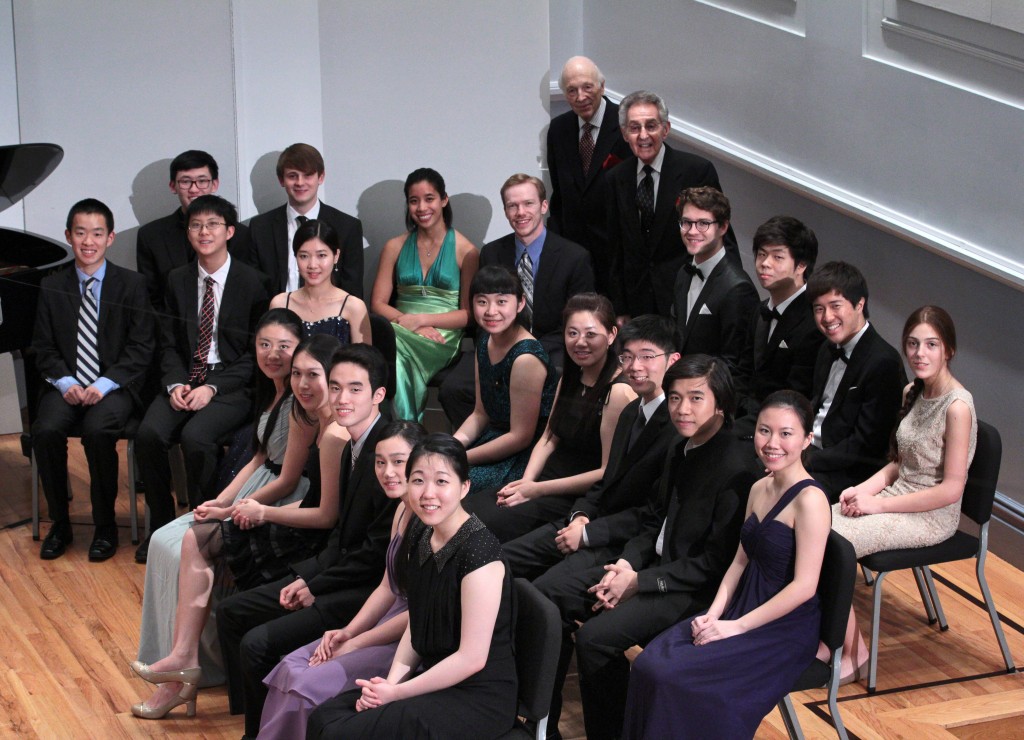
Music competitions today seem to sprout up practically anywhere that there are instruments, such that the array of contest names in winners’ biographies rapidly becomes a blur, from the first annual This prize to second national That award. I must confess that, because of this blur, it took me a while to take notice of the Stecher and Horowitz Foundation’s New York International Piano Competition (NYIPC), which started in 2002. Naturally I had known the names of duo-pianists Melvin Stecher and Norman Horowitz (no, not that Horowitz!), as the duo had enjoyed decades as a performing team since 1951, including being the dedicatees of Walter Piston’s Concerto for Two Pianos and Orchestra and giving it its premiere. In addition, the duo had created a school, a foundation, teaching publications, and more. What I had not realized, though, was that these two musicians, along with their distinguished colleagues and friends, were on a mission to do something very big for the future piano world. They have done just that with the NYIPC.

Unbeknownst to me (as I sometimes only briefly scan the biographies of young artists I review), I had already reviewed or heard some of this foundation’s prior winners, several of whom are now firmly ensconced in their young careers or appearing as finalists and winners of competitions around the world (click here for a list of past winners- New York International Piano Competition Winners List). Clearly this competition has become a magnet for some of the best young pianists today, and the reasons are many. Naturally the total of $50,000 in prizes is one reason (the First Prize winner taking home at least $10,000). Exposure is another, with leaders in the field hearing these winners, learning about them in glossy brochures, and even reading personal statements on music written by the contestants themselves. This year’s brochure incidentally featured letters from our governor, mayor, and others, with a cover illustration of an official Competition Egg created by none other than Theo Fabergé (late grandson of the legendary Peter Carl Fabergé)!
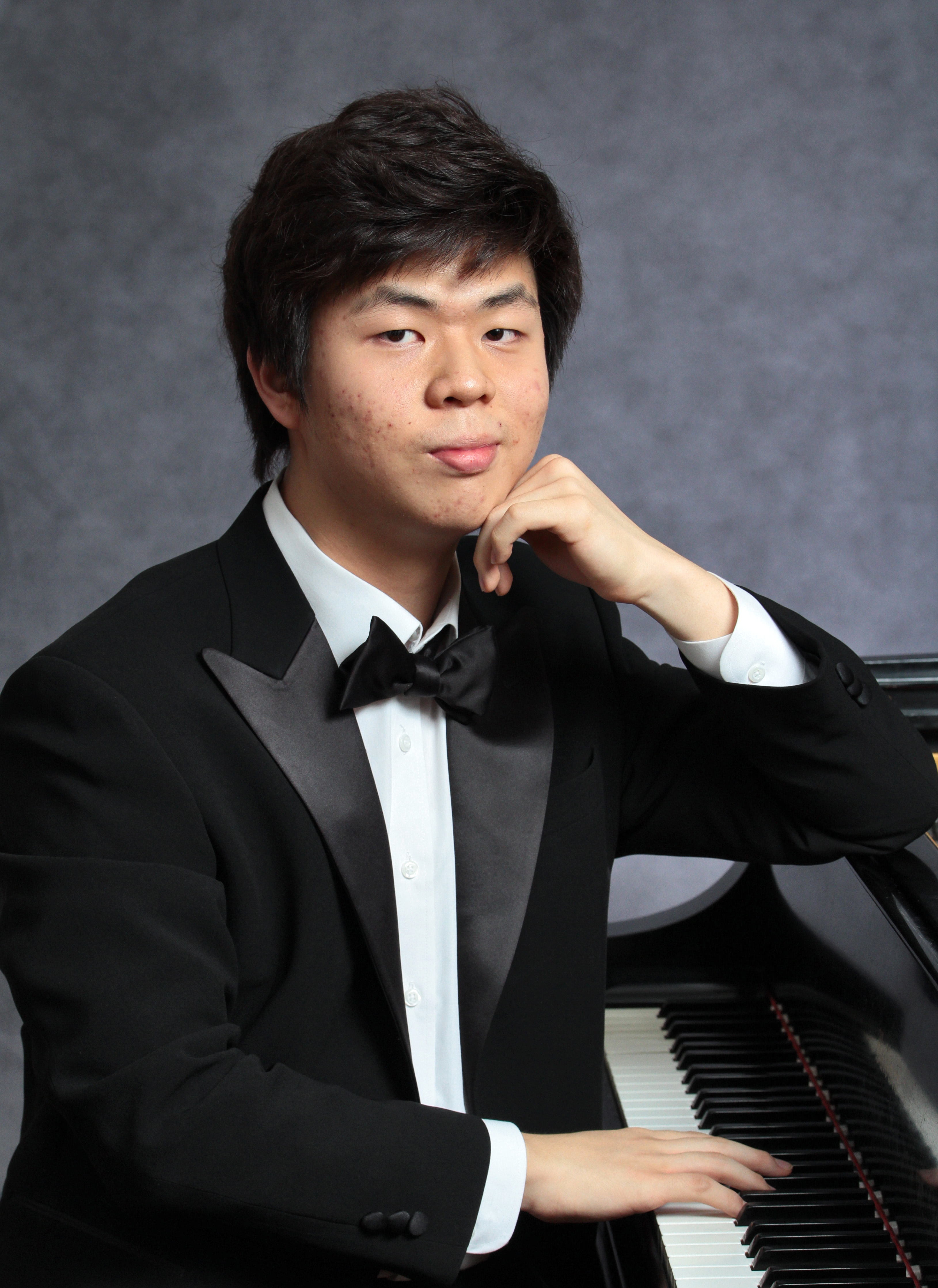
JOYCE B. COWIN FIRST PRIZE Jun Hwi Cho, Age 18 Country of Birth: South Korea Residence: Flushing, New York Cash Award of $10,000 Concert and Recital Appearances

JOYCE B. COWIN FIRST PRIZE
Jun Hwi Cho, Age 18
Country of Birth: South Korea
Residence: Flushing, New York
Cash Award of $10,000
Concert and Recital Appearances

Apart from ever-growing prestige, an additional draw of the NYIPC is the care shown for each contestant, evident in the humane contest rules whereby no contestant is eliminated from round to round – every contestant gets to play every round. Muffing a passage in an etude does not render one unheard in one’s stronger offerings, say, a sonata or a concerto. Such rules evolve when musicians are running things! Beyond these considerations, each of twenty-something participants, not just the top winner, leaves with enough cash to compensate for the effort (even for those travelling from China, Russia, the Republic of Georgia, and the United Kingdom), while also gaining a lasting relationship with this foundation through concerts, mentoring, and more. Oh, that I were twenty-one again (the age range is 16-21)!

If it seems that I have acquired a case of Stockholm Syndrome on behalf of the NYIPC, I did sit through an hour-long set of speeches detailing these strengths, prior to hearing this year’s winners all too briefly – necessary pomp, one supposes, given the considerable fundraising behind it all. Fortunately, all was enlivened by the witty commentary of renowned radio personality Robert Sherman, who also briefly interviewed each of the four performing winners; one wished, nonetheless, for more music.
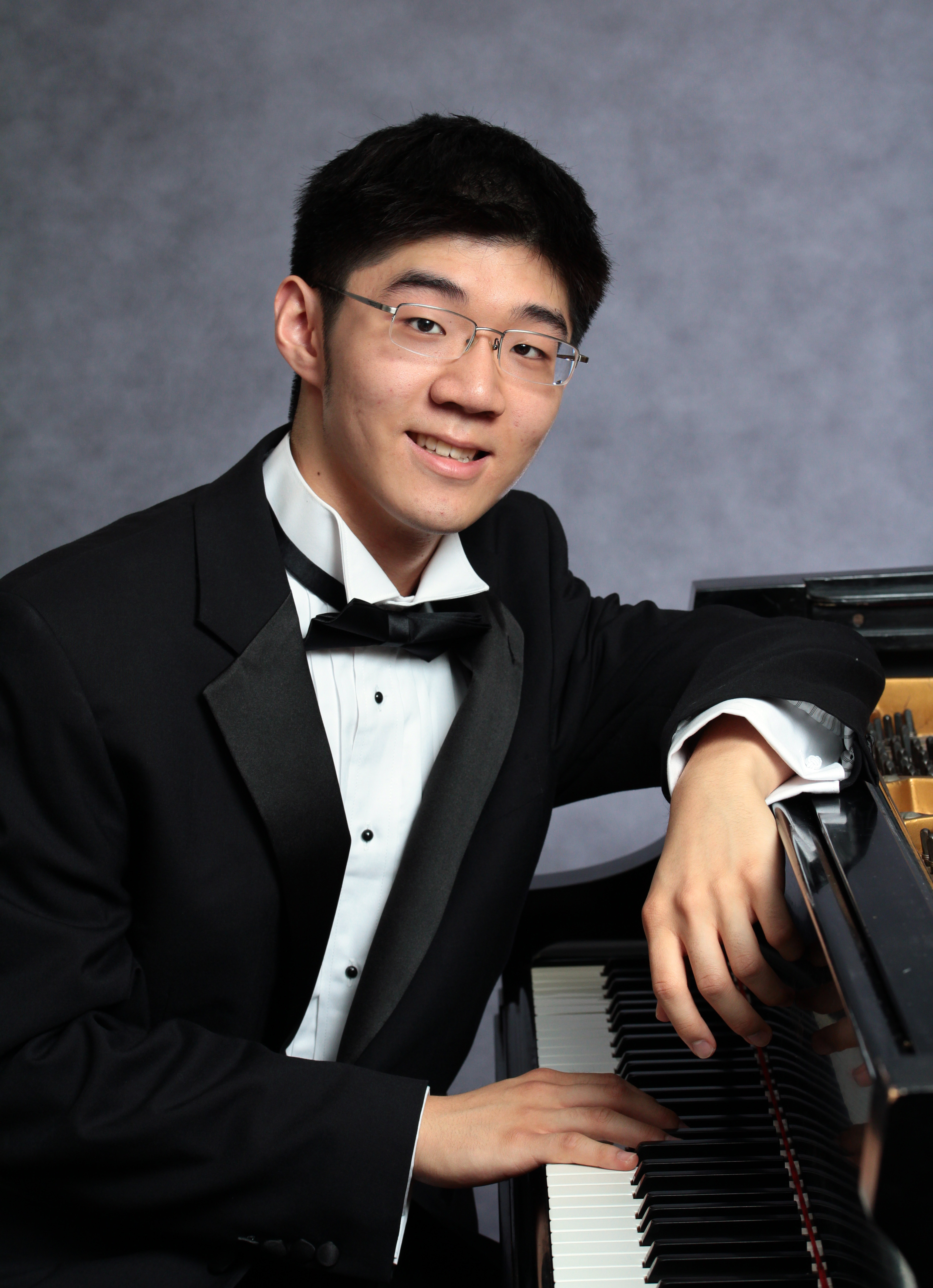
SECOND PRIZE Daniel Kim, Age 17 Country of Birth: United States Residence: Lexington, MA Cash Award of $6,000 Concert and Recital Appearances

SECOND PRIZE
Daniel Kim, Age 17
Country of Birth: United States
Residence: Lexington, MA
Cash Award of $6,000
Concert and Recital Appearances

The first performer up was Daniel Kim, as winner of the Best Performance of Commissioned Work, Nocturno Nazqueño, by Gabriela Lena Frank. Ms. Frank, a brilliant composer of multicultural background (Chinese, Peruvian, Lithuanian, Jewish) seems to favor her Latin American side, in a style evocative of South American landscapes and folklore. Seventeen-year-old Mr. Kim projected the musical imagery sensitively and convincingly, a remarkable feat considering the scant few months he had to get to know this music. On being asked by Robert Sherman how he felt when first looking at the score, he replied with candor, “the first thing that went through my head was probably panic.” Indeed there were considerable challenges, interpretively and technically, including the need for nuances in timbre, rapid repeated notes, wide stretches, and, as one was led to understand, some aleatoric elements to reveal each player’s uniqueness. Mr. Kim went on to say, though, how he enjoyed it as he started to embrace the elements of mystery and dance and the feeling of the lives of the rancheros. All of these were very much present in his performance, and if they were half as present in the twenty-odd performances of other contestants, then Ms. Frank is quite fortunate – as well as the young pianists. The commissioning of such a work to be disseminated throughout the world is a win-win enterprise.
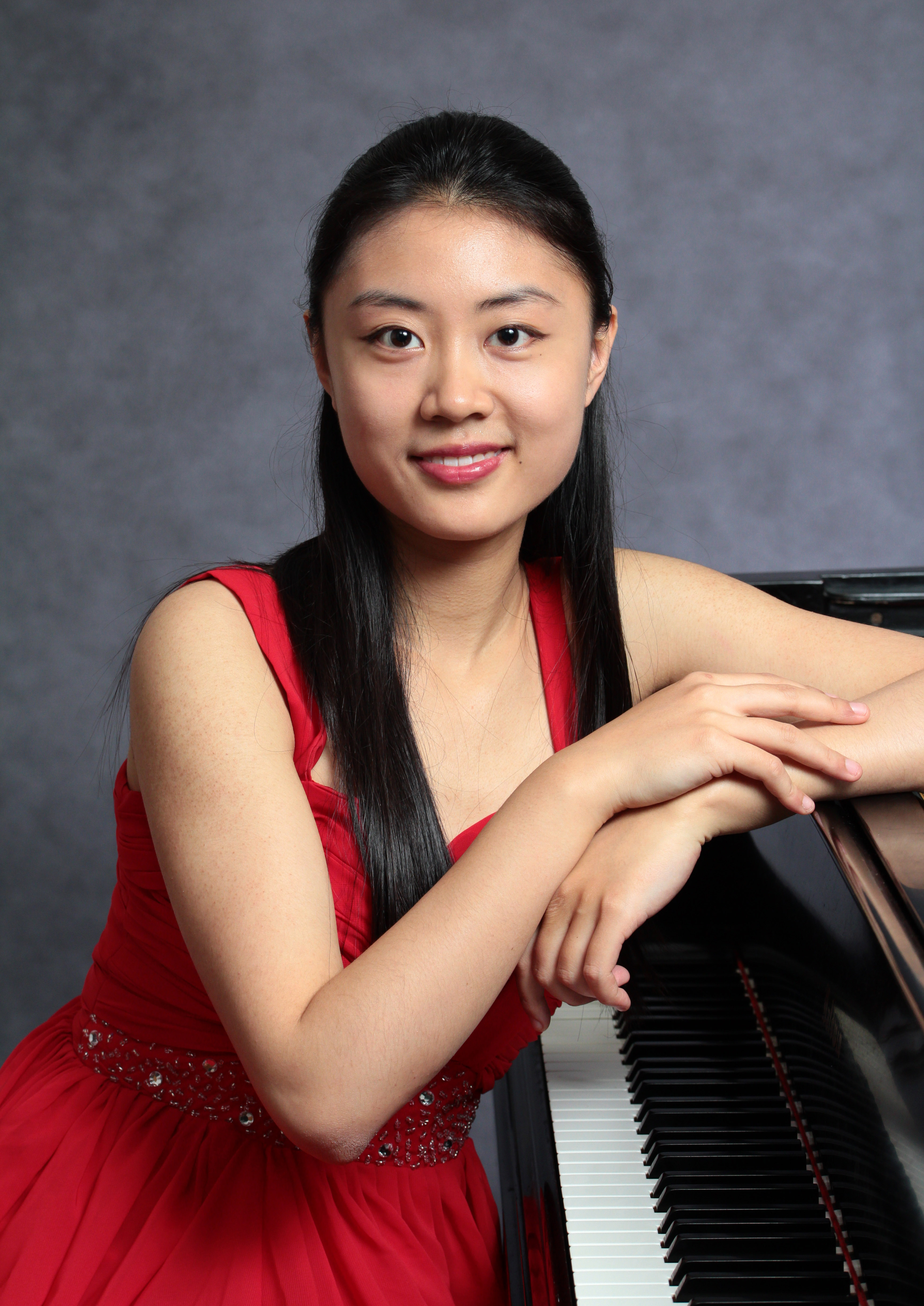
THIRD PRIZE Yilin Liu, Age 19 Country of Birth: China Residence: San Francisco, CA Cash Award of $3,000 Concert and Recital Appearances

THIRD PRIZE
Yilin Liu, Age 19
Country of Birth: China
Residence: San Francisco, CA
Cash Award of $3,000
Concert and Recital Appearances

The next performance was of a four-hand piece by Franz Schubert, Rondeau in D Major, subtitled “Notre amitié est invariable” (“our friendship is unchanging”) and performed by the First Prize winners of The Melvin Stecher and Norman Horowitz Prize for one-piano, four hands, Thomas Steigerwald (21) and Max Ma (17). A touching reminder of the years of performing together for Stecher and Horowitz, the piece seemed also to allude to the friendships that are inevitably launched as these young performers team up with their ostensible “rivals” – a beautiful element to include in a competition. Mr. Steigerwald and Mr. Ma, after just a week of rehearsal, seemed already to have forged a collegial bond and performed with good mutual sensitivity. What was perhaps not quite there in terms of unity of conception was more than compensated for by hair-trigger reflexes and acute listening.
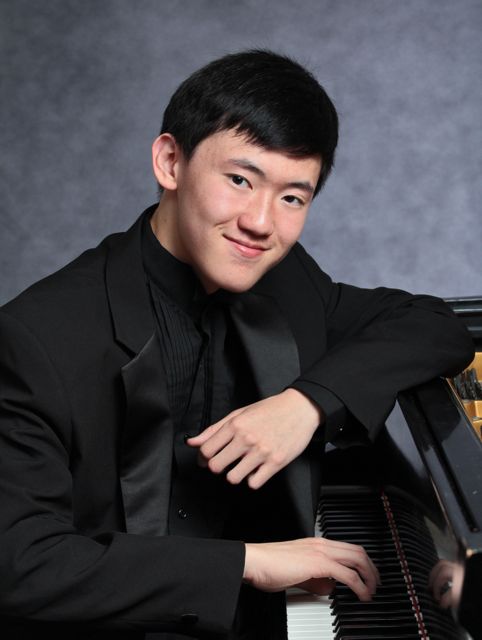
 

MELVIN STECHER AND NORMAN HOROWITZ FIRST PRIZE ONE-PIANO, FOUR HANDS ENSEMBLE  Max Ma, Age 17 Country of Birth: United States Residence: Newcastle, Washington

MELVIN STECHER AND NORMAN HOROWITZ FIRST PRIZE
ONE-PIANO, FOUR HANDS ENSEMBLE
Max Ma, Age 17
Country of Birth: United States
Residence: Newcastle, Washington
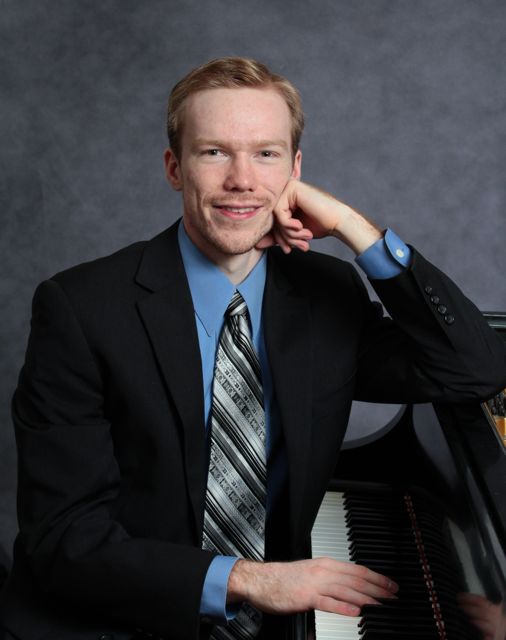


Thomas-Steigerwald-1

Thomas Steigerwald, Age 21 Country of Birth: United States Residence: Uvalde, Texas Cash Award of $3,500 Divided between the winning team


Daniel Kim returned to the stage to perform as soloist winner of the Second Prize, this time playing the first movement of Schumann’s G Minor Sonata, Op. 22. With a good sense of the drive that suits this work so well, Mr. Kim gave the movement a good solid delivery, no small achievement in such a challenging environment. One could see tremendous potential in this performance, and the fact that it was subject to the slightly “on edge” feeling that comes from an awards concert was in fact an advantage, as an impetuous spirit is an asset here. One looks forward, nonetheless, to hearing Mr. Kim in more extensive performance and in a more controlled setting.

Last of the performers was First Prize Winner (Joyce B. Cowin Prize), Jun Hwi Cho, age 18, performing Chopin’s Polonaise in A-flat Major, Op. 53 (the “Heroic”). Speaking beforehand about having hurt his right hand, Mr. Cho was jokingly reminded by Robert Sherman that in his accompanying statement he had written, “I will overcome any hardship I have in order to become a great pianist.” Overcome he did, and there was power and speed enough in his left hand to more than compensate for whatever might have affected his right hand – and frankly the right hand sounded quite capable as well. Mr. Cho showed a good deal of the firepower one expects to hear in a prizewinner, and one looks forward to hearing much more from him with the coming years.
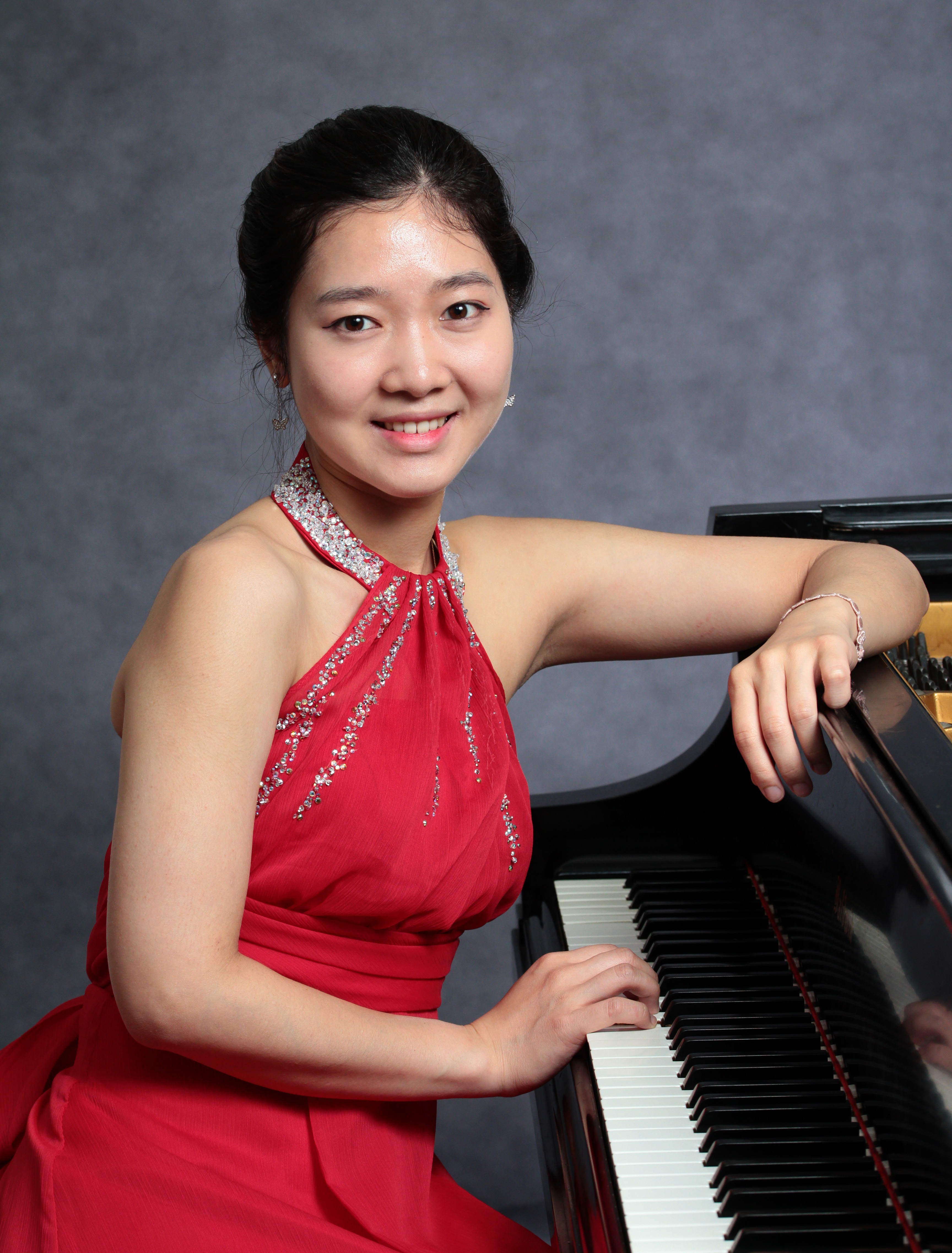
 

FOURTH PRIZE Seol-Hwa Kim, Age 21 Country of Birth: South Korea Residence: Goyang-Si, South Korea Cash Award of $2,000 Concert and Recital Appearances

FOURTH PRIZE
Seol-Hwa Kim, Age 21
Country of Birth: South Korea
Residence: Goyang-Si, South Korea
Cash Award of $2,000
Concert and Recital Appearances

One would have loved to hear in addition the prizewinners Yilin Liu (19), Seol Hwa Kim (21), Ning Yuen Li (20), Ling-Yu Lee (20), and all the others, but alas, there are limits. For that matter, one might have wanted to hear members of the jury, which included Tong-Il Han, Jane Coop, Jon Nakamatsu, Thomas Schumacher, Orli Shaham, Jeffrey Swann, and a screening jury of Francis Brancaleone and Anthony LaMagra – perhaps another time. Meanwhile, one eagerly awaits the festivities of 2016!

Share

Distinguished Concerts International New York (DCINY) presents “Under the Western Sky” in Review

Distinguished Concerts International New York (DCINY) presents “Under the Western Sky” in Review

Distinguished Concerts International New York (DCINY) presents “Under the Western Sky”
Utah Voices and Legacy Brass Ensemble; Michael D. Huff, director; Carrie Morris, accompanist
Mariachi Espuelas de Plata; Ramon Niño III and Imelda Martinez, co-directors
Cristian Graces, DCINY Debut Conductor; Distinguished Concerts Singers International
Stern Auditorium, Carnegie Hall; New York, NY
June 22, 2014


The program presented by DCINY under the umbrella title of “Under the Western Sky” was really three concerts in one, a rare treat for the enthusiastic audience.

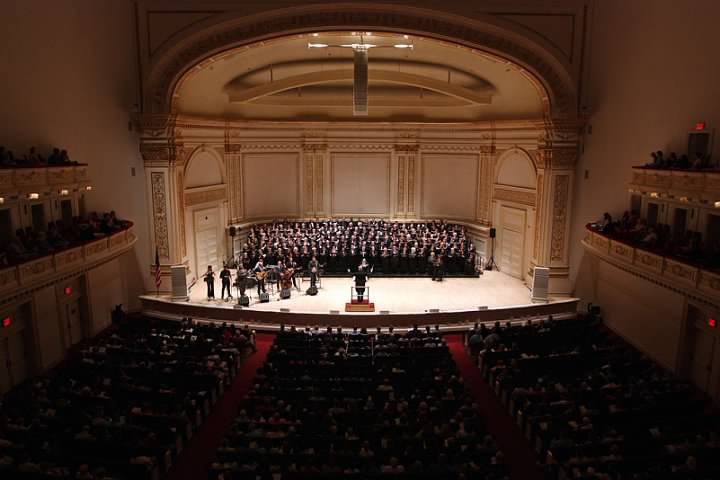
The first half was called “Hometown Praise: Music From Utah,” featuring the Utah Voices, led by Michael D. Huff, accompanied by the Legacy Brass Ensemble and Carrie Morris, keyboard (and an unidentified organist). The large choir  (approximately 110 members by my estimate) was perfectly prepared, in tune, with rich full tone that could produce a thrilling forte or whisper more confidentially at the softer dynamics. If you think “Utah choir” means only the Mormon Tabernacle Choir, you need to hear this group. Only a few times did they threaten to be overwhelmed, balance-wise, by the excellent brass players.

Their selections made one realize what a crucial role the sense of place plays in both faith and patriotism. Standouts included Kurt Bestor’s “Prayer of the Children,” a harrowing plea for peace based on the composer’s experience in Yugoslavia as a Mormon missionary, and Utah composer Leroy Robertson’s setting of “The Lord’s Prayer,” from his Oratorio from the Book of Mormon, NOT to be confused with the irreverent hit Broadway musical. The Irish folk song “Be Thou My Vision” arranged by the conductor, Mr. Huff, was beautifully done, with special contribution from Carrie Morris, finally getting to play the nine-foot Steinway instead of the electronic synthesizer she had been using prior. The section concluded with the rousing English folk song “Thou Gracious God, Whose Mercy Leads,” better known to some as “Oh Waly, Waly.”

After intermission, the tone shifted to a youthful emphasis. First came the charming Mariachi Espuelas de Plata, an award-winning high school group from North Side High School in Fort Worth, Texas. Their three pieces were done with suavity and great flair, using different combinations of the traditional violin, trumpet, guitar, one flute, and one harp, and some vocals.

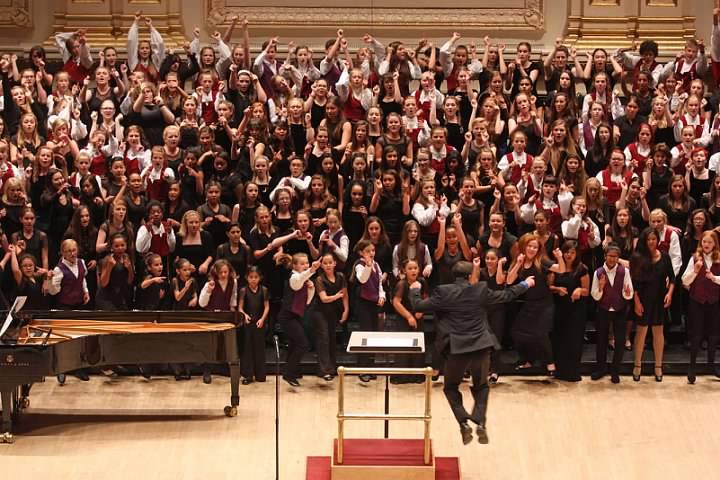
They then made way for the Distinguished Concert Singers International, a sort of collective choir, indeed international, of all-treble voices from: South Carolina, Indiana, Honduras, California, Australia, Washington State, Norway, Maryland, and Oregon. These girls’ and (unchanged) boys’ voices were scrupulously prepared, each choir by its own regular conductor, before meeting the excellent DCINY debut conductor/composer Cristian Grases.

Much of their work involved the integration of eurhythmics, that method of instilling music in early childhood through the use of bodily movement. You could feel how comfortable everyone was with the complex arrangements, all of which were done with clear diction and excellent pitch and humor, with a choir about double the size of the Utah Voices.

Dr. Grases clearly has a flair for this work, and must be applauded for his care. He was honored with the world premiere of his own Gloria, a setting of the second portion of the Ordinary of the Catholic Mass. Dr. Grases’ is in Spanish, and each of the five sections is a rhythmic travelogue of Latin America, from Colombia to Puerto Rico, the Andes, Venezuela, and Cuba. The joyful bounce was surely appropriate for this most celebratory section of the Mass, even if the numbers did have a certain “sameness” to them, that’s just nit-picking on my part.

Earlier, the choir had imitated the wind, and the conductor invited the audience to join in as well, in “El Viento” from  OperetaEcológica, by Dr. Grases’ teacher, Alberto Grau, whose clever reworking of “La Cucaracha” culminated with the extermination of the bug ( Dr. Grases himself) by a cute child imitating a bug spray can.

The entire afternoon was a multicultural and multi-musical celebration. Bravi!

Share

Music and More presents Jean Muller in Review

Music and More presents Jean Muller in Review

Jean Muller, piano
Weill Hall at Carnegie Hall, New York, NY
June 22, 2014


Assigned to review Luxembourgian pianist Jean Muller in an all-Liszt recital last weekend, I purposely avoided rereading my earlier review of him beforehand (Jean Muller all-Chopin recital January 18, 2013). A yearlong blitz of music, work, and stress had left a slight haze over my first impressions of him anyway, so I would be able to hear his artistry afresh, as I prefer.

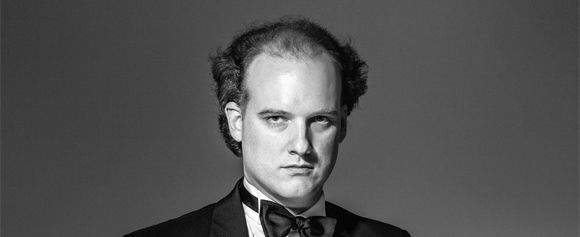
As it turned out, this pianist emerged as quite a different artist to me. Having now (after the recital) reread last year’s review, I am reminded that I had wanted a less cautious approach, but I had no such reservations in that regard this time. Part of this difference, of course, could be attributed to the current repertoire, all Liszt, but beyond that, there was an all-around extroversion and comfort onstage that I hadn’t recalled seeing or hearing from this artist before. From the Mephistophelian intensity of his flyer portrait to the confident projection of high drama in his declamatory phrasing, Mr. Muller seems now to be savoring a more commanding role all around. He still offers introductory comments from the keyboard with a refreshingly soft-spoken humility, but his music now seizes the listener with “no holds barred” immediacy. Perhaps one can credit the reinforcing effect of his recent world tours, but in any case it appears that Mr. Muller’s star is on the rise. There was drama without histrionics, power without excess, and always an overriding musical sense.

The program was in itself a statement in boldness, featuring Liszt’s complete Études d’exécution transcendante (or Transcendental Études, played from the third edition, 1852) and concluding with the Mephisto Waltz No. 1 (in the Busoni/Horowitz version). The performances were superb. The twelve Études encompass nearly every element of virtuosity that one could dream up for a pianist, from the rapid delicacy of Feux Follets to the treacherous leaps of Mazeppa and Wilde Jagd, the pining trills and filigree of the tender Ricordanza, and the thundering bombast of Eroica. All challenges were handled expertly “and then some.” Mazeppa (sometimes comically referred to as “Mess-uppa”) was extraordinarily successful considering its ferocious demands, while Eroica retained to the end the mock-epic humor that is only possible when the pianist himself has not been destroyed in the effort. Wilde Jagd left little to be desired, although some repeated chords might have benefited from crisper rhythm – and, at the risk of sounding greedy, I still wanted the ending just a bit wilder. Ricordanza, perhaps most challenging in terms of sustaining a listener’s attention through the long daydream, was judiciously paced and elegant, avoiding the mawkishness from which it sometimes suffers. In the same vein, Harmonies du Soir gave a beautiful sense of meditation and space after the urgency of the ubiquitous F minor Étude (No. 10, Allegro Agitato Molto), also played well. Vision was harrowing in its drama, as were the chilling chromatic runs of Chasse-neige, building to terrors worthy of Yeti. Not to be underestimated, the gentle, pastoral Paysage also presents its own challenges of pedaling and timing, and it was beautifully done as well, if not completely transcendent due to the concerns just mentioned. Even the shorter Études, Nos. 1 and 2 (Preludio and Molto vivace, respectively), the two perhaps least often singled out for individual performance, were elevated to stand as important pillars of entry to the set. All in all, it was an outstanding triumph.

Each live performance of this set has been fixed in my mind as a somewhat unusual event, and part of the reason is that, despite innumerable firebrands out there, the complete set is still not that often played live. Perhaps the reason is that the challenges still daunt many pianists, especially cumulatively, or perhaps it is that such programming itself has been criticized too often as unmusical or taxing on an audience. Though each Etude may fare well when featured alone, like the diamond against black velvet, when lined up in successive performances, they compete to outshine each other. If a pianist sets the standards high at the start, his audience’s ears get spoiled and saturated, setting up a grim case of diminishing returns. Those who do perform the entire set often convey the impression of a “stunt” or worse, and the bludgeoning of the keyboard makes a listener wish to fall through a secret trap door. One pianist who performed them all gave me a headache that lasted for the entire next day – individual Études had been good, but one wondered why the pianist had determined to torment himself with this Faustian goal.

By contrast, what stood out most in Mr. Muller’s recital was that, despite some residual awareness of the “stunt” – inevitable with this unbroken chain of hurdles – there was an artistic continuity and integrity throughout. The dynamic pacing was such that the Fortissimo playing never felt relentless, and by the time No. 6, Vision, was played there was still, despite earlier outbursts, further room for building. The house piano’s beautiful bass resonance helped the pianist achieve a power here that outdid all earlier sonorities, and the roar evoked the opening up of the earth. Like a well-told story, there evolved a shape to the entire set. The sheer variety of Liszt’s imagination came to the fore, thanks to such prodigious pianistic skills and sensitivity, and another point was chalked up in favor of this kind of programming. At times Mr. Muller displayed the range of an orchestra, and one could almost recycle Heinrich Heine’s own comment about Liszt, that “the piano disappeared and the music alone was revealed” if it were not for a glassy treble register on the instrument, reminded one that there was indeed just a piano there, needing of a bit of extra help.

As a side note, Mr. Muller also planned the program well, performing 1-8 in a row as the first half (Preludio and Wilde Jagd being good bookends) and following the last four on the second half with the Mephisto Waltz No. 1. His Mephisto Waltz was almost as exciting as that of Horowitz, who had augmented sections of Busoni’s version – although Mr. Muller’s performance was quite a bit neater. A standing ovation was repaid with an encore, the pianist’s own spin on Billy Joel’s Root Beer Rag.

Share

Camerata Virtuosi New Jersey presents “Dream High” Discovery Series II in Review

Camerata Virtuosi New Jersey presents “Dream High” Discovery Series II in Review

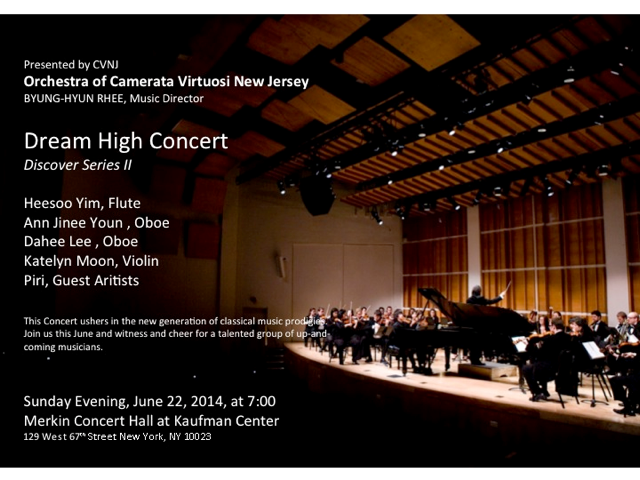
Camerata Virtuosi New Jersey presents “Dream High” Discovery Series II
Orchestra of Camerata Virtuosi; Byung-Hyun Rhee, music director and conductor
Special Guest: Quartet PIRI
Merkin Concert Hall. Kaufman Center; New York, NY
June 22, 2014


In a program entitled “Dream High,” the Camerata Virtuosi New Jersey presented four young soloists in selections of works by Mozart, Haydn, and Accolay. As preludes to each half, the Camerata and special guest Quartet PIRI, a clarinet quartet, contributed their own selections in addition.

Opening with a spirited reading of the Allegro of Mozart’s Divertimento in D major, K. 136, the Camerata Virtuosi got the night off to a good start. The playing was precise and well articulated, with balance that was excellent throughout. These qualities would serve well in the subsequent works.

Nine-year-old violinist Katelyn Moon (yes, nine-year-old!) took to the stage. It appeared that she was using a three-quarter-size violin. She played the Violin Concerto No.1 in A minor (written in 1868), by Jean- Baptiste Accolay (1833-1900). A one-movement work commonly referred to as a “student concerto,” it is a showpiece without extreme technical demands. Before one gets the impression that this piece is not worthy of performance, let one be reminded that many famous violinists have played it long after their student days were over, most notably Itzhak Perlman. One is naturally hesitant to pass judgment on such a young player, but certainly one can say that Ms. Moon is remarkable for her age; she tackled the work without difficulties and projected well in a steady performance. I should like to hear her again in three or four years playing a more challenging work, with a full-sized instrument.

Ann Jinee Youn followed with the Allegro spiritoso of Haydn’s Concerto for Oboe in C major, Hob. VIIg:C1, the only concerto Haydn composed for the oboe. Ms. Youn played with confidence, nimbly navigating the demanding passagework, and with a rich tone and solid intonation. Not only were the technical demands met, but subtler aspects of artistry are clearly emerging. Ms. Youn has a musicality beyond her years, and it was a most enjoyable performance.

Conductor Byung-Hyun Rhee was effective as a conductor and very attentive to the needs of his young soloists. From the basics, such as occasionally instructing when to bow (something easily forgotten by a nervous young performer), to the more critical points, keeping the orchestra in balance and synch with the soloists, he was an ideal collaborator.

After intermission, Quartet PIRI offered selections of Bizet, Piazzolla, and Luis Bonfa (1922-2001). Led by the personable Hana Kim, this clarinet quartet displayed style, commitment, and charm. Highlights were Piazzolla’s Oblivion, and the Manha do Carnaval from Bonfa, which got the audience into the act with finger snaps, as prompted by Mr. Kim.

The final soloist of the evening, Heesoo Yim, had the honor of playing the entire Concerto for Flute in G Major, K. 313 by Mozart. Ms. Yim is a complete player, combining technical facility, careful attention to matters of musicality, and clear projection. Her playing has a light, butterfly-like touch in the rapid passages, but without any of the “breathiness” of tone that so many young players have. Her playing in the Adagio was expressive without being affected, avoiding another pitfall of many lesser players. The Rondo was just the finishing touch on a top-notch performance. Ms. Yim was rewarded with an enthusiastic ovation from the audience.

These young performers should all have bright futures and I look forward to following their progress.


Share

Distinguished Concerts International New York (DCINY) presents “Dream a Better World . . . Ignite the Spirit!” in Review

Distinguished Concerts International New York (DCINY) presents “Dream a Better World . . . Ignite the Spirit!” in Review

Distinguished Concerts International New York (DCINY) presents “Dream a Better World . . . Ignite the Spirit!”
Lincoln High School Gospel Choir, T.H.I.S Movement Players
Darcy Reese, Director
Darnell Davis and The Remnant
Tonia Hughes, special guest
Alice Tully Hall, Lincoln Center, New York, NY
June 14, 2014
  

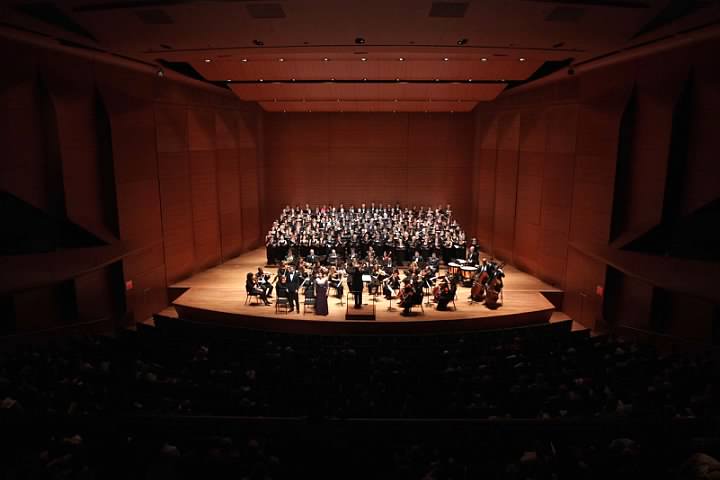
Good news! Gospel is alive and well in Minnesota. “Gospel” means “good news,” so this is particularly appropriate. Distinguished Concerts International New York (DCINY) presented a thrilling evening of mission-inspired music in a concert entitled “Dream a Better World…Ignite the Spirit!” at Alice Tully Hall on Saturday, June 14, 2014.

Once in a very great while, all critical apparatus simply must be thrown out the window in favor of a totally emotional “surrender” response to music-making that is so energetic and joyful that words would only diminish it. Nevertheless, I must try with a few words to convey a portion of what took place.

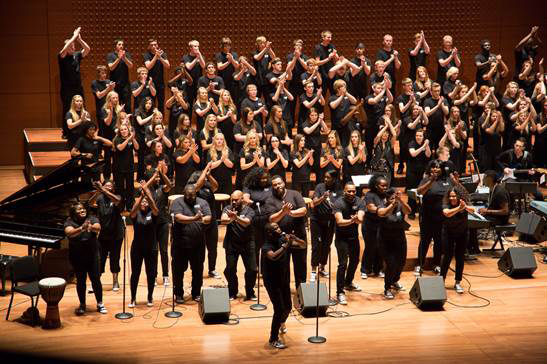
This is the very best of what American youth looks like, in an era when the din of school shootings and bullying threatens to absorb all our attention. Not only was the dedication of the students bursting forth, but the obvious glory of their fine teacher, Darcy Reese, and the supporting musicians and the community that gives rise to the group. The choir celebrates and emphasizes diversity. You can see the joyful commitment on every face. They move and respond naturally to the music in a way the canned antics of the television show Glee can’t equal. This is the real thing: glee.

I was seated amid many Minnesotans, who were beaming with pride. I heard their stories of cancelled flights, and four-, ten-, twelve-hour delays in getting to New York. It was all worth it for them and for the audience. Their children sang a two-hour program of excellent, mostly gospel, arrangements, all from memory. Many solo turns were taken by members of the choir, and they all performed with exquisite poise and sincerity. A few of the pieces were more like “soft” belief-oriented rock, and there were also a few readings made over background music.

The T.H.I.S. (The Hero Inside Shines) Movement was particularly inspiring, with its mission: “We refuse to let the world be as it is. We refuse to blind ourselves by excuses and lies. We are determined to have an effect on the world. We will persevere and change our world, one action, one note at a time.” The students have raised thousands of dollars for worthy causes, including Haiti, Africa, and the “Bully Bench” for children to sit on if they have no one to play with at recess, from a hometown of only 8000 people. If they had blown the roof off of Alice Tully Hall more than metaphorically, I’m certain their life-affirming energy would have spilled over the city, healing and transforming.

Special mention must be made of the heaven-bound singing of the guest artist Tonia Hughes, and one incredible pianist, Aaron Fagerstrom, whose understanding of authentic gospel style goes way beyond his young years. He made me smile when he finished a certain phrase using his wrist as a shock absorber, tapering beautifully and sensitively in the best “classical” manner.

In the words of Ms Reese: “Take the journey, experience the music, and pass it on.” Mission accomplished.


Share

Distinguished Concerts International New York (DCINY) presents Bluegrass & Gray: Sounds of Americana in Review

Distinguished Concerts International New York (DCINY) presents Bluegrass & Gray: Sounds of Americana in Review

Distinguished Concerts International New York (DCINY) presents Bluegrass & Gray: Sounds of Americana
Distinguished Concerts Orchestra, Distinguished Concerts Singers International 
Jefferson Johnson, DCINY Debut Conductor;  Michael Adelson, Guest Conductor
Carol Barnett, Composer-in-Residence; John Purifoy, Composer-in-Residence
Special Guest: Dailey & Vincent
Stern Auditorium, Carnegie Hall, New York, NY
June 8, 2014


I may have been the only New Yorker in a sea of warm and appreciative Southerners for the presentation by Distinguished Concerts International New York (DCINY) of Bluegrass and Gray: Sounds of Americana, an unconventional program of choral and bluegrass music on the main stage of Carnegie Hall.  While it is not unusual for a wide variety of ensembles to appear at Stern Auditorium, this performance was an odd mixture of styles, genres, and levels of professionalism.

The concert consisted of three parts, of which the second, a tour de force by the bluegrass band Dailey and Vincent, was the joyous highlight. I am not an aficionado of bluegrass music, but the level of technique and musicality shown by these players rivals that of the most celebrated groups in any branch of entertainment.  It took a few tunes to adjust the balance of amplification, and when the band was playing at full volume, the lyrics of the songs were unintelligible.  The instrumental solos, however, were tight and clean, even at the most bracing speed.  At the core of the group is a quartet of very fine singers, anchored by a rock solid bass (Christian Davis) and a tenor who can both float and belt,
Jamie Dailey.  All of the players, without exception, were impressive, but I must single out Darrin Vincent and Jeff Parker for their ease of execution and spontaneity.

Framing the Dailey and Vincent set were two choral works featuring choirs from Florida, Kentucky, Mississippi, New York, Tennessee, and Washington:  John Purifoy’s The Chronicles of Blue and Gray and Carol Barnett’s The World Beloved: A Bluegrass Mass.  A work with serious intentions, The Chronicles of Blue and Gray had moments of simple, unaffected beauty.  The text was assembled from writings of the Civil War era – popular songs, letters, speeches, and poetry, highlighting the anguish caused by the violent rift between North and South.  The speeches of Abraham Lincoln and the heartbreaking letters of soldiers about to die are difficult to improve upon by setting them to music.  Mr. Purifoy chose the smartest path- largely staying out of the way of his libretto.  His writing is idiomatic and generous, especially in the long, beautifully sung duet for Caitlin Hawkins and Travis Hazelwood.  In the end, though, I felt that the work could have used more invention and daring on the part of the composer.  Distant trumpets, lonely field drums, and open harmonies are overly familiar and specific aural images for war.  They lose their effectiveness, though, with repetition.

The finale of the program, The World Beloved: A Bluegrass Mass, smartly retained the services of Dailey and Vincent as both backup band and soloists.  Ms. Barnett provided a well-crafted, challenging composition for both chorus and guest artists.  She has a light touch with difficult music, and the combined choruses, for the most part, rose to the occasion.  The only miscalculation was the disparity between the highly amplified sound of the bluegrass ensemble and the more natural acoustic of the voices, which dampened the effect of even their most compelling passages.

Both choral works benefited from the clear and precise direction of the conductors Michael Adelson and Jefferson Johnson.  Mr. Adelson, in particular, was impressive in his control of detail and phrasing.   The very fine orchestra, credited simply as the Distinguished Concerts Orchestra, deserved to be listed in full for their excellent contributions to the program. The expertise of their playing, as of Dailey and Vincent, elevated the entire afternoon to a level worthy of Carnegie Hall.

Share

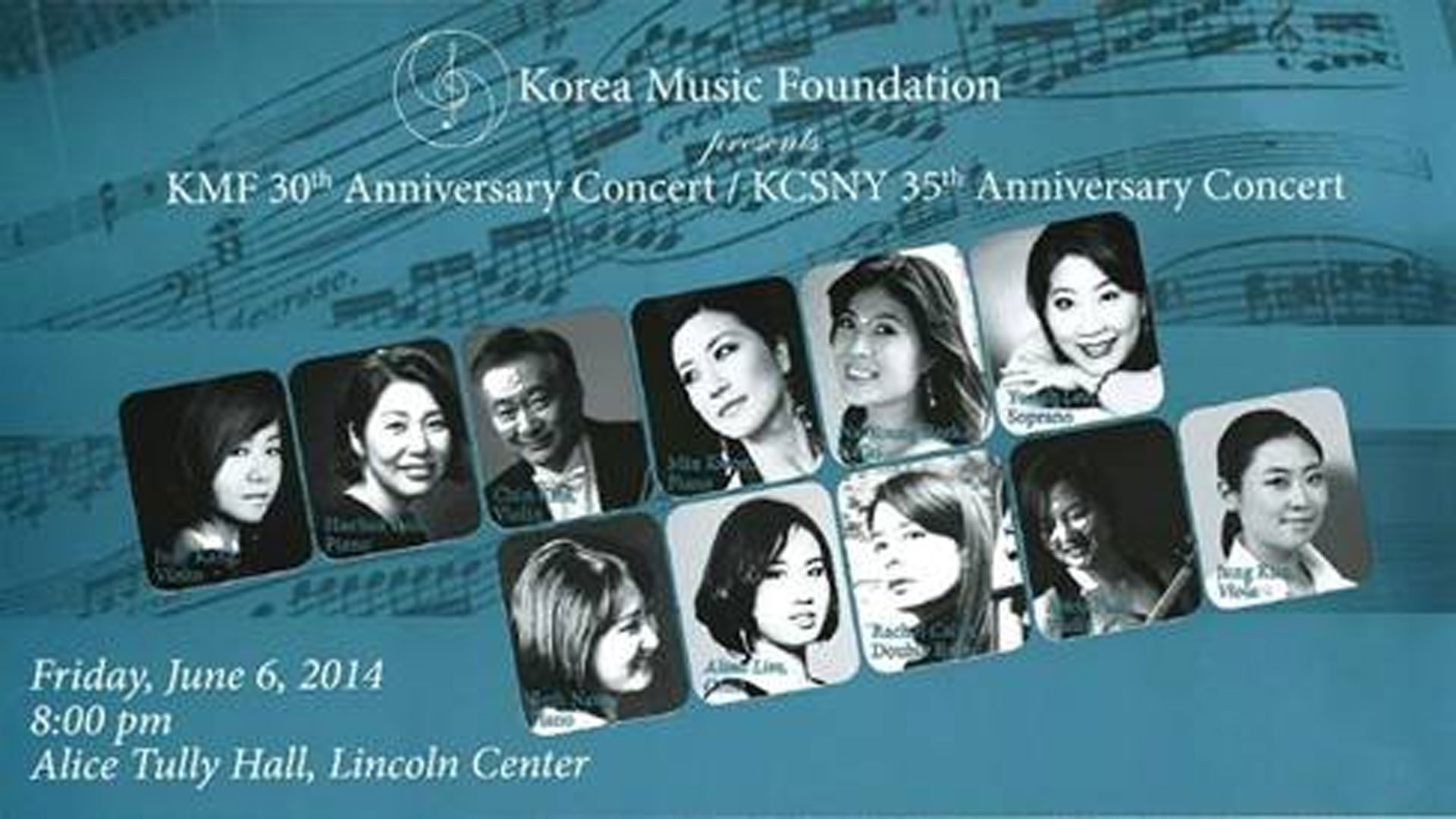
Korea Music Foundation 30th Anniversary and Korean Cultural Service NY 35th Anniversary Concert in Review

Korea Music Foundation 30th Anniversary and Korean Cultural Service NY 35th Anniversary Concert in Review

Korea Music Foundation 30th Anniversary and Korean Cultural Service NY 35th Anniversary Concert
Alice Tully Hall, Lincoln Center, New York, NY
June 6, 2014


Immersed in the stylish, staccato chatter at Alice Tully Hall on the evening of June 6, it was easy for one to surmise a thirty-year triumph for the Korea Music Foundation (KMF) and a fulfilling thirty-five-year stint for the Korean Cultural Service NY. Started in 1984 as a non-profit platform for Korean rising talent (somewhat less extensive than our Young Concert Artists, which provides management services for international winners, or Great Britain’s Young Classical Artists Trust, which promotes stars resident in the U.K.), the Korea Music Foundation invests in New York début recitals, orchestral concerts, chamber music, and fundraising events for its younger protégés and more established Korean performers. The Korean Cultural Service NY offers an array of annual concerts, exhibitions, films, and educational presentations on its premises at 460 Park Avenue. The convergence of these two groups’ respective celebrations resulted in a sure-to-please Lincoln Center gala of silks, flowing pastels, and generously delivered oceans of virtuosic passagework, conveyed by KMF favorites through a captivating, predominantly nineteenth-century program of solo and chamber works.

Four pages of insightful commentary by an unnamed author filled in the listener’s overwhelmingly upbeat experience. Even the most desolate of the program’s four substantial works, Ernest Chausson’s Chanson perpétuelle, Op. 37, for soprano, piano, and string quartet, a woman’s sensual suicide letter to a lover who has defaulted on their pact, was given a buoyant and transparent reading in the honeyed colors of Yunah Lee’s rich soprano and the tender, tremolando swells of strings and piano. Relying on exaggerated dynamic hairpins but never covering the voice with their muted chromatic undulations and immaculate intonation, the strings (Judy Kang and Anna Park, violins, Jung Yeon Kim, viola, Alina Lim, cello) and piano (Beth Nam) might have beckoned to Ms. Lee from a plush summer landscape rather than from the grief-stricken numbness of eternity; the sextet’s perspective seemed to stress the latter element in Poulenc’s 1950 description of French music as a coexistence of “somberness and good humor.” Poulenc surely knew of the work; Chausson’s last completed composition before his tragic end in a bicycle crash in 1899 preceded Poulenc’s forty-minute operatic soliloquy on the same subject (La voix humaine) by sixty years. The eight-minute Chausson may be performed in a version for soprano and orchestra, which might give an even more harrowing treatment to the stanzas of Charles Clos.

The Norwegian composer Johan Halvorsen supplied the concert opener, his 1894 Passacaglia based on the last movement of Handel’s Keyboard Suite in G Minor, HWV 432. Arranged here for violin and cello (Ms. Kang with Na-Young Baek), the piece overlays Handel’s durable harmonic progression with a Grieg-like double-concerto quality, gilded double stops and runs, pizzicato and spiccato variations, and festive twitters. The transcription is a perfect pleaser for any crowd, purists notwithstanding. Ms. Kang and Ms. Baek fed the delighted ears of a giddy weekend audience with tailored string acrobatics and tonal effects burnished to order, although the most fascinating sonorities emerged from their sul ponticello excursions over the bridge and the sustained polyphony produced by double stops in mock quartet texture.

The program’s central spotlight was rightfully reserved for HaeSun Paik, the solo pianist in Beethoven’s Fifteen Variations and Fugue in E-flat Major, Op. 35 (nicknamed “Eroica” for the Third Symphony, Op. 55, which used the rustic original theme in its finale). Ms. Paik, the most experienced of the evening’s performers, is a faculty member at the Cleveland Institute and a laureate of many of the world’s prestigious piano competitions, and her collaborations with recognized conductors and ensemble partners has only fortified the inner structure and warmth in her playing. Undaunted by the grandeur of the large-scale form and its nickname, Ms. Paik maintained drive and exquisite control while bringing out the playfulness in Beethoven’s silences, giving effervescence to double-throws and hand crossings in the early variations and casting the fugue as a youthful, untroubled precursor to those in Beethoven’s late sonatas. Most poignant in her delivery were the Minore (Variation 14) and its sequel, the timeless Largo (Variation 15), which left behind the country dance and basked in a soft-hued cadenza, gathering strength for the final spectacle of trills and meticulously sculpted articulations. That said, one could plead a case for an occasional lapse of sheer beauty and intimacy in Beethoven’s stormy op. 35; the concurrence of this piece with the realization of increasing deafness and isolation documented in Beethoven’s heart-wrenching Heiligenstadt Testament of 1802, the year of composition of the “Eroica” Variations, would warrant at least a hint of irony, a germ of the Teutonic strength that could ignite the century’s defiant spirit.

Adrenaline peaked in Schubert’s “Trout” Quintet in A Major, D. 667 for piano and strings, with Min Kwon, piano, established violinist Chin Kim (faculty member at three New York conservatories), Ms. Kim and Ms. Baek, viola and cello, and Rachel Calin, double bass. Five dramatic soloists united to produce an exuberant, visceral version of this well-chosen, conventional masterpiece, closing the anniversary gala with a show of appeal in every sense. Mr. Kim provided seasoned leadership and snappy dotted rhythms, although these were not always echoed as brightly in the piano’s imitations. Of special mention was the superbly mellow, elegant tone of Ms. Calin, who played a Carlo Giuseppe Testore double bass from 1690. It is curious that the deadlines of our modern administrative machinery whirr by without advance knowledge of the interpretations that will follow in real time: the adjectives “expansive,” “leisurely,” “tranquil,” and “conversational” in the Notes on the Program could not catch up with the lightning vibrato and glittery urgency of this ensemble, whose effective conception might have been more suited to the late romantic; although Schubert’s Scherzo was Presto, and impeccable.


Share

Musica de Camara 34th Anniversary Concert in Review

Musica de Camara 34th Anniversary Concert in Review

Musica de Camara 34th Anniversary Concert
Eva de La O, founder; RoselinPabón, conductor
Special Guest: Christian Colberg, viola
The Church of The Blessed Sacrament, New York, NY
May 22, 2014


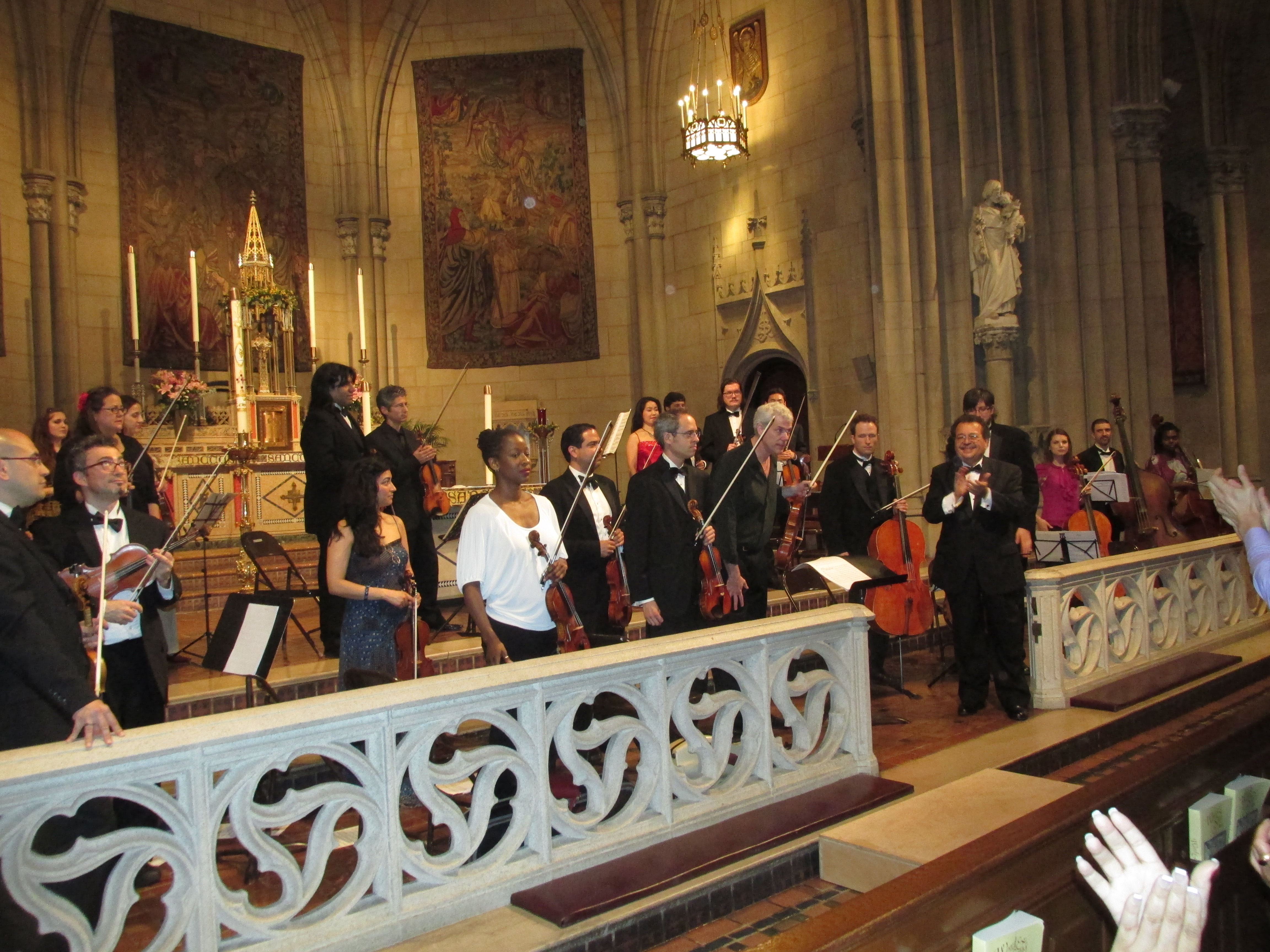
Writing a review for an organization that one has physical ties to can be quite challenging. [Mr. Sean appeared in performance with Musica de Camara on February 18, 2014- Editor’s note] This is not the case here. Eva de La O, founder and director of Musica de Camara, presented a group of musicians tonight that would make even the most discerning listener’s job difficult. This concert, under the direction of Maestro Roselin Pabón, was like a mosaic ribbon attached to thirty-four years of continuous gift-giving. To see and hear such youthful vibrancy tied together with professionalism of the highest order, I can think of no better way to say ‘thank you’ than a program of newly premiered works by talented young composers.

The featured soloist for the evening, Christian Colberg, performed a single movement from his Viola Concerto. Mr. Colberg offered the first movement, entitled Alonso, which depicts a scene from Cervantes’s novel Don Quixote as Alonso Quixano styles himself Don Quixote. Mr. Colberg’s impeccable intonation and clarity of sound allowed me to focus on the structure of the piece, which would have not been possible if the soloist were not of his caliber. This is a Twenty-First-Century work unmistakably written in the great Nineteenth-Century Romantic tradition, with broad, recurring themes, and fiendishly difficult passages. Mr. Colberg masterfully eschews that tradition at the climax and culmination of the piece by ending with a non-traditional cadence. It reminded me of a bullfighter tossing his sword to the ground and kneeling in triumph at the end of a long and bloody match.

Another composer/performer of note is principal bassist Pedro Giraudo (b. 1977). His Suite for String Orchestra, which was commissioned by Musica de Camara, is a delightful work written by a jazz master, who also is a fine classical player as well (reminiscent of the Argentine tango master Astor Piazzolla). Solos were tossed from section leader to section leader with the highest sophistication and skill. Diego Sanchez Haase’s (b. 1970) Sonata Paraguaya, which was premiered in the U.S. this concert, was a gift to Musica de Camara by the composer. While listening, it occurred to me that the nationality of each composer was integral to their compositions. Whether this was planned or not, it made for an interesting mix of sounds and rhythms from near and far. Dominican composer Angel Herdz (b. 1968) in his Serenata para Arcos, Op. 4, presented a work that was not as easy to place geographically, but the jagged lines in the third movement served as a nice diversion from the slowness of the piece. The youngest composer, Jessie Montgomery (b. 1981), favored the audience with her work for strings entitled Strum. This thirty-three-year-old violinist of the highly acclaimed Catalyst Quartet is one to watch, as she is a composer of film, theater, and concert music-a triple threat talent! Ironically, the oldest work on tonight’s program, Tiepmo Sereno, by Hector Campos Parsi (1922-1998), sounded the most modern to my ears. This work uses alternating major/minor modes, and repetitious phrases that build from nothing until they seem to nag at your soul. He paints a picture of stars and galaxies, and of our ability to visit such places in the very distant future.

Finally, how does one take a program of new music and in three days give a performance worthy of any stage in the world? You give it to Maestro Pabón. Here is a master who understands rhythm so well that it never becomes a distraction. I can tell he does his homework-nothing is left to chance, even though he has first-rate soloists under his baton. Maestro Pabón’s unspoken insight (he doesn’t speak much during rehearsals) landed on the ear of every listener that night. It is no small feat holding together an entire program of unfamiliar and difficult works. As I greeted the conductor backstage several moments after the concert, I couldn’t help but notice that he was the only one still perspiring.

As Musica de Camara brings thirty-four seasons of wonderful music making to a close, I look forward to the start of a new season, and that year thirty-five will be as generously rewarding as what I witnessed tonight.


Share

Distinguished Concerts International New York (DCINY) presents Celebration and Reflection, Part 2 in Review

Distinguished Concerts International New York (DCINY) presents Celebration and Reflection, Part 2 in Review

Distinguished Concerts International New York (DCINY) presents Celebration and Reflection, Part 2
Distinguished Concerts Orchestra, Distinguished Concerts Singers International
Bob Chilcott, conductor; Danielle Talamantes, soprano, Christian Reinert, tenor
René Clausen, conductor
Alice Tully Hall, Lincoln Center; New York, NY
May 26, 2014


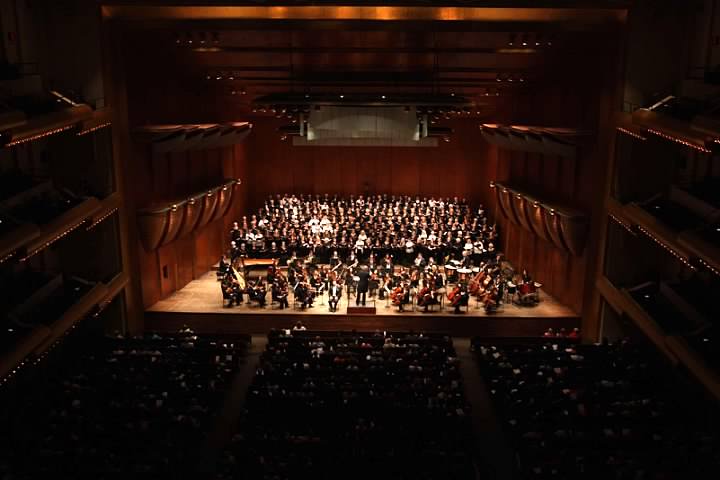
The Distinguished Concerts International New York (DCINY) presentation of the two-part concert series “Celebration and Reflection” continued with Part 2 on May 26, 2014 at Alice Tully Hall. Headlining this concert was the Requiem by Bob Chilcott, and the World Premiere of Festival Te Deum from René Clausen, with the added dimension of having both composers conducting their own works. The afterglow of Part 1 was still very much with me, and I was hopeful that the high standards would continue in Part 2. With chorus members from California, Georgia, Minnesota, New Jersey, New York, Ohio, Virginia, Italy, Korea, The Netherlands, Spain, and “individuals from around the globe,” there to lend their collective talents, it had the makings of an enjoyable evening.

The first half consisted of the Requiem by Bob Chilcott (b. 1955). Requiem was commissioned for performance in concert with Beethoven’s Mass in C major, and Mr. Chilcott followed Beethoven’s example in using the same orchestration of double woodwinds, trumpet, timpani, and strings. The traditional Latin Mass text was used, but the Dies Irae and Libera me were omitted and in their place, Mr. Chilcott used text from the Book of Common Prayer, “Thou knowest, Lord, the secrets of our hearts.” It was Mr. Chilcott’s stated goal to write a piece that “could be sung by singers of all abilities.” Drawing upon his own extensive experience as a singer and conductor, Mr. Chilcott has succeeded in the realization of his goal. Requiem is gentle and reflective, with accessible harmonic language and effective vocal writing that allows lesser-skilled singers to shine. There are moments of breathtaking beauty, most notably the Lux aeterna, but the entire work is uniformly excellent, in what this listener is now adding to his list of “finds.”

Mr. Chilcott proved himself to be an able conductor, who was completely immersed in the work. One could sense that he was performing the choral parts in tandem with the chorus. Soprano Danielle Talamantes and tenor Christian Reinert were revelations as well in their refined and emotionally powerful performances. The last measures of the Lux aeterna, featuring a soft ascending figure in the upper register, were sung by soprano Danielle Talamantes with a perfect diminuendo al niente, or to complete silence, and a child-like innocence that was exquisitely controlled and crystalline in its clarity. It was as if an angel were ascending into the heavens – a simple, but stunning effect. The audience immediately leapt to their feet to reward the composer with a justly earned ovation.

After a brief intermission, Grammy award-winning composer René Clausen (b. 1953), a DCINY favorite, took the podium. His work, On This Shining Night, using the poem of the same name by James Agee as text, opened the second half in a new arrangement for chorus and orchestra. Colorful and rich in melodic ideas, the scoring of the orchestra with the chorus enhanced the already expansive work, which was given an artistically satisfying performance.

Of his Festival Te Deum, Dr. Clausen writes, “The compositional style of the work can be rather easily classified as neo-Romantic, with straightforward rhythms, harmonic language that does not significantly move beyond traditional tension/resolution, and vocal and instrumental writing that is idiomatic, yet takes full advantage of instrumental and vocal capabilities.” These qualities are a hallmark of Dr. Clausen’s works and the reason why he is a great favorite of choral ensembles of all levels. As the title implies, this is a festive work full of vitality, optimism, and celebration. This listener, already an admirer of Dr. Clausen’s work, was impressed by both the piece and the first-rate performance. Festival Te Deum is yet another example of the gifts Dr. Clausen possesses as a composer, and is a work that is sure to enjoy extensive performances, as it will surely enter the standard repertoire.

As a final reminder of the occasion, An American Hymn by Cecil Effinger, with orchestration by René Clausen, closed the evening. This setting of America, The Beautiful was given a stirring reading, which ended the concert with a splash.


Share

Distinguished Concerts International New York (DCINY) presents Celebration and Reflection, Part 1 in Review

Distinguished Concerts International New York (DCINY) presents Celebration and Reflection, Part 1 in Review

Distinguished Concerts International New York (DCINY) presents Celebration and Reflection, Part 1
Distinguished Concerts Orchestra, Distinguished Concerts Singers International
Aimee Beckmann-Collier, DCINY Debut conductor; Rachel E. Copeland, soprano; Rachel Arky, mezzo-soprano; Shawn Mlynek, tenor; Jeremy Galyon, bass
Bradley Ellingboe, guest conductor; Dann Coakwell, tenor
Avery Fisher Hall, Lincoln Center; New York, NY
May 25, 2014

Memorial Day is a time for reflection and to give our thanks to all the men and women who gave their lives so we can enjoy the liberty that their sacrifices made possible. Distinguished Concerts International New York (DCINY) presented a two- part concert series entitled “Celebration and Reflection” to commemorate those heroes.  Avery Fisher Hall was the venue for Part One, the first half of the program being Mozart’s “Coronation“ Mass, and second half, the World Premiere of Star Song, by Bradley Ellingboe.

The Patriot Brass ensemble returned again this year and entertained the audience members as they entered the hall with a pre-concert selection of marches, popular tunes, and Americana.  As the chorus members from Iowa and Kansas (and “individuals around the globe”) filled onto the stage, the mood was set for a festive evening.

Mozart’s Mass in C major is called “Coronation” because it is believed that this work was performed at a coronation in Prague. Some claim it was used for the coronation of Leopold II in 1791, while others state it was used for Franz II in 1792. In any case, written in 1779, the Coronation Mass remains fresh and vital 225 years later, another testament to Mozart’s genius.

Conductor Aimee-Beckmann-Collier took to the podium, and it was apparent from the start that the chorus, soloists, and orchestra were all well prepared.  Attacks were precise and crisp, and the chorus sang with clear diction and good ensemble balance. Maestra Beckmann-Collier was a superb leader in her no-nonsense approach – passionate, but never out of control. It was also notable that she “kept it all together” during the Credo, when a stampede of approximately forty late comers made for their seats in a manner better suited for the Running of the Bulls at Pamplona! One must also commend the soloists, soprano Rachel E. Copeland, mezzo-soprano Rachel Arky, tenor Shawn Mlynek, tenor, and bass Jeremy Galyon in their standout performances as individuals, and in duet and quartet settings. Each voice was clear and projected with power to overcome the large forces behind them, without one overshadowing the others.  This was truly a winning performance on all accounts.

Star Song is a work built on a fascinating idea. The idea that “everything vibrates” and the implications of that idea all the way to the atomic level captured Mr. Ellingboe’s imagination. He writes, “The stars -and the atoms we share – were my muse. This is the central premise of Star Song. It is a big concept, and something I have pondered for a long time and probably always will, until the atoms that comprise me are off being something else.” The twelve-movement work features poems from Juhan Liv, John Milton, Saint Hildegard, Rainer Maria Rilke, Siegfried Sassoon, Billy Collins, Walt Whitman, thoughts from Vincent Van Gogh, and texts from traditional Hebrew and Algonquin. On paper this is very impressive, but how would it all translate to actual performance? In some instances, it was realized with excellence, but I was less taken with some sections.  The music is eclectic, but the more whimsical selections (most notably the Questions About Angels from Billy Collins) projected glib, Broadway-tinged writing, which in itself is not necessarily a bad thing, but a style that undercut the import of other sections. Mr. Ellingboe is a skilful composer with a wealth of ideas, so I was hoping for more. I do believe that he will continue to refine Star Song, and it will be interesting to hear a later performance.  The star of Star Song was tenor Dann Coakwell, who handled all the various styles with remarkable ability. It did not matter whether the style was a recitative, an arioso, or just slapstick, the end result was one of excellence. Mr. Ellingboe is also an engaging conductor as he led his composition with the enthusiasm he projects in abundance. Congratulations to the chorus members from New Mexico, Arizona, Illinois, and Virginia who gave their all as well in a committed performance. The large audience responded to Star Song with a heartfelt ovation.

Share