Katarzyna Musial, Pianist in Review

Katarzyna Musial, Piano
Camerata New York Orchestra, Richard Owen, Jr. Conductor
The Kosciuszko Foundation
March 18, 2012
Katarzyna Musial

Katarzyna Musial

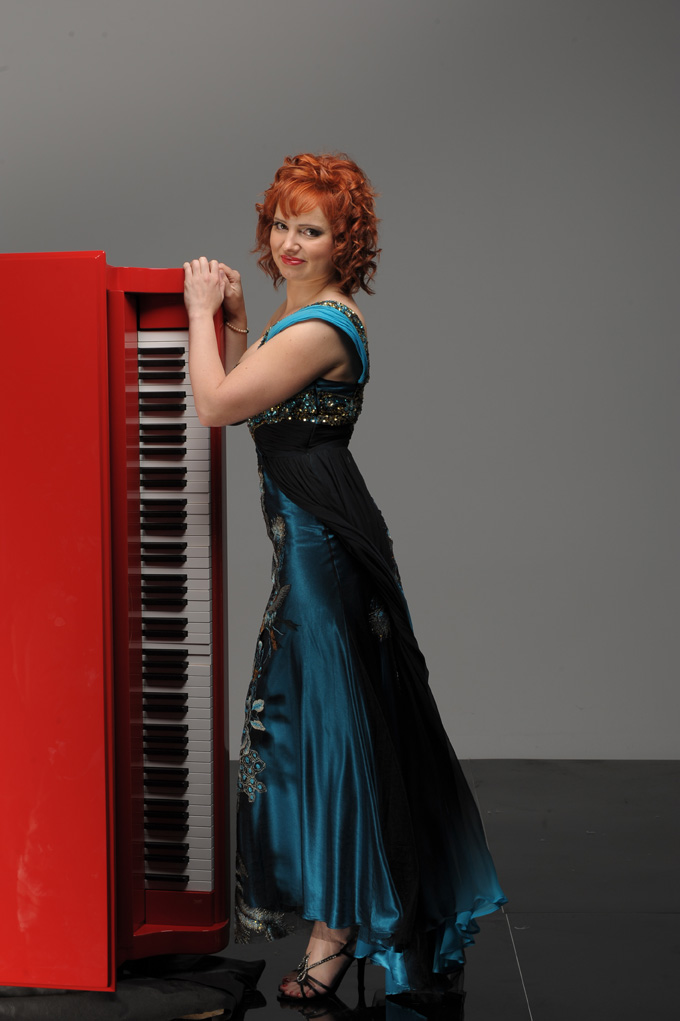
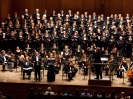
The Camerata New York Orchestra presented a delightful program on a delightful Sunday afternoon, March 18, with a guest soloist, the Polish-Canadian pianist Katarzyna Musial. The Camerata, now celebrating its tenth anniversary, is a spirited chamber orchestra, 25 players strong. The American conductor, Richard Owen, Jr., its founder and Music Director, a graduate of the Manhattan School of Music, Dartmouth College (he also worked at the University for Music in Vienna) has conducted extensively, operas and symphonic music, and is also a pianist who gives concerts with his cellist wife (the Owens live in Brewster, New York with their three sons.)

For its opening salvo, Owen and the Camerata played the 3-part Overture (Spiritoso; Andante; Presto) to “La buona figliola” by Niccolò Piccinni. Piccinni (1728-1800) is listed in the New Groves as “one of the central figures in Italian and French opera in the second half of the 18thcentury.” Piccinni’s overture to one of his earliest operas is a scampering, quicksilver-light opera buffa affair, more lighthearted and volatile than many of Gluck’s more “serious” works, and Owen’s incisive, sprinting performance abounded with grace and precision.

The critic for the Wiener Zeitung (Vienna News) had a glowing praise for Owen’s Austrian debut: “he must be a genius…how flowing and musical this young American was able to realize the music from the podium.” This listener was able to assess the conductor’s stick technique, care, and phrase shaping at point-blank in the first row—and players’ response—gained a vivid impression of his gestures, his phrase shaping, expressive cantabile desired rhythmic precision and ideas about nuance and idiomatic style. Fauré’s lovely “Pavane”, a very different type of work from the Piccinni Overture, came forth with long-lined flowing cantabile lyricism.

 The afternoon’s soloist, pianist Katarzyna Musial, has performed as a soloist and chamber musician throughout North America and Europe. In addition to the First Prize at the 2011 Bradshaw & Buono International Piano Competition (New York), Ms. Musial was a prize winner in the following competitions: the Krzysztof Penderecki International Competition of Contemporary Chamber Music (Cracow), the Kay Meek Competition (Vancouver), and she received the Alban Berg Prize for outstanding merit (Vienna), as well as the Philip Cohen Award for outstanding performance musicianship (Montreal).

Interested in the music of today, she has performed works by avant garde composer Jay Sydeman and gave the world premiere of a 35-minute piano suite dedicated to her, Mark Vance’s “Nevada County Epitaphs,” premiered at the California Music in the Mountains Festival. At this afternoon’s performance, Ms. Musial’s prodigious digits and tonal massiveness were impressive and appropriate for the driving, moto perpetuo called for in the Allegro Molto in Henryk Górecki’s two movement Concerto for Piano and Strings (the second, Vivace, was appropriately more gracious).Then Ms. Musial followed the Concerto with an encore, Turina’s “Seduction Dance”. Other recent concerto appearances include performances with the Toronto Sinfonietta, L’Orchestre Symphonique de L’Isle, the McGill Chamber Orchestra and the Bielsko Chamber Orchestra at the opening of the International Bach Festival (Poland).

Ms. Musial’s concert venues have included, among others, the Warsaw National Philharmonic Hall, the Chan Centre in Vancouver, the Isabel Bader Theatre in Toronto, Pollack Hall in Montreal and Weill Recital Hall in New York. She completed an Artistic residency at the prestigious Banff Centre, and she has worked with many distinguished artists that include Anton Kuerti, Paul Gulda and Piers Lane. She is a laureate of the Mrs. Cheng Koon (S.K.) Lee Scholarship as well as grants and scholarships from Conseil des arts et lettres du Québec – Vivacité Montréal, The Banff Centre, the Vancouver Chopin Society and the Quebec Polish Cultural Foundation.

The biggest surprise for this writer came after the intermission. Krzysztof Penderecki’s “Three Pieces in Baroque Style” astonished me; the famous Avant Garde didn’t pen these three courtly tonal lento and two Menuettos as a juvenile composer (as I first suspected); he wrote them down tongue-in-cheek on a lark, for a 1963 film.

The concert concluded with a magnificent account of Schubert’s Fifth Symphony (which he wrote when he was nineteen years old). Owen and his orchestra, in this small room, produced an impactful, physically potent performance—surely one of the best I’ve heard in years (remarkably close in style to the wonderful ones I remember from (Erich) Kleiber, Eduard van Beinum, Fischer-Dieskau and Toscanini).

Share

MetLife Foundation Music of the Americas Concert Series in Review

Stephanie Griffin, viola, Cheryl Seltzer, piano
Music of Brady, Greenbaum, Babbitt, Milhaud, Pärt, and Shostakovich
Americas Society; New York, NY
March 20, 2012
 
Stephanie Griffin and Cheryl Seltzer

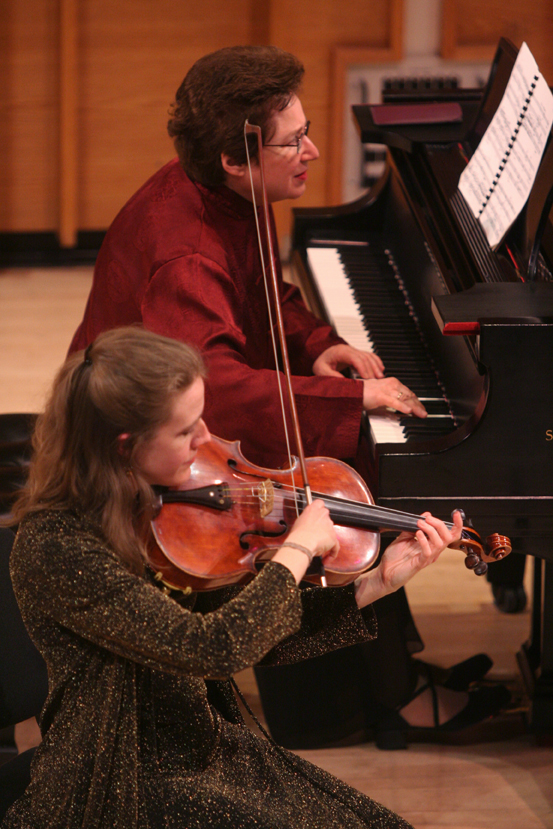
Stephanie Griffin and Cheryl Seltzer; Photo Credit: Hiroyuki Ito


Stephanie Griffin, violist and founding member of the Momenta Quartet, and Cheryl Seltzer, pianist, founder, and co-director of the internationally renowned group Continuum, joined forces recently in recital at the Americas Society. This pairing of two intelligent and sensitive musicians led to dynamic and thought-provoking performances. Billed as featuring an homage to Milton Babbitt, I found the concept of the entire program to be an homage by performers and composers to those who touched their lives. In the extensive program notes, Ms. Seltzer writes of her friendship and admiration for Babbitt, her teacher Milhaud, and the honor of having premiering a Pärt work with the composer present.  Ms. Griffin writes of her close friendship with Greenbaum, and Shostakovich’s tribute to Beethoven. This information gave the performances special meaning, and the performers demonstrated the sincerity of their words by their passionate playing of the works.

“Three or Four Days After the Death of Kurt Cobain” by Canadian composer Tim Brady (b. 1956) opened the program. This work brought to this listener’s mind the “Love-Death” music of George Crumb’s “Makrokosmos”, with “Smells like Teen Spirit” taking the place of Chopin’s Fantasie-Impromptu. The passing of the thematic material between the two players was done seamlessly and made what might have seemed an odd idea very effective. “Double Song for Viola Sola: In memoriam Milton Babbitt” from Matthew Greenbaum (b.1950) followed.  This work could be described as two voices speaking simultaneously, one voice quiet and the other much more assertive.  Ms. Griffin took this ingenious concept and gave an assured performance, capturing clearly the distinctive voices and making child’s play of the technical demands. I’m sure Babbitt would have heartily approved of the piece and the performance.

Written in 1950, eight years before his famous (and controversial) article “Who Cares if You Listen?”in High Fidelity magazine, Milton Babbitt’s “Composition for Viola and Piano” is a piece very much worth hearing. Babbitt (1916-2011), the mathematician, used permutations of various intervals in a colorful manner, with mercurial interplay of ideas between the viola and the piano. This is a work of equals, and the performers were outstanding–both as individuals and as a duo. Played with energy and commitment, this performance was a highlight of the evening and should serve as an impetus for the audience members to explore further Babbitt works.

“Quatre Visages”, written in 1943 by Darius Milhaud (1892-1974), is a musical depiction of four imaginary ladies in different locales. Ms. Griffin and Ms. Seltzer captured the jazzy charm of “La Californienne” (which one should note had a distinct French flavor), the mournful outlook of the time in “La Bruxelloise”, and the jaunty optimism of “La Parisienne”.  I found “The Wisconsonian” to be more frenetic than the “bustling” that the program notes suggested, but this was my only reservation in an otherwise delightful performance.

After intermission, Ms. Seltzer played Arvo Pärt’s “For Alina”, a short piece written for a young Estonian girl. Pärt (b.1935), after abandoning serial and other modern techniques, adopted an approach that he refers to as “tintinnabuli”.  “For Alina” was one of his first works in this new style. While not technically demanding in a virtuosic sense, it nonetheless requires considerable skill for the performer to produce the bell-like sound without a harsh percussiveness. Ms. Seltzer gave a brief performance (the performer often repeats the 15 bars of written music ad lib.) that showed her complete involvement and attentiveness to the finest of details.

Dmitri Shostakovich (1906-1975), like Mahler before him, wrote music with strong autobiographical meaning and content. His final work, the Sonata for Viola and Piano, Op. 147–written in the last year of his life–is no exception. This masterpiece could be considered Shostakovich’s final ‘letter’ to the world, which was only ‘read’ in its entirety after his death.  Ms. Griffin and Ms. Seltzer gave a performance to remember; one could sense that the aura of Shostakovich himself was in the room guiding the players.  The biting, sarcastic, and grotesque were all there, along with the quiet despair and the poignant. The finale, which has elements of Beethoven’s “Moonlight Sonata”, was said by Shostakovich himself to be in memory of Beethoven.  Ms. Griffin’s and Ms. Seltzer’s persuasive playing did honor to the final musical words of a great composer. The audience responded with well-deserved and extended applause, calling the performers back for multiple bows. One trusts that Ms. Griffin and Ms. Seltzer will pair up often in the future; both are wonderful musicians and make a dynamic duo.

Share

Gila Goldstein Pianist in Review

Gila Goldstein, Piano
Saint Andrew Music Society: Music on Madison
Madison Avenue Presbyterian Church, New York, N.Y.
March 18, 2012
 
Gila Goldstein

Gila Goldstein


Balmy weather in New York may seem like stiff competition for one’s afternoon versus sitting indoors at a piano recital, but a lot depends on the program and the artist. As it turned out, Gila Goldstein’s piano recital was the perfect welcome to imminent spring. Opening with a substantial work by J. S. Bach, whom many musicians associate with spring (both for his birthdate and his perennial newness), Ms. Goldstein gave one of the finest accounts I can recall of the Partita in E minor.

From its opening Toccata movement, tastefully and meaningfully embellished, she projected its singing lines with a sense of freedom without ever losing sight of the pacing and framework, clearly and thoroughly conceived. To say that a performance is thoroughly satisfying may sound to some like faint praise, but, considering how rarely such a reaction occurs with Bach performances today, it is not. As a pianist-reviewer it can be difficult to set aside one’s preferences within the wide range of possible Bach interpretations, and unsurprisingly, there were fleeting moments in Sunday’s recital when I felt I would have tried for something different; remarkably, however, in each case the dispute was settled by hindsight (or should I say hindsound?), in that her choices ultimately made sense in revelatory ways. I especially admired Ms. Goldstein’s expert treatment of overlapping voices, where individual lines are often either buried or thumped out, and here they simply shone clearly through the transparency of texture she achieved. The Allemande movement was poetically delivered, and while some might take exception to the tendency to shrink suddenly in volume at melodic high points (here and in other movements), there was Romantic poignancy in such moments. The Corrente was so feather light and marvelously controlled in each nanosecond that I was sad that the repeats had not been observed, as it was all over in a blink. Here and elsewhere, Ms. Goldstein followed her heart, and in the end the repeats and absence of repeats all balanced out in a logical way. The Sarabande was thoughtful and compelling, though I occasionally felt that some of the embellishments (as a way to be declamatory perhaps?) burst forth in a way that distracted a bit from the long lines. In any case, it was always engaging, and the Tempo di Gavotta and brilliant Gigue left one wanting for nothing. I would love to hear Ms. Goldstein play and record much more Bach, as I imagine she could easily become one of my favorite Bach interpreters.

In a way, all one has to do after such a fine performance is to avoid spoiling the afterglow – so it was with some reluctance that I moved my attention to anything else – but Ms. Goldstein continued her program quite admirably. Chopin’s Polonaise in C-sharp minor, Op. 26, No. 1, was sensitively delivered next, with more of the arresting “subito piano” phrases one had heard in the Bach, and the exquisite Nocturne in B Major, Op. 62, No. 1, one of my favorites, followed without pause. Possibly the only thing I can imagine that would have heightened the beauty of this performance would have been greater seamlessness in the string of trills at the return of the opening melody  – it is something over which pianists lose sleep, but it can bring a performance to a transcendent level. Chopin’s Barcarolle Op. 60 brought the first half to a commanding close; although the Romantic leanings shown in the Bach had led one to expect more reveling in the extravagant beauty of this work, Ms. Goldstein was persuasive in a relatively taut, muscular reading, leaving much to ponder.

After intermission came Liszt’s Vallée d’Obermann from the Years of Pilgrimage, Volume I (“Suisse”), given great loving attention to detail in the gentler sections and a bold approach in the octave fusillades. Ginastera’s Sonata No. 1 added just the right dimension of dissonance after so much lush harmony, and it was just as vibrant as it needs to be. The first movement could have benefited from a bit more left hand clarity in extremely rapid passages, and the second movement left me wondering whether soft parts could have been still softer (especially where marked with “ppp”), but it seems rather greedy to ask for more of anything when such excellence abounded. Persistent applause was rewarded with an encore of Tchaikovsky’s “October” from The Seasons. It seemed the audience could have stayed for much more, myself included.

Share

Distinguished Concerts International New York: DCINY in Review

Requiem X 2: Mozart and Clausen
Avery Fisher Hall, Lincoln Center, New York
March 18, 2012
 
DCINY

DCINY- Requiem

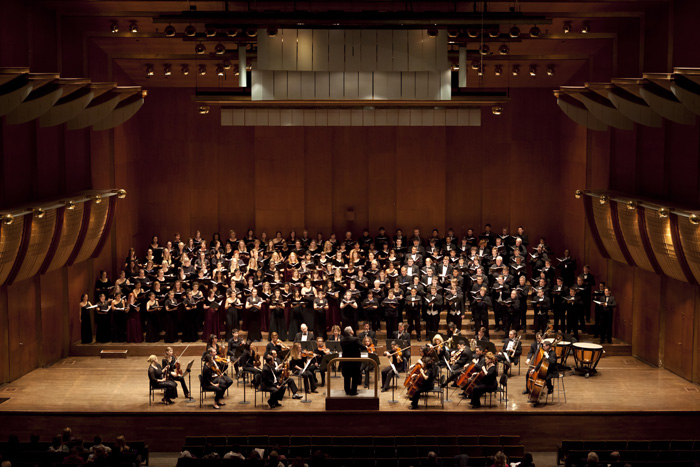
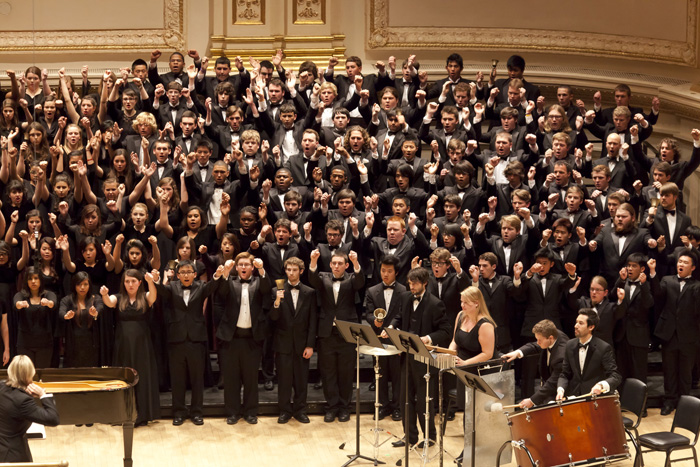
Distinguished Concerts International New York (DCINY) is an organization that believes in presenting concerts on the grand scale, with performers of all ages from schools and ensembles throughout the country. Having attended many DCINY concerts, I have seen and felt the excitement that fills the hall in anticipation of their performances.  Today was no exception, as over 200 singers filed onto the stage of Avery Fisher Hall with full orchestra; I was ready for a memorable concert. I was not disappointed.

The concert, entitled “Requiem X 2,” was just that, two Requiems. The first was the Requiem in D minor, K. 626 of Wolfgang Amadeus Mozart, and the second (New York Premiere) was the Requiem of DCINY composer-in-residence René Clausen.

Mozart’s Requiem in D minor, K. 626 has a storied history. Commissioned by Count Franz von Walsegg as a memorial to his late wife, it was unfinished by Mozart at the time of his death in 1791.  His student Franz Xaver Süssmayr completed the work, using various sketches Mozart had left and his claim of being familiar with Mozart’s wishes about the composition.  How much of the work is Mozart and how much is Süssmayr is still being debated to this day.

Conductor Vance George led with a steady and confident manner. The orchestra took his lead and played with precision, capturing both stormy despair and heavenly spirit in equal measure. Special mention must be made of the “Tuba Mirum”’s excellent trombone soloist, who played with amazing clarity and tone. I wish that DCINY would list the orchestra personnel in the programs so they could be credited! Soprano Jennifer Aylmer sang with a clear, soaring beauty, and Mezzo-soprano Holly Sorensen was radiant in the solo part written for Contralto. Tenor Young-Ha Kim sang with impressive projection, and Bass-Baritone David Salsbery Fry delivered a strong and committed performance. What was particularly striking was how well the four soloists balanced in ensemble sections; it is not unusual for one voice to overshadow the others, but there was no instance of that here. The chorus, consisting of five choirs from high schools in Arizona and Indiana, and choral groups from California and Massachusetts, lent powerful support to capture the full scale of this emotionally supercharged work.

René Clausen (b. 1953), currently Associate Professor of Music at Concordia College in Minnesota, possesses the ability to write music of substance that is still within the technical grasp of a wide range of performers. This quality has made Dr. Clausen a favorite composer of many choirs in the country.  He writes of his Requiem that it was written to be “accessible and ‘user-friendly’ to singers, players, and the audience.” One could say with confidence that he has succeeded in his goal.

Conductor Bradley Ellingboe was an engaging, attentive, and fully involved conductor whose dedication any composer would be pleased to have. He bounded athletically from the wings onto the stage and jumped to the podium. One could feel the energy even before the first note was played. Once again, I must give kudos to excellent soloists, this time on the French horn and the oboe.

If one was expecting a more modern version of Mozart, that notion was quickly dispelled. Clausen’s overall conception is not dark and foreboding, but serene and hopeful. Clausen has written a work of great power, with moments of conflict, naturally enough the “Dies Irae” with its sinister pizzicato basses and angry brass declarations, but the work as a whole radiated beauty. Soprano Leslie Umphrey was angelic in the “Pie Jesu.” Tenor Sam Shepperson contributed his vocal mastery with refinement, and the indefatigable Bass-Baritone David Salsbery Fry was back and still strong. Four choirs from New Mexico made up the over 200 strong chorus. After the last measures of the ethereal “In Paradisum” quieted to pianissimo, then faded to complete silence, one could hear the collective exhalation of the audience. After what seemed to be an eternity, the audience exploded into applause, which became thunderous when Dr. Clausen came to the stage for a well-deserved bow. This is a work that can stand comparison to any other Requiem and I do hope that it will be recorded and made available to the public. Congratulations to Dr. Clausen and DCINY!

Share

Guitar Fest: Pro Musicis Concert in Review

 Guitar Fest: Pro Musicis Concert in Review
Weill Recital Hall at Carnegie Hall
March 14, 2012
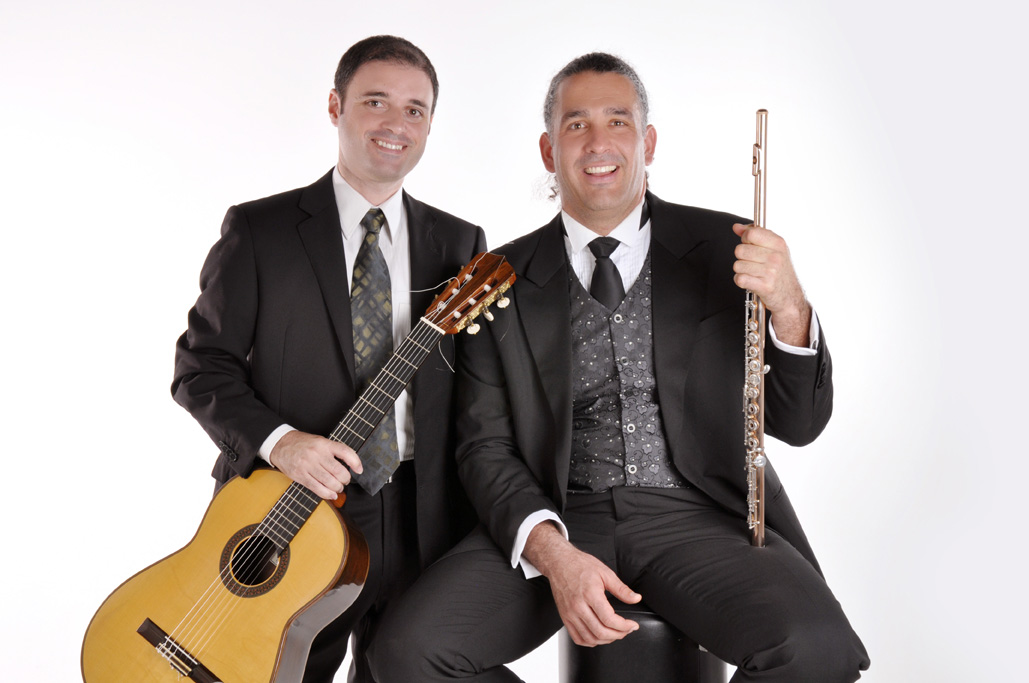
Duo Michel de Paula & Luiz Mantovani

Duo Michel de Paula & Luiz Mantovani

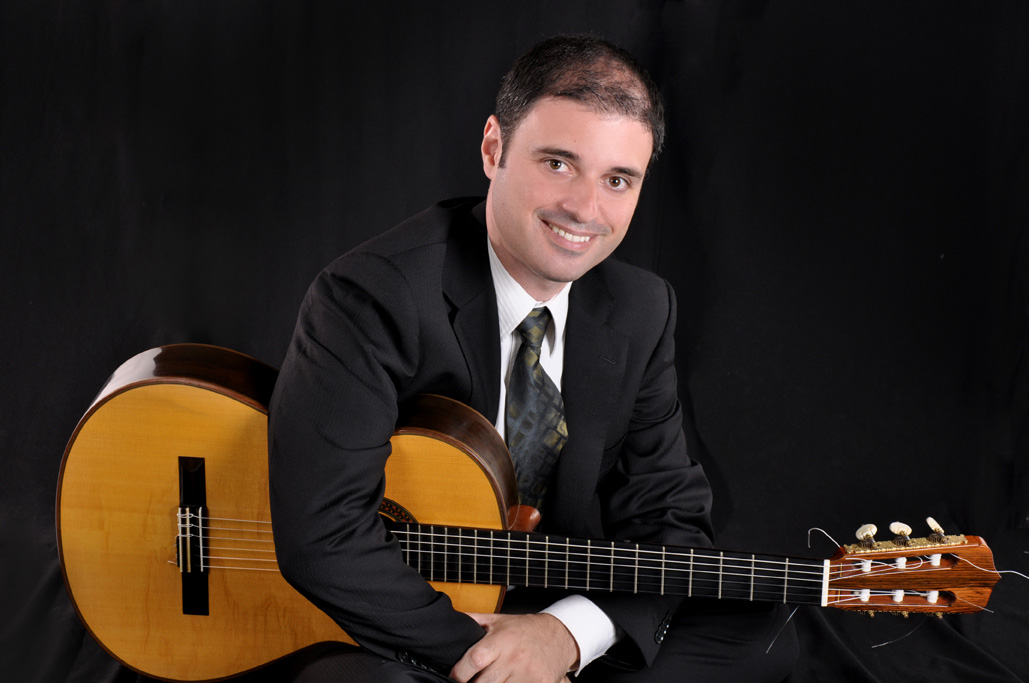
Luiz Mantovani

Luiz Mantovani

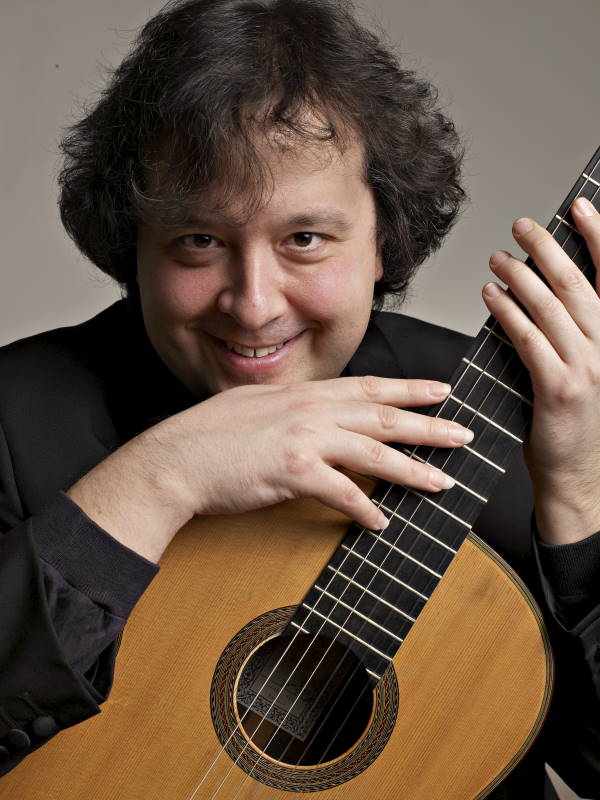
Emanuele Segre

Pro Musicis, a concert organization that began its auditions in 1965, has presented its awardees in more than 1,900 concerts in Europe, Asia, and North America, both in prominent venues such as Weill Hall and through community outreach programs. This season it presented a recital entitled “Guitar Fest” which included three of their four winning guitarists, Rafael Aguirre, Luiz Mantovani, and Emmanuele Segre. The three combined forces in solos and duos, joined by flutist Michel de Paula and cellist Nadège Rochat, in what was a thoroughly enjoyable evening. There was plenty of variety despite the fact that the program heavily favored music from Spain and South America, as the balancing of lyricism, pyrotechnics, intimate chamber collaboration, and solo virtuosity kept the surprises coming. David Leisner, composer, guitarist, and host for the evening, remarked on the generous spirit of the performers in sharing the stage, but really, the collaborations were to everyone’s benefit.

The first guitarist, Rafael Aguirre, chose to pair with Ms. Rochat, cello, to open with Manuel de Falla’s Spanish Dance from “La Vida Breve” (after which they’ve named their duo). Their blending was expert, and though the cello faced some intonation challenges, its sound did weave seamlessly into the guitar textures. Mr. Aguirre was restrained in his collaborative role. The same duo then played “Volver” by Carlos Gardels and two more selections of Falla, “El Paño Moruno” and “Polo” from “Siete Canciones Populares Españolas,” each player becoming more extroverted with time. Ms. Rochat showed some skillful bending of phrases, while Mr. Aguirre started to show more of the effortless virtuosity that would really come to the fore next in his solo works, including “Guajiras de Lucía” by Paco de Lucía (b. 1947) and Intermedio from “La Boda de Luis Alonso” by Jerónimo Giménez (1854-1923). An outstanding player with unquestionable technique, Mr. Aguirre showed an especially rare gift to make the guitar sing.

The second guitarist Luiz Mantovani took the stage with flutist Michel de Paula in the World Premiere of “Brazilian Landscapes No. 12” by Liduíno Pitombeira (b. 1962). A suite of contrasting impressions in five movements (Ponteio, Baião, Modinha, Frevo, and Acalanto), this set took listeners on a journey through Brazil with the aid of helpful program notes by Dr. Richard E. Rodda. Moving from its languorous prelude to the vibrant Carnival-inspired Frevo (with Mr. de Paula changing to piccolo), and back to its closing lullaby, the suite seemed not so much a mere set of vignettes as a deep immersion into the Brazilian tonal world, inviting many further hearings. The composer was present to bow and thank the performers, exceptional champions for this deserving work.

It was a joy then to hear Mr. Mantovani after intermission in a more familiar work by which one could concentrate on his solo artistry. His introspective rendition of the “Valsa-Chôro” from the “Suite Popular Brasileira” by Heitor Villa-Lobos was just perfect in its plaintive beauty.

David Leisner’s “Mirage” (1987) followed, bringing guitarist Emanuele Segre onstage in duo with Mr. Mantovani. The duo realized this finely wrought piece with tremendous dedication and projection. The contrapuntal opening was magnificently clear in its “dialogue” while in the rapid passages the duo combined as one in a single line. It is an excellent piece, and it was given a first-rate performance.

Mr. Segre continued the evening with two South American works, starting with “Canto de Ossanha” by Baden Powell (1937-2000). A captivating piece from its simple opening through its subsequent development, it was given an amazing degree of contrast and nuance by Mr. Segre, a most expressive and dramatic interpreter with one of the largest dynamic ranges I’ve heard from a guitarist. Prelude No.1 in E Minor by Villa-Lobos was followed by two works by Roland Dyens (b.1955), “Songe Capricorne” and then “Fuoco” from “Libra Sonatine”, alternately Bachian and jazzy, punctuated with percussive bursts, and full of intense expression. It was a dynamic close to an exciting evening.

Share

Britten’s “The Prodigal Son” in Review

Claudia Dumschat, Music Director
Richard Olson, Stage Director
David Neer, Peter Ludwig, Reid Pierre Delahunt
Christopher Preston Thompson, solo voices
Betty Howe, Dramaturg/Stage Manager
The Church of the Transfiguration, New York, NY
March 9, 2012

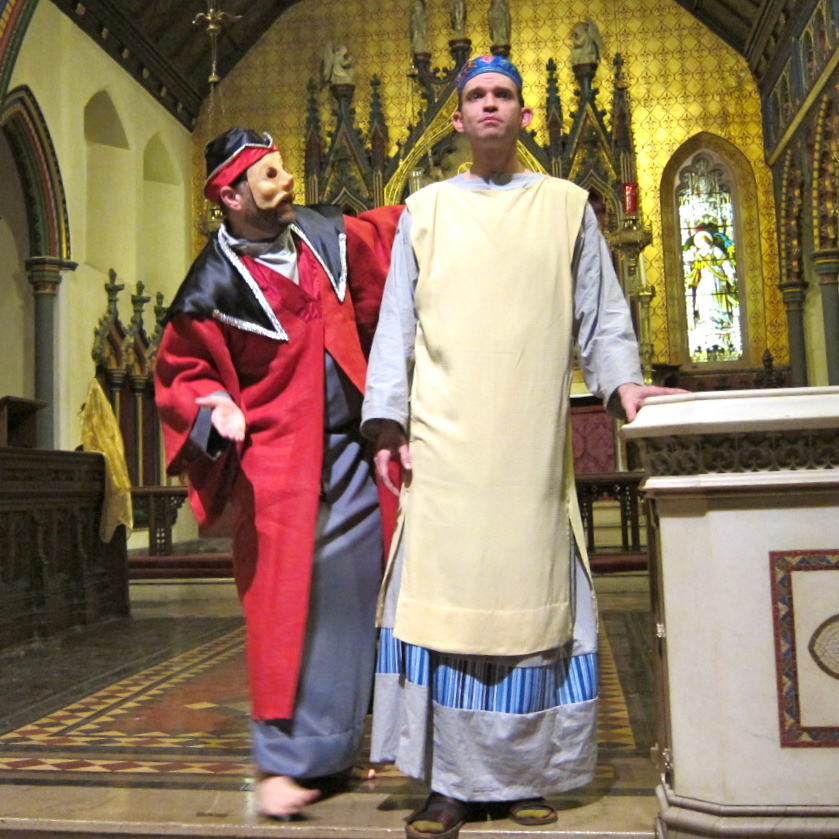
Daniel Neer as The Tempter (left) with Christopher Preston Thompson as The Younger (Prodigal) Son.

Composed in 1967/68, Benjamin Britten’s chamber opera “The Prodigal Son” is subtitled “A Parable for Church Performance.” And The Church of the Transfiguration, also known as “The Little Church Around the Corner,” proved to be a perfect venue in which to hear this superlative performance. With its all-male cast and its use of masks and stylized movement, the work shows the influence of Japanese Nō drama. In addition, the use of small drums, bells and gong all conjure up the sound of the music of the Far East.

The work began with the sound of chant far in the distance, a foolproof way of setting the mood for chamber opera performed in a church. The chanters, hooded monks, soon processed down the center aisle and assembled in the sanctuary. After the four main characters (The Father, The Elder Son, The Younger Son, The Tempter/Abbot) removed their monk’s habits and put on their costumes, the drama began to the accompaniment of the organ and chamber orchestra.

What followed was a performance that succeeded in all aspects. The four soloists were superb, each singing with dramatic intensity, great sound and crystal-clear diction. As the Tempter, David Neer had the meatiest part and skillfully expressed the character’s unctuous villainy. Peter Ludwig’s portrayal of The Father expertly balanced self-satisfied pomposity and deep paternal love. And as the two sons, Reid Pierre Delahunt and Christopher Preston Thompson clearly contrasted the two young men’s world view. Each soloist was a fine singing-actor.

Some of the men performing the roles of monks, servants, parasites and beggars, and all of the boys portraying “distant voices” were members of the church’s Choir of Men and Boys. They all sang with great tone and strong sense of ensemble. Highest praise must go to Music Director Claudia Dumschat who lead the fine chamber orchestra and performed the all-pervasive organ part. Under her leadership, the musical preparation and execution were exemplary. Mention should also be made of the simple but quite evocative costumes by Costume Designer Terri Bush. The dramatic action, responsibility of Dramaturg/Stage Manager Betty Howe and Stage Director Richard Olson, was persuasive and melded seamlessly with the singing. All in all, a wonderful performance.

Share

Berlin and Vienna Philharmonics, Boston and St. Louis Symphonies in Review

Four Renowned Orchestras Come to Carnegie within Two Week Span
Carnegie Hall; Stern Auditorium
February 23-March 10, 2012

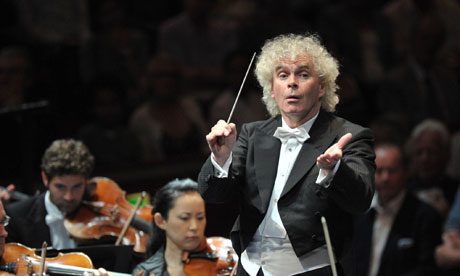
Sir Simon Rattle


After a relatively quiet January and early February, a slew of renowned orchestras invaded Carnegie Hall in what seemed like a new orchestral movement. Curiously enough, they weren’t all moving together or feeling the music with unity. As a result, it wasn’t necessarily the most famous ensembles that made the greatest and lasting impressions. A talented player’s natural musical movements as a solo or chamber music performer are absolutely crucial to use in the collective music-making of an orchestra section because it is important to the visceral excitement that captivates the audience; this is especially necessary in today’s visual world. The stellar performances at Carnegie Hall emanated from the orchestras that moved with the music harmoniously and had the best chemistry.

The Vienna Philharmonic is known for swaying together with the music, but they often didn’t this time around; guest conductor Lorin Maazel sometimes didn’t have the ideal communication with the players, and the orchestra often seemed uninspired. Some players surprisingly sat stiffly in their chairs and formally went about business as usual in orchestral music to Wagner’s “Ring”. They’ve played this music a great deal, but mostly from the pit at the Vienna State Opera. In fact, they often moved and looked like they were in the pit, seemingly disinterested about how they appeared as a collective unit. This attitude sometimes negatively affected their sound. Berlin, on the other hand, presented a string section in which everyone passionately moved together, wherever the phrases took them, and they used their bow exactly the same way (the Juilliard Orchestra under Alan Gilbert recently performed “The Rite of Spring” in this fashion). Even Berlin’s string tremolos in music of Mahler (the 2nd) and Bruckner (the 9th) had the type of invested energy that a pack of lions or a defensive tackle has when they go in for the kill. There were sweat and tears on each note. It doesn’t hurt, of course, that music director Simon Rattle and the Berliners are having a love affair. Rattle’s connection with the music is infectious, and it kept spreading with every measure. Perhaps the Berlin Philharmonic should have its own gold coin too.

David Robertson has the same effect on St. Louis Symphony musicians that Rattle does with his—even though Robertson has only been there a short while. “The Firebird” (complete ballet) sizzled with energy, and the cellos and first violins—most visible because they are on the outside and close to the audience—used full bows when needed and swayed together with the direction of the phrases, staying deeply involved at every microcosm of change in the musical atmosphere. The players’ expressions were what you typically see from a talented conductor: totally in character at all times. Robertson motivated the players, and in turn the players inspired the audience. Concertgoers need to see players’ involvement in the same way the orchestra needs to see the conductor’s devotion.

The brass sections are another way to compare. Boston Symphony’s brass—as well as the Vienna Philharmonic’s—did not shine like those of Berlin and St. Louis. And it’s a fair comparison because the music (and its corresponding sound-expectation) I am referring to was from large orchestral works of the Late Romantic and 20th century periods. In Vienna’s case, their brass needs to be asked to play with a big sound when needed because Richard Strauss always made a point of telling conductors to never encourage the Vienna brass, and this tradition has stuck, it seems (Maazel didn’t encourage them enough in Wagner’s music). In the case of Boston, perhaps they are an aging brass section; they did not play with much collective power in Shostakovich’s Symphony No. 5, conducted by Deneve, nor in the Symphonie Fantastique conducted by Eschenbach. The rest of the orchestra, for that matter, had trouble staying together some of the time, as Deneve was constantly pushing the tempo in ways the orchestra wasn’t used to, and Eschenbach was often fussing with the tempo (as if there aren’t enough tempo changes in Berlioz). Granted, the Boston Symphony had the disadvantage of working with three different guest-conductors, John Oliver taking over for Masur, who took over for Levine, Eschenbach and then Stephane Deneve, who made his Carnegie Hall debut.

St. Louis seemed proud of its current brass section; some of them are temporary position players—but they blended well and it seemed that they were excited to be on stage—and off stage, as a matter of fact. In the “Firebird”, Robertson showcased extra trumpets in the 1st tier boxes for antiphonal effecta novel and great idea for this workand they sounded robust and solid to the core, echoing the sonic brilliance on stage. I hope that Carnegie gives St. Louis at least two concerts next time they come to Carnegie.

Rattle and Robertson are the right fit for their orchestras. One can hope that Vienna will fare better with Franz Welser-Most on the podium when they visit Carnegie next year. Those who missed Berlin at Carnegie will sadly have to wait another two years. Boston has a big question-mark until they get a new music director. It will be up to that person to instill a sense of complete commitment in the music-making and also remind the players that the way an orchestra moves together—especially the outside players close to the audience—is integral to the audience’s satisfaction of a live performance. Otherwise, why bother? YouTube has fantastic close-up footage of unified orchestras moving to the music and homogeneously expressing its emotion. When it comes to live performances, we often need a new orchestral movement.

Orchestra                      Stars (out of 4)

 Berlin Philharmonic     ****

St. Louis Symphony     ****

Vienna Philharmonic    **1/2

Boston Symphony        **

Share

Young-Ah Tak, Pianist in Review

Young-Ah Tak, piano
Weill Recital Hall at Carnegie Hall
March 8, 2012

Young-Ah Tak

There was a buzz in the air preceding this concert. Was this just an excited audience of friends and colleagues, or was there something about the pianist I didn’t know? My curiosity was peaked. And just a few moments into Young-Ah Tak’s New York debut recital, one realized that something special was happening; we were in the presence of an extraordinary pianist. The program began with a brilliant performance of Muzio Clementi’s Sonata in B-flat Major, Opus 24, No. 2. Here we first heard the characteristics which were to make this a most memorable recital – crystalclear articulation of rapid passages, beautifully phrased legato melodies, noteperfect octaves. Even the trills, sparkling and energetic, were notable. As you read on, you will see that I was very, very, very impressed by every aspect of Ms. Tak’s playing. But although I want this to be considered a rave review, I must chide her for not repeating the exposition of the first movement of Clementi’s sonata. This repeat is not ad libitum, and leaving it out trivializes the movement, upsets the balance and distorts the structure. I urge her to think about this when performing similar movements in the future.

Next we heard the New York premiere of Judith Lang Zaimont’s “Wizards – Three Music Masters.” Commissioned in 2003 as the required work in the San Antonio International Piano Competition, it is a work which exploits many aspects of pianistic color. Even thoughto this listener—this piece was just another example of a 20th/21st century work in which one has no idea why one note follows the other, Ms. Tak’s playing was so convincing that I was sure she was playing exactly what was written in the score. Ms. Zaimont could not have asked for a better performance.

This was followed by scintillating performances of Liszt’s delightful transcriptions of two Schubert songs, “Gretchen am Spinnrade” and “Ständchen von Shakespeare.” Although I would have liked a bit more rhythmic clarity in the lefthand accompaniment of “Gretchen am Spinnrade,” Ms. Tak easily mastered the more difficult Lisztian virtuosic additions to both songs. What fun! The first half ended with a convincing performance of Leon Kirchner’s Piano Sonata No.1 (1948).

The entire second half was devoted to Schubert’s Piano Sonata in C Minor, D.958. Of three magnificent piano sonatas written in the last year of the composer’s all too short life, this dark and strange work is the least performed. And what a pleasure it was to hear Ms. Tak’s superlative rendition. Instead of writing a rhapsodic paragraph, I think my reaction will be made clearer if I just quote from the notes I took during the performance:

First movement: clear left-hand accompaniment during the second theme – so difficult ravishing pp (pianissimo) scales again didn’t repeat exposition
Second movement: singing legato melody with clear rhythmic accompaniment – beautiful!
Third movement: danced, great tension during silences
Fourth movement:thrilling!

After prolonged and well-deserved applause, Ms. Tak’s encore was a mesmerizing performance of Schubert’s Impromptu, Opus 90, No. 3. This was a recital I will long remember.

Share

Flury-Prinz Duo in Review

Dieter Flury, flute
Maria Prinz, piano
Weill Recital Hall at Carnegie Hall
March 5, 2012
 

Flury-Prinz Duo


In a concert sponsored by MidAmerica Productions, the Vienna Philharmonic’s Principal Flutist, Dieter Flury, was paired up with Bulgarian pianist Maria Prinz. It was a program dedicated to the 150th Anniversary of Debussy’s birth, and it contained two works written by the master: “Syrinx” for solo flute, and an arrangement of his “L’Apres Midi d’un Faune” by the Russian flutist and composer, Nikolay Ivanovich Platonov. “Syrinx” was given a beautifully shaped account; expressive and atmospheric. “L’Apres…” was given fine continuity of the work’s perfect architecture. The middle section, where the tempo is more driven and playful, was performed with more than a few missed notes in the piano part. Yet it was the music’s endearing serenity that made the lasting impression.

The Bach Sonata in B minor, BWV 1030, contained some lovely give-and-take of the musical line. In general, Flury played lightly, with horizontal phrasing that gave the music direction, and Prinz played more vertically, giving each note more equal attention. Balance was good; thankfully, the piano was on the short-stick, and one could hear all the flute lines throughout the entire concert. On many other occasions in this hall, I have heard the piano drown out the flute, so kudos to Prinz for her awareness to balance. Perhaps it was her cautious type of playing–a sensitivity to the flute’s vulnerability to the weight of the piano sound–that caused Prinz to play without much musical phrasing.

Prinz and Flury played perfectly together throughout the program, with excellent ensemble at all tempo changes. Flury has excellent rhythm and played with clarity throughout the program. His intonation is stellar as well, although at times, I wish his tone was more robust. Prokofiev’s masterful Sonata in D Major, Op. 94, received an excellent interpretation, one with smooth transitions, smart pacing and admirable cohesion of musical ideas. The classic scherzo had a wonderfully catchy tempo; unfortunately, Prinz had a difficult time with some of the passage-work in this movement.

In Milhaud’s Sonatina for Flute and Piano, there were lovely nuances of tempo, and the character of the music was infectiously playful. Enescu’s “Cantabile et Presto” from 1921 needed more dynamic range and contoured phrasing. It seemed that many passages within the forte dynamic started at a moderate sound and ended the same way. There were some nice subito pianos, but that wasn’t enough to always show the arch of the music.

In an encore, Faure’s “Fantasie”, Op. 79, Flury gave an outstanding virtuoso performance with a brilliant technical display. The second encore was Debussy’s “Le Petit Negre”, arranged from the original for solo piano. The work is somewhat jazzy for Debussy, but the piano playing did not swing on the syncopations; the short notes and the long notes had equal amounts of finger pressure, thus the beats and off-beat syncopations were heavy and sounded the same.

There was a full-house of flute enthusiasts in the hall; this was a worth-while celebration –not only of the flute–but of the master, Claude Debussy, who knew the instrument better than most.

Share

Reflections of Life (DCINY), in Review

DISTINGUISHED CONCERTS INTERNATIONAL NEW YORK: DCINY
REFLECTIONS OF LIFE: Distinguished Concerts Orchestra International and Distinguished Concerts Singers International in Music of James Eakin III and Greg Gilpin
Stern Auditorium at Carnegie Hall; New York, NY
February 20, 2012
 

“Reflections of Life” Distinguished Concerts Orchestra and Singers International; PHOTO CREDIT – Richard Termine


Distinguished Concerts International New York (DCINY) has a gift for drawing large numbers of performers from far and wide and bringing them to still larger audiences, creating what are often spectacular events. Their most recent concert featuring music by James Eakin III and Greg Gilpin was no exception. High school and adult choruses from New Jersey, Texas, Alabama, Colorado, Wisconsin, Indiana, Minnesota, Louisiana, California, and Pennsylvania all converged onto the Perlman Stage, with choirs also filling several front balconies, enveloping the listener with sound; if one doubted the life-affirming power of classical music today, one might have a change of heart just from the sheer collective energy. Granted, not all the music performed was strictly classical, but Broadway and folk music were blended seamlessly into the mix with the help of DCINY’s versatile orchestra. Special guest, Clay Aiken, made an appearance to lend his support to the festivities with brief comments during the second hal8f.

The first half was devoted to the World Premiere of a 47-minute choral work, “Flowers Over the Graves of War” by James Eakin III, who has also written extensively for film and television. As the composer explains in his notes, “Commentary on the horrors of war and pleas to God for forgiveness and guidance permeate this work.” In six movements set to poetry by Michael Dennis Browne, along with Latin texts from traditional Requiem movements, the work ultimately conveys messages of faith, mercy, hope, and peace. As the composer also comments, the three soloists express the more introspective lines; soprano, Ida Nicolosi, mezzo-soprano Kirsten Allegri, and tenor Gregory Warren were commendable in their parts. A highlight was in the Sanctus, where the upper voices joined in duet, later united with the tenor in powerful trio. According to the composer, the higher voices were to express the “unwavering love and faith of a child” with the lower voices expressing darker elements. One wondered by the end of the work whether this “work of contrasts” (as the composer describes it) might have prospered from more juxtaposition of dissonance and consonance as well as the contrasting registers and textures, since even some sections modifying text about war seemed quite mild; on the other hand, such sweetness suited the choirs at hand, as well as the ultimate message of mercy. The use of percussion in martial sections added ballast, and while the orchestra may have been a bit overzealous in volume, the soloists generally met the challenge of projecting over them. Overall, I found this a moving work by a composer from whom I’ll be interested to hear more. Deft conducting by Tim Seelig brought it all together well.

After intermission we heard original and arranged music of Greg Gilpin
, with the conductor at the podium.  Mr. Gilpin conducted with infectious energy, and his choral works matched his conducting style in their all-embracing range.  Listening to the opening piece, “Why We Sing,” one could understand the popularity this work has had with choruses since its publication in 2005.  “Through the Eyes of a Child” (text by Mark Burrows and music by Gilpin and Burrows) brought out one of the themes of the evening, the bond between young and old, and “A Child’s Credo/In Virtute Tua” (a World Premiere) underscored that bond further.  These are works of immediate appeal that blur distinctions between classical and popular music. “There’s Room for Many-a More!” added the joyous touch of the American Spiritual, and a medley of favorites from 
”The Music of ‘The Wizard of Oz’” capped off the evening in high spirits.  Mr. Gilpin seems destined for ever-widening popular appeal. As is often the case with arrangements, there were some program omissions in crediting original sources; naturally the medley was Mr. Gilpin’s conception, but it seems a shame when, for example, “Somewhere Over the Rainbow” is sung, not to see the name of its composer Harold Arlen mentioned anywhere.  In any case, the end of the evening found the audience quite uplifted.

Share