Pro Musicis Concert in Review

Elsa Grether, violin
Delphine Bardin, piano
Weill Recital Hall at Carnegie Hall
New York, NY
February 15, 2012


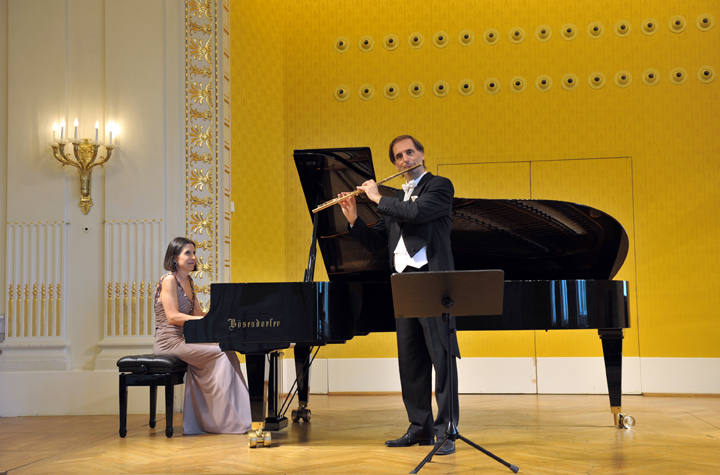
As a result of winning the Pro Musicis International Award in Paris, the violin and piano duo Elsa Grether and Delphine Bardin (both born in France) made their Carnegie Hall debut on February 15th. They always played precisely together, with excellent rhythm and well-timed tempo changes, and their program was well thought-out. The Handel Sonata in D, Op. 1, No. 13 and the Brahms first Sonata opened the program fairly well, but the second half, comprised of Szymanowski’s “Mythes” and Debussy’s Sonata in G Minor, defined this duo as polished, adventurous and compelling.

The Handel Sonata, which was given an expressive approach, had lovely moments that were only marred by Grether’s occasionally uneven vibrato and a sense of pitch that was not completely accurate. The Handel and Brahms sonatas were sensitively played by pianist Bardin, but with the piano on full stick, it was sometimes difficult—here and elsewhere on the program—to distinguish some of the important violin phrases with clarity. In the Brahms, Grether was not in her element with regards to intonation during shifting and the high register, and there was a tentative approach to her playing—an approach that I’m certain was meant to sound sweet or tender, but left me wanting more richness of tone quality and less of an airy (“impressionistic”) sound.

 The atypically thin texture Grether applied to the Brahms worked well in the Debussy Sonata, and ironically—when she needed to—she also applied a beautifully strong tone that was sometimes missing in the Brahms. Perhaps she became more confident as the recital progressed, or perhaps she has greater familiarity with the Debussy, son of her soil. The Debussy interpretation contained poignant, memorable moments that reminded us that the composer was at his wistful, yet sometimes defiant end.  The Szymanowski was played with impressive virtuosity and an ear for its unique special effects and mellifluous colors of sound. Grether and Bardin were equally impressive at handling the variety of pyrotechnics. The duo excited the audience, who received two encores and left the hall happy.

Share

Katelyn Tran, Pianist in Review

Katelyn Tran, piano
New York Piano Academy: West End Presbyterian Church, New York, N.Y.
January 25, 2012
 
 
Katelyn Tran

Katelyn Tran


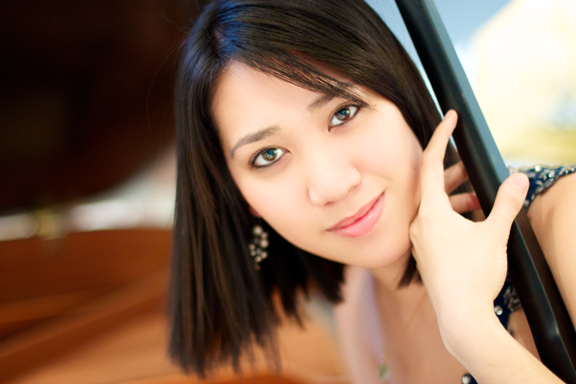
Still a high school student only 17 years old, Katelyn Tran has an arsenal of piano technique and repertoire that would make many twenty-something conservatory pianists envious. Well taught for seven years by distinguished composer-pianist Ronn Yedidia (who presented this recital) as well as Veda Zuponcic prior to that, Ms. Tran lists a string of competition awards that already takes a full page. What’s more, the mentions of what repertoire she has covered in these various competitions show her as a musician with genuine musical fluency and versatility, not some formulaic “bag of tricks” taken out through win after win. Her playing itself, as heard in this debut recital, confirmed that she has a musical grasp far beyond her years, as well as the technique and stamina to carry her through ambitious programs. Should she choose to pursue the musical life beyond this point, there seems no limit to how far she might go. As music is a “jealous mistress” that decision will be the key.

Beethoven’s Sonata No. 27, Op. 90, in E minor opened the program. Ms. Tran played it with the kind of mellow maturity it requires, and my only reservation was that I wanted a tiny bit more breathing at phrase endings. As it was an opener, one might expect some adrenaline-related rushing, so this minor restlessness made hardly a blip on one’s radar.  Following Beethoven came two movements of Schumann’s Grand Sonata No. 3, Op 14, in F minor, the Allegro Brillante and the Quasi Variazioni: Andantino de Clara Wieck. It is always a joy to hear this Schumann programmed, as it is full of marvelous surprises but played less often than so many of the composer’s other works – another testament to Dr. Yedidia’s teaching through the exploration of a wide piano literature. Ms. Tran handled it with a mastery that was astonishing to behold in one so young, and one could envision that, given time to live with it, hers could become one of the outstanding renditions of the piece. Chopin’s Scherzo No. 2, Op. 31, in Bb minor rounded out the first half.  Small interpretive disagreements aside, she gave it a winning performance. Occasionally I felt too much haste in her finger work, in that passages seemed to “slide into home plate” rather than to arrive with fullness, but that quality is almost endemic to the world of the busy teenager. Hers was playing that moved ceaselessly to the next thing, as undoubtedly one so talented must do in life when faced with a surfeit of gifts.

Mussorgsky’s Pictures at an Exhibition after intermission felt more “in the moment,” and the local color was ample. “The Old Castle” felt more desolate and expansive than ever, and I’ve never heard heavier oxen depicted than in her “Bydlo” movement – one had to resist laughing out loud to watch this delicate, elegant young lady create such sounds. The “Ballet of the Unhatched Chicks” also popped with life. Only some understandable messiness towards the end of the whole piece showed the effects of the program’s demands. It crossed my mind that it could also be the specter of Liszt’s Mephisto Waltz No. 1, yet to come, that prevented Mussorgsky from receiving the consummate finish it could have had, and the truth is that the program would have been sufficient without the Liszt; that said, when I heard her Liszt I could see why she (or her teacher) could not resist adding it. She handled it like child’s play. Over time the Mephisto Waltz may gain a touch more of its seductive element to match the speed demon aspect, but what a tremendous foundation it will have.

Ms. Tran graciously provided an encore of Debussy’s Clair de Lune, a very emotional touch marking the close of her years at the New York Piano Academy and the debut of untold wonders. It was simply beautiful.

Share

Distinguished Concerts International New York

DISTINGUISHED CONCERTS INTERNATIONAL NEW YORK: DCINY
THE MUSIC OF KARL JENKINS
Stern Auditorium at Carnegie Hall
January 16, 2012

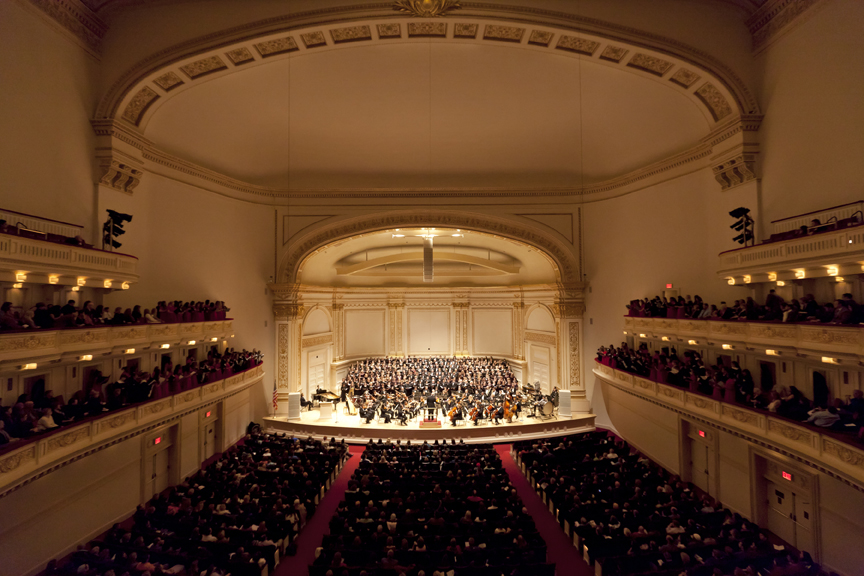
A full house greeted the Distinguished Concerts Orchestra and Jonathan Griffith, Artistic Director, on Martin Luther King Day. The opening work of the program was Jenkins’ “The Wooing of Etain” in its United States premiere. The piece is unusually scored for soloists that include soprano saxophone, electric bass and uilleann pipes. Despite the unconventional use of  instrumentation, the work is sweetly tonal, warm and embracing. It was performed with affection and commitment, although some of the individual playing was slightly off pitch. The soloists: Rob Derke, Carlo de Rosa and Joseph Mulvanerty, performed and improvised with technical brilliance.

Jenkins’ “Sarikiz”, a violin concerto given its Carnegie Hall premiere, won the audience over instantly with its Carl Orff-like primitive energy and minimalistic repetition. Apart from the occasional reference to Kazakh folk themes, Jenkins uses two Kazakh indigenous percussion instruments, the dabel (hand drum) and the kepshek (tambourine). Like Orff’s beloved “Carmina Burana”, for example, very little counterpoint is used, the simplest of chords were often employed, and the percussion–while effective–is sometimes used a bit too often (here, they also covered the violin soloist at times). The idiomatic, virtuosic violin scoring holds the audience’s attention in this appealing work–especially with the right soloist. Jorge Avila did an outstanding job with the violin part, and his charismatic stage presence helped keep a diverse audience riveted.

Carol Barratt’s Fantasy Preludes for piano was given a solid performance by Danny Evans and receiving its United States premiere, was composed with an original touch–even though there were many reminders of 20th century modern and impressionistic influences. Nine preludes in all, there was a good deal of counterpoint–which was a refreshing change–and interesting harmonic variety as well. Melodic writing was sometimes chromatic, sometimes more spacial–but almost always lyrical. I would have placed the violin concerto after this work, as the solo piano looked and sounded anti-climactic after witnessing the orchestra.

A diverse audience was to be expected, as it was Martin Luther King Day, and Jenkins’ world premiere, “The Peacemakers”, included quotations from many important leaders or texts.

Those that were quoted include Gandhi, Mother Teresa of Calcutta, St. Francis of Assisi, Nelson Mandela, and Anne Frank (a touching, special addition to this list). Of course, there was also a Martin Luther King tribute. The excellent performers included soprano Antoni Mendezona, flutist Kara Deraad Santos, the return of saxophonist Rob Derke and electric bassist Carlo de Rosa, Benny Koonyevsky on ethnic percussion, and Joseph Mulvanerty on uilleann pipes.

Jenkins’ “The Peacemakers” is poignant, resonant, and meaningful. The music accompanies the corresponding texts with devotion. The instrumentation chosen always suited the origin or culture of the text; for example, the bansuri (Indian flute) with the Gandhi text, and the African percussion with the Mandela text worked perfectly. Martin Luther King’s tribute included an incredibly inventive mix of the Blues and Robert Schumann’s “Traumerei” (“Dreaming”).

Share

Ang Li, Pianist in Review

Ang Li, piano
Weill Recital Hall at Carnegie Hall
December 18, 2011

The recent New York recital of Chinese-Canadian pianist Ang Li was billed both as her Weill Recital Hall debut and as a Franz Liszt 200th birthday year celebration entitled “Years of Pilgrimage.” Referring to the masterful suites of Liszt’s, “Années de Pèlerinage,” the program actually included only one work from these sets, “Les jeux d’eaux à la Villa d’Este” from Book III; beyond this selection, the program title was mostly a gentle suggestion of unity for music that also included Liszt transcriptions of Schubert and Wagner and Liszt’s Ballade No. 2 on the first half, and two contemporary Canadian works, plus music of Debussy and Granados on the second half. It was certainly more wide-ranging than other “Liszt celebrations” heard this year – some would even say that some stated connections were rather tenuous – but it did demonstrate that it is hard to find any music not connected to Liszt by “six degrees of separation” or fewer.

It was a wise decision for Ang Li to branch out, as she came to life most with the more modern works on the program. There is no question that Ms. Li has the technical equipment for the rigors of Romantic virtuoso piano music, and her credentials, including numerous accolades and international tours, point to her mastery and versatility; her temperament, on the other hand, seemed a better fit for works by the non-Romantics. She showed a particular affinity for Debussy’s timbres through her finely controlled touch in “Brouillards” (“Mists”), while Minstrels had just the right bumptious feeling. “Feux d’artifice” (“Fireworks”) closed the group of three Debussy Preludes with brilliance, leaving one wondering whether an impressionistic theme program can be far behind in his upcoming 150th anniversary.

Prior to Debussy, we heard the US Premiere of  “Es ist genug!” (2007) by Jérôme Blais (b. 1965). An intriguing, partly improvisatory work, it incorporates into a dreamlike tonal backdrop various fragments of music by J. S. Bach, as representative of the sacred in this composer’s otherwise atheistic view. One heard, among other fragments, bits of Bach’s D Major Prelude (WTC, Book II) and the B-flat Partita with bits of the title Chorale. What could have resembled (and at times approached) an Ivesian dream of Juilliard’s practice floor before a Bach recital was held together powerfully in Ms. Li’s inspired and focused conception. The composer was present to speak and receive applause, as was Jared Miller (b. 1988) whose “Souvenirs d’Europe” (2011) were given a persuasive account. Prompted by recent travels in Europe, Mr. Miller’s three pieces suggested fountains (“Fontaines”), the cathedral of Notre Dame (“Origines”), and a Spanish tourist scene (“¡La Rambla!”). Kinship with Liszt stopped at the travel-themed title, though, as these were in a new, individual tonal language (perhaps with the exception of “Origines” which struck one as resembling Messiaen – appropriately enough, given the inspiration). Miller writes brilliantly for the piano and shows remarkable accomplishment for one so young. He was quite fortunate, one must add, to have a pianist as skilled as Ms. Li to perform his music.

Also very successful was the Granados Allegro de Concierto, which closed the program. The end of the program’s westward travel arc concluding in sunny Spain, it seemed to warm the musical temperature of things, in phrasing and timbre, where the opening Liszt half had not.

The opening work, the Wagner-Liszt transcription of Isolde’s Liebestod had plunged the audience into high drama perhaps too suddenly, and the three Schubert-Liszt song transcriptions (“Wohin?”, “Der Müller und der Bach,” and “Gretchen am Spinnrade”) were well done, but felt somehow disengaged. Liszt’s “Les jeux d’eaux à la Villa d’Este” was technically stunning (and a beautiful precedent for the Jared Miller fountains), but even the octave fusillades in the Ballade No. 2 in B minor, though confidently executed, seemed to leave performer and audience a bit cold.

All in all, I look forward to hearing Ms. Li again in ever more personally expressive playing. Encores of a Chinese folk song (Chen Peixun’s “Autumn Moon Over the Calm Lake”) and Alexina Louie’s “Memories In An Ancient Garden” showed where some of that more personal involvement might lead.

Share

Distinguished Concerts International New York (DCINY) in Review

“MESSIAH…REFRESHED!”
Jonathan Griffith, conductor
Avery Fisher Hall, Lincoln Center
November 27, 2011

Distinguished Concerts International New York has long been bringing large choruses to this city to perform in concerts with soloists and a fine freelance orchestra. I have heard them before, usually presenting very exciting performances of contemporary works. And today’s performance of Handel’s “Messiah,” entitled “Messiah…Refreshed!”, did have a 20th century component, as it utilized the Eugene Goosens re-orchestration for full symphony orchestra commissioned by Sir Thomas Beecham in 1959. I was very excited to hear this orchestration again, for I remember enjoying it with great guilty pleasure during my college days. This review will contain no discussion of Baroque performance practice, for this orchestration unashamedly does not care about such things. Historical accuracy was of no interest to Sir Thomas. As he said: “A musicologist is a man who can read music but can’t hear it.”

The performance did not turn out to be a slavish recreation of the 1959 recording by Sir Thomas Beecham. Just as a realistic painter, once he has mastered the rules of perspective and can no longer create convincing primitive landscapes, a fine musician such as Maestro Jonathan Griffith could not allow himself to use the often lugubrious tempi stipulated by Thomas Beecham. Neither could the soloists forget all they have learned about ornamentation. So although the performance was an inconstant recreation, it was far more musical than the original.

The members of today’s chorus, the Distinguished Concerts Singers International, were drawn from choruses located in seven of the United States and two foreign countries. I have been most impressed by the DCINY choruses that I’ve heard in the past. But they never had to negotiate the quick coloratura passages which today’s chorus was called upon to perform. Although their performance of chordal sections was often stirring–on the words “wonderful, counselor” in the chorus “For unto us a child is born”, for instance–the same cannot be said for the sixteenth-note runs which each section is called upon to sing in this and many other movements. I am reminded of another statement by Sir Thomas Beecham, said to have made while exhorting a chorus during a rehearsal of “For unto us a child is born:” “Ladies, please think of the joy of conception, not the pain of childbirth.”  Save for the coloratura sections, the choral singing was more than adequate, what one would expect from over 200 people singing “Messiah.”

The soloists were successful to varying degrees. Countertenor Nicholas Tamanga stood out with his beautiful tone and attention to the meaning of the words. But the use of a countertenor instead of a mezzo-soprano/alto was anomalous, something which didn’t fit into this souped-up-retro-version of “Messiah.” Tenor Ryan MacPherson performed his solos with ease, exhibiting a fine tenor voice in all parts of his range. Bass Michael Scarcelle also sang well, but at times had trouble keeping together with the orchestra. I’ve rejected all of the words which I’ve thought of to describe the singing of soprano Sara Jean Ford, as I don’t want to seem unkind. She was just not up to performing this great Baroque work. Her singing was expressionless, distant, and uncommunicative.

The mighty orchestra was fine, although the timpanist seemed a bit overzealous at times. I chuckled at the cymbal rolls on the words “for he is like a refiner’s fire.” And guiltily enjoyed the flute obbligatos in “O thou that tellest good tidings to Zion.” It is interesting to note that, since in this orchestration the trumpets and timpani were playing a good deal of the time, their impact in the few movements in which they appeared in Handel’s original score was weakened. But the overall sound was thrilling.

I can fully understand why–at the end of the performance–the audience responded with fervent and heartfelt applause. Those who knew members of the chorus were thrilled to hear their friends, neighbors and members of their family performing this great work in a New York concert hall with a huge orchestra under the direction of a fine conductor. For most of the audience, matters of Baroque performance practice were not concerns. Most of the things I have discussed in the preceding paragraphs meant nothing to them, and rightly so; they heard a well-paced performance of a beloved masterwork with a Technicolor orchestration, and they responded accordingly. A good time was had by all, including this reviewer.

Share

Narek Arutyunian clarinetist in Review

Narek Arutyunian clarinetist in Review
Steven Beck, piano
Merkin Concert Hall at Carnegie Hall, New York, NY
December 13, 2011


Narek Arutyunian, Clarinetist

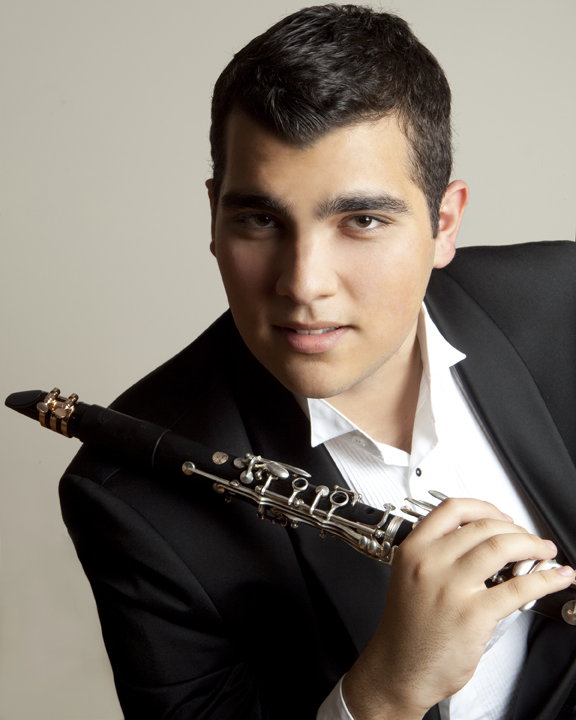
Narek Arutyunian, Clarinetist; Photo Credit: Christian Steiner

Music is a form of communication, transference of ideas from the player to the audience.  This would seem to be the motivation behind any performance, and yet, many performances fall short of this goal for a myriad of reasons.  Narek Arutyunian, 19 year old clarinetist, and a winner of the 2010 Young Concert Artists International Audition, is first and foremost a storyteller, in the tradition of the best folk artists.  He brings his considerable talent, facility, and appreciation of his heritage to refine this tradition into art.

Mr. Arutyunian’s most notable strengths are his big, well supported tone and flair for the dramatic gesture.  He was at his best in repertoire that drew upon his natural affinity for specific genres.  In the first movement of the Poulenc Sonata for clarinet and piano, his interpretation had, as in much of Poulenc’s music, a schizophrenic nature to it, sounding alternately suave and unhinged.  The following Romanza ventured beyond Poulenc’s marking of “Tres Calme” into a wrenching and painful lament.  Only in the concluding “Allegro con Fuoco”, however, did the clarinetist’s distinctive bright and polished sound find a perfect fit for this glittering concoction.

Each half of the recital contained a work that exploited popular genres, either to develop a theme (Jean Francaix’s Tema con Variazione) or to evoke the flavor of another culture (Paul Schoenfield’s Four Souvenirs). Mr. Arutyunian dispatched both these compositions with great humor, musicality, and a jazz artist’s sense of rhythm.  In the Francaix, his phrasing on the backbeat made both the lopsided Moderato and the quirkily accented grace note waltz come to life.  Just as remarkably, he employed a singer’s phrasing in the Gershwinesque Larghetto and a pristine white tone in the Adagio to great effect.  Even more impressive was the Schoenfield, in which he showed a complete mastery of each of the four miniatures, most especially in the melancholy Tango, a cousin to the Depression era song, “Brother, Can you Spare a Dime?”

Joseph Horovitz’ Sonatina is a well crafted, idiomatic piece of writing for the clarinet, but unmistakably of its time, polite and superficial.  Both this and the Sonata by Edison Denisov filled niches on the program, one for its lightness, the other for its unconventionality.  That said, Mr. Arutyunian made strong cases for each.  Only in von Weber’s Grand Duo Concertant did I feel that the clarinetist’s extroverted and highly subjective approach didn’t really work.  The swift and sparkling passagework of the Rondo was terrific, but elsewhere his playing seemed forced both in tone and rhythm.  This is a style which requires the player to emerge from within the structure of the music.

Two truly entertaining encores brought the program to a close.  Mr. Arutyunian’s partner in this recital, the pianist Steven Beck, is simply a wonder.  He plays beautifully, with unfaltering rhythm and technique, sharp ears and keen intelligence.  Their collaboration was seamless.

Narek Arutyunian is already an accomplished and exciting player who is generous to his audience.  I look forward to hearing more from him as he continues to grow artistically.

Share

Cuarteto Rústico in Review

George Anthony Figueroa, violin
Ariadna Buonviri, violin
Cassandra Stephenson-Sulbarán, viola
Jorge Espinoza, cello
Hosack Hall, New York Academy of Medicine
December 9, 2011

This concert was presented by Musica de Camara, one of whose missions is to present concerts in non- traditional venues, so as to bring great music to under-served communities. Who knew that the New York  Academy of Medicine, located just south of the Museum of the City of New York at Fifth Avenue and E 103rd  Street, housed a wonderful auditorium? And although the armchairs and movie screen at the rear of the stage  indicted that music was not the primary focus of Hosack Hall, I found it a perfect place in which to hear this  fine performance by the Cuarteto Rústico.

The members of the quartet all have Latin American roots (Chile, Columbia, Venezuela and Puerto Rico) and  state as their mission “to promote the origins, history and culture of the Americas through its music.” They  also state that “folk, popular and classical music from Latin America is at the heart of their repertoire.” And  tonight’s concert was true to their mission. It began with a spirited performance of Silvestre Revueltas’ Sting  Quartet No.4, “Música de Feria.” In four quite short movements, this work is “a brash and rowdy picture of  a Mexican rural fair.” Yes, it is brash, rowdy and contains Mexican rhythms and melodies, but I found it a  typical example of quite forgettable twentieth-century “classical music.” I was, however, most impressed by the
playing of this fine quartet – a focused sound at all dynamic levels, beautiful phrasing, a perfect balance among  the instruments.

We then heard the String Quartet No.1 by Heitor Villa-Lobos, the Brazilian master whose music is anything  but forgettable. His harmonic language is unmistakable and quite beautiful, as heard in the first movement,  titled “Cantilena.” Many string quartets strive for a consistently blended, homogeneous sound, and when a  homophonic texture called for it, we heard such a sound from Cuarteto Rústico. But what I liked most about  the quartet’s playing was that each instrument retained its own color, making crystal clear the polyphonic web  which was present in so much to tonight’s music.

Popular music followed; an arrangement for string quartet of Antonio Jobim’s bossa nova, “Chega de  Saudade.” During this work, which went on just a bit too long for this listener, the quartet played with the same  intensity, clarity of texture and fine sound as in the previous “classical” works. The first half ended with Astor  Piazzolla’s “Fuga y Misteri,” an excerpt from the composer’s tango opera “Maria de Buenos Aires.”
After the intermission we heard the concert’s longest work, Mozart’s String Quartet in C Major, K.465. By the  way, it was erroneously listed on the program as String Quartet No.6. It is, however, the composer’s twenty-  second string quartet. The mistake arises from the fact that it is also the last of the six quartets Mozart dedicated  to Haydn and had published in 1785 as Opus 10, No.6. I felt that the tempi in the first and last movements  were too fast, which made for moments of insecure playing. And strangely, although they didn’t repeat the  first movement’s exposition, they did so in the fourth movement. (For my strong feelings about repeating the  exposition, see the second paragraph of my review of the Nov 3, 2011 concert by The Stone River Chamber  Players.)

The concert proper concluded with a wonderful performance of Jorge Figueroa’s jazzy “Salsa Clásica” for  String Quartet. It was followed by an encore recognized by most of the audience, Carlos Gardel’s “Por una  Cabeza.”

Share

Kotaro Fukuma, Pianist in Review

Kotaro Fukuma, Pianist in Review
Weill Recital Hall at Carnegie Hall
December 6, 2011
Kotaro Fukuma

Kotaro Fukuma


In a Weill Hall recital presented by New York Concert Artists and Associates, Kotaro Fukuma, who was born in Tokyo but now resides in Berlin, performed a beautifully varied program for a full house audience. The first half consisted of selections from Bach’s “Art of the Fugue” plus a work that was inspired by them: the Sonata No. 31 in A-flat Major, Op. 110 by Beethoven. The Beethoven has a fugal movement of its own, and Mr. Fukuma performed it–like the Bach–with great clarity of rhythmical articulation. Indeed, his technique is superb. I would have preferred a little more delineation of the fugal entrances—i.e. more dynamic contrast between the entrance and subsidiary counterpoint. There could also have been better phrasing in terms of showing the direction of the melodic line; for example, phrases beginning with a softer, lighter touch and ending with fuller climaxes.

In the second half, Fukuma confirmed his stellar technique with Liszt transcriptions. “Ab Irato” from “Grande Etude de Perfectionnement” was fantastic. “La Campanella” could have had more Romantic-period exaggeration of dynamics; like in earlier pieces, he needed to play with a more varying touch and bring more shape (crescendo and diminuendo phrasing) to the musical lines. He ended it brazenly and powerfully, however, with polished octaves that were as clean as a whistle. One became riveted by the music’s concluding dramatic intensity.

In Ligeti’s Book I Etudes (selections), Fukuma played with a wonderfully articulate left hand, and excellent all-around clarity of rhythm. In “Arc-en-Ciel”, he could have brought more dreaminess to the atmosphere. In general, more phrasing within the given dynamics and subtleties of color were missing, but his interpretation of “Automne a Varsovie” seemingly held the audience spellbound with its sudden flare-ups of high octane heat.

Sergei Liapounov’s music from the “Etudes d’execution transcendante”, Op. 11

displayed more of Fukuma’s technical strengths, with thunderous, blazing octaves. His encores (Chopin/Liszt: “Meine Freunden” and another Liapounov Etude) were equally impressive, as they were permeated with impeccable virtuosity. Come to think of it, he didn’t miss a note all evening.

Share

Aglaia Koras pianist in Review

Aglaia Koras pianist in Review
Weill Recital Hall at Carnegie Hall, New York, NY
November 29, 2011

Aglaia Koras

A large and most enthusiastic audience was on hand for this very demanding recital by Aglaia Koras. Works spanning over 150 years of music history, from Bach to Rachmaninoff were performed. She began with Mozart’s Fantasy in D minor, K. 397. My first impression was “too romantic,” as she used lots of pedal and much rubato. The “fantasy” aspects of this piece are built in and don’t need to be exaggerated to be clear. The final D Major section, however, was played with crystalline classical clarity. My curiosity was aroused. What would happen next?

And next were two Impromptus from Schubert’s Opus 90. In the first, No.3 in G-flat Major, we heard an example of a quality of Ms Koras’ playing which, for this listener, was the most memorable aspect of the recital – her beautiful legato playing of lyrical melodies. In addition, the left hand accompaniment, which is so often the weak point in performances of works by Schubert, possessed the same clarity we heard at the end of the Mozart.

What would be Bach’s Chromatic Fantasy and Fugue in D minor be like? It was thrilling, one of the best performances I’ve heard of this work when played on the piano. In my notes I wrote of the Ms. Koras’ playing: “clear craziness.” I could have done without the exaggerated ritard at the end of the fantasy, but the fugue, which often sounds anticlimactic after the wildness which it follows, was played so that every line in the polyphonic web was clearly delineated – no mean feat.  Towards the end, however, things began to rush and seemed to get out of control, a problem which returned in some of the following works.

The first half concluded with Beethoven’s “Appassionata” Sonata No.23 in F minor, Opus 57. The first and last movements suffered from rushing the already much too fast tempi. My notes said: “out of control.” So on the first half of the recital we saw both positive and negative aspects of Mr. Koras’ playing: beautiful singing legato melodies and clear passage work in both hands vs. rushing and choosing tempi which are so fast as to make everything a blur.  What would the second half bring?

During the Brahms Rhapsody in B minor, Opus 79, No.1 both the good and the bad were again present: a beautifully played middle section with its soft legato melody and clear accompaniment was preceded and followed by quite a mess. The following Chopin Nocturne in C-sharp minor, Opus posthumous was beautifully played, as one would now expect of a soft, lyrical piece on this recital. This is not to infer that Ms Koras does not have the technique to play loud and fast music. To the contrary. In many of tonight’s works she showed that when she chose a tempo that remained within the parameters suggested  by the structure of the music, she played forcefully with no loss of beauty in her sound or control over the clarity of the texture. In the Schubert E-flat Impromptu her finger work in rapid passages was perfect. She made a crescendo in the same Schubert that was breathtaking. But it was her choice of tempi (much too fast) and her inability to control them (rushing) that brought her to grief in the Beethoven, Brahms and in the recital’s final work, Chopin’s Sonata in B-flat minor, Opus 35. And yet, in the b section of the sonata’s funeral-march-third-movement we heard the evening’s most exquisite very, very soft and legato playing. The other movements just didn’t make sense.

Three Chopin encores (a waltz, the “Revolutionary” Etude and the Fantasy Impromptu) followed a tumultuous standing ovation.

Share

Lloyd Arriola pianist in Review

Lloyd Arriola, piano
Weill Recital Hall at Carnegie Hall, New York, NY
November 20, 2011
 
Arriola Lloyd, pianist; Photo Credit by Kristin Hoebermann of Hoebermann Studios, New York

Arriola Lloyd, pianist; Photo Credit by Kristin Hoebermann of Hoebermann Studios, New York


Continuing the celebration of Franz Liszt’s 200th anniversary, Lloyd Arriola added his Weill Recital Hall debut to the festivities, bringing works to the table that are less than familiar to the average concertgoer. One could dedicate this entire review to Mr. Arriola’s bold and original programming, but the performer himself warrants full focus here; suffice it to say that the unconventional selections underscored the freshness that pervaded the recital in every way.

My first impression of Mr. Arriola was of his highly entertaining program notes, written in a conversational style with occasionally irreverent humor (e.g., a comparison of two of Liszt’s “sister” works to Wynonna and Ashley Judd), but always with expertise and insight. After decades of attending concerts, these are among the few sets of program notes I am actually tempted to save. I’d like to devote a separate article to this subject –how program notes should not read like a college theory essay or worse – but will meanwhile say that they do matter. Mr. Arriola “sells” his music, and it starts before the concert. The pianist’s biography, listing a doctorate from Juilliard and numerous performances as soloist, collaborator, and conductor, was similarly refreshing, avoiding the puffery one sees so often, but presenting the portrait of a working musician wearing many hats, all requiring top-notch skills. Following the biography was a page of grateful acknowledgments that would make an Oscar-winner blush.  If all this text painted the picture of Mr. Arriola as a passionate “people person” his first steps onstage confirmed it. Cheers greeted him before he played a note, not the work of a claque, but the intense, spontaneous outburst of many friends present.

In an instant summoning of concentration, Mr. Arriola took on an opener of Liszt’s “Grand solo de concert,” composed as a test piece for students at a Paris Conservatory competition in 1849. A test it is, chock full of every kind of technical stunt possible (and some impossible!), but Mr. Arriola handled it with polish and aplomb. It is a substantial and exhausting work, especially when played with the intensity given on this occasion, so one marveled not only at its choice (it is understandably neglected), but also at its placement as opening piece.

A hard act to follow, it was followed nonetheless by another neglected giant, Liszt’s Fantasia and Fugue on the Chorale “Ad nos, a salutarem undam” (Illustration No. 4 from Meyerbeer’s “Le Prophéte”) transcribed by Ferrucio Busoni. Here Mr. Arriola coupled his large-scale technique with an absolutely solid mastery of structure and difficult fugal writing. It was a dramatic performance – a rare combination of passion and extroversion with laser-sharp cerebral focus. Occasionally, I felt Mr. Arriola overplayed dynamically, producing some unduly harsh sounds along with some rather distracting foot stomping, but I would take his commitment any day over its opposite. The excitement of the evening was, after all, palpable.

After intermission came an assortment of what one might call curiosities. Liszt’s shortest composition “Prélude omnitonique” (about six seconds long) was summarized by the pianist’s announcement that “every birthday party deserves a gag gift.” All jokes aside, Liszt was in many ways a visionary (as one might see in a more serious vein in the “Bagatelle sans Tonalité” and other works), and a listener enjoyed this break from the pyrotechnics. After some laughter, the Prelude was replayed (a nice touch) as an introduction to “Vagyodas Amerika Utan” (“Longing for America”) by the late Liszt proponent Ervin Nyiregyhazi (1903-1987). It was a welcome discovery for those of us who know the name Nyiregyhazi mainly as a controversial pianistic figure. Also most welcome was Liszt’s introspective “En Rêve (1884-85) played with sensitivity. In addition we heard Fantasia in D (2011), a work Mr. Arriola commissioned from Harrison Gross, a 17-year-old student at the school where Arriola is a pianist. It was a touching gesture.

Liszt Magyar Rapszódia No. 12 (Heroïde élégiaque), an earlier version of the Hungarian Rhapsody No. 5, closed the program with brilliance and spirit. An encore by the pianist cleverly fused Gershwin’s “Someone to Watch Over Me” with bits of Liszt’s Piano Concerto in E-flat (along with touches of Fats Waller and others). One could only guess that Liszt, the quintessential performer, would have approved. The audience certainly did.

Share