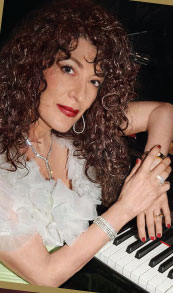
SongFusion in Review

SongFusion in Review
Christ Church, New York, NY
October 7, 2011

SongFusion

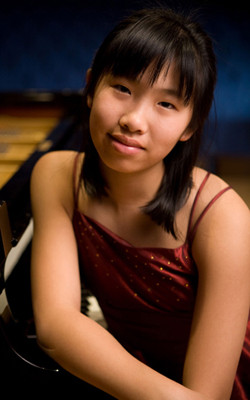
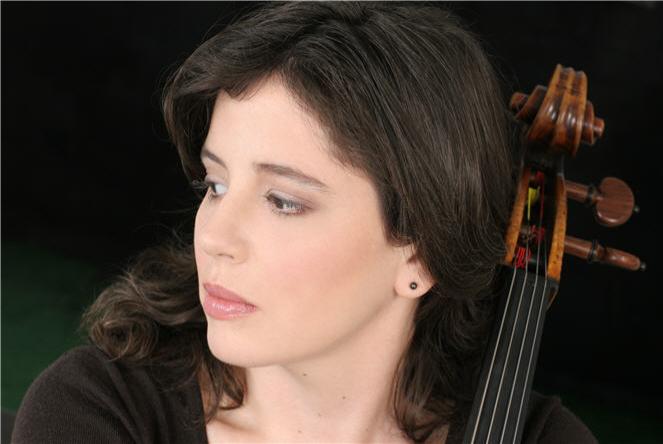
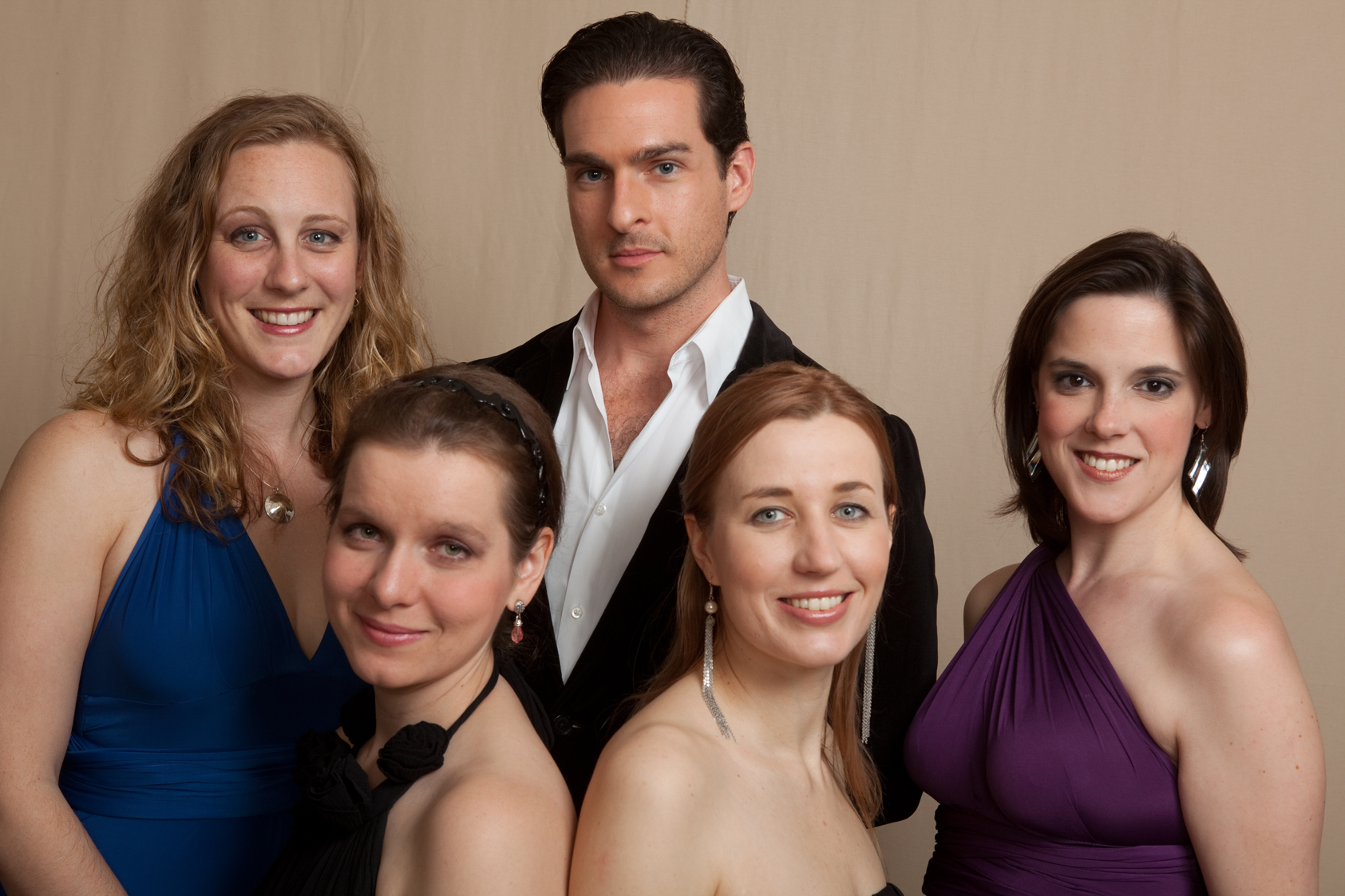
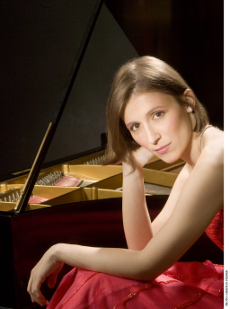
For this concert, the five members of SongFusion (sopranos Victoria Bowers and Mary Mackenzie, baritone Michael Kelly, pianists Liza Stepanova and Kathleen Tagg) were joined by seven guest artists in a program titled “Uncommon Prayer, An Evening of Art Songs Exploring Spirituality Around the Globe.” From beginning to end we heard fine performances by thirteen highly skilled musicians who had clearly worked very hard to put together and rehearse this well-constructed recital. 

In the printed program we read that “SongFusion is a New York-based ensemble dedicated to presenting a wide range of art song repertoire in innovative ways.” The key word here is “innovative.” The first two of these innovations – “programs that explore familiar themes from unexpected angles” and “collaborating with instrumentalists…” – have been part of many art song recitals for quite a long time, and do not create a radical break with earlier traditions. Three other types of collaborators were listed – dancers, actors and visual artists –but none of these were present on tonight’s recital.

 The first set of the evening was called “Religious Songs,” and began with a performance of Maurice Ravel’s “Kaddish,” a setting in Hebrew of the mourner’s prayer. Baritone Michael Kelly performed the work from the left side of a darkened stage which was lit only by candles. This led me to expect that lighting effects would be an important part of the “innovative” nature of this concert. But attempts at “dramatic lighting” only appeared during the six “Religious Songs.” Mr. Kelly, accompanied by pianist Lisa Stepanova, gave us a heartfelt performance of “Kaddish.” His voice is expertly produced with beautiful colors in all parts of his range. Unfortunately, the house lights were also out, making it impossible to read the well laid-out texts and translations in the printed program.

Three songs by Hugo Wolf, arranged for soprano and organ by Max Reger, followed. Quite diatonic, I would never have guessed that these works were by Wolf. But they gave a chance for guest performer Ryan Jackson to show us what the Christ Church organ can do. They were sung with warmth and poise by soprano Mary Mackenzie. The first set concluded with two selections from “Four Hymns” for tenor, viola and piano by Ralph Vaughan-Williams, performed by guest artists Brenton Ryan, tenor, and Edward Klorman, viola, with SongFusion pianist Kathleen Tagg. Although Vaughan-Williams is thought to have what many think is a rather bland harmonic style, I found these pieces far more interesting than the Wolf songs. Mr. Ryan sang beautifully, with confident and well-produced high notes. The sense of ensemble between the various performers in this and all other works on this concert was of the highest quality.

The rest of the first half was called “A Portrait of Composer Libby Larsen.” We heard “Saints Without Tears” (1976) performed with fine diction and sparkle by soprano Victoria Bowers and guest artists Henrik Heide, flute and Heungwon Oh, bassoon; “Lord. Make Me an Instrument” (1996) performed by Michael Kelly and Lisa Sepanova, and “Donal Oge” (2011) performed by Mary Mackenzie and Kathleen Tagg. This was the New York premiere of this last work, commissioned by SongFusion. This set was preceded by a rambling and effusive paean to the composer, delivered by a member of SongFusion. I know that performers have been urged to “break down the barrier” between themselves and the audience by speaking between musical numbers. Unfortunately, this evening, these intra-performance speeches were embarrassingly amateurish, in contrast to the thoroughly professional singing and playing. And although the performances of Larsen’s music were up to the standard of that of the previous works, I find her music uninteresting. But the house lights were finally raised so that from now on we could read the printed texts.

The major set of the second half was called “The Spirit of Foreign Lands.” Although the texts of two of the three sets of songs, Karol Szymanowski’s “Songs of the Infatuated Muezzin” (Arabia) and John Harbison’s “Mirabai Songs” (India) fit in quite well with the concert’s theme of “Spirituality Around the Globe,” I’m not sure how the erotic, anti-colonialist, exotic texts of Ravel’s “Chansons Madégasses” belong. But no matter, as this was one of the concert’s high points. Guest artist mezzo-soprano Naomi O’Connell’s rich voice beautifully conveyed the sensuality and passion of these wonderful Ravel songs, and she was ably supported by flutist Henrik Heide, cellist Andrew Janass and SongFusion pianist Lisa Stepanova.

A short Epilogue, the vocal quartet with piano: “Two Priests” from John Musto’s “Book of Uncommon Prayer,” brought the concert to a rollicking conclusion.

Share

The Hope and Love Concert in New York City in Review

The Hope and Love Concert in New York City
Ji-Hae Park, violin
Ji-Eun Baek, accompanist
Sae-Nal Lea Kim, guest accompanist
Zankel Hall at Carnegie Hall
October 10, 2011

Ji-Hae

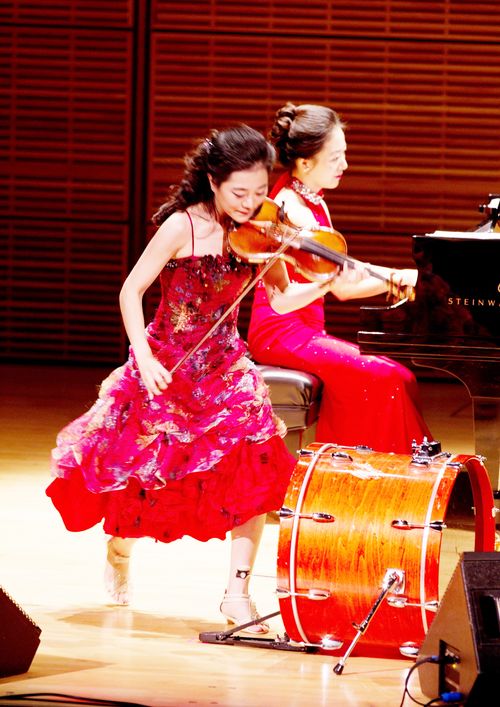
In a concert entitled “The Hope and Love Concert in New York City,” which was produced by Double J Ent., violinist Ji-Hae Park dazzled and thoroughly entertained her audience in a most versatile program. Her stage persona is extremely charismatic and emotional, and she was able to bring out all the stylistic and dynamic contrasts of her varied composers. Her program ranged from Saint-Saens to Mozart and Rachmaninoff to Korean composer Je Myung Hyun and “Chim Chim Cheree” from the musical “Mary Poppins.”  

In this song from “Poppins,” Park brought out the music’s mystery and sweeping lyricism. The mood lighting also helped with just the right ambience. In Richard Strauss’s early Violin Sonata in E-flat, Op. 18, she combined a virtuoso technique with a luxurious Romanticism, and confirmed that this youthful yet masterful work is worthy of regular performances. Physically, as well as musically, she keeps the audience entranced with her body language—either swaying horizontally or sometimes swooping as low as possible to the stage. Her range is stunning; she sounds brilliant at the top of her register, and remarkably rich and dark on the low G-String.

Another highlight of the program was the fiendishly difficult, free-wheeling work: Saint-Saens’ “Danse Macabre.” Here, she offered a virtuoso technique plus great intensity to the melody’s chromaticism and swirling dance patterns. “Souvenir de Korea,” arranged with finesse by Park herself, is a beautiful work. Je Myung Hyun’s “To the Land of Hope:  Hui Mang Ui Na Ra Ro” is an appropriate choice for this program, which is designed to bring people together; her goal, as stated in her program notes, is to use the violin as an instrument to spread the gospel and love of God to as many people as possible. She also makes every effort to unite audiences by incorporating classical, pop music, traditional Korean folk tunes and gospel music, among other styles, on concerts as well as on her recordings. Some of the many accolades she has received include becoming the ambassador of The Korean Christian Art and Music Council, The Handong Global University, and The Africa Future Foundation.

Park was born in Germany in 1985. She plays on the Petrus Guarnerius 1735 Venedig, on loan to her from the German Foundation since 2003. She was the first prize winner of the National Music Competition of Germany Jugend Musiziert in 2001 (solo) and 2002 (chamber music), among many other prizes. She studied with Professor Ulf Hoelscher at the Karlsruhe Musikhochschule in Germany and Professor Jamie Laredo at Indiana University, where she received a full scholarship. Her accompanists Ji-Eun Baek and Sae-Nal Lea Kim gave her excellent support, and the audience on hand was enthusiastic throughout the concert.

Share

Nadejda Vlaeva Pianist in Review

Nadejda Vlaeva, piano
YASI Piano Salon; New York, NY
October 4, 2011

Nadejda Vlaeva

Nadejda Vlaeva, a Bulgarian pianist who studied at The Sofia Music School, The Sofia Music Academy, The Sweelinck Conservatorium in Amsterdam and The Manhattan School of Music with teachers Antoanetta Arsova, Anton Dikov, Jan Wijn, and Ruth Laredo (she also worked closely with Lazar Berman), played unusual fare on her recital at YASI Piano Salon on October 4th—a program co-hosted by the American Liszt Society NY/NJ Chapter and the Yamaha Artists Service.

Ms. Vlaeva, who resides in New York, has extensive concert experience in Bulgaria, Russia, Slovakia, Hungary, The Netherlands, Germany, England, Spain, Barbados, Canada and the United States, and she has garnered extravagant encomiums from conductor Hans Graf (“her musicality and the depth of her interpretation amazed me”), Guarneri Quartet Primarius Arnold Steinhardt (“One of the people of extraordinary ability whom we hope for but rarely see”) and Lazar Berman (a “God Given” talent). She has made several CDs for MSR Classics, the Bulgarian Gega New Series, and her latest release for Hyperion.

Six of the 13 Bach/Saint-Saens transcriptions formed the first group on the recital program: the Recitative and Air from Cantata No. 30; from the Violin Partita No. 3; the Largo from the Violin Sonata No. 3; the Bouree from the Violin Partita No. 1; the Adagio from Cantata No. 3; and the Overture from Cantata No. 29 “Wir danken dir Gott,” BWV 29. Nowadays, concertgoers are accustomed to the heavy gravy of Bach-Busoni or Bach-Liszt, so I found it refreshing and fascinating to hear Bach’s music with a light mayonnaise dressing (Romantic to be sure, but French rather than Germanic). The aforementioned Overture from Cantata No. 29 turned to be none other than a D Major transcription of the ubiquitous Preludio to the E Major Violin Partita; what a world of difference–harmonically and stylistically–between Rachmaninoff’s (“Bachmaninoff’s”) arrangement of the selfsame piece! Ms. Vlaeva produced some of her strongest, most winning playing for this opening salvo: she has color, temperament, vitality and considerable dexterity.

“Carnivale di Milano,” Op. 21, by Hans von Bulow, was interesting to hear from the conductor who pompously donned black gloves for the Eroica’s Funeral March, called Brahms’s first symphony “Beethoven’s Tenth,” and condescendingly “dissed” Verdi’s Requiem. Ms. Vlaeva played five movements from the Suite: No. 1, Polacca; No. 4,Intermezzo fantastico; No. 7, Intermezzo lirico; No. 9, Intermezzo scherzoso; and No. 10, Galop. As in Hugo Wolf’s “Italian Serenade”, von Bulow found a modicum of levity and cuteness—not his most natural temperamental attire, to be sure, but essentially congenial.

After the intermission, Ms. Vlaeva gave a clarion, thrusting, and rhetorical account of Liszt’s “Dante Sonata, a Bulow arrangement of Liszt’s Dante Sonnet “Tanto gentile”, and ended the printed part of her program with an intermittently potent, sometimes sprawling and slapdash account of the Liszt “Carnival in Pest” (his Hungarian Rhapsody No. 9).

There were three encores: among them, an ostensible spirited but messy, and rhythmically spastic Liszt “Gnomenreigen, and Rebikov’s “Music Box.”

Share

DCINY: A Concert of Commemoration Honoring the Tenth Anniversary of 9/11

DCINY: A Concert of Commemoration Honoring the
Tenth Anniversary of 9/11Distinguished Concerts Orchestra International
Distinguished Concerts Singers International
Rene Clausen, Guest Conductor
The Really Big Chorus
Jonathan Griffith, Rehearsal Conductor
Karl Jenkins, Guest Conductor
Avery Fisher Hall
September 11, 2011

DCINY: A Concert of Commemoration Honoring the Tenth Anniversary of 9/11

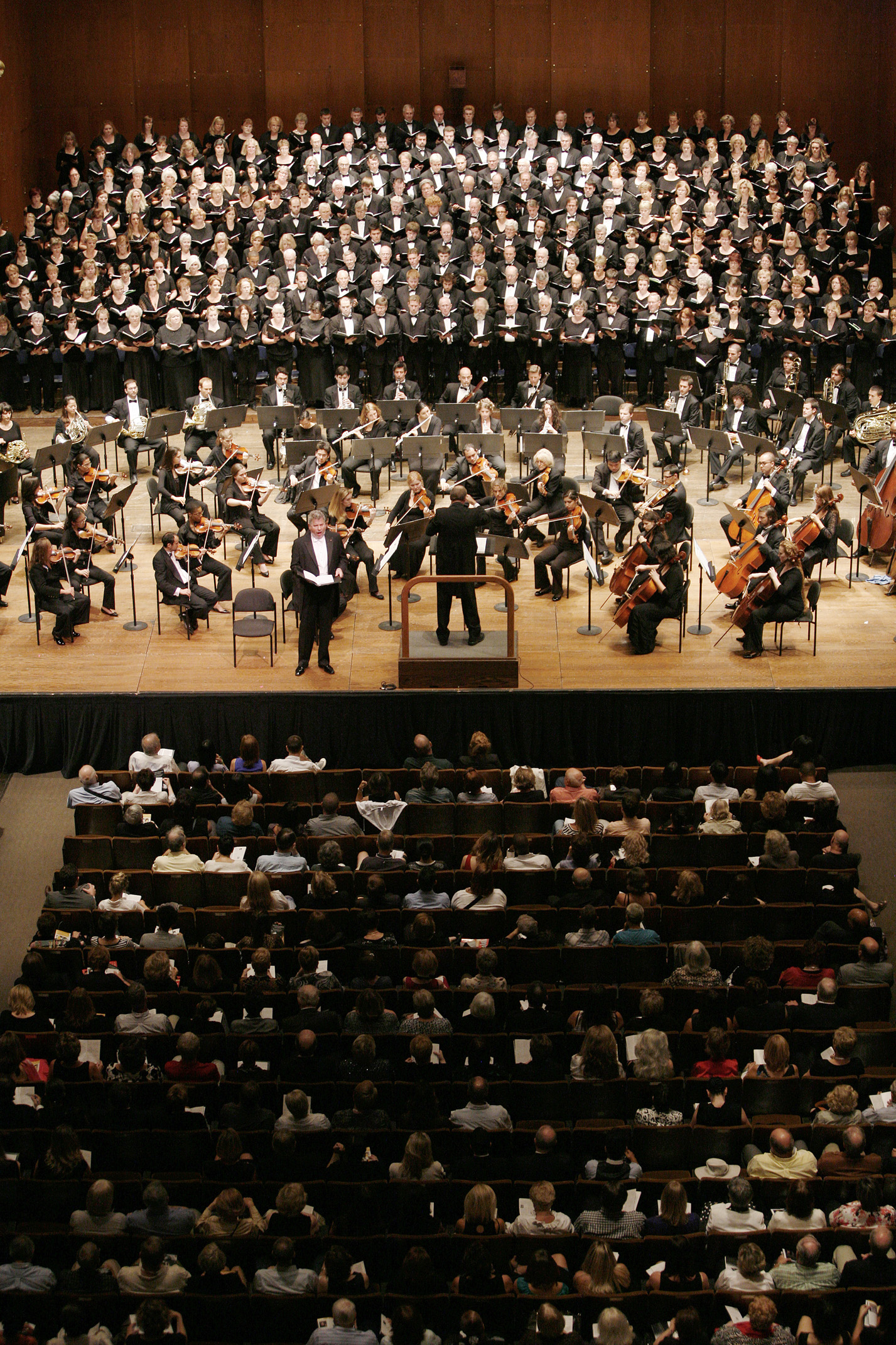
One of the most extraordinary concerts of the last few years took place at Avery Fisher Hall on September 11th, 2011. In performances presented by DCINY, known as Distinguished Concerts International New York, the audience couldn’t have received a better gift: beautifully performed, inspiring music. The crowd in attendance was so large that the lines of people spiraled around the columns in the lobby of Avery Fisher—everyone waiting to be uplifted, and they were.

Samuel Barber’s familiar “Adagio for Strings,” made even more famous by the war film “Platoon” (1986), was a highly appropriate choice for an opener. Rene Clausen prepared a solid, polished account of the work. The strings played with excellent intonation, the ensemble-playing was crystal clear, and the tempo moved along at just the right pace. The audience was clearly touched by the music and the performance. In Clausen’s own “Memorial,” the harrowing events of 9/11 were presented with a rather literal, vivid picture. For me, it hit a bit too close to home, but it ultimately seemed to win over the audience; the movements were “September Morning”, which was serene and sunny as the day began, “The Attack”, complete with crashing chords, dissonance and chaos, and the lovely “Prayers” and “Petitions” movements. It was this second half of the work that helped put people more at ease. Bradley Ellingboe, the Bass-Baritone soloist, sang with great expression and eloquence. The Distinguished Concerts Orchestra International and Distinguished Concerts Singers International performed with deep conviction and connection to all those in attendance, and as a result, the audience—some of them family members of victims—was riveted at every turn.

After intermission, we heard Karl Jenkins’s “For the Fallen: In Memoriam Alfryn Jenkins” in its US premiere. Only four minutes long, it still made an indelible impression. “Armed Man: A Mass for Peace”—on the other hand—is epic in length (63 minutes) and often had the weight, relevance and spiritual profundity of a Mahler symphony.  Even though they didn’t have a lot to sing, the soloists, Erika Grace Powell, Charlotte Daw Paulsen, Brian Cheney and Bradley Ellingboe, were excellent. The Distinguished Concerts Orchestra International and The Really Big Chorus under Maestro Jenkins sounded lush, resonant and deeply committed.

The afternoon will linger in the hearts and souls of those who were lucky enough to be on hand for this important concert on this commemorative day.

Share

Nataliya Medvedovskaya Pianist in Review

Nataliya Medvedovskaya Pianist in Review
Bargemusic, Brooklyn, N.Y.
August 4, 2011
 
Nataliya Medvedovskaya

Nataliya Medvedovskaya


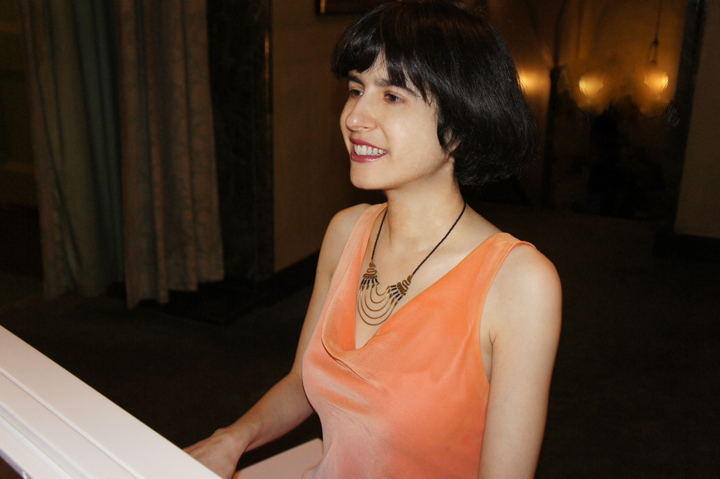
In a series entitled “Here and Now,” pianist Nataliya Medvedovskaya offered a unique smorgasbord of modern works in the equally unique venue, Bargemusic. The “Here” is New York, the base of 10 composers on her program including herself (the exception being Jeremy Beck from Kentucky), and the “Now” stretched from the present to as far back as 1976, the date of Lowell Liebermann’s Piano Sonata, No. 1. The program notes state that Ms. Medvedovskaya researched several hundred compositions before choosing her program based on “fresh compositional ideas, arresting tonal values, and colorful, interesting harmonies.” While not all of these criteria came to mind equally with each piece, it was clear that the pianist herself felt complete commitment to each one, playing all with thoughtful involvement, projection, and polish. Each work was memorized, which is no small feat in newer piano literature and an unusual testament to the performer’s dedication. Many of the composers were present and expressed deep gratitude for this pianist’s performances, and listeners were grateful for a sampling of largely unfamiliar fare played with excellence.

With a change to the printed program, the opening work was Eugene McBride’s Nocturne, a modern, somewhat Scriabinesque version of the genre of Chopin and Field, with some intense development in its central section. It invited the listener inside, as befits an opener. Eugene Marlowe’s 3 pieces from “Les Sentiments D’Amour” followed: “Rougir Pour la Première Fois” (First Blush) “Melancolie” (Melancholy), and “Le Charmeur” (The Flirt), played with polish and élan. Marlowe’s accessible, breezy style was a good foil for what came next, some compositions by the pianist herself. Ms. Medvedovskaya’s 4 pieces, Scherzo, March, Lullaby, and Burlesque, proved effective miniatures showing significant influence of Shostakovich and Kabalevsky (my listening companion suggested “Shostalevsky”). Nothing disparaging is meant, as these are interesting character pieces, simply that Ms. Medvedovskaya’s years at the legendary Rimsky-Korsakov Conservatory of St. Petersburg, Russia have had their imprint. Next came Debra Kaye’s Visions Fugitives (2 piano pieces), inspired by Ms. Kaye’s stay in Taos, New Mexico. Though the title obviously refers to Prokofiev’s Op. 22, the music, in its evocation of a noble, open landscape, seemed to bear some kinship with Copland. It brought large emotions into small forms.

The first half ended with Lowell Liebermann’s Piano Sonata, Op. 1, composed at age fifteen (1976). An auspicious start to the impressive career that ensued, this work contains more than just seeds of future greatness, as it has moments of haunting beauty (especially the third movement, Lento), along with taut craftsmanship. Ms. Medvedovskaya gave it a cogent performance, with a particularly rousing fourth movement finale.

After intermission, there were again intriguing miniatures, Binnette Lipper’s two Bagatelles (from a set of seven) of which were selected the whimsical “Dalliance” and the extraterrestrial-inspired “Spatial Relations” both given vivid characterizations in the pianist’s interpretations. A Toccata by Jeremy Beck held its head up well next to its twentieth-century predecessors in the genre by Ravel and others, and Ms. Medvedovskaya paid attention to sound and balance throughout it, never stressing the sheer perpetual motion aspect. In contrast followed Rain Worthington’s “Hourglass,” a reflection on the passage of time. Reviewer Jack Sullivan from American Record Guide described Ms. Worthington’s music well, attributing to it a “Satie-like repose.” Ms. Medvedovskaya brought out the timeless, sinuous qualities with sensitivity. “Prelude” by Beata Moon recovered the recital’s momentum with the fluidity of music inspired by dolphins, and almost “New Age” in style, though with some immediately affecting Romantic harmonies. Ms. Moon’s second piece held me less, its climactic glissandi seeming a bit facile in context.

Some good old-fashioned fun brought the program back to earth with Robert S. Cohen’s two movements from “An Ant’s World.” “The Work Never Ends” set the scene as the busy world of ants, while “Invasion of the Anteaters” married the ragtime feel of some Bolcom works with dark humor reminiscent of Gounod’s Marionettes. It was a sped-up quote from Chopin’s Funeral March, though, that made for the most outright laughter. The pianist relished every bit of the fun, as did her audience.

The program closed with the first scene from Ms. Medvedovskaya’s own ballet based on “The Wonderful Adventures of Nils,” a fairy tale by Nobel Prize-winning Swedish author Selma Lagerlof. Soprano Felicity Graham narrated with Ms. Medvedovskaya at the piano, a fine collaboration with only one mishap of the text entering early. This vibrantly dramatic music is absolutely perfect for ballet, and one expects choreographers to be tripping over one another for the rights to it. I trust that the next time I hear the music I will also see it fully realized, as it is currently under commission, we are told in the notes. Meanwhile, one’s appetite was whetted. Fireworks from across the river joined in seeming celebration of its final notes, the end of a remarkable evening.

Share

CD in Review: David B. Goldberg

CD in Review: David B. Goldberg
Absolute Music CD1: 13 Tracks

David Goldberg

David B. Goldberg spent the last three years writing and producing “ABSOLUTE MUSIC CD 1: 13 TRACKS”, with the general idea that music today is frequently used in service to other media, while its own abstract nature has become secondary. His CD strives to bridge the gap between high and low art, contribute something new and different to the musical landscape, while at the same time be accessible to all. After a break of seven years, Goldberg began to compose again three years ago. This CD incorporates his latest work.

The 13 tracks are simply labeled with a number, and this way they leave much to the imagination. The tracks vary greatly in both style and mood. Sections that are hypnotically repetitious with subtle change–i.e. minimalistic–fit the best with the electronica sound that permeates the disc (the music was composed using computer programs such as Finale). Yet–thanks to Logic Audio, a program that gives a human playback–there are some very personal elements to the music: a liberty to rhythm (rubato), a good deal of expression such as vibrato, and a wide range of dynamics. Although this disc sounds like it could be a demo, the recording is already on sale on iTunes and the like. According to Goldberg, he is aiming for that electronica edge to the sound in “Absolute Music”, and he is not craving live musicians for performance or for future recordings of this work. He does however intend to find an orchestra of live musicians for future endeavors–especially theater pieces–and he has written for musicians and live performances in the past.

Some of this “Absolute Music” CD sounds other-worldly, perhaps lending itself to the Science Fiction genre. Some of it could serve as video game music or other types of film music because everything about film is obviously pre-recorded, and nothing about it is live. And when listening to “Absolute Music”, you feel you are being taken on a journey without any specific narrative. This is common when listening to Brahms, who avoided descriptive titles and program music; the closest he came to describing what you were hearing was when he composed and titled his “Tragic Overture”. But even here, instead of naming an overture after a Shakespearean drama such as “Romeo and Juliet” (Tchaikovsky) or “Othello” (Dvorak), Brahms chose to label his work in the most general of terms–leaving the listener great freedom of thought.

Track 1 is consistently gripping and lends itself to the aforementioned action-film or video game music, with some ethnic harmonic and melodic flavor added in. The crashing, dissonant chords are indeed startling and effective. The next track provides welcome contrast with its hypnotic and soothing syncopations. Track 3 could use some more chord changes; if the desire here and elsewhere is to keep it simple for the audience, Goldberg could find some middle ground to satisfy the more sophisticated ear.

Track 4 is folksy and rather archaic with a catchy lilt, and the fifth track–in a refreshing minor mode–goes perhaps a little overboard with its use of percussion. Some moments here and elsewhere feel a bit random; melodic ideas are sometimes disconnected to preceding ones, leaving things a bit disjointed. Goldberg, however, is not trying to recreate traditional forms, but rather take you on an abstract journey. And sometimes journeys can be very bumpy roads.

The sixth track could use more advanced counterpoint and imitation, while the following track–Track 7– does indeed incorporate more mature compositional techniques, captivating this listener with its time changes, as well as its atmosphere.

Track 8 has a spooky, entrancing horror film music feel, and the following music on Track 9 also has some droning sounds, but adds an appealing combination of flute solo and chimes. The 10th track contains the strands of strings and piano combined with an unusual, video game-like rumble. Tracks 11 and 12 are also quite unique, sometimes combining new age-like chordal music with Neo-Baroque ornamentation and trills.

Track 13 is mysterious–like the work’s title as a whole–but also contains the most interesting use of counterpoint; it is written with compositional maturity, yet it’s accessible at the same time. It is often a challenge to satisfy both educated audiences and more novice listeners, but with this track and some preceding tracks, Goldberg succeeds.

The CD’s electronica sound, which sometimes wears thin, can still exist on its own without the benefit of live musicians because the music takes you on a voyage away from reality. Then naturally, an ideal contemporary way to represent fantasy is with a futuristic sound.

Share

Luisa Sereina Splett pianist in Review

Luisa Sereina Splett pianist in Review
Weill Hall at Carnegie Hall, New York, NY
May 26, 2011

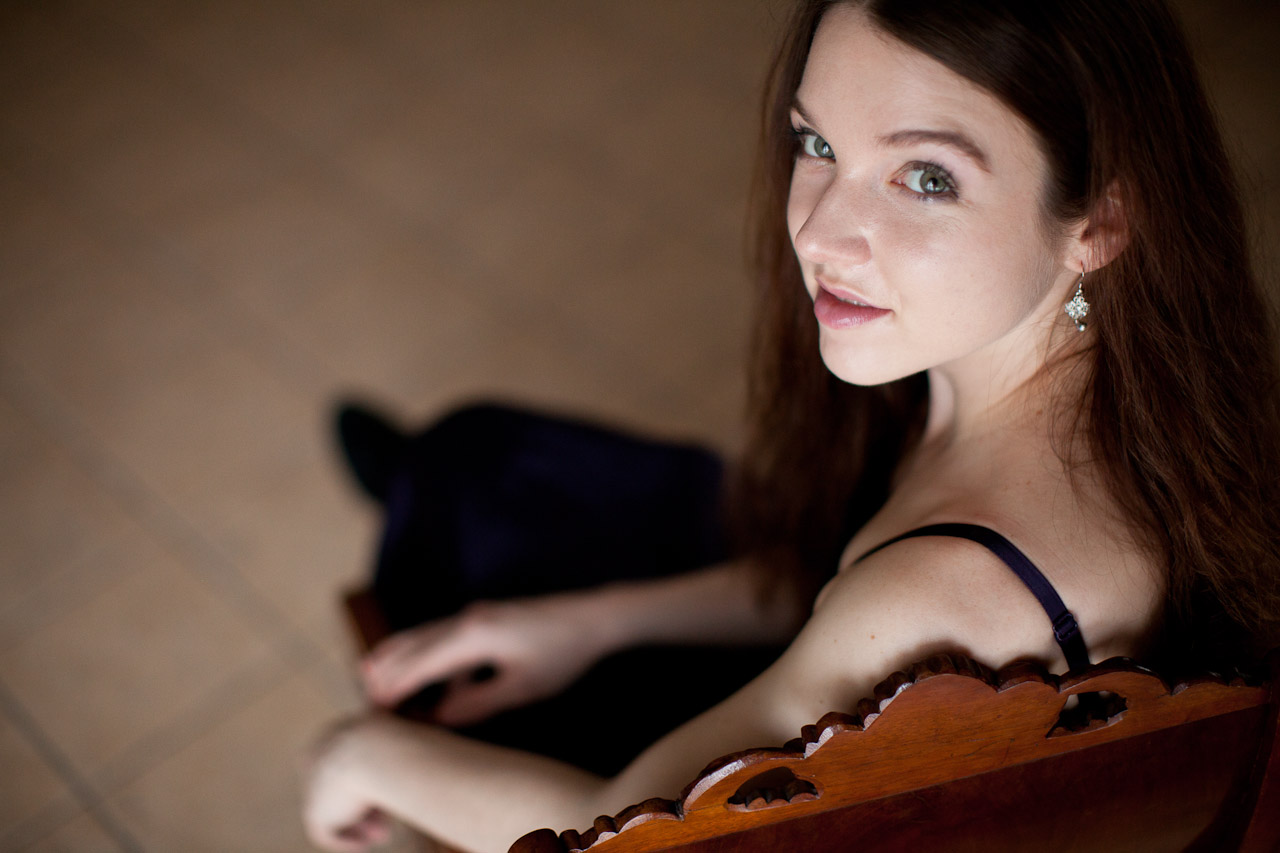
For a promising pianist in her twenties making her springtime debut at Weill Hall, Luisa Splett chose a program that was surprisingly autumnal. Opening with one of this reviewer’s personal favorites, Medtner’s quietly haunting “Sonata Reminiscenza” (from Op. 38 “Forgotten Melodies”), Ms. Splett played with a delicate, measured sound and a cerebral restraint that allowed the composition to reveal its own wistfulness, as if she were simply hearing it from afar. Showing minimal physical movement or romantic liberty and taking barely a nanosecond of rhythmic license, she might have elicited an initial description of being cold or mechanical, but by the end she had conveyed the piece with the purity of a still life painting, an artwork in which the beholder needs to take an active interpretive role with no predigesting or pandering. A strict adherence to each beat, which might also have seemed wooden at first, convinced me by the end that it enhanced the piece, evoking loss and the passage of time, as the work’s title and message suggest. The tone throughout was beautiful, thoughtfully prepared and mellow, though I did want more range at times. It was ultimately an unusual and moving performance, ending with a sense of surrender that was extremely poignant. It would be tedious to enumerate the skills, years of study, and international concerts that helped hone this performance, but suffice it to say that Ms. Splett had an early start, having been born to a family of musicians in Switzerland, and that she studied in Chile and Russia, where she is now preparing to defend a doctoral dissertation on the work of pianist/composer Emil Frey.

More retrospective and introspective music followed, namely the oft-ignored Ninth Sonata of Prokofiev, the last one he completed, around six years before he died. After the violent, biting, and sorrowful qualities of Prokofiev’s “War Sonatas,” the Ninth Sonata (Op. 103 in C Major) stands in complete contrast as a work of serenely narrative quality and less overt drama. Relative to the pyrotechnics in the earlier sonatas, it is far subtler in its demands on the pianist, though requiring imagination throughout, especially in its wittier moments. For this reason, one at times one wanted more contrast and projection from Ms. Splett, but her polish, as seen in the Medtner, was again outstanding. She showed such meticulous attention to the score that a keen, trained listener could probably take dictation from her performance and reproduce the exact score. This quality, along with choice of repertoire, may not easily gain the adulation of lazy or impatient audiences, but it should win the attention of purists and sincere musicians.

Schubert’s mature and meditative B-flat Sonata formed the second half of the program, another “last” of genre, composed in the final year of Schubert’s life. Ms. Splett handled it with what was starting to emerge as her signature serene polish, while also allowing the listener to plumb its depths in its darker moments. It was a fitting close to a unique and beautiful recital.

Once again, it is hard not to comment on how unusual it is for a pianist in the early years of a career to unify a program with what amounts to a theme of looking back in reflection. Understandably, many pianists play debuts that announce, “Here I come!” in displays of brilliance and drama designed to counter an attention deficit, but Ms. Splett is simply not one of them. It is not that she played it “safe” with her choices, as pianists who play these works well know, but that she simply put her program conception first, with intelligence, integrity and the perspective of an old soul. It was a memorable evening from a dedicated artist.

Share

The Winners of the Bradshaw & Buono International Piano Competition in Review

 The Winners of the Bradshaw & Buono
International Piano Competition
Weill Recital Hall at Carnegie Hall, New York, NY
May 22, 2011

Katarzyna Musial, Pianist

Founded seven years ago, the Bradshaw & Buono Competition, administered by Cosmo Buono, Artistic Director, and Barry Alexander, Executive Director, is dedicated to discovering a new generation of highly talented classical musicians, and to helping them establish and sustain a career. Auditions are held annually; the contestants come from all over the world. The winners, divided into age groups from Elementary, Middle and High School to College and Adult Amateur, are presented in recital at prestigious concert halls.

It required two concerts to accommodate the 25 first prize winners of the 2011 Competition. Of the eleven who performed at the second one, the youngest was eight years old. Their selections ranged from Beethoven to Scriabin, Liszt and Ginastera, naturally chosen to display primarily their virtuosity and power. This added up to more fast, loud music than one would be likely to hear at a conventional recital program, inducing a sense of gratitude in the listener for every slow, soft, lyrical piece. (The slow movement of Beethoven’s Sonata Op. 111 was a real surprise.)

One of the program’s highlights for contrast was the group presented by Katarzyna Musial. Born in Poland, now living in Canada, Ms. Musial holds degrees from the University of Cracow, the Vancouver Academy of Music, and Montreal’s Concordia University. She has won prizes in the Penderecki International Competition (Cracow), the Kay Meek Competition (Vancouver), the Alban Berg Prize for outstanding merit (Vienna), and the Philip Cohen Award for outstanding performance musicianship (Montreal). At this concert, she performed two Preludes by Olivier Messiaen: “The Dove,” and “A Reflection in the Wind,” the first a gently murmurous, impressionistically shimmering piece, the second a stormy, turbulent one, and three Argentinian Dances, Op. 2, by Alberto Ginastera:”Dance of the Old Herdsman,” “Dance of the Beautiful Maiden,” and “Dance of the Arrogant Cowboy.” As the titles indicate, the first was sturdy and assertive, the second melodious and caressing, and the third wildly virtuosic, with cascading runs, heavy chords, and glissandi all over the keyboard. Ms. Musial met all these challenges head-on. Her technique is brilliant, her tone beautiful, sonorous but never harsh, with a great variety of touch, color and nuance. She had made the idiomatic rhythms and inflections of the Dances completely her own, and projected both fiery temperament and songful lyricism.

Share

Yongmei Hu, pianist in Review

Yongmei Hu, pianist in Review
Alice Tully Hall at Lincoln Center, New York, NY
May 22, 2011
 

Yongmei Hu


Leafing through the biographical notes of Yongmei Hu prior to her recent New York recital, I was struck not so much by the requisite litanies of achievements and accolades as by her charitable involvement, ranging from the children’s foundation, Alphabet Kids, to Musicians on Call, which brings music to hospitals (plus fundraisers for children with cancer and a performance with Melissa Etheridge at the Breast Cancer Symposium in Washington, D.C.).  Despite a policy of ignoring things extra-musical or prejudicial while reviewing, it was hard not to appreciate the generous spirit in evidence here to match what turned out to be a lovely stage presence. The program listing of two of the finest works in the piano literature, Brahms’s Sonata, Op. 5, in F minor and Chopin’s Preludes, Op. 28, seemed to promise a perfect afternoon, but of course they present colossal challenges as well. In some ways Ms. Hu rose to those challenges, while in others, there was clearly room for growth.

One had to credit Ms. Hu for bravery in choosing to tackle the Brahms F minor Sonata, as the unwieldy stretches throughout did not seem ideally suited to her pianistic abilities. Some pianists overcome such challenges by taking a bit of extra time for reaching, something that even can enhance Brahmsian grandeur, but Ms. Hu tended to do the opposite, as if to get past these challenges quickly (the omission of the first movement repeat underscoring this haste). The result was more messiness than one is accustomed to hearing. Sometimes haste can start a cycle of distraction as well in the performer himself, and this distraction appeared to rattle even the much-loved Andante espressivo; one of the heavenly moments in piano writing is the gentle settling into D-flat major, but the pianist seemed to be anticipating a later section as she opened with a B-flat bass note. The presence of mind she showed was admirable, even playing another incorrect B-flat presumably to balance things out, but clearly something was amiss. While I am extremely lenient about missed notes in the “no holds barred” performance, there are certain errors that reflect more than an off day, suggesting possibly that one has not internalized a work sufficiently deeply or thoroughly. Some later hallowed passages did much to redeem this performance, but the rushing and lapses seemed inevitably to return, unfortunately marring even the last dozen or so bars. Perhaps some of the unsettled feeling may have stemmed from a virtual stampede of latecomers entering after the first movement, leaving Ms. Hu waiting at the keyboard interminably to start the second movement, but in any case one imagined the Chopin Preludes on the second half would enjoy a fresh start.

Much of the Chopin did indeed fare better. The C Major Prelude had a sure-fingered brightness, followed by good momentum in the A minor, albeit at the expense of some pathos. The left hand passagework of the G Major Prelude was a model of fleet and feathery lightness, though one wanted perhaps more singing quality in the right hand. The E minor Prelude was also one of the high points of the set; its tone, balance, and character projection were just right. The spirit in it carried through to some of the other preludes, much of the B minor (No. 6), E Major (No. 9), B Major (No. 11), D-flat Major (No. 15, “Raindrop”), and A-flat Major (No. 17). Low points, due to messiness or lack of thoroughness included the usual suspects, the g-sharp minor, which emerged as a series of downbeats in a hazy flurry and the fiendish B-flat minor, which simply went off the rails, as did the deceptively difficult E-flat Major. All could have prospered from being taken just a bit more slowly. Other reservations included a need for more phrase punctuation in the rather operatic F minor Prelude, plus some curious readings throughout; all finished well, however, with a solid and convincing ending to the final Prelude in D minor. Especially brilliant were the tricky chromatic thirds in which I’ve heard some very famous pianists struggle. Such fine moments led one to feel that, on a different day and given sufficient time to know each work more thoroughly, Ms. Hu would have a recital program to make musicians sit up and take notice.

Share

The Park Avenue Chamber Symphony in Review

The Park Avenue Chamber Symphony in Review
David Bernard, Music Director and Conductor
Ted Rosenthal, Piano
Bernstein, Beethoven, Rosenthal (World Premiere), and Gershwin
All Saints Church; New York, NY
May 15, 2011
David Bernard conducting the Park Avenue Chamber Symphony.  Photo: Jennifer Taylor

David Bernard conducting the Park Avenue Chamber Symphony. Photo: Jennifer Taylor


The Park Avenue Chamber Symphony’s performance of Beethoven’s Eighth Symphony was captivating throughout; the clarity of rhythm and the musical conviction of the players were superb in what was a sparkling account. Music Director and Conductor David Bernard made the most of Beethoven’s melodic material by emphasizing the shape of the musical line, and Beethoven’s trademark sforzandos (heavy accents) were punctuated with tremendous vigor. All dynamics were presented with great contrast, but Bernard also brought out the nuanced, Haydnesque elements in the music: the humor, the grace, the lightness of touch in the orchestration, and he emphasized the Viennese dance music that permeates the score.

Bernstein’s “Candide Overture” was given a vibrant account, as this tricky piece–with all its contrapuntal elements–was appropriately feisty and comical. In Ted Rosenthal’s “Jazz Fantasy” for Piano and Orchestra (world premiere), the soloist, Rosenthal himself–who is better known as a jazz pianist–played the improvised sections with panache and enthusiasm. When he was playing the written-out parts, he seemed a bit stifled–which is odd because he composed the piece himself.  Then again, Rachmaninoff was not always at home when he played his own music. In the “Jazz Fantasy,” Bernard was–despite all the difficulties of a new piece–relaxed and precise. The cello section had some difficulties with intonation and ensemble, but the violins and woodwinds were accurate and had a nicely blended sound–although not always audible. When they were heard, the solo flute and clarinet were wonderful. The brass section was sometimes excessively loud or unreliable; the trumpet soloist, for example, made a noticeable fumble at the very opening of the piece. On a side note, there was a cute moment when the jazz drum set player glanced over in the direction of the classical percussionists, with a thinly veiled look of disapproval as they played a rather bland, orchestrated version of a Latin clavé rhythm. A few moments later, the clavé motif shifted to the drum set player, who played it with a natural affinity, and had a slightly smug look on his face as he did.

The “Jazz Fantasy” certainly had overtones of “Rhapsody in Blue,” although it pales in comparison to Gershwin’s masterpiece. (What wouldn’t?) It seemed to be a big crowd pleaser anyway; both Mr. Rosenthal’s piece and “Rhapsody in Blue” received standing ovations. In the Gershwin, the conductor and soloist communicated exceptionally well, the clarinetist played an excellent opening solo, and the strings seemed more secure and enthusiastic in this piece, without question due to the work’s familiarity. In the Gershwin, Rosenthal took many refreshing liberties in fantastic solo playing, adding some rather long improvised sections to the piano cadenzas. In a delicate scherzando passage near the end, Rosenthal and the orchestra were at odds rhythmically, but this appeared to be the fault of the first violinists, as their eyes were glued to their music here. Overall, “Rhapsody in Blue” was very moving, and in summation, this was an immensely enjoyable concert. 

Holly Nelson for New York Concert Review; New York, NY

Share