Aglaia Koras, Pianist in Review

Aglaia Koras, Pianist in Review
Weill Recital Hall at Carnegie Hall; New York, NY
May 9, 2011

Aglia Koras

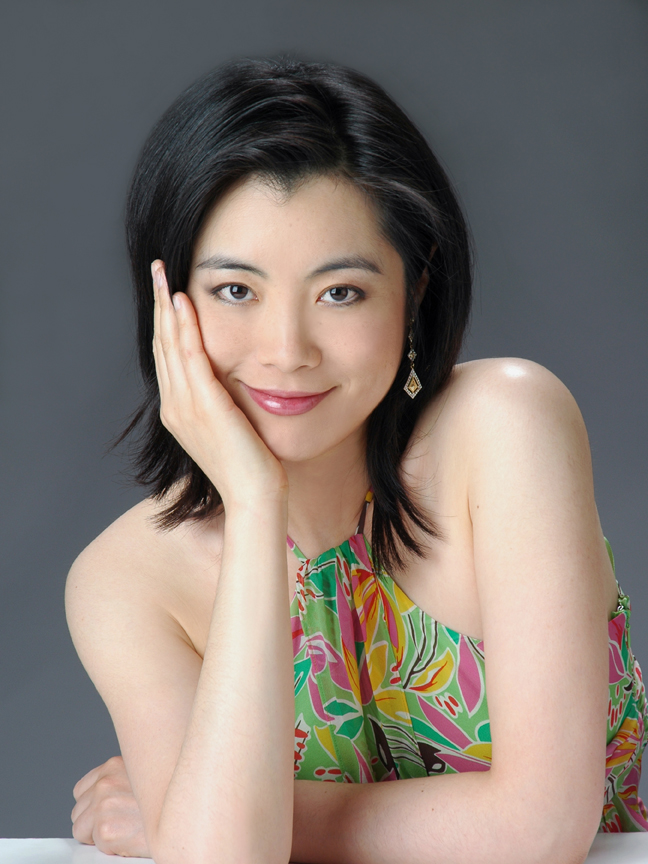
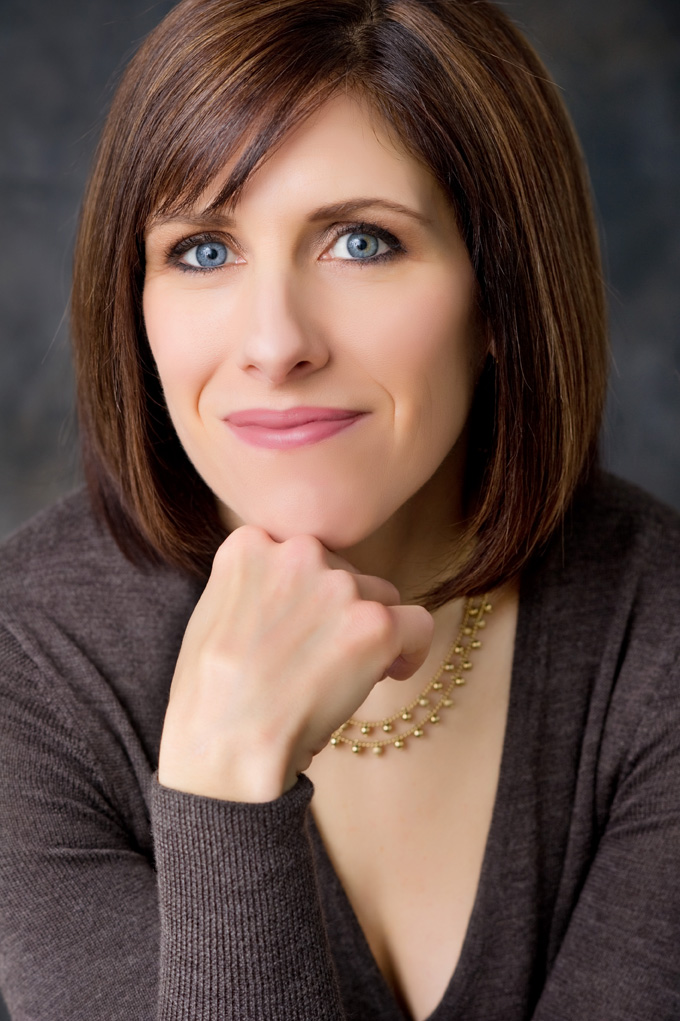
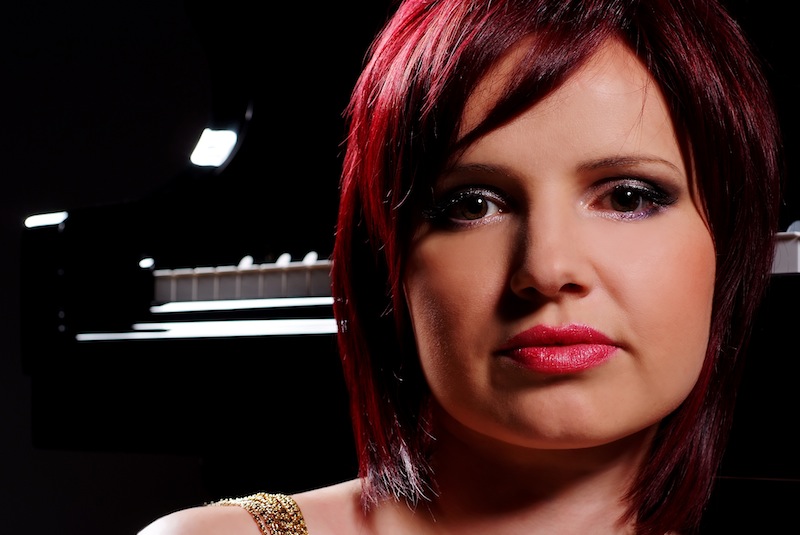
Aglaia Koras devotes much of her performing to the music of Frederic Chopin, and on May 9th, she continued her passion for his music with some Nocturnes, Mazurkas and Etudes, among others. This concert, performed for a packed audience, was presented by MidAmerica Productions. Koras played with elegance–particularly in slower, more serene works, and she performed impressively from memory.

The C-sharp minor Nocturne, Op. Posth., which opened the program, was played exquisitely and poetically. The same could be said of the A minor Mazurka, Op. 67, No. 4 that followed. There was lovely shading and phrasing in both the Barcarolle in F-sharp major, Op. 60 and in the Nocturne in D-flat major, Op. 27, No. 2.

In the Fantaisie-Impromptu in C-sharp minor, Op. 66, Koras could have played more clearly in faster passages, but her devoted, stormy playing was captivating indeed.

In the Polonaise in A-flat Major, Op. 53 (“Heroic”), agitated passages were slightly rushed,

and phrases were sometimes muddied due to over-pedaling. Nonetheless, her audience was very enthusiastic–and so was I, as her eloquence comes across as very heartfelt indeed. A special Kudos to Koras for her insightful programming as well; the “Harp” Etude in A-flat, Op. 25, No. 1 and the “Cello” Etude in C-sharp minor, Op. 25, No. 7 lent an air of orchestration to the evening. Even though Chopin was hardly a symphonist (he is considered to have been a rather uneducated orchestrator), he seemed to enjoy incorporating instrumental sonorities–either consciously or subconsciously–into his piano works.

This season–according to biographical notes–Koras has been invited to perform with the St. Petersburg (Russia) Symphony Orchestra and to perform again with the Beethoven Festival Orchestra at the Kennedy Center Concert Hall. In recent seasons, she was invited to perform an all-Chopin recital in Mexico City and at the Wolf Trap Ball, among other appearances. Clearly, Chopin is in her blood, and audiences consistently fill Weill Recital Hall to hear her play his music.

Share

Samuel Magill, cellist in Review

Samuel Magill, cellist in Review
Beth Levin, piano
Bruno Walter Auditorium
New York Public Library for the Performing Arts
Lincoln Center, New York, NY
May 7, 2011

Samuel Magill

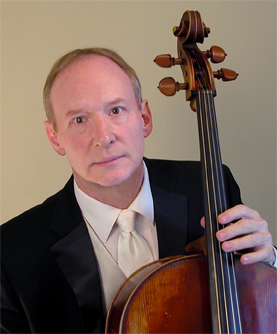
Samuel Magill is a very fine cellist. His technique is solid and disciplined, his tone warm, sonorous and variable, his expressive projection direct and immediate. Trained at the Peabody Institute and Shepherd School of Music, his teachers included Zara Nelsova, Laurence Lesser and Irving Klein. A longtime member of New York’s great Metropolitan Opera Orchestra, Mr. Magill has been Principal Cellist of the New York Symphonic Ensemble, which featured him as soloist in many famous concertos; his Trio, the Elysian, won the 1997 Artist International Award. Mr. Magill has numerous critically acclaimed CDs to his credit, including the first recording of the Cello Concerto by Vernon Duke (Vladimir Dukelsky). His annual recitals at the Bruno Walter Auditorium, begun in 1994, always present a first performance and an unjustly neglected work of the 19th or early 20th centuries.

Mr. Magill’s excellent pianist at this concert was Beth Levin, renowned on stage and disc as recitalist, concerto soloist, chamber musician, and champion of contemporary composers. She made her debut with the Philadelphia Orchestra aged twelve and soon afterwards began to study with Rudolf Serkin at the Curtis Institute. Her subsequent teachers include Leonard Shure and Dorothy Taubman.

The program’s novelty was the world premiere of a new Sonata by Andrew Rudin (b.1939). A student of George Rochberg, he is renowned for his works for the stage and also as a pioneer in electronic and synthesizer music. He has taught at the Juilliard Graduate School, and for 37 years at the Philadelphia Music Academy. He retired in 2001, but continues to compose; the cello sonata was written last summer.

The work is very dramatic and seems to project an air of anguish and loss. The titles of its four movements vividly describe their emotional content: “Proclamation” begins with crashing piano chords answered by the cello; in “Rparteé” and “Discourse,” the instruments engage in agitated or conciliatory conversation, and “Consolation” is a mournful, resigned lament. Entering fully into these contrasting moods, the players gave an authoritative, moving performance, which was warmly received by the audience. The composer was present to share the applause.

The program’s rarity was the Cello Sonata in B minor Op. 27 by the French organist and composer Louis Vierne (1870-1937). A student of Charles Widor, he took over his mentor’s post as organist of Notre Dame Cathedral, and is remembered today chiefly for his organ symphonies and orchestral works. He must have possessed remarkable fortitude: born blind, he regained some sight as a child but lost it again in adulthood, and wrote his late compositions in Braille. He died, as he had wished, while playing the organ. The Cello Sonata is in three movements. A stately Introduction leads to an Allegro moderato; the middle movement is slow and expansive, the Finale fast and brilliant. Influenced by Cesar Franck’s style, the work is very lush and romantic; the players luxuriated in the sound, but kept the expressiveness from becoming sentimental.

The program also featured Beethoven’s Sonata in D major, Op. 102, No. 2, and Debussy’s Sonata in D minor. Playing with complete technical command, sensitive give-and take, and an unerring sense of style, the performers brought out the Debussy’s impressionistic color and whimsical humor, and the Beethoven’s classical austerity; even the counterpoint in the thorny Fugue came through clearly.

Share

Lori Sims, Pianist in Review

Lori Sims, Pianist in Review
Zankel Hall at Carnegie Hall; New York, NY
May 7, 2011
 

Lori Sims


Pianist William Masselos (1920-1992) was honored in a most special way this past weekend, in a tribute piano recital by Lori Sims, presented by the organization Hausmusik. Widely recognized not only as a great pianist in diverse repertoire but as a particularly important champion of twentieth-century American piano music, Mr. Masselos is also fondly remembered by those of us who were at Juilliard during his tenure there as something of an unsung hero — despite his countless enviable achievements. One applauds Hausmusik for paying tribute and also for choosing Lori Sims, a pianist of prodigious abilities, to do so.

Each work on the program related in some way to William Masselos, at times in exact repertoire matches, notably Ben Weber’s Fantasia (Variations), and at other times through subtler connections, well-explained in the pianist’s thoughtful program notes. Rather than playing the “six degrees of separation” game, I prefer to focus on Ms. Sims, whose own personal connections to each work were evident from the first notes onward, and whose masterful readings obviated the need for any extraneous “raison d’etre.”

First off, Ms. Sims gave an extremely taut, precise, and intelligent performance of Copland’s Piano Variations. With an energy that suggested she was spring-loaded, she brought the work electricity and clarity. Nerves of steel are to be expected from a pianist who has won major competitions, including the Gina Bachauer 1998 Gold Medal, but hers are exceptional, unruffled even by the blaring of loud vocal music from some unknown source during her first entrance onstage. The intensity never let up, and Ben Weber’s Fantasia was another tour de force, this time exploiting the pianist’s gift for more romantic, lush sonorities.  What Ms. Sims likened to “Scriabin’s neurotic energy” seemed to abound, and one could only be astounded that after this Weber and the Copland, there were still three Griffes “Roman Sketches” and Barber’s monumental Piano Sonata yet to come (to complete an hour-long “first half”).

The Griffes pieces did provide some impressionistic relief from the musical tension, but only for the audience, as the pianistic demands simply shifted to a different kind of artistry. “The White Peacock” requires a special languid sensuality, and Ms. Sims brought it out to a tee. “The Fountain of Acqua Paola” needs streaming showers of delicacy, expertly colored, and it had just that. “Clouds” had no less mesmerizing an effect.

The Barber Sonata, showing not a trace of fatigue, was sure-fire. While it may not have been this listener’s all-time favorite performance of the work, it was an amazingly polished, assertive close to a first half of mammoth difficulty. Perhaps if one had to pinpoint a reservation about it, it would be that Ms. Sims has such a formidable technique that she made short work of some of its heroic climaxes. In the fourth movement Fugue especially, my favorite performances let loose with an almost ferocious abandon toward the close. Ms. Sims could perhaps be called “unostentatious” (as the honoree, Mr. Masselos, was described by Harold Schonberg), but one wanted to share in the sense of triumph and release that she had so richly earned.

The program’s second part was made up of Clara Schumann’s Romances, Op. 11, Nos. 1 and 3, and Robert Schumann’s Fantasy, Op. 17. These works showed great sensitivity, thoughtfulness, and fervor, and there were many moments of nearly transcendent beauty. Somehow, though, the truly indelible impression was made on this listener by the twentieth-century works. Ms. Sims showed that she has a rare gift for bringing audiences closer to these works, and it is a gift that should continue taking her to new musical heights.

Share

Continuum in Review

Continuum
Merkin Concert Hall, New York, NY
May 1, 2011
 

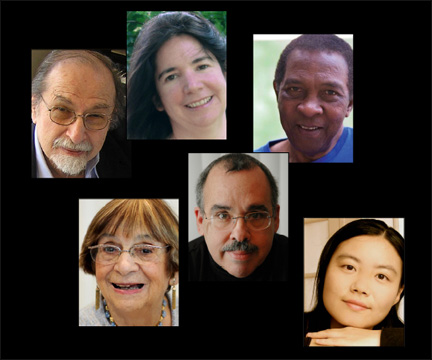
Top: Elliott Schwartz, Ileana Perez Velázquez, Carman Moore; Bottom: Ursula Mamlok, Roberto Sierra, Wang Jie


You can be fairly sure you are at a Continuum concert when the “earliest” music on the program dates from 1998, when everything else is a New York or World Premiere, and when you hear music differently for at least several days afterward. Such was the case recently at Continuum’s 45th birthday concert. They continue, as they have indefatigably for decades, to bring us fascinating music by relative newcomers and composers of international stature.

U.S. composer Carman Moore (b. 1936) was featured first, in a work entitled “SHE”  (An Appreciation – 2010) scored for an ensemble of four, including soprano, violin, clarinet, and piano. Organized according to what the composer describes as “the five archetypes of female life,” (from infancy through old age), this imaginative and involving work weaves quotes of Lord Byron, Lucretius, Sun Bu-Er, and Basho into the composer’s original text, a paean to women. An intriguing conception, its was brought to life appropriately by the four extremely gifted female performers.

Veteran Continuum violinist Renée Jolles shone next in a virtuoso performance of Sonata para violin y piano (2010) by Roberto Sierra (b. 1953). A tour de force requiring sensitive dovetailing with the pianist, precision in what Sierra calls “my own versions and transformations of Caribbean rhythms,” and tireless technique for just about every violin challenge in the book, it was handled with an ease that was impressive, especially considering that Ms. Jolles was engaged onstage for all of the roughly seventy minutes before intermission.

Using the same instrumentation as “SHE,” Continuum concluded its first half with “A Longing for Spring, A Multi-language Song Cycle” (2011) by Shanghai-born Wang Jie (b. 1980). Set to a Tang Dynasty poem by Tu Fu (712-770 AD) the work’s evocations of nature, war, torment, and tears were enhanced by super-titles and calligraphy projected onto a screen. There were so many ways to appreciate this composition, through sight, sound, and meaning, that interest never lapsed. One could not possibly grasp it all in a single hearing, but Ms. Wang’s multi-faceted work will undoubtedly earn future performances. She is certainly an artist to watch.

Some of my favorite music of the evening was in the opening of “Idolos del sueño”  (“Dream Eidolons” – 2010) by Cuban-born Ileana Perez Velázquez (b. 1964). Soprano, clarinet, violin, cello, and piano conveyed the transparency of water and ephemeral reflections in an almost miraculous way, drawing the mesmerized listener into the world of Cuban poet Carlos Pintado. Not all of the work held me quite as strongly as the beginning, but I do look forward to hearing more by this talented composer.

Continuum paid tribute next to the 75th birthday of Elliott Schwartz (b. 1936) with a performance of his “Vienna Dreams” (1998), an appealingly nostalgic trio for clarinet, viola, and piano using fragments of Mozart, Schubert, and Brahms (and as the notes suggested, the presence of Mahler and Schoenberg hovering nearby). It was given a winning performance, as was the finale of the concert Mosaics (2011) by Ursula Mamlok (b. 1923). Mosaics, a four-hand piano work composed with a particularly artistic use of serialism, combined the forces of the ensembles founders, Joel Sachs and Cheryl Seltzer, in a fitting close to a celebration of 45 great years.

All works benefited from excellent performances of Mary Elizabeth Mackenzie, soprano; Moran Katz, clarinet; Renée Jolles, violin; Stephanie Griffin, viola; Christopher Gross, cello; Joel Sachs, piano; and Cheryl Seltzer, piano.

Share

Joyce El-Khoury, Soprano in Review

Joyce El-Khoury, Soprano in Review
Olga Koussevitzky First Prize Winner; The Musicians Club of New York
Natalia Katyukova, piano
The A&D Building; 150 E. 58th Street; New York, NY
April 28, 2011


Joyce El-Khoury has an absolutely glorious voice that can easily project to the last row of the balcony in any opera house. Her top register is exquisite because she can belt it with great authority, but can also allow it to float to pianissimo, with subtle colors.

She also has a marvelous dramatic and stylistic range. Going from Puccini’s “Chi il bel sogno di Doretta” to Verdi’s “Arrigo, ah, parli a un core” is no easy task, but she conveyed the requisite strength and innocence when necessary. And her varying abilities with diction and style were confirmed with a mesmerizing performance of “Song to the Moon” from Dvorak’s “Rusalka”. Singing in Czech, she lent a unique solemnity and vulnerability to the music. Ravel’s “Sheherazade” was tender and abundantly seductive and expressive. The lavish orchestra part, transcribed for piano, is difficult for the pianist, but Natalia Katyukova did an amazing job of recreating the symphonic colors. In addition, she was able to play her multitude of notes flawlessly in low light and without a page turner.

In Verdi’s “E Strano…” aria from “La Traviata”, she pulled out all the stops, bringing intense timing to the silences as well as great beauty to her entrances. Her sheer volume of sound is so powerful at times, that the chandelier seemed to sway along with the music. Dramatically, she was always in the moment, even when Katyukova had a lengthy tutti section at the piano. This was top-tier singing and music-making; the chemistry between El-Khoury and Katyukova was palpable throughout the evening. Unfortunately, the concert was not publicized in the right places, as there were too many empty seats. As beautiful as the Architects and Design (A&D) Building is, Steinway Hall (where the winner’s recital was last year) brings in more people. There is no doubt that a performer with El-Khoury’s credentials is an excellent draw; she sings at the MET and with orchestras such as The Munich Philharmonic. She has an exciting future ahead of her.

Share

Alexander Beridze, pianist in Review

Alexander Beridze, pianist in Review
Alice Tully Hall at Lincoln Center, New York, NY
April 19, 2011
 

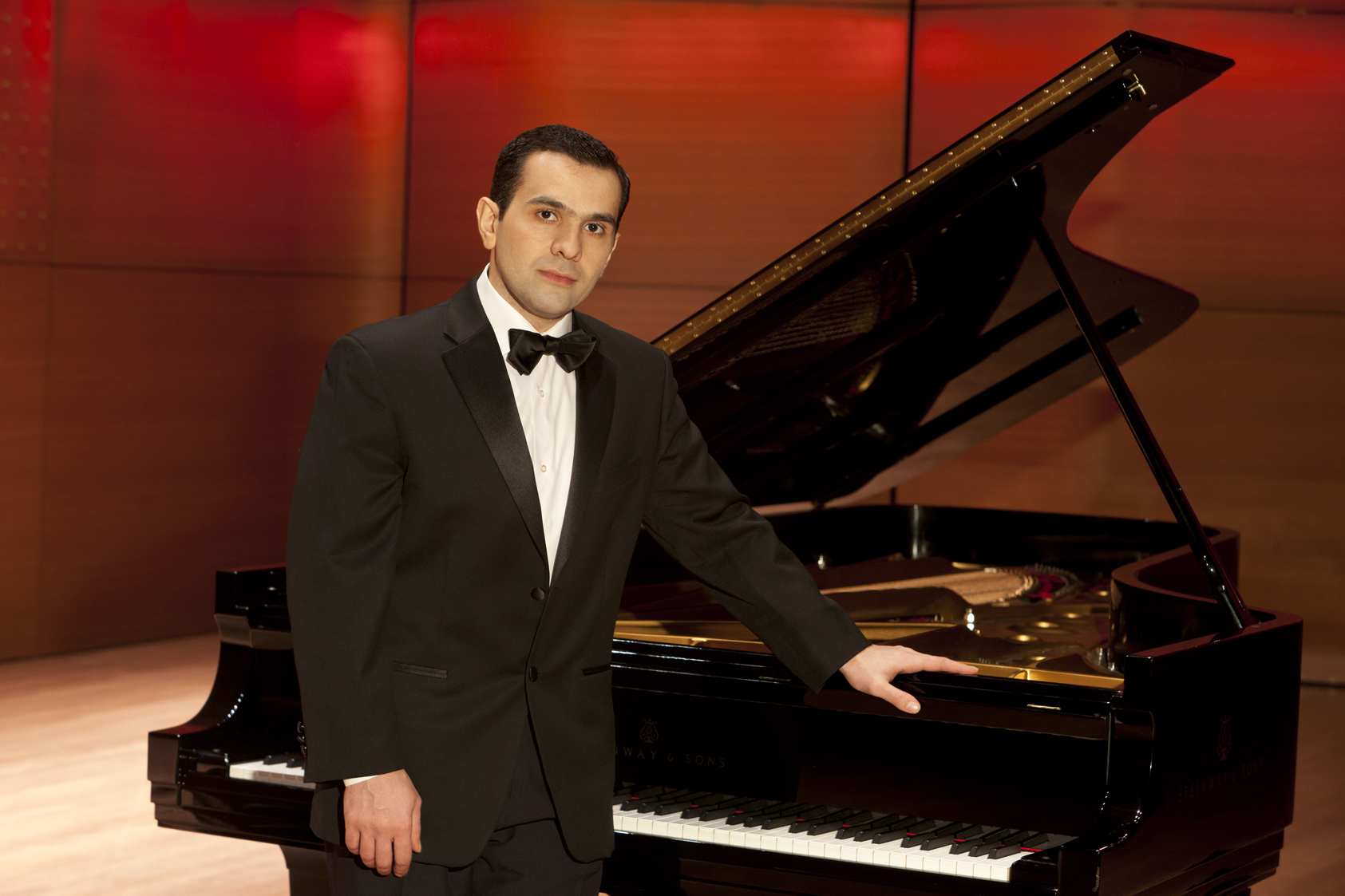
A large audience packed Alice Tully Hall this week to hear Georgian pianist, Alexander Beridze, representing the Cincinnati-based World Piano Competition as its 2009 Gold Medalist. In a year flooded with news stories about troubles in the classical music world, it was a joy to witness such intense audience excitement in anticipation of an evening of piano music. This listener was filled with particularly keen anticipation after hearing and reviewing Mr. Beridze in June of 2009 (Vol 17, No.1) in an outstanding recital that included two of the same works, the Brahms Sonata in C Major, Op. 1 and Stravinsky’s Three Movements from Petrushka. Though the prior venue had been a piano showroom, Mr. Beridze had sustained the large, magnetic conceptions that had seemed destined for a wider forum – and here was that forum.

After speeches by the competition’s administrative and local leaders, Mr. Beridze opened with Beethoven’s 32 Variations in C Minor, dispelling the atmosphere of pageantry with a taut and no-nonsense performance from solemn opening to stirring finish. While I prefer more breathing room in this work, it was understandable to feel a good deal of forward propulsion at the outset of this important recital. It was a strong opening.

Brahms followed Beethoven, a nice segue given the Opus 1’s famous rhythmic kinship with Beethoven’s Sonata Op. 106 (the “Hammerklavier”). Mr. Beridze is utterly at home with the challenges and beauties of this Brahms work and should play it often. One hopes he will play it again in a still more resonant hall, as (even post-renovation) the Alice Tully Hall acoustics present a pianist with the challenge of rapidly decaying sound. Having heard Mr. Beridze’s formidable gifts in a live room on a brighter instrument, this listener was especially sensitized to the discrepancy between what was being put forth and what was being received. That said, the musical intent did come across, and it was a credit to Mr. Beridze’s skill and heroic outputs of energy. The rapid-fire leaps and riveting machine wrist work left one in wonderment (and excitement to hear this pianist’s Petrushka later in the program). Just as recalled from two years ago, the close of the Andante was particularly moving.

Schubert’s Impromptu Op. 90, No. 3 after intermission was a quiet gem, given admirable attention to voicing. Acoustical challenges still arose, leaving one wondering whether the decay of longer notes might be offset more by softer ensuing ones, but at any rate, Mr. Beridze projected its meditative quality with sensitivity. The Schubert-Liszt song “Auf dem Wasser zu Singen” followed, dazzling with its precision and range, and Liszt’s Etude “La Campanella” was simply electrifying.

If anyone still had questions about Mr. Beridze being a fabulous pianist, his Petrushka settled the matter conclusively. This work, a monstrous beast to most pianists, seemed simply a play toy to him, albeit a musical and imaginative play toy. One sensed the pianist having fun with it, delighting in the ballet’s characters and celebrating what was a brilliant finale to a superb recital. Bravo!

The cheering audience was quieted down with one of the most beautiful renditions of the Chopin Nocturne in D-flat (Op. 27, No. 2) that one can recall. One could hear the proverbial pin drop.

Share

New Asia Chamber Music Society in Review

 New Asia Chamber Music Society in Review
Weill Recital Hall at Carnegie Hall
April 19, 2011 
New Asia Chamber Music Society

New Asia Chamber Music Society; Photo Credit: Richard Termine

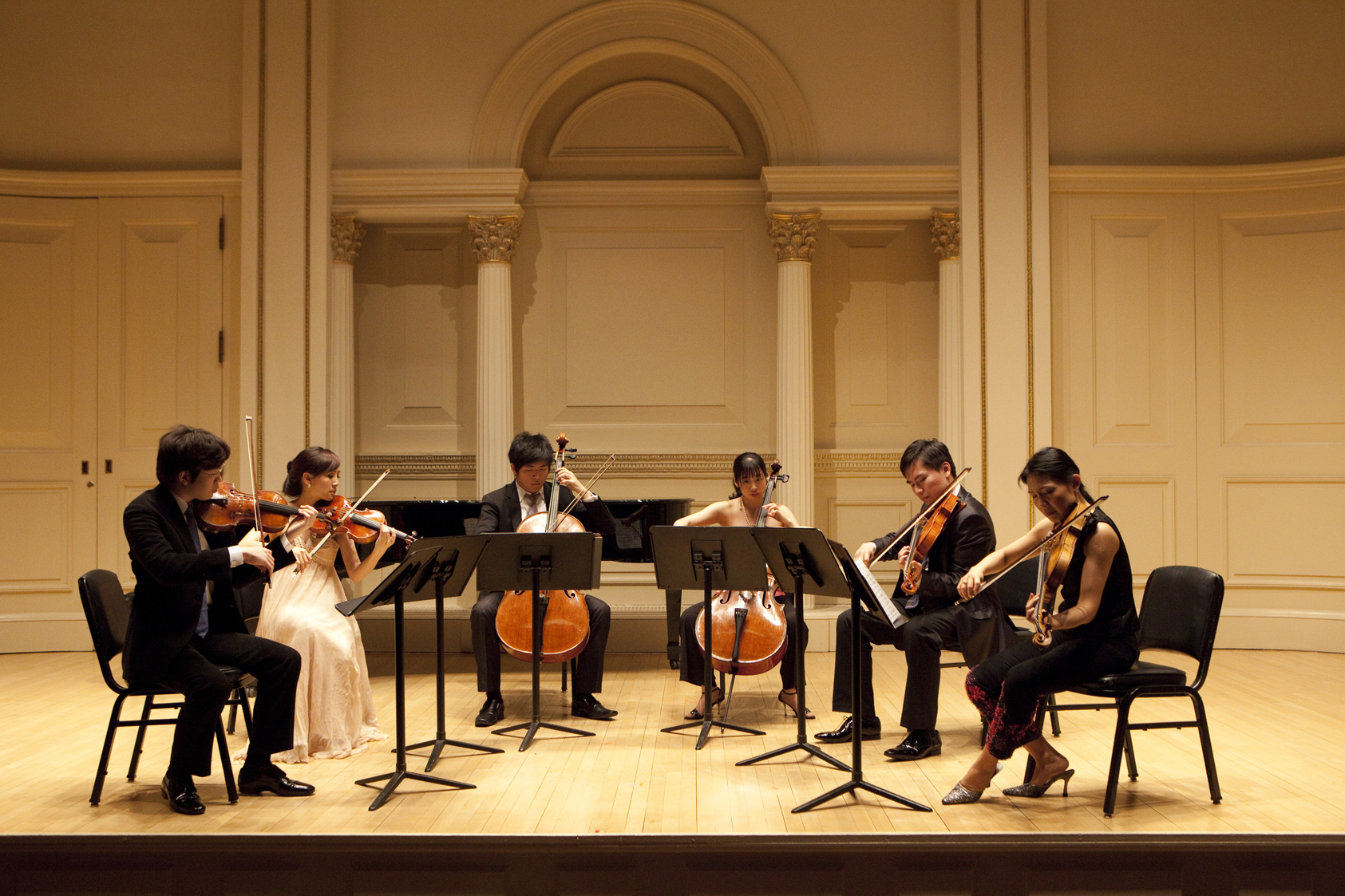
There is an infusion of fresh blood in the chamber music world, if the recent performance by the New Asia Chamber Music Society is any indication.  This newly formed ensemble, comprised of many young and gifted players, is an impressively organized and professional group.  Their debut at Weill Recital Hall was tight and well rehearsed, which allowed the players to make music with sense of pleasure and spontaneity. 

In the Brahms F minor Quintet, the heart of soul of this particular performance rested squarely with the cellist Nan-Cheng Chen and the violist Wei-Yang Andy Lin.  Mr. Chen is a natural musician, who plays with a beautiful, singing tone and a keen awareness of ensemble.  Mr. Lin, just as integral, but in a quieter way, is an ideal collaborator.  He uses vibrato as a measured, expressive tool, and his pure intonation anchors the group.  Although this quintet didn’t quite master the blend and uniformity of style that more seasoned players achieve, this was still a compelling performance.  The use of nuanced dynamics and articulation, especially in the middle movements, gave texture and life to the music.  Mr. Lin spun a pristine, cantabile melody in the Andante second theme, and the entire ensemble dispatched the Scherzo with breathtaking fire and precision.

Jay Lin’s, “…as time flows and eclipses…” was given a dark hued, richly vibrant reading by the New Asia players.  Mr. Lin has a real gift for layering sound and color to create tension.  Both his piano writing and his shimmering string figures sounded fresh and evocative.

The program finale, Tchaikovsky’s Sextet, op. 70 (Souvenir de Florence) was the least convincing offering on the program.  All the elements that go into a good performance were present.  Each individual made important, musical contributions to the whole, yet there were whole passages in which the players seemed to have conflicting ideas about interpretation.  The Adagio movement especially felt too tightly controlled, so that I missed that floating, Italianate quality.  This is a piece that would benefit from more instinctual impulses.

In general though, this is an ensemble of a very high standard.  I enjoyed their music making and I congratulate them on generating a large and enthusiastic audience.

Share

Alexej Gorlatch, Pianist in Review

Alexej Gorlatch, Pianist in Review
Zankel Hall at Carnegie Hall
April 14, 2011

Alexej Gorlatch; Photo Credit: Akira Muto

Judy and Arthur Zankel Hall, part of the Carnegie Hall complex, presented Alexej Gorlatch on April 14th as the First Prize winner of the AXA Dublin International Piano Competition. Gorlatch, who is 22 (born in Kiev, in 1988), was also the Silver Medalist at the 2009 Leeds International in the U.K., where his performance of Beethoven’s “Emperor” Concerto elicited a glowing comment from the Guardian (Manchester): “…immaculate in its poetry and aggression.” Those two characteristics, when you think of them, are more apt than conflicting for that particular Beethoven masterpiece; certainly Gorlatch’s technically superb pianism at the Zankel recital was impressive for its “poetry” but, let’s face it: any hopeful who could enter–and triumph–at so many daunting marathons would, ipso facto, be an “aggressive” and determined, self-assured contender!

Mr. Gorlatch’s burgeoning career has been adorned by a succession of prizes and honors since he was eleven-years-old. To name some: the German National Jugend Musiziert Competition (several times); the Steinway Competitions of Berlin and Hamburg; the Grotien Steinweg in Braunachweig; and the Robert Schumann Competition for Young Pianists in Zwickau, where he was awarded the Yehudi Menuhin Prize for best participant. He garnered prizes at the Vladimir Horowitz International Competition in Kiev and at the Chopin International in Warsaw.

In fact, this writer covered the then 18-year-old artist’s April 4, 2007 recital at Weill Hall when he came to us as the winner of the 2006 Hamamatsu International Competition (reviewed in Volume 14, No. 3 of this magazine.) His program at the time included the Beethoven Sonata, Op. 101, Schumann’s Fantasy Pieces, Op. 12, and all twelve Chopin Etudes, Op. 10. I praised his Beethoven as “structurally clear, tautly organized and sensibly clarified…a young man’s approach…Though additional areas of experience and insight may undoubtedly reveal spiritual mysteries, Gorlatch’s way was certainly on the right track.” The Schumann tone poems were “thoroughly idiomatic: clearly and simply phrased and free from affetuoso point-making… His playing represented the best of the best of the admirable Teutonic tradition (Gorlatch has been living and studying in Germany), with warm, robust down-to-the-bottom-of-the-keys sonority, yet with sufficient glow and color and ardent rhythmic vitality.” At that time, I was not quite so contented with Gorlatch’s performances of the Chopin Etudes: “Having praised his purposefulness, it seems churlish to remark that I wish he would loosen up a bit. Playing a concert also has a side potential for entertainment, and although I certainly don’t want ‘cuteness’ and pandering to an audience, I daresay that there is room for a bit of drama and communication…Mr. Gorlatch is obviously a great talent, but as he develops, he will realize that a performer can also be communicative and be fun to listen to…’’ That was when he was 18.

I am particularly pleased to report that at this concert–four years later–he showed just the type of growth I would hope for (and expect) from an already promising artist. His performances of Beethoven’s Op. 110, Bartok’s “Out of Doors”, Four Debussy Preludes and a Chopin group had far more nuance, flexibility, color, and humor. The Beethoven sonata was notable for its almost operatic cantabile, and the pianist brought out innumerable, cherishable passing felicities. I am a bit surprised, however, that he chose to divide the runs in the first movement between the hands (as Beethoven himself calls for in the E major recapitulation later on), but this is a miniscule quibble.

The Bartok had great sensitivity and a feeling of detached understatement. The accuracy and precision were indeed awesome, although the requisite calm and repose of “The Night’s Music”’s insect noises were judiciously recreated against an unusual backdrop of anxious momentum. The opening “With Drums and Pipes” and the culminating “The Chase” were unusually subtle, but a bit too refined. Gorlatch’s way with the Bartok reminded me of Perahia’s sensitive interpretation.

One could say the same thing about the Debussy which–high praise indeed–were in the Gieseking tradition. He elicited a beguiling fragrance in “Les Sons et Parfumes Tournent dans du Soir” (from Book II) and an almost troubadour like declamation of “La Fille aux Cheveux de Lin” that made it seem it was being improvised on the spot. For once, “Feux d’Artifice” (Book ll) sounded decorative and entertaining (not the usual bombastic firecrackers that burn your hands!). “Ce qu a vu le vent d’Quest” (Book l) similarly may have been more notable for its delicacy than its Katrina-like ferocity; but its sophistication ultimately won me over.

In the concluding Chopin group, the “Barcarolle”–a bit laid-back at first–did summon a modicum of drama; the ending run was terrific. Four Mazurkas from Op. 67 and 68 were undulant and dance-like; (the A minor, Op. 68, with its trills, was played “Lento”– a slow dance, not “Lento” as a dirge); I liked its curvaceousness. The A-flat Polonaise, Op. 53, a mite small-scaled for my taste, was almost too easy for him; the famous octaves went by astonishingly and fleetly well. (But Rubinstein’s sui generis interpretation will always stubbornly retain my loyal affection).

And I am delighted to observe: Mr. Gorlatch’s new stage presence has livened up gratifying well. He gave us two encores: the c-sharp minor Etude, Op. 10, No. 4 was almost Richter-like in its brilliance and headlong tempo; and the E-flat Waltz, Op. 1 came forth with intoxicating dazzle.

A wonderful concert!

Share

Jourdan Urbach, Violinist in Review

Jourdan Urbach, Violinist in Review
Karen Beluso, Piano
Le Poisson Rouge; New York, NY
April 1, 2011


April 1st was host to a Children Helping Children benefit concert held at Le Poisson Rouge, a popular music venue and bar in downtown Greenwich Village. CHC’s young, exuberant founder and director, Jourdan Urbach, delivered a vibrant, virtuosic violin performance with the help of his much-appreciated pianist Karen Beluso. (Joining the dynamic duo later in the program was mezzo-soprano Gabrielle Lowell.) The evening featured arrangements of jazz-age golden oldies, as well as a number of Urbach’s original compositions.

Urbach started out the night strong with a lighthearted rendition of George Gershwin’s “Porgy & Bess”, arranged by “3 nice, Jewish boys” (Gershwin, Heifetz, and Urbach), as comically noted in the program. Evident the moment he picked up his bow, the 19-year-old’s playing was superlative in every way. Urbach exhibited both impeccable technique and exquisite artistry in each piece that graced the room, reveling in the jazz and country undertones that flowed throughout the concert. Glimmers of a smile could be seen on the Yale student’s face whenever he executed a graceful portamento or flawless up-bow spiccato. In his difficult arrangements and compositions, Urbach is a violinist that dares to challenge himself and thrives. Beluso followed him perfectly, although the level of some of the compositions and arrangements would have been raised that extra notch had she been more featured.

The casual nature of the evening continued despite a few short interludes, concluding with the New York premiere of “Hope”, an operatic song cycle by Urbach. Gabrielle Lowell’s delivery of Emily Dickinson poems in English, Spanish, and Yiddish was appealing, but the work was not particularly memorable. Understandably, Urbach’s strength was manifested in the beginning and middle portions of the program, during which he made use of his classical education and signature blues style. The public should keep an eye on this up-and-coming philanthropist-musician. He is apt to go far on his own ambition, delighting audiences every step of the way.

Chelsea Blakeburn for New York Concert Review; New York, NY

Share

Birmingham Symphonic Winds in Review

Birmingham Symphonic Winds in Review
Keith Allen, conductor
Alice Tully Hall; New york, NY
April 17, 2011

Birmingham Symphonc Winds


 In the last three years I have reviewed three superb choral ensembles brought to New York by Distinguished Concerts International New York (DCINY.) The high standards of DCINY were again reflected in this performance by the Birmingham Symphonic Winds (BSW). Founded in 1992 by conductor Keith Allen, this forty-five member English group was begun to “meet the demands of players in the area to perform with a high quality wind ensemble.” And one couldn’t ask for higher quality playing. From beginning to end, this very youthful ensemble played with perfect intonation and beautiful blend. The conducting of maestro Keith Allen was unobtrusive and precise. And his comments between movements created a warm bond with the very enthusiastic audience.

 Titled “Atlantic Crossing,” the concert featured eleven works by British and American composers. It opened with a rousing performance of “Second City Ceremony” by Phillip Sparke, the title alluding to Birmingham’s relationship to London, England’s “first city.” Designed as a concert-opener, this work was one the five BSW commissions we heard this afternoon. Upon hearing the fortissimo opening fanfare, I worried that the sound produced by the ensemble at full throttle was too loud for Tully Hall. And although this feeling returned once or twice during the concert, these loud sounds were never harsh or even edgy. They were unforced and viscerally exciting, if at times a bit too much for this listener’s ears

 Another commission followed, Nigel Hess’s “Shakespeare Pictures.” The first movement used the same jazzy language we heard in “Second City Ceremony,” the second featured lovely playing by the solo woodwinds, while the third juxtaposed perfectly blended sounds by the brass and woodwind choirs, something which we would hear throughout the afternoon. “Prelude from 49th Parallel,” part of an orchestral film score written in 1941 by Ralph Vaughan Williams, was then performed in a transcription for band by Leroy Osmon. During this work I found the BWS’s playing to be wonderfully expressive.

  Although a bit more dissonant than the works by Sparke and Hess which preceded it, Guy Woolfenden’s “Divertimento for Band” featured more of the same jazzy language and, in the last movement, a similarly easy-listening-melody. Emma Stockdale’s second movement flute solo was quite beautiful. Mr. Sparke’s “A Weekend in New York” then called on all the big-city clichés, including bent minor thirds. I found the performance a bit stiff, especially the sections which should swing.

 A fourth BSW commission ended the concert’s first half, and what an ending it was! Martin Ellerby’s “The Canticle of the Sun”, a work for solo percussion and concert band composed in 2006, was written for this afternoon’s soloist, Simone Rebello. While a piano soloist sits at a keyboard and a violinist stands in one spot, Ms. Rebello moved between the many instruments which stretched from one side of the stage to the other. She used a violin bow on the vibraphone, she expressively played chords on the marimba using four mallets, she perfectly executed very rapid scales on the xylophone, she played drums, cymbals and crotales. It was a pleasure to listen to and a thrill to watch.

The oldest work on the concert began the second half, a transcription for wind orchestra (sic!) of “Jupiter” from “The Planets” by Gustav Holst. Although it was composed almost one-hundred years ago, it seemed to me that many of the more contemporary works heard on the first half of this concert, save for being a bit more dissonant, utilized a similar musical language. Next we heard two movements from another work with soloist, Karl Jenkins’s “Euphonium Concerto,” featuring David Childs. I have a soft spot for the euphonium, having always marveled at its ability to sound like singing. And that’s just what Mr. Childs accomplished during his performance of the Romanza as his expressive phrasing was the kind that you would hear in song performed by a great baritone. And yes, in the last movement we heard him play at a speed that even a trumpet player would have difficulty reaching. The audience marveled at this display, but I found the rapid line to be blurry. This was not the performer’s fault – it’s the physics of a very long tube.

After the concert’s first American work and another BWS commission, the regular program concluded with John Philip Sousa’s “Humoresque on Swanee.” These humorous variations on George Gershwin’s first big hit, followed by an encore, Gershwin’s “Strike up the Band,” brought this wonderful concert to a rip-roaring happy conclusion. 

Share