Julie Boulianne, mezzo-soprano in Review

Julie Boulianne, mezzo-soprano in Review
Metropolitan Opera, New York, NY
March 2 and 3, 2011
Follow up to review of October 28, 2003

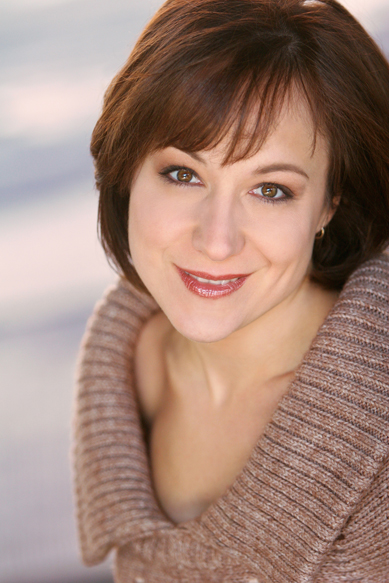
Julie-Boulianne; Photo Credit: Dennis Kwan

One of the rewards of being a music critic is having the opportunity to anticipate the success of a young performer. Seven and a half years ago, my review of Julie Boulianne’s New York debut recital began: “It took just one or two phrases to realize that mezzo-soprano Julie Boulianne, Joy in Singing’s 2003 Award Winner, is a great talent – a beautiful voice, a strong technique, a compelling stage presence.” And in the last paragraph I stated: “Her performance of the aria from ‘Les Huguenots’ leads one to anticipate success on the opera stage.” Recently I had the pleasure of hearing Ms. Boulianne on the stage of the Metropolitan Opera, singing small but attention-grabbing roles in performances of Glucks “Iphigénie en Tauride” (March 2nd) and Gounod’s “Roméo et Juliette” (March 3rd.) And “success on the opera stage” it was!

In “Iphigénie en Tauride” Ms. Boulianne performed the role of the goddess Diana. As any deus ex machina should, she made her entrance rapidly dropping from the fly space above the stage while suspended by a wire. (I wonder how it must have felt beginning her Met debut on February 12th in such a manner.) In 2003 I heard her in the intimate confines of Merkin Concert Hall. But how would she fare on the vast stage of the Metropolitan Opera House? I am happy to report that her rich voice filled the hall (I was sitting in the balcony) and she commanded the stage just as the goddess she was portraying should.

When singing the pants role of Stephano in “Roméo et Juliette,” she had the stage to herself at the beginning of Act III. No longer as a goddess, but this time a young man, she sang her aria with impetuous abandon and was most convincing in the sword fight which followed.

These two fine performances give us a taste of what Ms. Boulianne is capable of. To again quote from my October 28, 2003 review: “This listener would relish the chance to hear her Cherubino.”

 Harry Saltzman for New York Concert Review; New York, NY

Share

Karen Hakobyan, composer and pianist in Review

 Karen Hakobyan, composer and pianist in Review
Weill Recital Hall at Carnegie Hall
March 1, 2011

Karen Hakobyan

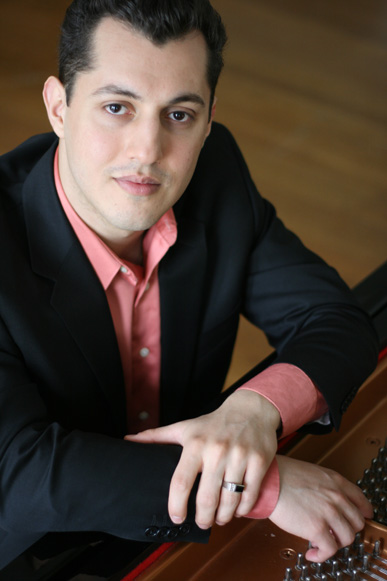
 No one who was in attendance at the recent concert of works by Karen Hakobyan could possibly have felt shortchanged.  The Armenian composer and pianist, a musician of abundant gifts and bountiful ideas, structured an evening that was a survey of both his compositional development and his facility in writing for varied instrument groups.  Mr. Hakobyan’s precocious enthusiasm for making and writing music is infectious.  Indeed, it is a testament to him that all the musicians who performed his works, most of which were fiendishly difficult, seemed relaxed and fully engaged.  My major reservation with this program was with its length.  Simply put, there were just too many pieces to digest.  A little shaping and editing would have shown the composer’s strengths in a better light.

By his own description, Mr. Hakobyan’s earlier works dominated the first half of the program.  Although Elegie for Violin and Piano (1999) is a product of a fourteen year old’s imagination, it still provided some technical challenges for its players.  All the hallmarks of the composer’s voice were already in evidence in the Elegie – virtuosic passagework with fistfuls of notes, and the juxtaposition of different stylistic sensibilities (late Romantic, early to mid – Twentieth century.)  These, and a mania for fugues, were woven, in some form, into the next four works, a Prelude and Fugue for Piano, a stunning Toccata for Solo Flute, and two pieces for string quartet.  The string quartets, in particular, showed a more developed palette of dynamics and layering of voices.

The musical language that was introduced in bits in the beginning of the program was pervasive after the intermission. Of these later pieces, the strongest were the Suite for Solo Violin, the Trio for Flute, Clarinet and Piano, and the brilliant Piano Variations, op. 1.  As is often the case, Mr. Hakobyan’s assets are also his weaknesses. He is never at a loss for ideas, but those ideas would carry more weight if there were less of them.  Having said that, the sheer virtuosity of his more successful ventures was a delight to hear.  All of the performers were of a very high standard, but special kudos must go to the flutist Emi Ferguson and the violinist Guillaume Molko.

Share

Musicians Club of New York in Review

Musicians Club of New York in Review
Music by Paul Kirby and Jon Liechty
Liederkranz Club; New York, NY
March 1, 2011

Paul Kirby


In an evening filled with anecdotes and a variety of styles, Paul Kirby’s works often inspired and entertained. And he played well at the piano too. In “Remembrance,” from Songs without Words, Kirby’s delicate strands were reminiscent of the tender song “Time to Remember” from “The Fantasticks.”   His next work could not have been more different. “Theme and Variations for Violin and Piano”, which began in 1967 during student days, is a meticulous 12-tone composition for violin and piano. It also has its own bluesy, lyrical appeal–some of that music written much later–as late as 2008. The contrast in styles, which reflects the ever-changing direction of music in the last forty years, was interesting indeed. The violinist was Elliot Rosoff, and Kirby continued at the piano. They blended extraordinarily well–even in tricky spots. Although the venerable Rosoff had some bow control issues, he sustained the audience’s attention with his stage presence and devotion to the music. 

In a return to more theatrical music, Kirby’s “Would She Remember,” from Musical Theatre Songs, was charming and eloquent. Philip Anderson sang his lovely tenor with deep involvement and charisma. 

Jon Liechty’s Trio for flute, violin and piano had lovely moments, although the last movement entitled “ A Last Goodbye” droned on a little too long. The music was also a bit too simplistic with its arpeggiated writing in the movement “Solemn Reply”. Liechty played well at the piano and was joined by flutist Enrico Sartori and violinist Mario Gotoh, who lent fine support. Liechty’s playing was more mechanical in his work “Crash Test”, but then it had to be. The work, which is hard-edged and robotic/computer-like, has a very repetitious nature. But as evocative as the piece is, it does grow rather tedious. 

Kirby’s “Markings” from 1992 varies stylistically based on the text. The work is lovable, although it has moments that lack originality. In “Tired and Lonely,” for example, you feel the presence of Gershwin’s “Porgy and Bess” for too long a period. But in other sections, Kirby was quite innovative, such as when he used a wind machine while sitting at the piano. Other places hinted at Berg, Prokofiev and Kurt Weill–but only hinted, which is good, for you can see Kirby does have his own voice. Philip Anderson certainly has his own voice too, as his high tenor is sweetly distinct, and here–even though he was sometimes covered by the piano set at full stick–he again brought out all the mood changes with conviction.

Share

Texas Christian University Wind Symphony in Review

Texas Christian University Wind Symphony in Review
Bobby R. Francis, conductor
Texas Christian University Jazz Ensemble
Curt Wilson, conductor
Stern Auditorium at Carnegie Hall
February 24, 2011


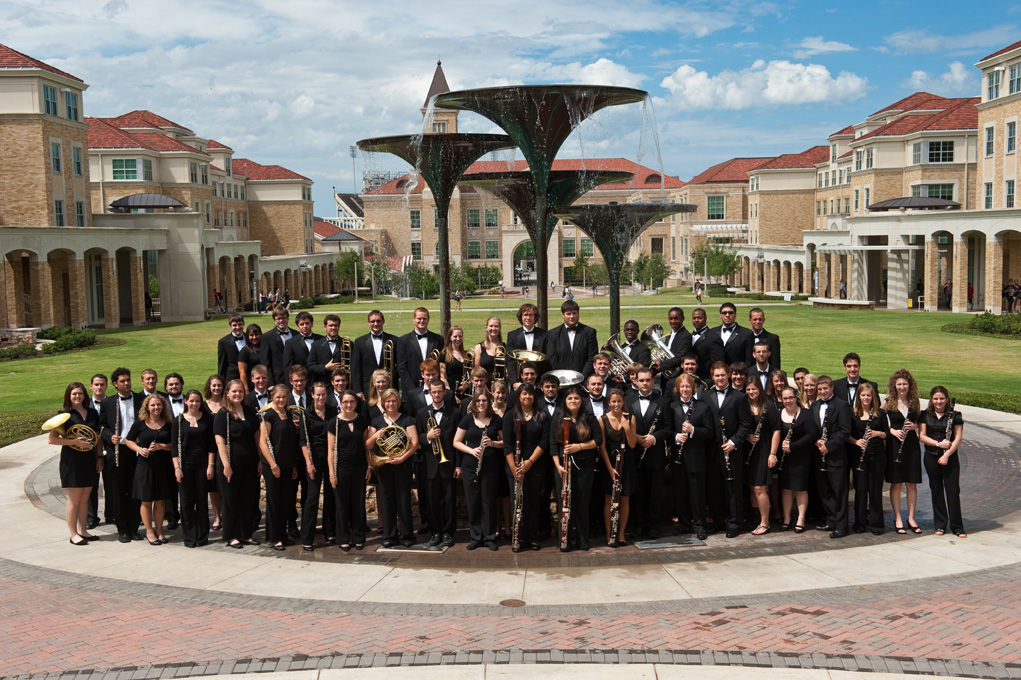
Texas Christian University brought its wind, brass and percussion players to Carnegie Hall, and I for one was pleasantly surprised regarding the extremely high quality of these young players. When the first-rate American Brass Quintet appeared on stage as guest artists, for example, they didn’t put these students in their place by comparison; on the contrary, everyone blended in so well that it was difficult to differentiate between the students and the pros.

Joseph Turrin’s excellent “Jazzalogue No. 1” from 1997 opened with a finely tuned, polished sound. The contrapuntal entrances were well placed and the balance was very clear. Jeremy Strickland, guest conductor, deserves kudos for preparing them so thoroughly. Patrick Williams’ Rhapsody for Concert Band and Jazz Ensemble was equally excellent, as guest conductor Curtis Wilson did a splendid job coordinating the many entrances.

John Mackey’s “Hymn to a Blue Hour,” composed last year, is a beautiful, stately, solemn work that was performed with deep commitment and excellent intonation. Here, guest conductor Brian Youngblood deserves credit for the preparation. Anthony Plog’s “Concerto 2010” is a solidly structured work with often pungent harmonies and raw melodic voicing. The percussion has a lot to do, and they were excellent, except that the xylophone was ahead of the brass in spots.  The harmonic style changes a bit too abruptly, but not nearly as much as in David Maslanka’s amateurish and eclectic Symphony No. 8 from 2008. Not only is it cliche and basic in its tonal language and counterpoint, the chordal changes and sectional transitions were often shockingly random.

In any case, these young musicians and their conductors deserve much credit for their topnotch performances of all the works on the program. They made a great impression.

Share

The Texas Christian Percussion Orchestra in Review

 The Texas Christian Percussion Orchestra 
Merkin Concert Hall, New York, NY
February 23, 2011

The Texas Christian Percussion Orchestra

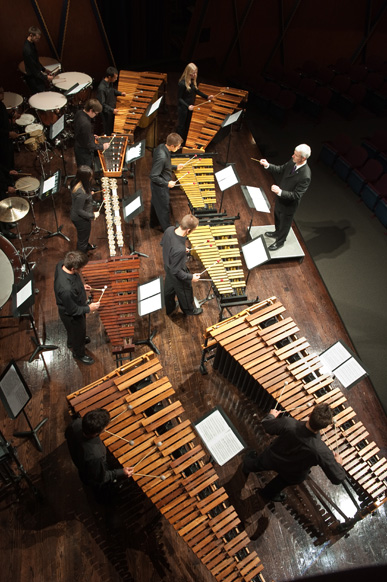
In a very fine recent concert by the TCU Percussion Orchestra at Merkin Hall, the group was especially notable for two remarkable assets.  The first was a fluidity of talent, allowing several different players to shift from one instrument to another with apparent ease and expertise.  In this era of specialization, it was a pleasant surprise.  The second was a sensitive awareness of balance, something rare in young musicians (or musicians in general, for that matter.)  It was nice to hear finely graded dynamics on instruments like the snare drum and tam-tam, which are so often played without subtlety. 

A variety of mallet instruments dominated the stage space and the compositional texture of the program, especially in its first half.  Raymond Helble’s Prelude and Rondo alla Marcia, an attractive neo-Baroque work, initiated a trio of fairly traditional pieces with reinforced melodies resting on plush harmonies.  Offrendas #3, a sun kissed Brazilian lullaby by Ricardo Souza, followed in smooth succession, beginning placidly, and evolving into something more rhythmically dense, while retaining a calm surface.  The composer Eric Ewazen, present at the performance of the third piece, his three movement Symphony for Percussion, rightly applauded the players enthusiastically for a beautiful rendition.  The symphony, with big tunes and a Hollywood sensibility, was a perfect match for the musicians at their level of artistry and expression. 

The works on the second half of the program were more expansive in both instrumentation and contemporary orchestral techniques.  Dave Hall’s nightmarish Doors, the aural equivalent of a Dali painting, was followed by David Maslanka’s Hohner, a highly sophisticated and atmospheric composition, with an unusual structure.  It began with an exhilarating coup de theatre, a blast of antiphonal tympani, with an aftershock of rattlers from all corners of the stage.  The TCU Orchestra rose to the challenges of both these pieces with fervor and consistency.  For the program’s finale, Dwayne Rice’s I Ching required still greater depth and dexterity, especially from the mallet players.  They employed the same relaxed focus and concentration as they had all evening, a proof of their own maturity as musicians, and a testament to the excellent training they have received from their teacher and conductor, Brian A. West. 

Share

CD Review: Tien Hsieh, piano

CD Review: Tien Hsieh, piano
“Mostly Transcriptions” in Review
Tien Hsieh; Piano Titanic Ti273
Bach-Busoni Toccata, Adagio and Fugue in C Major, BMW 564
Schubert-Liszt  “Der Muller and der Bach“, D. 795 No. 19 (S. 565); ‘‘Die Schone Mulleri“
Chopin-Liszt  Meine Freuden, Op. 74 No. 5
Bach-Liszt Fantasy and Fugue in G Minor, BMV 542
Schumann-Liszt “Widmung” (Myrthen, Op. 25 No.1)
Cortese Elegy (2008)
Schumann-Liszt “Frulingsnacht“ (Liederkries, Op. 39 No.12)
Schubert-Liszt “Litanei auf das Fest Aller Seelen“, D. 343
Liszt “Venezia e Napoli” (Gondoliera; Canzone; Tarantella)

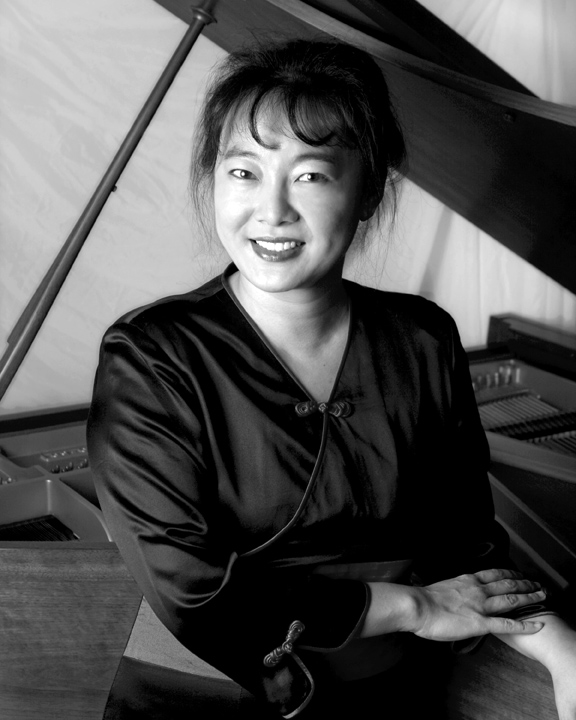
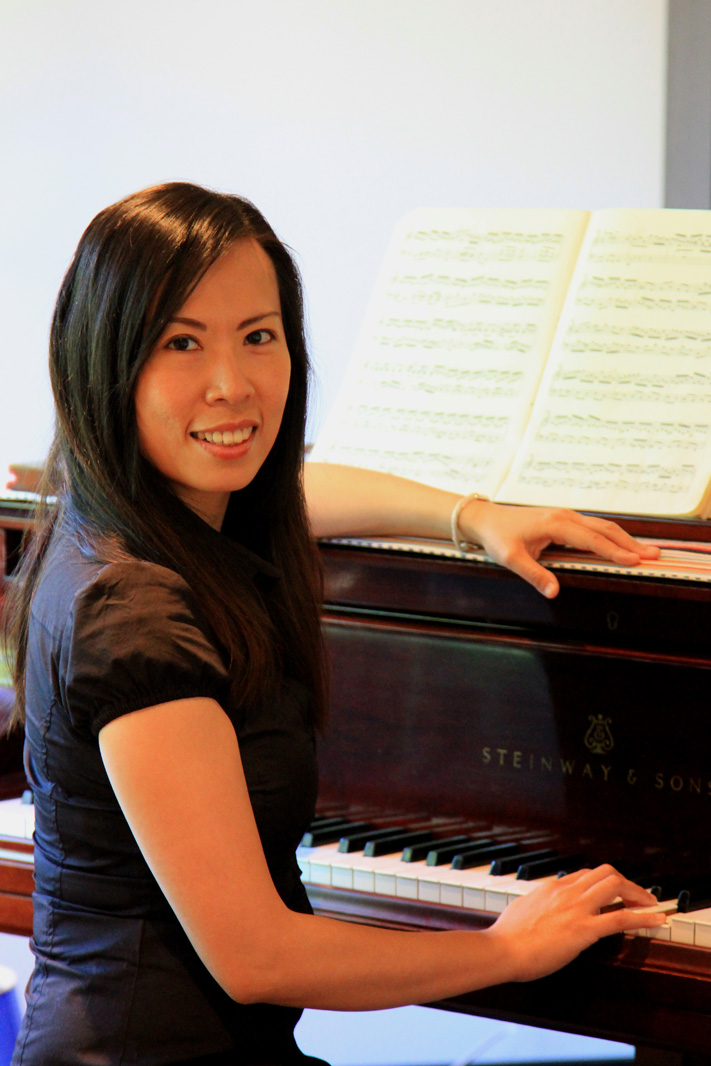
Tien Hsieh

The two exceptions to this “Mostly Transcriptions” CD are theVenezia e Napoli” triptych from Liszt’s Second Book “Italie” of his work Annes de Pelerinage (Years of Pilgrimage), and Glen Cortese’s Elegy, composed in 2008. Along with the Bach-Busoni, both were handsomely played at Ms. Hsieh’s Weill Hall recital in May 2008 (which I had the pleasure of reviewing in Volume 15 No. 3 of this journal). When I heard the Cortese at its World Premiere, I expressed a desire to rehear the composition. On closer scrutiny, the Elegy is indeed attractive–in a style rather reminiscent of Copland’s vintage period (e.g. “Appalachian Spring”).

I was hoping that Ms. Hsieh would have likewise recorded the rarely encountered and atypically self-effacing Liszt piano transcription of Beethoven’s song cycle “An die Ferne Geliebte”, and perhaps she will on her next CD. But ‘faute de mieux’, I am very pleased that she has returned with her impressively exciting accounts of the Bach-Busoni and also the Bach-Liszt Fantasy and Fugue in G Minor, and the Schumann-Liszt “Widmung” (which was likewise an encore at the end of the 2008 Weill Hall concert). I still retain in my mind’s ear beautiful performances of Beethoven’s Op. 111 and Schumann’s “Humoresque” at that recital.

In commenting upon this recorded anthology, I can reiterate that Tien Hsieh is a formidable virtuoso and also a magnetic musical persona. Her bio says she was born in Taiwan and that she studied with her mother, Sylvia Hsieh (a renowned pedagogue in her own right), and with Dr. Marc Silverman at the Manhattan School of Music (her other mentors were Abbey Simon, Ruth Tomfohrde, Jane Allen and Carol Tafoya). In terms of color, texture and concentration on detail, she immediately makes you sit up and take notice! The opening measures of the Bach-Busoni Toccata, slashing and sparely pedaled, along with the arranger’s clever “Busonifications”, recreate the facsimile of the original organ, with its characteristic squeal and visceral intensity. (I might add that the state-of-the-art fidelity of the recording further enhances the physical allure of this thrusting and appropriate interpretation). (Note too, Ms. Hsieh’s precise articulation of the Fugue).

Her high-Romanticism approach works wondrously well in much of the chosen selections, although just two of the compositions of the “Mostly Transcriptions” roster may be a little ‘too much’:  The Liszt version of “Der Muller und der Bach” seems a trifle fussy, with the melodic line overstretched, and Ms. Hsieh, in my opinion, allows the accompaniment roulades to be a distraction away from the gravitas, and at the expense of ongoing simplicity. (There is a remarkable recording on Vista Vera by the Soviet pianist Rosa Tamarkina, (1920-1950), who died tragically from cancer at the age of 30). Likewise, the Van Cliburn RCA recording of his signature piece, the Schumann-Liszt “Widmung”, also strikes this writer as more ongoing and less finicky than Ms. Hsieh’s.

Liszt’s “Venezia e Napoli” is, to be sure, an intriguing contrast to Jerome Lowenthal’s just released version, Bridge 9307A/C, of the complete “Annees de Pelerinage”, and Lowenthal’s tautly structural interpretation. Lowenthal, who studied with the late William Kapell, makes a wonderful contrast with Ms. Hsieh’s slower, more ruminative take on the pieces. Both extremes make cogent good sense as unquestionably ‘idiomatic’.

All of the remaining items are, in their various ways, miraculously and convincingly recreated. Note, too, that the total timing of 77:15 is uncommonly generous. The disc is warmly recommended.

Share

Dan Franklin Smith, piano: “La Vida Iberiana” in Review

Dan Franklin Smith, piano: “La Vida Iberiana” in Review
Musica de Camara
St. Cecilia’s Church, New York, NY
February 18, 2011
 

Dan Franklin Smith

Just less than a year ago, I had the pleasure of giving a rave review to Dan Franklin Smith in a recital of works by living composers. Though that first hearing set the bar very high, I was delighted, in his recent program entitled “La Vida Iberiana,” to find that my enthusiasm for his artistry has not waned.

Mr. Smith embarked on his musical tour appropriately with Turina’s “Sanlúcar de Barrameda,” named for the port in Spain from which explorers Columbus and Magellan set sail. The “Sonata Pintoresca” as it is subtitled, was resplendent with the colors and imagery of Spain (as suggested by titles of its four contrasting movements) and was played with virtuosity and sensitivity. Improvisational transitions that can sometimes sound vapid possessed life and inevitability, while trills that can easily sound meretricious were gripping and heartfelt. Mr. Smith strikes one as the kind of player whose integrity could probably ennoble even the most maligned and cliché-ridden works; in a world where Ravel is used for commercials and Liszt is played by cartoon characters, such playing is a much-needed antidote.

It is always a joy to see the still-underappreciated Mompou on a program, and Mr. Smith’s Cancion y Danza No. 6 that followed was no exception. I would have liked its phrases wrung a bit more of their inherent pathos, but that is perhaps a tall order after the exhausting and exhaustive Turina. It could also be that the piano was not cooperating (an Otto Altenburg in a highly reverberant church), but in any case, there was room for more dynamic nuance.

To close the first portion of the program was Infante’s “El Vito Variations”, which had some audience members humming with happy recognition. Though I confess I’ve always thought of the piece as unlikable kitsch (and yes, there’s some kitsch I like), Mr. Smith’s expert treatment came close to redeeming it for me.

“La Maja y el Ruisenor” (“The Maiden and the Nightingale”) by Granados (from Goyescas) opened after intermission. Once again, the piano did not seem ideally suited to the piece, but the pianist handled the tinnier treble lines with grace.  Following the Granados came Surinach’s Cancion y Danza, No. 1, a nice but contrasting tie-in to Mompou’s work of the same title.

Representing Portugal, Vianna da Motta’s delightfully pianistic “Chula do Douro” (from Scenas Portuguesas, Op. 15) gave another perspective on “La Vida Iberiana,” albeit filtered through Lisztian ears. Mr. Smith played it with élan, setting a good backdrop for the plaintive opening of “Alma Brasileira” (Choros #5) by Brazilian, Villa-Lobos, played with a wonderful coloristic sense and plenty of atmosphere. Iberian influence on the New World entered the program here.

“Sin Rumbo” (subtitled Vuelvo al Sur or “Return to the South”) was a welcome taste of the ever-popular Piazzolla, and Santa Maria (#1 from Plenas) by Hector Campos-Parsi brought the musical tour to the infectious rhythms of Puerto Rico, energetically projected. The recital closed with André Previn’s “Three South American Sketches” (Festivo, Flor de Jardim, Mina d’Agua), played with the same brilliance and panache that I recall hearing when Smith played them last May, though now in a fresh context.

An enthusiastic audience received an encore of the famous Albeniz Tango in D (though the only word of the announcement we could make out was “Falla” so we were quite surprised – a hazard of not using a microphone perhaps).

All in all, it was another success for Mr. Smith, and also for Eve de la O, who has been dedicated to this music series, Musica de Camara, for 31 years.

Share

Duo Sirocco in Review

Duo Sirocco in Review
Nathalie Houtman, recorders and xiao (chinese flute)
Raphaël Collignon, harpsichord
Pro Musicis 
Weill Recital Hall at Carnegie Hall
February 16, 2011


Duo Sirocco

What a wonderful and informative evening!  More than just a concert of music for recorder and harpsichord, it was a virtuoso display by two masters of their instruments, combined with a most enlightening history lesson. Yet there was nothing pedantic about this evening’s presentation entitled “A Baroque Concert in the Chinese Emperor’s Palace.” From the opening “Air Chinois” to the closing sonata by Arcangelo Corelli, the concert flowed along so gracefully and pleasantly that it almost seemed to be choreographed.

Who knew that “the musician, missionary and priest Teodorico Pedrini (1671-1746) was sent to Beijing in 1701 by the Pope at the behest of the Emperor of China, who had expressed a wish to have a European artist in his service?” (The preceding was a quote from the fine program notes written by members of the Duo Sirocco and Dr. Richard E. Rodda.) Who knew that one of the first serious western studies of non-western music was written by the French Jesuit missionary Joseph-Marie Amiot (1781-1793) who arrived in Beijing in 1751?

The program, described in the notes as an attempt “to reproduce a concert that would have been given at the palace of Emperor Qian Long (1735-1794),” began with “Air Chinois,” Amiot’s transcription of a Chinese melody, plaintively performed on the Xiao (Chinese flute) by Nathalie Houtman. Ms. Houtman, who began playing from the rear of the hall, walked towards the stage down the right aisle. The non-western aspect of the unaccompanied melody was reinforced by an expressive upward-sighing-figure at the end of each phrase. Meanwhile, Mr. Collignon was quietly walking down the left aisle and then up onto the stage. With perfectly rehearsed timing, he sat down at the harpsichord and joined Ms. Houtman for the conclusion of the Amiot.

The “western-music” part of the concert began with the Sonata for Recorder and Harpsichord, Opus 3 No. 6 by the aforementioned Teodorico Pedrini. (We were to hear two more of these sonatas later in the program, all part of the composer’s Opus 3, his only surviving works.) Although these works are of minor musical merit, they were beautifully performed with an impeccable sense of ensemble and great ornamentation. As they were of great historical interest, I am very glad to have heard them in this context. More interesting musically was the next work, a sonata by the French composer and flute virtuoso Michel Blavet (1700-1768).

Although they were brilliantly performed, the works by Pedrini and Blavet paled next to the music of Jean-Philippe Rameau and Archangelo Corelli. For this listener, the musical high points of the concert were the three harpsichord works by Rameau. I marveled at the harmonic vocabulary of “La Dauphine” and was thrilled by the weird chord progression in “L’Enharmonique,” made even more expressive by Mr. Collignon’s subtle use of rubato. The repeated notes imitating the sound of chickens in “La Poule” were made even more interesting by the way Mr. Collignon varied the articulation. This was great technical skill in the service of great music.

It should be noted that none of the five works which appeared on the printed program as “Sonata for Recorder and Harpsichord” were originally written for these instruments. As stated in the program notes, the three Pedrine sonatas were written for violin and bassoon continuo (bass instrument and harpsichord improvising the stipulated chords), the Blavet for transverse flute and basso continuo, the Corelli for violin and basso continuo. In the baroque, the bass instrument which doubled the lowest note of the harpsichord was often omitted, and other treble instruments could perform the parts originally written for violin or flute. The virtuosic high point of the evening took place during Ms. Houtman’s performance of the Corelli violin sonata, the concert’s final work. What is idiomatic on a violin would seem to be almost impossible on the recorder. After I heard the fast arpeggio “string crossings” in the first movement, in my notes I wrote “Wow!” After the second movement I wrote “faster?”, and after the third I marveled “even faster!!”  What fleet fingers, what quick tonguing, what thrilling playing!

After a rousing round of applause, Mr. Collignon ambled onto the stage strumming a tiny Renaissance guitar. Mr. Houtman followed, and together they brought the concert to a delightful conclusion with a rollicking performance of an arrangement of the Tambourin from Rameau’s “Pièces de clavecin, 1731.”

Share

Continuum in Review: Music at the Crossroads/Composers of Central Asia

Continuum in Review: Music at the Crossroads/Composers of Central Asia
Merkin Concert Hall; New York, NY
February 13, 2011


Continuum’s “Music at the Crossroads” concert featured composers of Central Asia, and the program successfully combined ancient traditions with modern ones. Continuum’s exploration of rarely-heard music is sometimes a result of its travels to remote parts of the globe. In this case, the ensemble has toured several times to Central Asia, most particularly to Uzbekistan, but also to Kazakhstan and Tajikistan. The strong musical traditions and the creativity of composers there obviously made an impact on the talented group of directors and performers that form Continuum.

The concert featured Dmitri Yanov-Yanovsky, who is from Uzbekistan. Yanov-Yanovsky has worked tirelessly on behalf of his country’s cultural life as professor of composition and founder/director of the Ilkhom Festival, an innovative annual international event. Highly regarded in Europe and the former Soviet Union, he recently spent two years at Harvard University on a special fellowship invitation and currently is teaching in the Chicago area.  Continuum programmed three of his works: “Chang-Music IV” (1991), a work for string quartet which emulates the Central Asian cimbalom; “A-S-C-H” (Hommage to Alfred Schnittke for ensemble – 2004); and “Five Limericks by Edward Lear” (2005) for mezzo-soprano and piano trio. Each work and every musician captivated the audience at hand. Another fascinating work from Uzbekistan, “Music for Chamber Ensemble” (2004) was composed by Yanov-Yanovsky’s former student Jakhongir Shukurov; this was a smart addition to the program.

Throughout the evening, the music hinted at its unique ethnicity, but also pointed to the region’s ancient music. The Kazakh composer Aktoty Raimkulova’s “Alatau”, for ensemble (2011), and written specifically for this concert, reflects her country’s folk music. The title refers to the majestic mountains hovering over her city, Almaty. Continuum brought the usual spark and polish to the performance. The country of Tajikistan, while currently desperately poor and underdeveloped after a long civil war, has a rich musical heritage. Central Asian influences were heard in the works of Tajikistan-born Farangis Nurulla-Khoja: Blind Flower” for mezzo-soprano and ensemble (2008), and Benjamin Yusupov’s “Haqqoni,” both written for and premiered previously by Continuum. Nurulla-Khoja now lives in Montreal, and Yusupov immigrated to Israel during Tajikistan’s civil war.Haqqoni” combines a live ensemble with vintage recordings of ritualistic chanting—plus singing from his family’s Bukharian tradition.

All the performers were excellent: Rachel Calloway, mezzo-soprano; Tanya Dusevic Witek, flute; Moran Katz, clarinet; Renée Jolles and Airi Yoshioka, violins; Eva Gerard, viola; Claire Bryant and Chris Gross on cello; Jared Soldiviero, percussion; Cheryl Seltzer, piano and Joel Sachs, conductor. Continuum has chosen just the right music and performers for a memorable—and thought-provoking occasion.

Share

Park Avenue Chamber Symphony in Review: Tchaikovsky and Rachmaninoff

Park Avenue Chamber Symphony in Review: Tchaikovsky and Rachmaninoff
David Bernard, conductor
Karine Poghosyan, piano
Tchaikovsky Piano Concerto No. 1
Rachmaninoff Symphony No 2
February 13, 2011

David Bernard conducting the Park Avenue Chamber Symphony; photo credit Stefan Cohen

The generosity of spirit and affection that infuses the work of two of the most beloved Russian composers, Tchaikovsky and Rachmaninoff, must be genuine and heartfelt in a good performance.  By this standard, the Park Avenue Chamber Symphony scored a triumph in their rendering of two of these composers’ most iconic works, in a recent concert at All Saints Church.  The Armenian pianist Karine Poghosyan joined the orchestra for the Tchaikovsky First Piano Concerto in what proved to be a warm and sympathetic collaboration. 

The venue for the concert worked both for and against the artists.  As churches go, All Saints is small and intimate, where a good deal of the audience practically sits right on top of the orchestra.  While this allows for a more visceral experience of the music, the acoustic can be simply overwhelming and indistinct in the loudest and most densely textured orchestration.  And what else could explain the choice of a baby grand piano for the concerto but a simple lack of available floor space?  In spite of these liabilities, there was still much to admire in the performance. 

Ms. Poghosyan is a relaxed and natural musician, very obviously at home in the Tchaikovsky.  Her technique is big and secure, with blazing octaves, clean articulation, and a beautifully weighted touch.  More importantly, her virtuosity was not a shallow display of party tricks, but a tool for musical expression. Although it was a disservice to hear her on such an inferior instrument, her strengths were not diminished.  

David Bernard, the Chamber Symphony’s Music Director, led both pieces from memory, with clarity and a sense of spontaneity, even in such well worn repertoire.  Despite occasional struggles with ensemble and intonation, the orchestra played with a strong sense of style and commitment.  Several soloists offered impressive playing, notably the principal cellist and oboist in the Tchaikovsky, and the clarinet and English horn in the Rachmaninoff.  Special mention must be made of the string ensemble in general, who, under the guidance of Mr. Bernard and their concertmaster, David Edelson, play with the depth and fervor of the old school European orchestras. 

Share