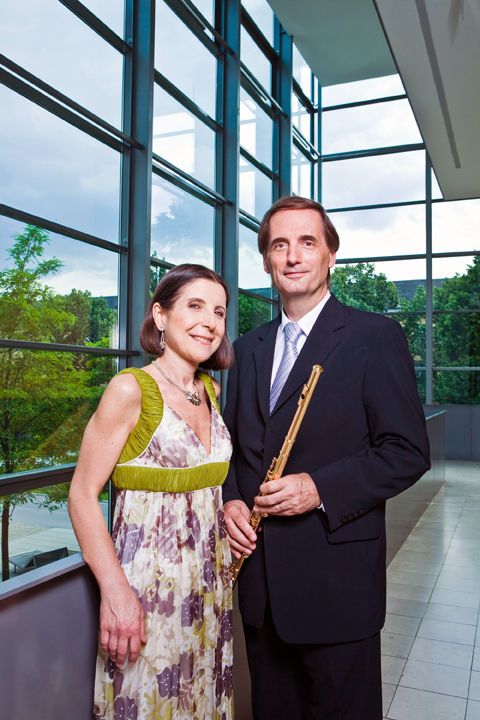
Dieter Flury, flute and Maria Prinz, piano in Review

Dieter Flury, flute
Maria Prinz, piano
Weill Recital Hall at Carnegie Hall
February 12, 2011

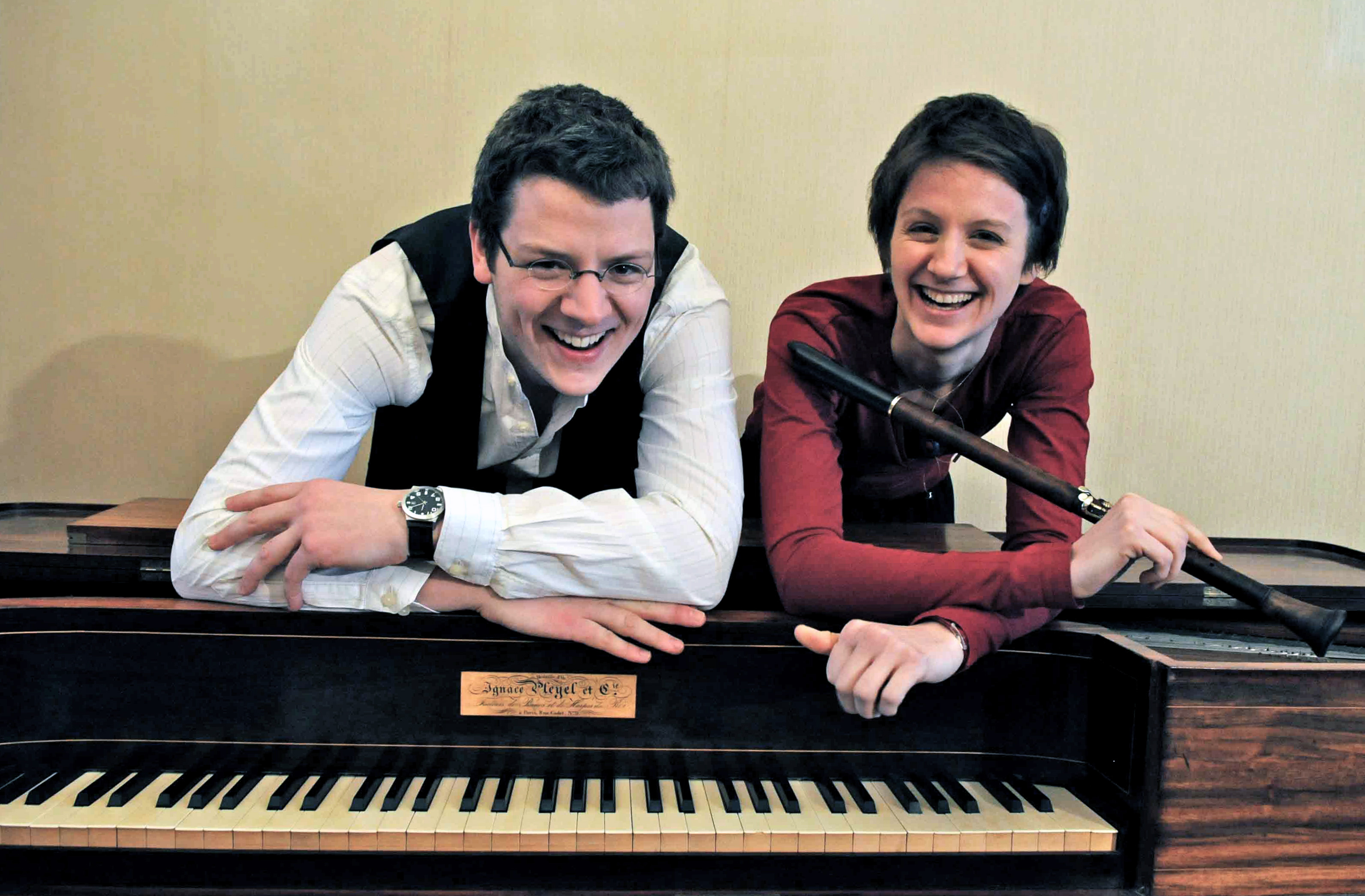
Dieter Flury and Maria Prinz; Photo Credit: Johannes Ifkovits

In this program, entitled “Viennese Classics for Flute and Piano,” Bulgarian pianist Maria Prinz and Swiss flutist Dieter Flury proved that you do not have to be born in Vienna to love its musical traditions. In her program notes, Ms. Prinz wrote that having lived and worked in the city of musical dreams for 25 years as “foreigners” has given them enough familiarity with, and enough distance from, the style to balance emotional involvement with objectivity.

 Mr. Flur, in addition to appearing with other leading orchestras, has been solo flutist of the Vienna Philharmonic since 1981; Ms. Prinz, besides enjoying a successful solo career, has taught at Vienna’s University of Music and Performing Arts since 1987. The high expectations raised by these credentials were not disappointed. Both players proved to be complete masters of their instruments; Mr. Flury played on a golden flute whose radiance was matched by its warm, round, shimmering tone; Ms. Prinz was an exemplary collaborator, leading and supporting with equal sensitivity and, with the piano on the small stick, never too loud. The only flaw in their performance was their penchant for exaggerated phrasing and overuse of dynamic contrast, as if they trusted neither the music nor their own expressive playing to speak directly to the audience.

The first hint of these tendencies came in the program’s opening work: Mozart’s Sonata in B-flat major, K. 378, originally for violin and piano. Every repeated figure turned into an echo, and in the first movement, Mr. Flury fell prey to the problem of dealing with the transition from the first to the second theme, making a huge ritardando where a slight hesitation would be more effective;. The Sonata works well on the flute, especially the bright Finale, and Mr. Flury also captured the expressive intensity of the passages in the darker register.

 The concert included two unfamiliar works by Beethoven: a set of Variations, Op. 107 No. 7, and a Sonata in B–flat major without opus number. The variations bear the unusual title “For piano with the accompaniment of a flute,” but in fact the instruments act as equal partners. The Theme is a melancholy Ukranian folksong that was also used by Hummel in his Trio for flute, cello and piano. Doubts have been raised about the authenticity of the Sonata, and, indeed, while some of its themes and their development could well belong to his early period, others seem to point to less distinguished authorship.

Haydn’s Sonata for flute and piano No. 8 in G major is a transcription of a transcription: its original source is Haydn’s String Quartet Op. 77, No. 1; Haydn himself arranged it for violin and piano, omitting the Minuet and Trio. In the flute version, Mr. Flury simply played the violin part, and, since the piece is sunny and high-spirited, the transformation was very successful.

The program closed with that popular staple of the flute repertoire, Schubert’s Introduction and Variations on his own song, “Trock’ne Blumen” from the cycle “Die schoene Muellerin,” D.802.  Written at a time late in his life when he was experimenting with combining intimate chamber music with technical fireworks, it demands a lot of virtuosity from both performers; it concludes with a jaunty March, but, being based on a slow, mournful song in a minor mode, its lyrical, singing element predominates. The highlight is a variation in major whose beauty and simplicity stop the heart. The two players’ deeply expressive performance left no doubt of their love for the music. Though they displayed plenty of brilliance when appropriate, even the bravura variations never became mere showpieces. In response to the sell-out audience’s enthusiasm, they played an encore: Mozart’s lovely C major Andante, announced by Mr. Flury as “Maria’s favorite.”

Share

Festival Chamber Music in Review

 Festival Chamber Music in Review
 Ayako Oshima, clarinet
David Jolley, horn
Yuri Funahashi, piano
Calvin Wiersma, violin
Theodore Arm, violin/viola
Ruth Sommers, cello/director
Weill Recital Hall at Carnegie Hall
February 2, 2011

 Festival Chamber Music is a rotating group of enterprising top-notch New York musicians. They like to take time out from their busy lives as performers and teachers to present new and unfamiliar works in a variety of instrumental combinations, as well as staples of the standard repertoire. Founded in 1988 by its director, cellist Ruth Sommers, in Dobbs Ferry, the group moved in 1992 to New York City, where it performs an annual series of five concerts to sell-out audiences.

Its most recent program was of particular interest. It featured Beethoven’s popular Piano Quartet, Op. 16 in E-flat major in an excellent performance, and works by two virtually unknown Czech composers: the Quintet for piano, violin, cello , clarinet and horn, Op. 42 by Zdenek Fibich (1850-1900), written in 1893, and the String Trio by Gideon Klein (l9l9-l045), one of the so-called Holocaust composers, written in 1944. Fibich, though born in Prague, did not follow in the footsteps of his compatriots Smetana and Dvorak, the fathers of the Czech nationalist movement; rather, his music–though never openly derivative–is steeped in the Romantic German tradition. In the Quintet, Fibich’s compositional skill shows in his modulations (which use a lot of deceptive cadences), and in his ability to exploit and combine the instruments’ colors and timbres to best effect. The first and last of the Quintet’s four movements are in sonata form; the Scherzo, marked “with wild humor,” foreshadows Shostakovich in its acerbic sarcasm, but this is relieved by two cheerful Trios, a waltz and a polka. A solo piano passage leads back to the da capos. The Quintet’s centerpiece is the slow movement, a truly beautiful, long-breathing melody, stated first by the piano in solid and arpeggiated chords, then repeated with a florid violin obbligato. The work’s most pervasive characteristics are its democratic distribution of the solos, its unabashed romanticism, and its surging, soaring melodies; but the heart-on-sleeve quality of the music is so genuine that sentiment never lapses into sentimentality.

Gideon Klein already had several compositions to his credit when he was sent to Terezin in 1941. At 20, he must have been one of the youngest of the composers who perished in the Nazi death-camps, and, if this String Trio is any indication, also one of the most talented. A brilliant pianist, his ability to use the string instruments’ resources was remarkable. Though naturally still under the influence of contemporary stylistic trends, the Trio displays a personal voice and an astoundingly mature emotional range. Its three movements are all based on Moravian folksongs. The first and last are fast, skittish, jumpy, abrasive, and dissonant, often punctuated with Slavic and Hungarian off-beat rhythms; the last one ends in a Bartokian dance and a crash. The Trio’s core is the much longer, slow, middle movement: a set of variations of contrasting tempos, textures and characters that encompass defiance, grief and despair, leaving the listener shaken and heart-broken. Klein became one of Terezin’s heroes, organizing its musical and cultural activities. The Trio was written nine days before Klein’s deportation to Auschwitz; he died there a year later.

Heard at two rehearsals, the playing of this demanding program was excellent. Pianist Funahashi alternated imperceptibly between leading and supporting, always sensitive, never too loud; hornist Jolley and clarinetist Oshima were outstanding in their prominent roles. The Quintet had an almost orchestral sonority at times. The string players negotiated their often stratospheric parts with aplomb; cellist Sommers provided a firm foundation, violinist Wiersma was a strong leader in the Beethoven and Klein; Arm, doubling on violin and viola, had the courage to play the bigger instrument first, but kept his intonation intact – no mean feat.

These fine, adventuresome musicians deserve our admiration and gratitude for bringing these unjustly neglected works to our attention in such committed, persuasive performances.

Share

The Mirror Visions Ensemble in Review

The Mirror Visions Ensemble in Review
Works by Russell Platt and Tom Cipullo
Bargemusic
January 29, 2011

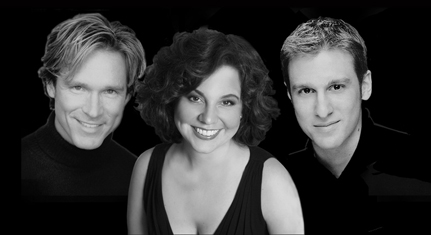
Mirror Visions Ensemble

It is a good idea to arrive at concerts early, not only so that one can have time to read the program notes, but also in order to make the transition from the hectic life of the city, to place a “cordon sanitaire” around the event being attended. This is especially important when attending events at Lincoln Center or at the Carnegie Halls, as one needs to decompress after a ride on the NY Subway. My favorite pre-concert “cordon sanitaire” begins just after exiting the subway at the York Street Station of the F train. One then walks Down Under the Manhattan Bridge Overpass through DUMBO. There are fleeting views of the Manhattan Bridge on the right and soon parts of the Brooklyn Bridge come into view. After a right turn down Old Fulton Street, one soon arrives at the East River. Ahead is the Manhattan skyline, to the right the span of the Brooklyn Bridge, and to the left, moored to the Brooklyn shore, is home of Bargemusic. Floating in the East River, this one of our city’s most unusual and pleasant chamber music venues.

Founded in 1992 The Mirror Visions Ensemble (Tobé Malawitsa, Artistic Director) has commissioned more than seventy vocal chamber music works. Given the magnificent performances we heard tonight from soprano Vira Slywotzky, tenor Scott Murphree, baritone Jesse Blumberg and pianist Alan Darling, contemporary composers are very fortunate to have such skilled and dedicated performers championing their music. Tonight’s concert featured two of The Mirror Visions Ensemble’s commissions.

The first half was devoted to Russell Platt’s “From Noon to Starry Night: A Walt Whitman Cantata.” This setting of ten Whitman poems was written in a spiky but not painfully dissonant harmonic style, often leavened by major triad final chords. It began with two trios which were sung with perfect intonation and rhythmic clarity. The first was fairly tonal, but spiced by added “wrong notes” in some of the chords, while the second was a waltz. Each of the following solo movements was performed with attention to the meaning of the words and with impeccable diction. I found the consonant opening of the fifth movement, “I Saw in Louisiana a Live-Oak Growing,” quite beautiful.

After intermission we heard Tom Cipullo’s “A Visit with Emily,” settings of letters and poetry of Emily Dickenson and letters of T.W. Higginson. As did Mr. Platt, Mr. Cipullo spoke about his work before it was performed. I usually dislike these pre-performance-spoken- program-notes, but Mr. Cipullo’s were most informative, quite funny, and very well delivered. Most interesting was the statement that his settings were not meant to augment or to clarify the meaning of the poems, but to express his reaction to them. Mr. Cipullo’s music has none of the retro-consonant elements employed by Mr. Platt, and it never wavers from an astringent harmonic language. If there was a “retro” aspect to his music, it was his skillful use of use of earlier musical devices, an aspect of this work I enjoyed very much. Movements three (sung by Mr. Blumberg,) four (sung by Mr. Murphree,) and five (sung by Ms. Slywotzky) were based on poems which had to do with fame. Movement six combined the melodies of these three songs, a devise called a quodlibet.  It was brilliantly performed by the three soloists and pianist Alan Darling. In later movements we heard a catch, a chaconne, a passacaglia and another quodlibet.

And after hearing fine performances of skillful settings of great poetry in a unique venue, I could reenter reality by retracing my steps under those two great bridges mentioned in paragraph one. Only in New York!

Share

Concert for Peace – Celebrating the Spirit of Martin Luther King, Jr. (DCINY)

Concert for Peace – Celebrating the Spirit of Martin Luther King, Jr.
Distinguished Concerts International New York in Review (DCINY)
Carnegie Hall, New York, NY
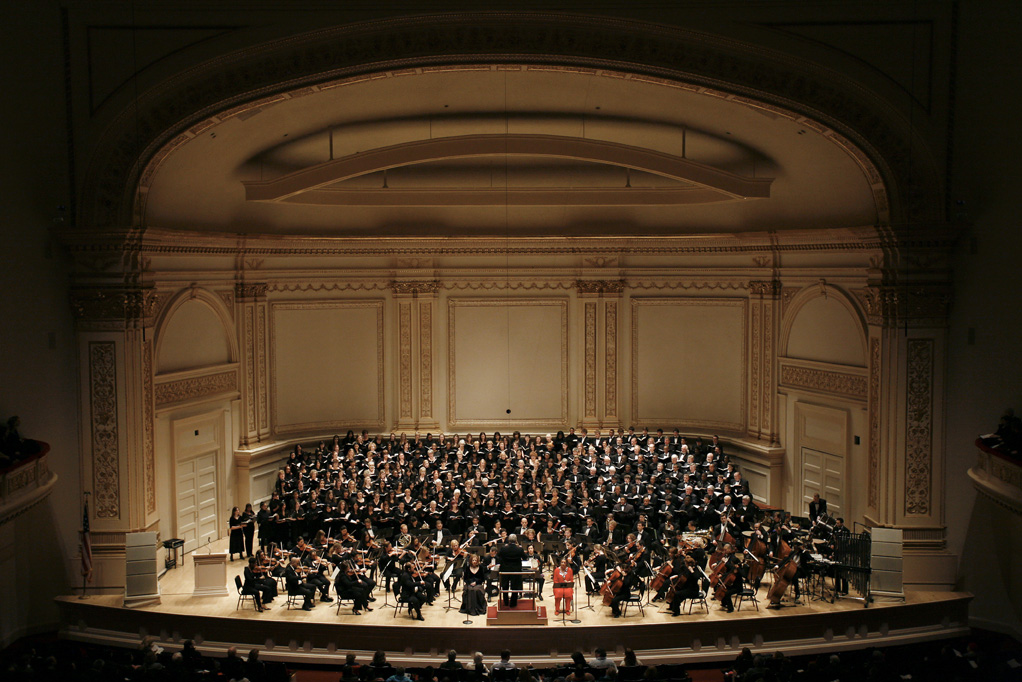
January 17, 2011

Distinguished Concerts International New York, or DCINY, as the group calls itself, rounds up choruses from around the world, brings them to New York and presents them in concerts mostly composed of recently written but highly accessible music.  The concert on January 17 was dedicated entirely to the music of DCNY’s composer-in-residence, Karl Jenkins. Originally from Wales, Mr. Jenkins is, according to his website, the most frequently performed living composer in the world. His style is tonal and presents a fusion of classical, ethnic, and popular music.  The music often sounds like the best of movie music; indeed Mr. Jenkins has achieved great success as a composer of both television commercials and film scores. Although his music is sometimes too repetitious for my taste, it is often rousing and at times quite beautiful.

The two works presented on this concert were Mr. Jenkins’ “Gloria” and “Stabat Mater.”  The first piece was a U.S. premiere.  The major part of its text was taken from the Gloria of the Latin Mass.  Interspersed were readings from other religions: the Bhagavad Gita, (Hindu), the Diamond Sutra, (Buddhism), the Tao Te Ching (Taoism), and the Qur’an (Islam). The choruses were the Kings Chorale from Canada, the Laramie County Community College Choir from Wyoming, the Methodist College Chapel Choir from Ireland, the Ottawa University Concert Choir, and the Sno-King Community Chorale from Washington.  Charlotte Daw Paulsen was the mezzo-soprano soloist and DCNY’s Artistic Director, Jonathan Griffith conducted. The orchestra was drawn from local players. The choruses sang with assurance and beauty of tone, although from where I was sitting they were at times not as loud as might have been wished. Ms. Paulsen has a lovely voice but was similarly under-powered.  The exemplary conducting of Jonathan Griffith cannot be faulted.

The second half of the program, almost twice as long as the first half, was a performance of Mr. Jenkins’ “Stabat Mater,” written in 2008.  This work employs ancient instruments and modes from the Middle East alongside the standard Western harmonies and instrumentation. As he did in the first half’s “Gloria,” Mr. Jenkins interpolated six movements in other languages which strikingly contrasted with the Latin of the standard “Stabat Mater” text. One of these movements, “And the Mother did weep” was, for me, the high point of the concert. This lovely, haunting piece for chorus and orchestra was full of surprising and enchanting twists and turns of melody and harmony. I hope I have the chance to hear it again. In other interpolated movements, there is also a part for “ethnic vocals,” performed by Belinda Sykes, who also played the Mey, a Middle Eastern double reed instrument. The choruses for the second half of the program were the Kirk Choir of Pasadena Presbyterian Church, from California, the Mendelssohn Choir of Connecticut, the Fairfield University Chamber Singers, the Saddleworth Musical Society from England, the Sine Nomine Singers of North Carolina, the University of Johannesburg Choir from South Africa, and the West Windsor-Plainsboro High School South Chorus from New Jersey.  These groups, all well-prepared, were capable of more power than the forces on the first half, although their intonation wavered a bit during the a cappella “Fac ut portem Christi mortem.”  The concert ended with a grand climax, as the choruses from the first half joined in from the balcony. The audience leapt to its feet and there was thunderous applause.

Share

Hlif Sigurjonsdottir, Violinist in Review

 Hlif Sigurjonsdottir, Violinist in Review
Merkin Concert Hall, New York NY
January 15, 2011

Hlíf Sigurjóns

Violinist Hlif Sigurjonsdottir was born in Copenhagen and grew up in Iceland, where she began her musical studies at an early age. Going on to work with many eminent musicians in Europe, Canada and the United States, she credits her first teacher, Bjorn Olafsson, concertmaster of the Iceland Symphony Orchestra, and her last teacher, Gerald Beale of New York, with inspiring her to make a specialty of Bach’s solo sonatas and partitas, and with leaving a strong mark on her approach to them. At this concert, she performed the Sonatas No. 2 and 3 and the Partita No. 1, completing the cycle begun earlier in New York. She has also released a double CD of all six works.

Ms. Sigurjonsdottir’s Bach was a mixture of many styles, part baroque, part contemporary, part oriented to violinistic comfort and effect. Playing on a modern violin by Christophe Landon and with bows by Landon and Isaac Salchow, she produced a very small tone that never varied in color or intensity and only rarely in volume. Her intonation was excellent except in the high positions; her bowing technique was light and flexible, but she broke all chords upward, regardless of where the melody lay. She made no attempt to use the four strings of the violin to bring out Bach’s voice-leading, changing strings and positions for greatest technical convenience rather than contrapuntal clarity. Perhaps the performance’s most serious shortcoming was a lack of variety; there was hardly any difference of character or expression among these three very diverse works or their highly contrasting movements.

Today, the practice of performing from memory is ubiquitous, but, from a music-historical viewpoint, it is comparatively recent. (Toscanini, whose vision was very poor, introduced it to conducting with the dictum “Better to have the score in your head than your head in the score.”) Many soloists claim that not looking at the music is liberating, but it can also have the opposite effect. (Clifford Curzon, the great English pianist, decided to use the score for the Mozart concertos when he realized that many passages were so similar that he sometimes found himself playing the wrong one.) Bach’s works for solo violin are treacherous to memorize, and Ms. Sigurjonsdottir was ill-advised to attempt it. She got lost in the First Partita, but adroitly covered it up by going back to the beginning of the movement; finally, though, she had to have a stand and the music brought to the stage. In the formidable Fugue of the Third Sonata, however, her memory slip caused chaos: two stands were required to accommodate the music, which consisted of many single sheets so mixed up that a volunteer had to come to the stage from the audience to help put them in order and stay to act as page-turner. This added a charming touch of informality to the concert, but disrupted the Sonata. However, the rest of the performance was so much more confident and secure that one wished Ms. Sigurjonsdottir had used the score from the beginning.

The program included the premiere of the Prelude from a five-movement sonata written for her by Merrill Clark, entitled “The Sorceress.” A lively, propulsive piece, it is based on a repetitive figure of a major second using a drone-like open string.  The composer was present to share the applause.

Share

Continuum in Review

Continuum in Review
Northern Exposures II: Canadian New Music—The Trailblazers
Americas Society
December 13, 2010 

Left to right: R. Murray Schafer, John Weinzweig, Ann Southam, Claude Vivier, Barbara Pentland, Gilles Tremblay, Diana McIntosh

In the second concert of a series featuring Canadian music, Continuum went back into time to present music from an older generation (works mostly from the 70’s and 80’s) and entitled the program “The Trailblazers”.  (The first concert in this series featured Canada’s more contemporary composers.) This program—like the first—did not disappoint, as the music was gripping, daring or sweetly pastoral; and it was once again varied, enlightening and well-prepared.

The concert opened with harpist Bridget Kibbey’s magnificent performance of R. Murray Schafer’s “The Crown of Ariadne”. The work, which asks the harpist to play percussion in addition to the usual duties, was as captivating as the performance itself; it was innovative from start to finish. Barbara Pentland’s Caprice for solo piano was short but sweet—superbly rendered by pianist Cheryl Seltzer. Next on the program was John Weinzweig’s monumental “Trialogue” for soprano, flute and piano. Although composed without any sense of real tonality (whispers, laughter and shrieking abound), this entertaining theater piece laced with psychological undercurrents engages the audience as well as a classic Broadway show. The audience loved the performance, which was presented in a memorable comic-dramatic style by soprano Mary Mackenzie, flutist Fiona Kelly and Pianist Joel Sachs.

Ann Southam, who sadly passed away about two weeks prior to this performance, wrote a haunting piano quintet seemingly in her own memory, as its hypnotic and tender opening piano chords seem to ring in eternity. Seltzer did a lovely job of letting the music speak simply and lie in its own serenity. The work fades repeatedly as it began, but in the middle, the string writing is contrapuntally complex, and violist Stephanie Griffin, violinists Renee Jolles and David Fulmer, and cellist Claire Bryant played with technical finesse and commitment.

Diana McIntosh’s appealing and more conventional “Nanuk” was a workout for violist Griffin—who played it with conviction and superb command of the instrument, while Gilles Tremblay’s “Cedres en voiles—Threne pour le liban” is much more cutting edge modernity—with marvelous effects for the solo cello. It was played brilliantly by Bryant. Claude Vivier’s “Pulau dewata” for variable ensemble—this time in an arrangement for piano trio by Henry Kucharzyk—is completely original in concept and material.

With this marvelous program of Canadian composers, Continuum has once again proven that we should be more and more exposed to the music of the North.

Share

“Amahl and the Night Visitors” :In Review

The Transfiguration Camerata and Choir of Men and Boys
“Amahl and the Night Visitors” and other selections
An Arnold Schwartz Memorial Concert
The Church of the Transfiguration (“The Little Church Around the Corner”)
December 17, 2010

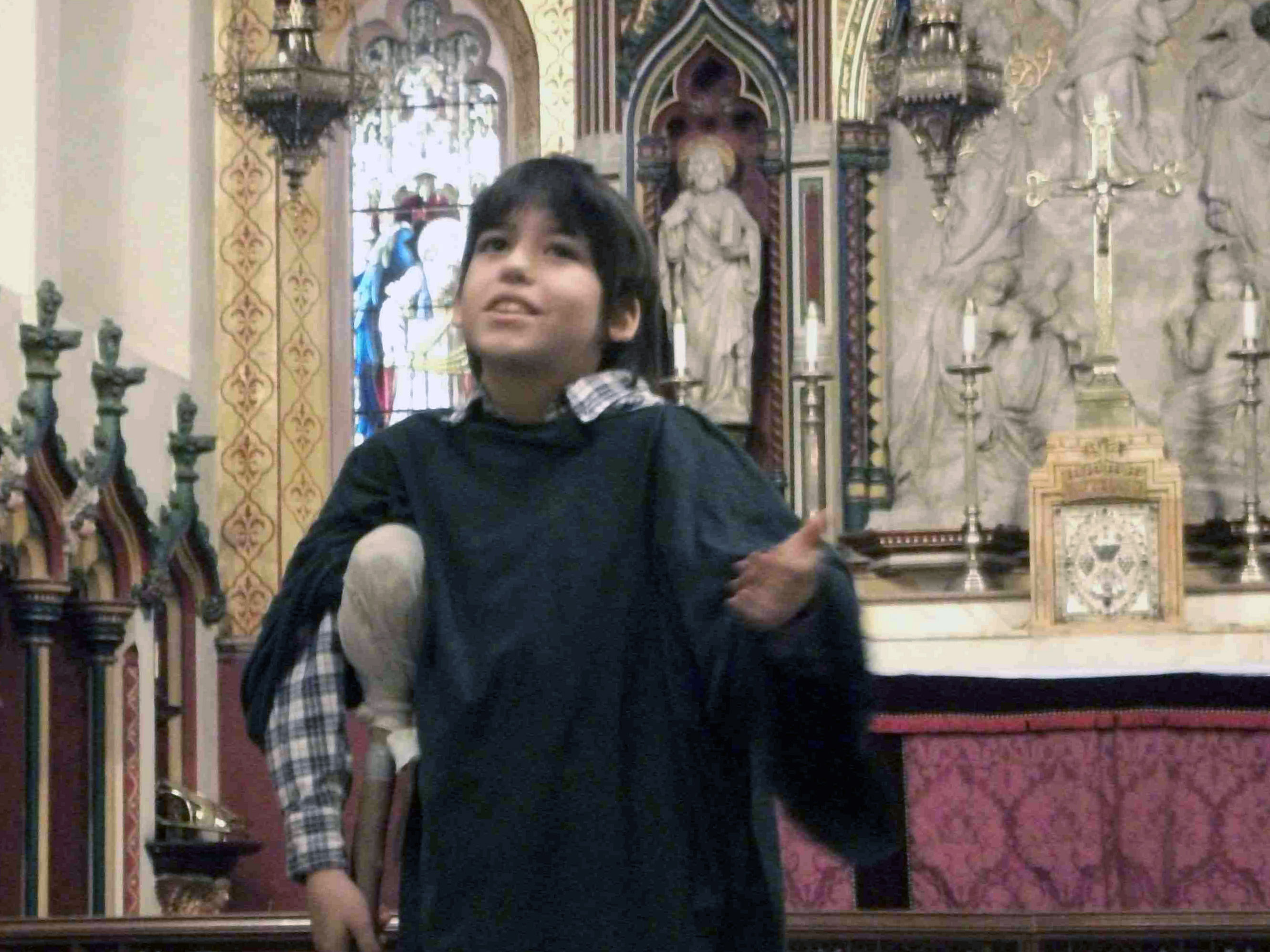
Colin DePaula as Amahl . Photo Credit: Juliet DePaula

Although “Amahl and the Night Visitors” was a highlight of the evening, there were other welcome selections that began the Transfiguration Camerata and Choir of Men and Boys concert on December 17th. Three pieces from Britten’s “Ceremony of Carols” began the program with good vocal diction and excellent harp playing by Francis Duffy. Faure’s beautiful “Cantique de Jean Racine” continued with some lovely solo singing, and “Il le ne le divin enfant”, expertly arranged by Victor Kioulaphides, contained more fine solo contributions—but now with the best choral singing of the evening, as it was tailored perfectly for the boys’ range. The few choral problems in the Britten and Faure were a result of the music going a bit too high for the boys at hand; their intonation was sometimes off the mark, and their collective singing often lacked expression and color at the top.

In “Amahl and the Night Visitors”, the young Colin DePaula as Amahl was superb and charismatic from start to finish. His voice is pure-pitched and very expressive, and he was always in character. He’s a real find and a talent to watch. Aside from a false start to the opera—it had to begin again after the singers missed their entrance—this was an enjoyable “Amahl”. For one, the small orchestral ensemble was excellent, well-assembled by conductor/pianist Claudia Dumschat. They were always in tune, even in the long last chord which features the strenuous, often inaccurate low range of the oboe. The three kings sang with refined pitch and vocal quality in their harmonizations, and Charlotte Detrick played the part of the mother quite well.  Some of the choral singing was tentative, especially when it was a cappella, and some of the kids didn’t always know the lyrics.

This archaic, venerable church is a treasure. In terms of a performance space, upstage center singing in “Amahl” lacked the resonance you might expect. In addition, the visual experience was sometimes frustrating (especially with regards to Lynn Neuman’s attractive choreography on house right) because of columns and the absence of performer platforms or elevated audience seating—although director Richard Olson did make inventive use of the aisles and the back of the audience. In any case, the full-house in attendance seemed to enjoy each work on the program; although they were captivated by it all, the most memorable of the night was Amahl—and by that I mean Colin DePaula in the title role.

Share

The Park Avenue Chamber Symphony in Review

The Park Avenue Chamber Symphony in Review
“Baroque Celebration”: Vivaldi’s “Four Seasons” and Gloria
David Bernard, Music Director and Conductor
David Chan, Violin
Florilegium Chamber Choir; Nicholas DeMaison, Director
All Saints Church, New York, NY
December 12, 2010
 

David Bernard leading the Park Avenue Chamber Symphony from the harpsichord continuo in Vivaldi’s Four Seasons with soloist David Chan, Concertmaster of the Metropolitan Opera Orchestra. Photo Credit: Claire Stefani

In an all-Vivaldi concert, the Park Avenue Chamber Symphony got in the holiday spirit with the composer’s Gloria in D, RV 589 and his eternally famous “Four Seasons”. The orchestra’s violin soloist was Metropolitan Opera Concertmaster David Chan, who inspired a riveting and stellar performance on all fronts. Music Director David Bernard, who led the performance while playing the harpsichord, did an excellent job of maintaining solid ensemble-playing and consistently driven tempos in what was a crisply articulate, high-energy account.  To top it off, there was a brief poetry reading prior to each season, read with poise and clarity by All Saints Church Music Director Cynthia Weinrich; this was a great idea. Chan played at the highest level possible—with both sweet-toned polish and gutsy intensity—bringing a romantic air of expression to the piece, as one should when there is such detailed, innovative tone-painting (musical descriptions) in the music.

Because “The Seasons” was given such a memorable performance, it could easily have been on the second half of the program. And all four seasons (four concertos with several movements each) are in fact longer and more epic in stature than this Gloria. Naturally, one can understand why Bernard chose the Gloria to conclude the concert; choral works with numerous performers—a visual as well as an aural delight—usually do provide for an emotionally or spiritually satisfying conclusion. But since the superior Vivaldi opus and performance was “The Seasons”—I would have preferred the save-the-best-for-last approach and conclude with that work instead.

Bernard conducted the Gloria from memory and with an astute ear for phrasing and color. My peeves were the sometimes less-than-polished solo singing—although soprano Nina Riley sang beautifully—some out of tune trumpet playing, and the fact that The Florilegium Chamber Choir was sometimes tentative and difficult to hear (especially in lower registers). When I could hear them, however, diction was clear and the phrasing was elegant. Principal cellist John Yakubik’s solo playing was also appealing.

Another reason I can see why the Gloria was indeed placed on the second half was because it led nicely to a Holiday Sing Along, in which Bernard placed the chorus antiphonally on both sides of the church. Here, the voices came through loud and clear—although it didn’t hurt that the large audience at hand lent their voices to what was a robust reading of several Christmas Carols. It is a credit to David Bernard that he has such enthusiastic followers in his audience. Usually you can hear it in applause, but this time it was through the music itself.

Share

Maximilan Anikushin and Friends in Review

Maximilan Anikushin and Friends in Review
Samuel Barber Centenary Recital
Bruno Walter Auditorium
Lincoln Center; New York City, NY
November 18, 2010

Maxim Anikushin

The splendid pianist Maximilan Anikushin, with his friends, mounted a welcome and comprehensive retrospective to honor the centenary of the American composer Samuel Barber in the midst of bicentennial tributes to Haydn (d. 1809), Mendelssohn (b. 1809), Chopin and Schumann (both born in 1810.)  (Orage warning: the Liszt bicentennial will be coming down the pike—prepare for another onslaught imminently!) Barber’s beautifully crafted music richly deserves celebration and it is, without question, more audience-friendly than Elliot Carter, who is still with us (Barber died in 1981.)  

The first half of the program was devoted to Barber’s solo piano works, commencing with his most famous and impressive piece, the sonata, commissioned by Vladimir Horowitz, who premiered it in 1949 and subsequently recorded it for RCA Victor. Mr. Anikushin’s beautifully written program annotations interestingly relate that the composer had initially wanted the work to be a three movement sonata, but Horowitz convinced him that the piece needed a “very flashy last movement.” This last movement caused Barber much frustration. After months with no progress, Horowitz telephoned Barber and, hoping to inspire him, called him a ‘constipated composer.’ Barber became angry and wrote the entire last movement (the Fuga) the next day! This was in June 1949, nearly two years after the work was commissioned.  

The Sonata was appropriately followed by the four Excursions–vintage 1945–also in its day quite popular; Nadia Reisenberg performed them at her 1947 Carnegie Hall recital (published by Bridge Records, 9304A/B) and gave them to countless pupils. Next came a fine nocturne written in 1959 to honor John Field (not Chopin as one might have thought). The Three Sketches were the juvenilia of a talented teenager: A Love Song “To My Mother”, Tempo di Valse (1924); To My Steinway Number 2201 (Adagio, 1923); and “A Minuet to Sara”, (1923). Barber confesses that he “borrowed” its theme from Beethoven’s notoriously popular Minuet in G Major.  

Anikushin’s elegant performances were models of style, humor and– when called for–brilliantly clean, incisive technique; architecturally crystal clear and also amply subjective without hypertension. Anikushin told me that he loves Barber, and his adoration and enthusiasm were brilliantly self-evident.  

Anikushin, whose May 9, 1999 debut at Carnegie’s Weill Recital Hall earned high praise from this reviewer in New York Concert Review: “…undoubtedly destined to enter the annals of his generation’s important young pianists”, has studied with Y.I.Batuyev, Milton Salkind, Oxana Yablonskaya and Solomon Mikowsky, and holds Bachelor’s, Master’s and Doctoral degrees from the Juilliard School and the Manhattan School of Music.  

After intermission, Dr. Anikushin gave a vibrant and memorable account of the 1932 Sonata for Cello and Piano, partnered by Adrian Daurov, who is currently at Juilliard. The Canzone for Flute and Piano, Op. 38a of 1961, was played by flutist Mayumi Yokomizo with a big, luscious tone (it may have been her gold instrument that partly influenced me!) Finally, there was a group of Five Songs: “Promiscuity”, Op.29, No.7 (1953), “The Secrets of the Old”, Op.13 No. 3 (1938), “Sure on this Shining Night”(1938), “A Nun Takes the Veil”, Op. 13 No.1 (1937) and “The Desire for Hermitage”, Op. 29, No. 10 (1953), communicatively sung by Megan Moore, an alumna of Hope College and the Manhattan School of Music.

Share

Victoria Mushkatkol in Review

Victoria Mushkatkol, piano
Weill Recital Hall at Carnegie Hall
December 2, 2010
Presented by the Vladimir Nielsen Foundation.

Victoria Mushkaktol

Born and trained in Russia,  pianist Victoria Mushkatkol graduated with highest honors from St. Petersburg Conservatory, where she was a protégé of the eminent teacher Vladimir Nielsen; now living in New York, she honored him by founding a piano festival in his name at Sag Harbor in 2007. She is enjoying an international career as soloist, chamber musician and teacher, and is currently on the faculty of the Juilliard School’s Pre-College Division.

Victoria Mushkatkol is a splendid pianist. Her command of the keyboard is complete; her technique is so relaxed and effortless that it is a pleasure to watch her in action. Perhaps the most immediately striking aspect of her playing is her tone: rich, warm and singing, with a perfectly smooth legato, it has a large palette of colors and nuances and a wide range of dynamics. Indeed, it seemed amazing that a person of her delicate stature could produce such a powerful, sonorous sound. Her stage presence is natural and unaffected; she projects total concentration and emotional identification with the music.

In this season commemorating several composers’ anniversaries, she celebrated Chopin before intermission (returning to him for her encore), and Liszt afterwards. Her strong affinity for romantic music was immediately clear. Her Chopin was free and flexible, but the tempo changes were balanced, the transitions poised. The A-flat major Ballade Op. 47 was full of dreamy poetry and passionate ardor; the Barcarolle Op. 60 rocked and lilted. In the B minor Sonata Op. 58, she brought out the character of each movement, carefully building up the dynamic and dramatic climaxes.

The second half of the program began with Schubert’s B-flat major Impromptu, Op. 142, No. 3, a set of variations on the “Rosamunde” theme that he loved to recycle. It is a study in tonal, textural and expressive contrasts whose mood and character changes Ms. Mushkatkol captured very effectively; her rhythmic liberties, though, seemed to hark back to Chopin’s style.

Schubert’s practice of writing variations on his own songs may have inspired Liszt to use them as launching-pads for the brilliant paraphrases favored by the piano virtuosos of his day. Ms. Mushkatkol selected four of these: “Aufenthalt,” “Gretchen am Spinnrade,” “Du bist die Ruh’,” and “Erlköng.”  Based on some of Schubert’s most popular songs, they demonstrate Liszt’s skill in weaving the vocal line into the accompaniment. Naturally, this demands great technical and tonal control on the part of the pianist; for example, in “Gretchen am Spinnrade,” the sound of the spinning-wheel’s repetitious whirring must be maintained through all the verses; in “Erlkönig,” where even Schubert’s original piano part with its repeated octaves and chords is a test of endurance, Liszt created a tour-de-force that seems to require more than two hands and ten fingers.

Liszt’s “Rhapsodie Espagnole” with its brilliant writing and idiomatic Spanish rhythms made a rousing finish and elicited an ovation.

The audience included many children of various ages and nationalities, whose rapt attention marked them as budding pianists; from their floral tributes and warm hugs it was natural to surmise that they were paying homage to a beloved teacher.

Share