New York Repertory Orchestra in Review

New York Repertory Orchestra
David Leibowitz, Music Director/Conductor
Olivier Fluchaire, violin
Church of St. Mary the Virgin, New York, NY
October 23, 2010

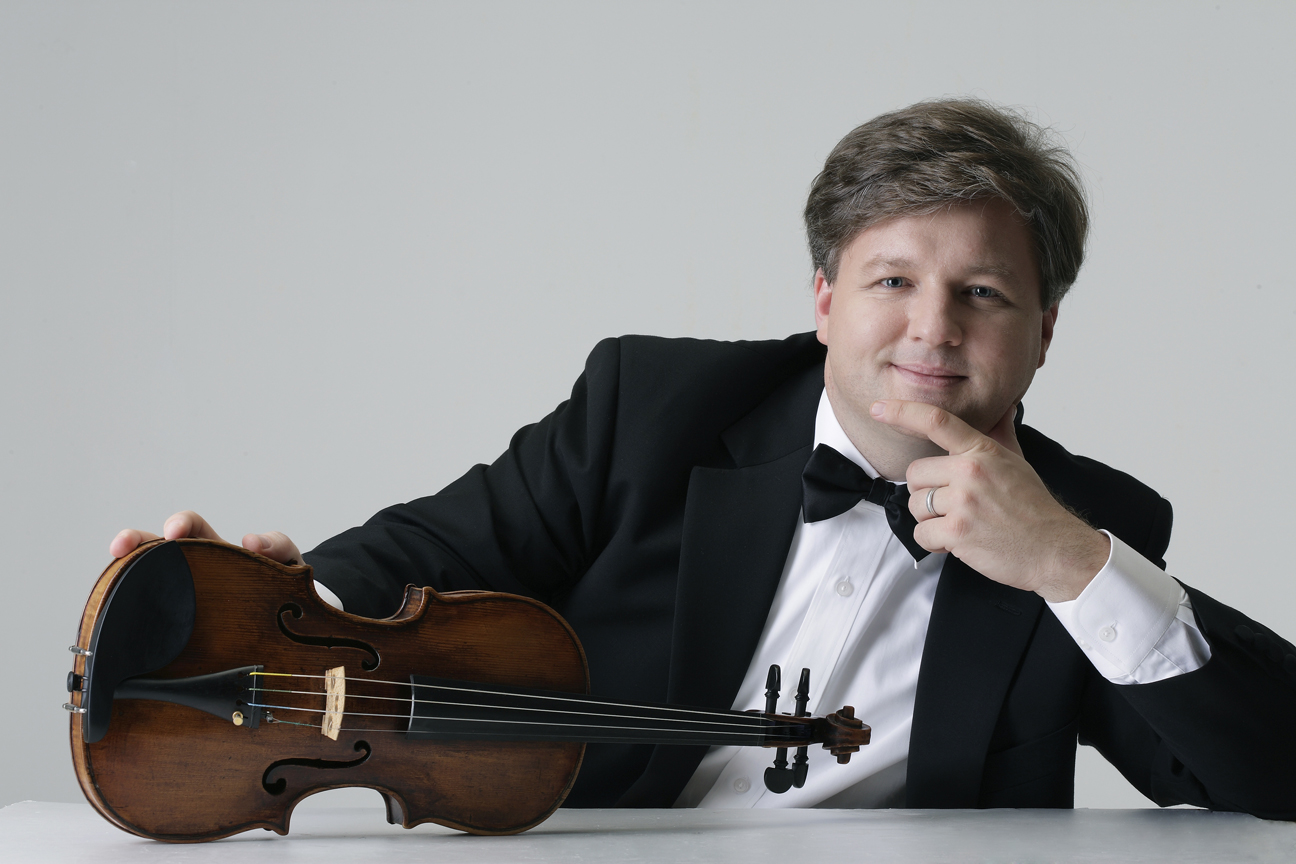
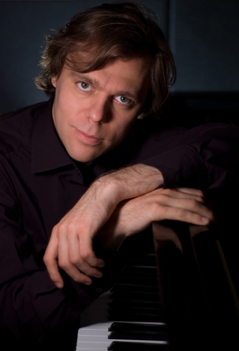
Olivier Fluchaire

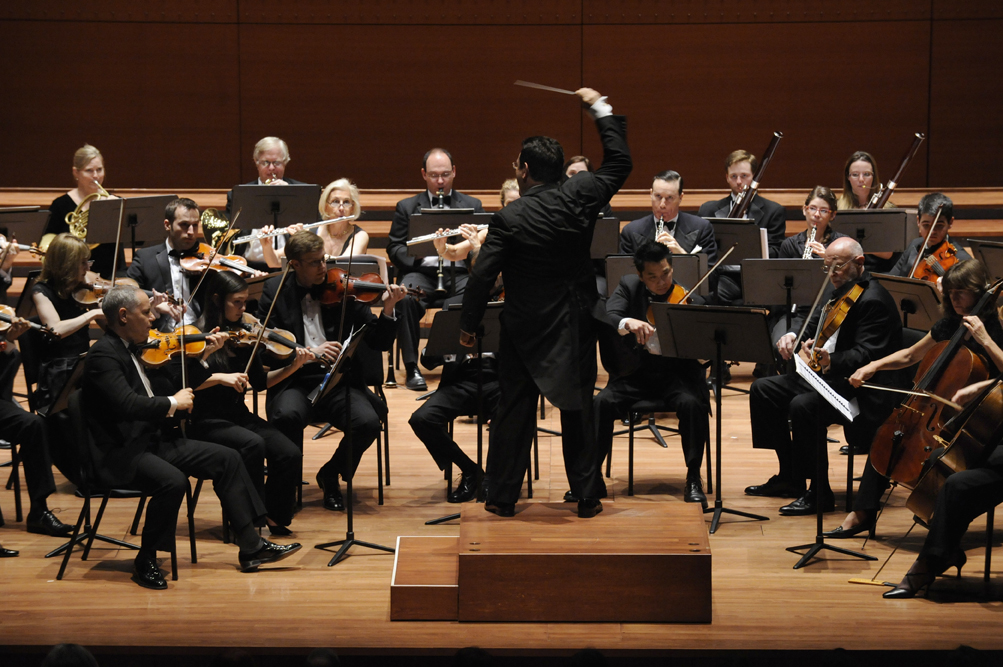
Described as New York’s leading community orchestra, the New York Repertory Orchestra consists of professional and amateur musicians. They come together for the joy of making music, which they share by performing “provocative programs” at the highest possible level. And they certainly have a lot of fans: at this concert, the church was filled with appreciative, enthusiastic, obviously regular listeners, who greeted one another, and the players, like old friends.

The Orchestra was founded in 1991 by its Music Director, David Leibowitz, who has conducted operas, ballets and concerts world-wide; he also teaches at various prestigious colleges, universities and summer institutes. As he proved on this occasion, he is not only an excellent conductor, but also an inspiring leader.

The program was adventurous and ambitious, and consisted of rarely played works – a wise choice in a city so full of concerts. It opened with the Concerto for Small Orchestra Op. 34 by Albert Roussel (1869-1937), written in 1927. The first movement is lively, energetic, and quite dissonant; the second is slow, somber and languid, featuring long, sustained chords in the woodwinds; the third is a marathon run of fast notes in perpetual motion. The orchestration is colorful and inventive.

The Roussel was followed by Astor Piazzolla’s “Four Seasons of Buenos Aires,” arranged by Leonid Desyatnikov and Gidon Kremer for violin and string orchestra, with the French-born violinist Olivier Fluchaire as soloist. After winning his first competition at age eleven, Fluchaire studied with Yehudi Menuhin at his London School and concertized throughout Europe; he came to New York, where he now lives, in 1992, and studied with Daniel Phillips and Patinka Kopec. He is active as soloist and chamber musician, and also teaches at several colleges, including Hunter College and the City University. A spectacular virtuoso, he played with effortless brilliance, unbridled passion, and a remarkable flair for Piazzolla’s rhythmic and melodic idiom. Due to the acoustics, the orchestra sometimes covered him, but the pieces’ many unaccompanied cadenzas showed his sonorous, intense, variable tone to fine advantage. He warmly acknowledged Principal Cellist Shanda Wooley, who stood out in a substantial solo.

The program concluded with the Symphony No. 4, Op. 29 by the Danish composer Carl Nielsen (1865-1931). Written in 1914, it reflects his horror at the outbreak of World War I, and expresses his belief that “even if all things were destroyed or dead, nature would begin to breed new life again.” He called it “The Inextinguishable” because “music is life, and like life, inextinguishable.” The Symphony has four contrasting, connected movements; the music fluctuates between outbursts of chaotic frenzy played by full orchestra, and serene, almost cheerful melodies played by groups of solo instruments; at times it disintegrates, then revives with renewed energy; it ends in triumphant affirmation. 

The Church of St. Mary the Virgin is spacious and beautiful, but, like many large churches, has extremely reverberant acoustics; as a result, it was impossible to hear separate strands of melody or changes of harmony. (The players, too, must have had trouble hearing themselves and each other.) Only the wind instruments’ different timbres could be easily distinguished. The echoes also acted as amplification, especially when the music was loud. For example, Nielsen employs two sets of timpani, one on each side; at full throttle, they sounded ear-splitting and obliterated everything else.

 These circumstances made it very difficult to get a sense of the quality of the Orchestra’s sound and ensemble, though the solo wind players were clearly outstanding. But there was never a doubt of the participants’ enthusiasm and total commitment both to the music and the joint enterprise. The heart-warming air of good fellowship and mutual supportiveness contributed mightily to the success of the concert and the bond between performers and listeners.

Share

American Fine Arts Festival and Pianist Victor Maslov in Review

American Fine Arts Festival and Pianist Victor Maslov in Review
Weill Recital Hall at Carnegie Hall; New York, NY
October 23, 2010

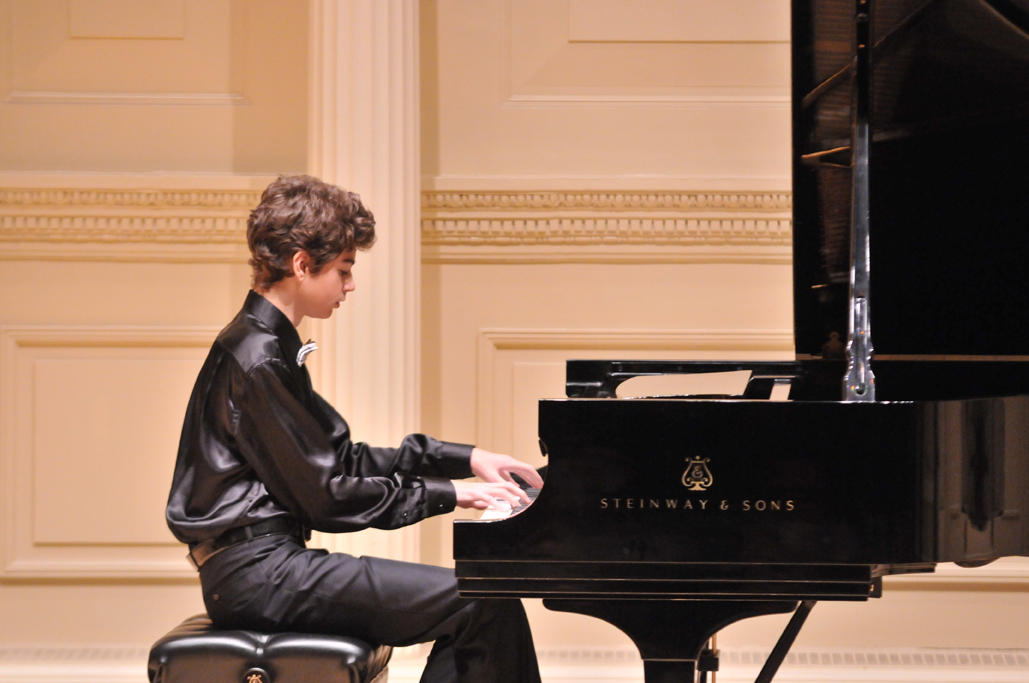
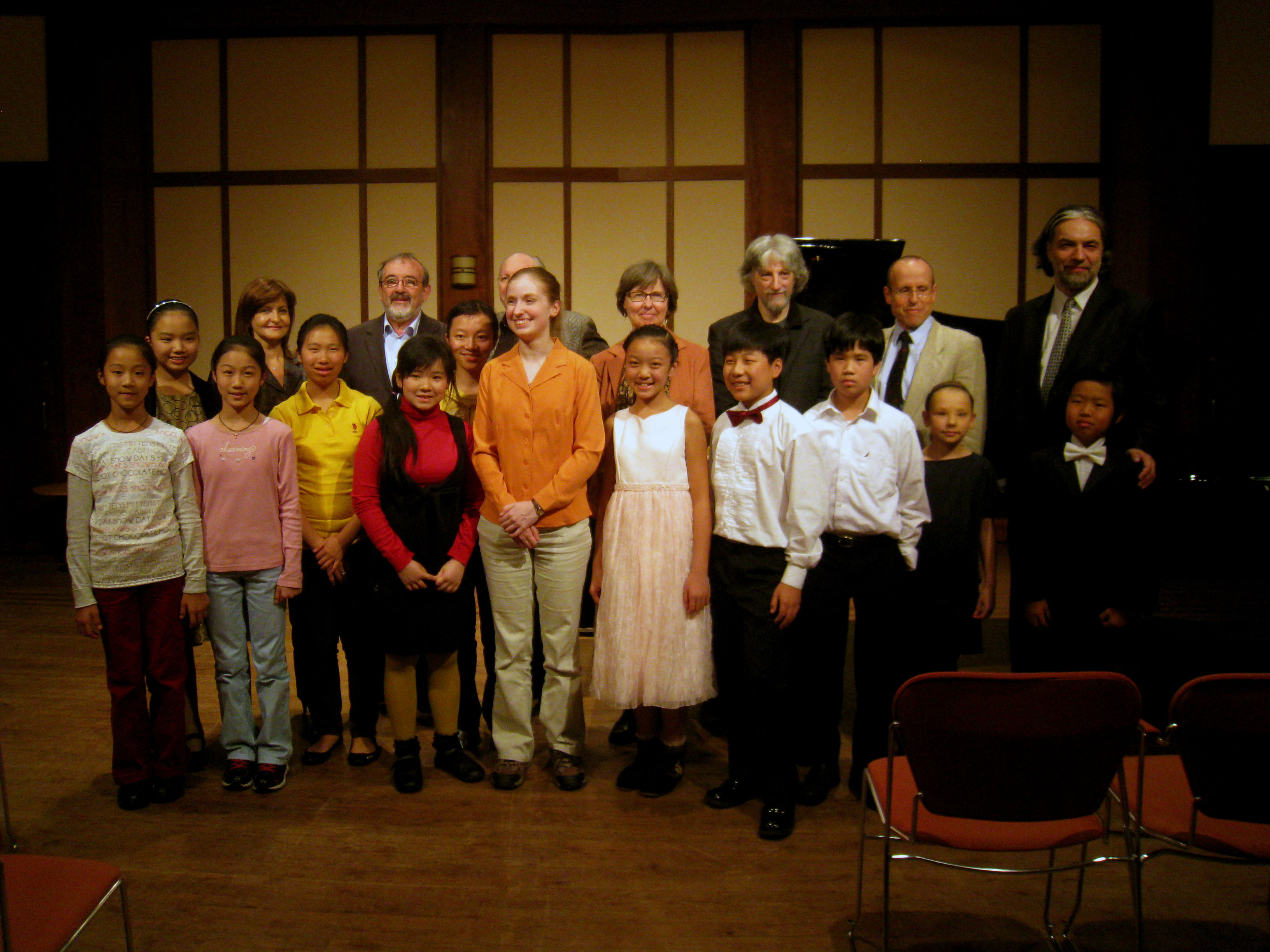
The American Fine Arts Festival is certainly an ambitious organization, embracing singers, string players, and pianists of a large age range (from six and up) in its various competitions, courses, and concerts, including their recent “Fall Gala Concert and Golden Voices of America,” to which New York Concert Review was invited. Directed to their website (www.afafestival.org), I was overwhelmed just trying to assimilate their long list of winners in multiple categories within each contest, but the concert program introduced still more players as guest soloists and ensembles, added to the twenty-four performing winners! There would not be room to detail the performances of each participant, and as one would expect, there were varying levels of development, but that point becomes moot, as we were asked to review primarily pianist Victor Maslov.

Victor Maslov (b. 1997) is a pianist of significant accomplishment for one his age, and he shows tremendous potential for a strong future in music. Tchaikovsky’s “Dumka” (Op. 59) was given a sensitive, if understated, performance. In the middle of an afternoon that stressed the dramatic, through costumes and projection of operatic characters, it was refreshing to hear this young player let the music speak for itself, with little physical motion or hyperbole. In a change of the printed program’s order, he followed with Schumann’s Abegg Variations, Op. 1. Here, haste seemed to cause some blurring, and one lost some of the work’s wonderful details, but it had excitement and held together nonetheless.

After intermission, Maslov played the Schumann-Liszt transcription, “Widmung” in a performance that showed a good balance between the pure vocal line and all the arpeggiation. For me it was again a bit fast, with some ensuing inaccuracies including some not firmly grasped rolled chords, but this happens even to the most experienced pianists.  Following it was Liszt’s Tarantella, which had some astonishingly brilliant parts. I have every confidence that, with patience, this young pianist will make his mark.

Speaking of patience, one wanted a bit more of that quality throughout the afternoon, both in the tempi chosen and in the choice of repertoire (perhaps an issue to take up with the teachers). A number of these young players played and sang works that take a lifetime to mature and to be polished, but I personally would prefer to hear a simple miniature performed with finesse rather than attempts to interpret works beyond a child’s present physical and emotional reach. Mr. Maslov was one who came close to all-around mastery of his repertoire.

Some highlights of other performers included a highly expressive rendition by Latvian singer Oksana Lepska (b. 1995), of Andrew Lloyd Webber’s “I Don’t Know How to Love Him,” and Madison McIntosh’s “Deh, Vieni, Non tardar” from “Le Nozze di Figaro” of Mozart. Also quite good were Prokoviev’s “Harp” Prelude, Op. 12, No. 7, played by Connie Jiang (b. 2000), and an enjoyable “Duetto Buffo di Due Gatti” (attributed to Rossini) sung by the “Lucky Ten” Girls Ensemble from Massachusetts.

Some spirited ensemble singing closed both halves, but the obvious humorous intent was somewhat thwarted by the audience’s lack of a printed translation from the Russian (or an explanation). The audience, presumably including many of the performers’ family members, appeared to enjoy it all the same.

Share

“Crossing Waves”

“Crossing Waves”
Keziah Thomas, Harpist in Review
Weill Recital Hall at Carnegie Hall, New York, NY
October 16, 2010

Keziah Thomas

English harpist Keziah Thomas, who divides her time between London and New York City, devised the project ‘Crossing Waves’ in order to use her transatlantic connections to promote the harp repertoire of British and American composers. She commissioned a new work by British composer Andy Scott especially for this project. Taking Thomas’ project title as the title for his commission, Scott’s “Crossing Waves” was given its world premiere at the Forge, London on September 26, 2010. The piece is inspired by the exploits of Roz Savage, who rowed solo across the Atlantic Ocean in 2005. Savage was present at the concert and spoke a bit to the audience, which brought us additional insight. The music breaks down into three main sections: the first reflects the uneasiness of the journey’s beginning, the second section represents the serenity of the ocean waters mid-way, and the final section transmits the tremendous optimism and excitement regarding the outcome of the journey. Ms. Thomas’ journey in commissioning the work, as well as Mr. Scott’s experience writing this piece has had a most successful outcome as well, as “Crossing Waves” is a most stupendous work for solo harp. The work is very idiomatic for the instrument and constructed perfectly, and the innovation is remarkable—while at the same time, the melodic strands and rhythms are catchy and memorable.

Keziah Thomas’ journey to Carnegie Hall has also been successful. The idea of pairing British and American composers is a most natural one for her. Her program was well thought-out and varied; for example, her opening work—the Suite for Harp by Britten—was followed by the remarkably exotic “The Pearl Divers” by the American Douglas Gibson, who was born in 1976, the year of Britten’s death. Thomas played with a Kyoto-like delicacy in the latter work. Elie Siegmeister’s “American Harp” has a bit too much of Copland’s “El Salon Mexico” and the Bernstein influence to be called original, but it was nonetheless entertaining in the hands of Ms. Thomas. Thomas speaks most eloquently to the audience when introducing the works, and her other selections also brought joy to the audience, but the highlight of the evening was clearly Mr. Scott’s “Crossing Waves”, a totally original and engaging composition which should be performed on many future harp recitals—in this country and across the ocean.

Share

The Gemini Piano Trio in Review

The Gemini Piano Trio
Hsiu-Hui Wang, piano, Sheng-Tsung Wang, violin, Benjamin Myers, cello
Weill Recital Hall at Carnegie Hall, New York, NY
October 16, 2010

The Gemini Trio

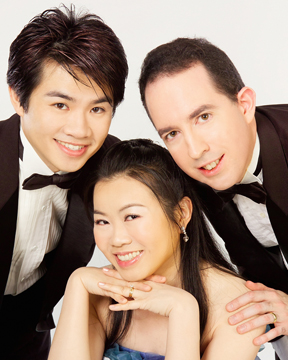
This group is a true family affair: the pianist is the sister of the violinist and the wife of the cellist. No wonder they have achieved such a high level of unanimity and rapport. But of course, though personal kinship can help, it also requires hard work and dedication to forge a fine ensemble and make it sound totally natural.

The Gemini Trio is on the faculty of Maryland’s Goucher College in Baltimore and Howard Community College in Columbia. The members are all active, successful soloists; individually, they hold degrees from the Hartt School of Music, the University of Maryland, Peabody Conservatory, and the New England Conservatory. As a group, they have taken top prizes in many prestigious competitions, performed on several continents, and released two CDs of trios by Brahms, Ravel, Ives, and Shostakovich. This concert marked the Trio’s New York debut.

The program demonstrated the players’ stylistic versatility, featuring masterpieces from three periods: Beethoven’s Trio Op.1 No.1, Shostakovich’s Trio No.2 and Mendelssohn’s Trio No.2. The Beethoven was a model of classical elegance and restraint; phrasing, articulation and dynamics were carefully observed, balance and interplay between the instruments were exemplary. In the Shostakovich, the players allowed themselves more dynamic and emotional abandon without lapsing into excess; the Scherzo was very fast and impetuous but always controlled; the slow movement was heart-breaking. The Mendelssohn was unabashedly romantic: quite free, intense, and ardent. The corner movements were stormy and passionate, the Scherzo was spooky but almost too fast and whispery for human ears to follow, the slow movement was serene and poetic. The phrasing sometimes seemed a bit overdone and lopsided, and there was perhaps an over-abundance of slides. But the playing was always honestly felt and very expressive.

Best of all, the players were concerned only with the music, and used their technical command and tonal variety entirely in its service. They did nothing for effect, never exaggerated, never called attention to themselves, never showed off. The pianist’s pedal technique was remarkable: she seemed to change pedal with every note even in the fastest passages. Moreover, except for the most massive chords, she kept her left foot on the soft pedal, even in her solo passages, so there was no break in the sound quality. As a result, the piano, though wide open, never covered the strings; indeed, it was often too subdued. Altogether, this was a most enjoyable evening of true, unaffected music-making.

Though the printed program requested that the applause be held until after the final movement of each work, the sell-out audience could not restrain itself and showed its enthusiasm after every movement, causing the players to look startled at first, then to smile with amused resignation. To remove the temptation for an outburst after the ghostly Mendelssohn Scherzo, they plunged right into the last movement. After the final ovation, they responded with an encore: a trio arrangement of Elgar’s “Chant d’amour.”  

Share

The Park Avenue Chamber Symphony in Review

The Park Avenue Chamber Symphony in Review
David Bernard, conductor
Pedro Diaz, oboe
Beethoven Symphony No. 6 (“Pastorale”)
Cimarosa/Benjamin Oboe Concerto
Copland “Appalachian Spring” Suite
All Saints Church; New York, NY
October 17, 2010

The Park Avenue Chamber Symphony led by David Bernard

David Bernard has a very impressive memory, as he conducted the entire program—including the concerto and a fairly difficult Copland work—without a score. Beethoven’s sixth symphony was a fitting choice since they did the fifth last year. Is the seventh on the horizon for next season? Most of the movements’ tempos were a bit too slow for my taste and the winds sometimes got out of sync.—the horn also cracked several times—but the exciting storm movement sounded terrific; even the second violin section’s famously treacherous eighth-note passage (simulated rain drops) was polished to excellence.

Copland’s notoriously difficult “Appalachian Spring” Suite needs and seemed to have gotten plenty of rehearsal time, and it paid off; the orchestra played it very well. My only peeves were brass playing that was behind the strings in the first big orchestral passage (do they have enough rehearsal time in the church to get used to the distant surroundings and the time lag, etc.?), and a famously tricky 2/4 and 5/8 section involving piano, double basses and syncopated trombones that became unhinged. But most difficult moments went very smoothly.  This time–opposed to the Beethoven—the tempos were atypically fast, but they correlated with each other well. The opening A’s were unusually and nicely poised, the closing chorale section was phrased beautifully, and the last three glockenspiel and harp notes were perfect.

Pedro Diaz, the solo English horn player at the MET, performed elegantly and exquisitely on the oboe in Cimarosa’s Oboe Concerto. Purity and sweetness of tone plus precise articulation were in evidence. Bernard and the orchestra performed sensitively and were with Diaz all the way.

The Park Avenue Chamber Symphony titled their varied and immensely enjoyable program “Springtime Serenade”, and that brings up a subject for debate: the necessity of program titles. Many Orchestras try to find a gimmick such as headliners or catch-phrases to make the concert more inviting, but is a contrived title the right gimmick?  In this case, we are well into autumn and the orchestra’s delightfully contrasting program consisting of Beethoven’s “Pastorale Symphony”, Cimarosa’s Oboe Concerto, and Copland’s “Appalachian Spring” has one third of its program entrenched in spring, but is not worthy of a program title devoted to it.  I see Vivaldi’s “Seasons” coming up on a December PACS program (I look forward to that); if the Spring Concerto had been previewed here, you have a bigger reason to hint at spring in a title—maybe. Beethoven’s “Pastorale” could be about fall as much as spring or summer; in his description, Beethoven talks about feelings upon arriving in the country, etc., but is non-specific with regards to a season. Concert program titles tend to be limiting, especially when the programming is as varied and innovative as Mr. Bernard’s. The title: ‘Beethoven’s Pastorale, Copland’s Appalachian Spring and MET soloist Pedro Diaz’ would sell lots of tickets without any added gloss.

On a program page listing future concerts, ‘Jazzy Classics’ is the title of a terrific program that features Shostakovich’s 6th Symphony, Gershwin’s “Rhapsody in Blue” and a recent Jazz composition by Ted Rosenthal, but one of their website pages avoids the label ‘Jazzy Classics’, which is good. After all, the excellent and immensely enjoyable Shostakovich 6th symphony is not jazzy nor widely considered a classic, and Ted Rosenthal’s world premiere piece entitled “Jazz Fantasy” is not a classic—yet. But it is great that the orchestra is performing those works and I hope many people attend. I certainly look forward to it.

Share

Tureck International Bach Competition for Young Pianists: Winners’ Gala Concert

 2nd Tureck International Bach Competition for Young Pianists: Winners’ Gala Concert
The Rose Studio at Lincoln Center, New York, NY
October 11, 2010
 

The legacy of Rosalyn Tureck is alive and well, not only through her treasured recordings, but through sustained efforts of devoted students, notably those of Golda Vainberg-Tatz, director of the Tureck International Bach Competition for Young Pianists.  Held this year for the second time, the competition drew highly gifted and accomplished pianists (eligible from ages six through nineteen), playing in eight categories including the Short Preludes and Fugues, Inventions, Well-Tempered Clavier, Suites, Partitas, and various large works including the Concerti and Goldberg Variations. While no one won a prize in the Goldberg Variation category this time, it is impressive that there were several young entrants playing this large, demanding work. I sadly did not get to hear them, but what I did hear at the winners’ recital was excellent: all eight pianists were extremely well prepared and professional, and some were much more than that.

The printed program made no mention of ages (a refreshing change from circus-like prodigy-fests), so each player, whether pint-sized or college-aged, was presented in a professional context. Opening the program was the winner in the concerto category, Andrew Sung, playing the Concerto in F minor, BWV 1056. Self-assured, and showing admirable control and focus, he played in fine collaboration with his “orchestra” (a second piano, played by Damon Denton). His slow movement was fluid and graceful.

Natasha Hou Wu followed suit with a poised and precise Prelude and Fughetta in G Major, BWV 902. Evenness of touch and a firm intellectual grasp were much in evidence. One guesses that there must be some dedicated, unsung teachers behind such polish, along with Ms. Wu’s own gifts. The same may be said for the other players, including Sibo Wang, who played the Duet in G Major, BWV 804 with considerable intelligence and clear demarcations of phrasing. His polish was impressive too, though listeners were getting quite accustomed to that quality by this point!

The next winner, Zitong Wang, stood out as sensitive and lyrical in the Sinfonia in D minor, BWV 799. Going beyond intellectual and technical grasp, she seemed to probe the piece emotionally, especially towards its close.

Hilda Huang, co-winner with Jennifer Campbell in the Well-Tempered Clavier category, offered the A minor pairing from Book I and the A-flat Major one from Book II. With extreme rhythmic intensity, she brought out the conversational elements of the fugues with commendable skill.

Victoria Frances Young, winner in the Suites and Partitas category, played the French Suite in G Major, BWV 816, with brilliance and vigor. Some very fast tempi may have approached breathlessness, but there was an engaging ebullience to it all. With strong physical reactions to each crescendo (almost sending her off the bench), her involvement and commitment were clear.

Playing the Toccata in G Minor, BWV 915, was winner Jesslyn Julia Gunawan. Reflecting a sure sense of style, she also showed a genuine awareness of the more interesting harmonic twists and turns. The fugue had an infectious spirit, almost dance-like in quality.

Possessing perhaps the most maturity and artistry of all was Jennifer Nicole Campbell, who played David Auldon Brown’s Sonata No. 1, as winner of an additional contemporary music prize. (In addition to the Bach works, each contestant played a freely chosen contemporary work, post-1950.)  A sensitive colorist and intelligent musician, Ms. Campbell reflected total immersion in her music. She is already a full-fledged artist, and she brought the evening to a fitting close.

Endorsements, greetings, and a prize sent from Evgeny Kissin (and flowers sent by his father) added to the sense that these young musicians are being inducted into a rare and special group; in fact, they are.

Share

Sahan Arzruni, Pianist in Review

Sahan Arzruni, Pianist in Review
With Cihat Askin, violinist
Zankel Hall at Carnegie Hall; New York, NY
October 7, 2010

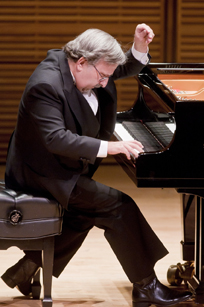
Sahan Arzruni - Photo Credit: 2010 FrontRowPhotos.

In a most unusual presentation of music from the Middle East—specifically that of Turkey and Armenia—pianist Sahan Arzruni performed admirably for a full-house crowd at Carnegie’s Zankel Hall. The concert was presented by the Turkish Consulate General in New York. Despite the hall’s somewhat dry acoustics, Arzruni’s playing was riveting from start to finish. He has complete command of the instrument and exudes a quality that lets his audience know that he is a deeply probing musician. Also insightful was his programming, which ties together rarely heard music by Turkish and Armenian composers. Much of the traditional music by Turks and Armenians are rooted in their respective regional dialects, and this concert music reflected the different ways the dialects are spoken—with their varying accents and stresses of phrase.

Some of the composers were familiar names, such as Aram Khachaturian, who was born in Tbilisi. His Poem and Toccata are lovely, as is Komitas’ nicely contrasting Piano Dances. H. Ferid Alnar’s Piano Pieces are evocative, with titles such as “On the Hillside” and “East Winds at the Seashore”, and naturally concludes with a tuneful Folk Dance. Arzruni captured both the traditional and forward-looking qualities in the music.

Sahan Arzruni, pianist and Cihat Askin, violinist - Photo Credit: 2010 FrontRowPhotos.

Guest violinist Cihat Askin made a good impression as well. He performed a work called “Crane” by Aslamazyan, music based on the music of Komitas, which made good programming sense, since we heard a work by Komitas earlier in the evening. Askin played with elegant phrasing and an enthralling spirit. In “Salacak Sarkisi” by Askin himself, he beguiled the audience with his superb technique. He returned with a more familiar composer in Khachaturian’s “Chant-Poeme” and Saygun’s more virtuosic “Demet Suite”. Both artists had great chemistry and consistently impressed the audience with committed, engaging performances. I only wish Askin’s sound resonated in the hall more. Arzruni was masterful and insightful with his performances of Hovhaness’ “Achtamar” and “Lake of Van” Sonata, in addition to his excellent playing in Koptagel’s “Tamzara” and Toccata.

Sahan Arzruni presented a program that can be perceived as an effort to bring the people of Turkey and Armenia closer together artistically. There are many common traits…and unique differences as well.

Share

Fourtissimo: Soyeon Lee, Ran Dank, Roman Rabinovich, and Vassilis Varvaresos in Review

Fourtissimo:  Soyeon Lee, Ran Dank, Roman Rabinovich, and Vassilis Varvaresos, pianos
Zankel Hall at Carnegie Hall: New York, NY
October 8, 2010
 

Fourtissimo – Photo Credit: Lisa Mazzucco

Rarely has the literature for multiple pianos attracted four such exceptionally fine piano soloists as have come together in the dynamic new group Fourtissimo.  Having noted the “immense talent” of Young Concert Artists International Auditions Winner, Ran Dank, in 2009 (New York Concert Review, Vol. 16, No. 1), I was excited enough to read that he would be teaming up with rising star, Roman Rabinovich, about whom I wrote glowingly when he performed at the Salle Cortot in Paris in 2007 (Vol 14, No. 3); it thus seems a surfeit of riches to add the superb pianist (and 2010 Naumburg winner) Soyeon Lee and the outstanding Vassilis Varvaresos (also a winner of YCA, among other distinctions). Would the whole be greater than the sum of these parts? The answer is yes, thanks to the festive spirit, camaraderie, and constant variety in their program.

The music itself, including solos, duos, and works for two pianos and eight hands, was full of thrills, and the world premiere of “The Quadruple Carmen Fantasy and Fugue” by young composer Noam Sivan was chief among them.  Its witty and brilliant treatment of the Carmen themes exploited all four pianists’ skills extensively, with none of the dead wood or excessive doubling that plague the two-piano repertoire. Jazz and popular elements reinvigorated the well-known themes (as did the addition of tambourine at one point).

Four selections from Ligeti Etudes (for solo piano) alternated with the ensemble works, offering a much-needed textural relief, a sonic “palate cleanser,” and a solo virtuoso showcase for each pianist. It was a joy to hear these fascinating Etudes singly, rather than in rapid succession. Mr. Varvaresos first offered No. 9, “Vertige,” in a rendition so dizzying that one needed to clutch one’s seat.

Liszt’s two-piano transcription of Beethoven’s Symphony No. 9 (first movement) followed, played by Ran Dank and Soyeon Lee. In keeping with the ensemble’s professed inspiration, the “boldness and creativity of the Golden Age “ of pianism, it was a refreshing choice, played with precision and energy. Ligeti’s Etude No. 4 (“Fanfares”) was then given marvelous vibrancy by Mr. Rabinovich, who was joined afterwards by Mr. Varvaresos to close the first half with Ravel’s La Valse. La Valse was given a muscular, if somewhat overly goal-oriented, performance. The surges and swoons seemed too often only hastily suggested (as well as some of the coruscating passage-work), but what may have been lacking in sensual thrills was found in athletic vigor, with Mr. Varvaresos taking an extroverted lead.

All four pianists joined forces again for the New York premiere of Lowell Liebermann’s Daydream and Nightmare (2005). A short but fascinating piece, it showed Mr. Liebermann’s characteristic artistry from its slow meditative opening to its tumultuous close.

The Ligeti Etude series continued with No. 6 (“Autumn in Warsaw”) sensitively played by Ms. Lee, followed by Mendelssohn’s own arrangement for piano of the final movement (Presto) of his Octet Op. 20, played with fleet-fingered control by Mr. Dank and Mr. Varvaresos. Mr. Dank remained onstage for Ligeti’s Etude No. 1 (“Desordre”), expertly handled (even if I would have preferred even more pronounced accentuation of its jagged rhythms). Lutoslawski’s Variations on a Theme by Paganini, a surefire two-piano standard, was then winningly played by Ms. Lee and Mr. Rabinovich. Even more sense of diabolical play will put it “over the top,” but each successive performance will undoubtedly encourage that. Grainger’s “Fantasy on Porgy and Bess”  (after Gershwin), another two-piano favorite, closed with the “Fourtissimo” treatment, with four hands alternating tag-team-style for much of it, but ending with a souped up eight–hand finale. It was an apt finale to an evening full of fun.

An improvisatory encore including themes from Simon and Garfunkel’s “Scarborough Fair” and “Mrs. Robinson” (among others) brought the house down.

Share

Musica de Camara String Orchestra

Musica de Camara String Orchestra
Roselin Pabón, conductor
Metropolitan Museum of Art, New York, NY
September 25, 2010

Musica de Camara String Orchestra

Musica de Camara was established 31 years ago by the Puerto Rican soprano Eva de la O with a mission to present Hispanic music and musicians in concert. The organization has given several hundred performances in famous venues such as Carnegie Hall and Lincoln Center, and in educational institutions, community centers and churches, for audiences who rarely have an opportunity to hear classical music.
This concert presented the Musica de Camara String Orchestra in a program by Spanish and Latin American composers. The Orchestra, founded in 2008, grew out of a smaller chamber ensemble formed several years earlier to give concerts in New York City’s public schools. The present group of about 30 players has continued this commitment, and recently added lecture demonstrations on various aspects of music to its educational activities.
The members of the Orchestra constitute a veritable United Nations. Though they live and rehearse in New York City, they trace their heritage to many countries, including Yugoslavia, Korea, China, Puerto Rico, and Venezuela. For their concerts, they invite guest conductors. This performance was directed by the Puerto Rican Maestro Roselin Pabón, for 30 years Associate Musical Director of the Puerto Rico Symphony Orchestra, Musical Director of the Conservatorio de Musica, San Juan, and a frequent guest with orchestras in Europe and North and South America.
The players, all aspiring soloists, are young, serious, and committed to music; some are still pursuing advanced studies. For example, the assistant concertmistress, Nicole Leon, studies with Itzhak Perlman at the Juilliard School. Their playing was a bit tentative, but time and more performing experience will give them sufficient self-confidence to throw restraint and caution to the wind and give free rein to their natural, youthful involvement and enthusiasm. Concertmaster Francisco Salazar, principal second violinist Luis Casal, principal violist Edmundo Ramirez, and principal cellist Veronica Parrales played a number of solos with vibrancy and aplomb, indicating the group’s high level of talent.
The program opened with Fuga Criolla, a substantial, classical-style Fugue by Juan D. Plaza (1921-1965) from Venezuela. Of the two Danzas Concertantes by Xavier Montsalvatge (1912-2002) from Spain, the slow one had an American, the fast one a Spanish flavor. Aruán Ortiz (b. 1967) from Cuba was present to hear his Perla Caribena; its leisurely melodiousness gave the players a chance to make their instruments sing, as did the lush, sonorous Canambu by Eduardo Gamboa (b. 1953) from Mexico. The Suite for Strings, Op. 115, by Blas E. Atehortua (b. 1943) from Colombia had two fast movements: a rollicking “Scherzo a la valse” and a rhythmic, pungent Finale. Puerto Rico was represented by two composers: Jack Delano (1914-1997), whose Sinfonietta for Strings had a lyrical slow movement and a cheerful fast one, and Guillermo Figueroa (1892-1962), the earliest-born composer on the program, whose Puerto Rican Rhapsody on Themes of Rafael Hernández caressed the ear with its flowing melodies and old-style harmonies. Finally, Michelangelo 70 by the great Argentinean composer Astor Piazzolla (1921-1992), orchestrated by Carlos Rengifo, made a rousing finale, eliciting a standing ovation from the large audience, which had been showing great appreciation throughout the concert. Maestro Pabón responded with an encore: a Puerto Rican Danza, Sara, arranged by Guillermo Figueroa which Johann Strauss could have written on a Puerto Rican vacation.

Share

Armida (1817)

Great Performances at the MET

Armida (1817)
Music by Gioachino Rossini (1792-1864)
Libretto by Giovanni Schmidt
Production: Mary Zimmerman
Conductor: Ricardo Frizza
Choreographer: Graciela Daniele
Set & costume designer: Richard Hudson
Armida: Renée Fleming
Rinaldo: Lawrence Brownlee
Goffredo: John Osborn
Gernanco: José Manuel Zapata
Carlo: Barry Banks
Ubaldo: Kobie van Rensburg
Telecast on Channel 13 PBS: August 18, 2010

Armida- Renee Fleming and Lawrence Brownlee- Photo: Ken Howard/Metropolitan Opera

“Armida” is one of Rossini’s less familiar operas. It requires not only a soprano who combines dramatic power with brilliant coloratura, but includes no fewer than six tenor roles (shared in this production by five singers) demanding a stratospheric range, bel canto lyricism and ringing heroics. No wonder it is so rarely performed. Created for Renée Fleming at her request, this new MET production was a vocal and visual bonanza.

The story takes place during the Crusades, but evokes legends of earlier times. Princess Armida is a beautiful sorceress who lures men to her magic island (think Circe) and holds them captive in her luxurious palace (think Venus’ Mountain), entertaining them with music and dancing. This offers opportunities for spectacular scenery and ballet sequences, first by a group of demons with horns and long tails, then by wave upon wave of gorgeously costumed dancers. Armida finds the crusading knights easy prey, but falls in love with Rinaldo, the army’s general, when he succumbs to her spell. He has to be extricated by fervent appeals to duty and honor – unlike Tannhäuser, who abandons Venus because he has become bored – leaving Armida devastated.

The opera begins with a dark, ominous Overture notable for its colorful woodwind solos, performed most impressively by the principal players. Generally, though, the music is not top-level Rossini in invention or originality; indeed, whenever an arresting passage emerges, it bears a definite resemblance to “The Barber of Seville.” The vocal lines are designed primarily for maximal technical display with brilliant, florid ornamentation, not for melodic beauty or delineation of character. Armida, of course, gets the lion’s (or lioness’) share of pyrotechnics, but the tenors are not far behind: they seem to vie for the top notes and most spectacular coloratura. One might almost call the opera “The Battle of the Tenors,” and in fact one of them soon slays another (over an insult, not the highest note).

The singing in this performance was truly stunning. Renée Fleming, whose physical beauty made her a very convincing seductress, sometimes seemed a bit overwhelmed by the sheer length and intensity of her role, but sang with enormous virtuosity and abandon. The tenors dispatched their vocal fireworks with incredible bravura; Lawrence Brownlee made a real character of Rinaldo, the most demanding role musically and dramatically.

For these telecasts, the MET invites one of its stars to introduce the opera, and also to interview one or more of the principals during intermission. This requires stopping tired cast members on their way to the dressing room and subjecting them to usually inane questions about their feelings for the role they are performing – an imposition on the singers, who clearly yearn to be left alone, rest their voices and concentrate on the next act. Fleming could hardly contain her impatience to get away, though, although in an earlier telecast, she herself had interviewed Simon Keenlyside, a hot and weary “Hamlet,” who was reacting in exactly the same way. Could these interviews not be taped at some time other than during the performance? Though this might cause some loss of immediacy, it would save the singers – and many empathetic viewers – a lot of discomfort.

Share