Distinguished Concerts International New York (DCINY) presents Loralee Songer in Review

Distinguished Concerts International New York (DCINY) presents Loralee Songer in Review

LORALEE SONGER, MEZZO-SOPRANO; PERRY MEARS, PIANO
WEILL RECITAL HALL AT CARNEGIE HALL, NEW YORK, NY
OCTOBER 19, 2019

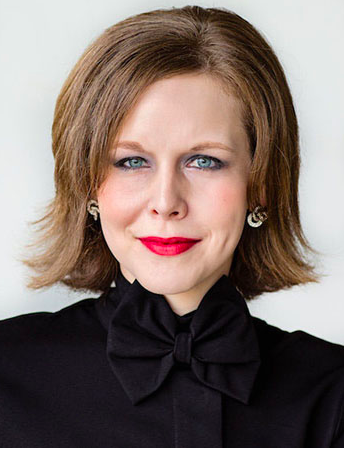
This recital by mezzo-soprano Loralee Songer featured individual songs and song cycles by six living female composers, set to texts by nine female poets. The styles of the songs varied from pop to somewhat dissonant 20th century norms. The skillful accompanist was Perry Mears. The printed program had one unusual feature, in that after each song title its duration was written. I can therefore state that there was thirty minutes of music on the first half and twenty-eight minutes after intermission.

The program began with two short songs, music by Lucy Simon and text by Marsha Norman, from their 1989 adaptation of Frances Hodgsen Burnett’s The Secret Garden. If I describe these songs as pop music, I am not using “pop” as a pejorative term. For me it describes music that is, amongst other things, undemanding and uncomplicated. Although it certainly was attention grabbing, I wonder why Ms. Songer chose to make her first sounds a scooping cry and not regular pitches. I listened to other renditions of If I Had a Fine White Horse and all singers began with recognizable pitches. As the audience applauded after the song’s conclusion, I worried that there would be applause after every song. Although I have nothing against an audience showing their enthusiastic appreciation, I would suggest that in future recitals Ms. Songer include in the printed program a request that the audience withhold their applause until the end of each set.

The performers then left the stage, something that is often done after the first set to allow latecomers to be seated. What I found unusual was that the performers left the stage between all of the (mostly short) sets. They returned to perform Lori Laitman’s setting of three poems by Emily Dickinson. The accompaniments of these works were slightly more dissonant than those of the previous set. Ms. Songer has a very bright voice which doesn’t sound very mezzo-like, and when she did sing in the lower register, it was quite weak.

Libby Larsen, whose music we heard next, was the only one of the six composers on the program whose name I recognized. Her song cycle, Love After 1950, was written in 2000 for the mezzo-soprano Susan Mentzer. I wondered what “after 1950” meant. Could it have referred to the year of Ms. Larsen’s birth?  It was the first of two cycles on this program whose texts dealt with woman’s difficulties in the “battlefield of love.” The music of each of the six songs was written in a different musical style including blues, cocktail piano, honky-tonk, and tango. Yes, I know that’s only five styles – Ms. Larsen’s website didn’t give a musical style for the last song.

The first half ended with One Perfect Rose, a short three-minute song with music by Emma Lou Diemer and words by Dorothy Parker. This was one of the works on the recital which had, as the program notes stated, a simple yet varied accompaniment that allows the words to shine. However, many of the other works had very complicated accompaniments, which pianist Perry Mears played with clarity and ease.

The second half began with the U.S. premiere of Godiva, music by Juliana Hall, text by Caitlin Vincent. While the first half of tonight’s recital was performed by memory, this and the following work were performed on book. For the first time in the evening I had trouble understanding the words. This was anomalous in that Ms. Songer’s diction during the first half was clarity personified, made obvious by the audience’s laughter at the comical portions of the text.

The recital concluded with the world premiere of tonight’s longest work, Little Black Book, with music by Susan LaBarr and text by Caitlin Vincent, which is described in the program notes as one that “highlights the struggle to find love in the digital age.”  Directly below the work’s title in the program proper was printed “a song cycle that fails the Bechdel Test.” As the program notes did not explain anything about the Bechdel Test, I went to the internet and found on Wikipedia: “The Bechdel Test is a measure of the representation of women in fiction. It asks whether a work features at least two women who talk to each other about something other than a man.” I also found that it is most often used in analyzing the portrayal of women in movies. And yes, as the program notes stated that these songs dealt with both Ms. Songer’s and Ms. Vincent’s romantic histories, the terms of the Bechdel test were certainly not met. The audience found many of the six songs very funny.

Throughout the concert, Ms. Songer sang with commitment, fine diction, and stylistic awareness. The audience agreed and, at the recital’s conclusion, showered Ms. Songer and Mr. Mears with tumultuous applause and the vociferous “woo-woo” sound which seems to have replaced “bravo” with contemporary audiences.

Share

Edward Auer and Junghwa Moon Auer: Schumann CD in Review

Edward Auer and Junghwa Moon Auer: Schumann CD in Review

Edward Auer and Junghwa Moon Auer: Schumann CD in Review
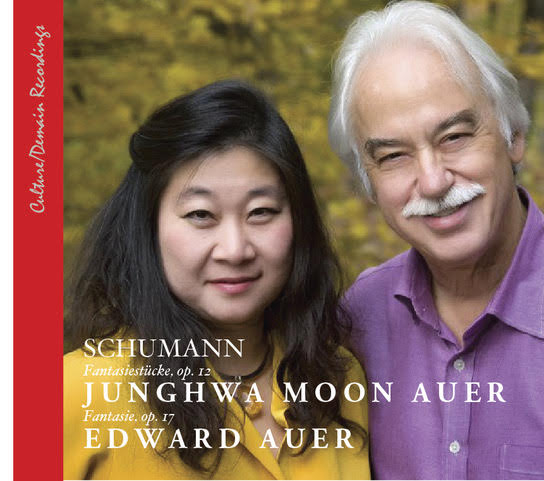
Schumann: Fantasiestücke, Op. 12 – Junghwa Moon Auer, Piano
Schumann: Fantasie, Op. 17 – Edward Auer, Piano
Producers: Edward Auer and Junghwa Moon Auer
Culture/Demain Recordings (no catalog mumber)
Total timing: 59:27

Edward Auer is a Juilliard graduate who serves on the faculty of the Jacobs School of Music at Indiana University. Junghwa Moon Auer, his wife, a graduate of Yeonsei University in Korea and the New England Conservatory, is coordinator of the Edward Auer Piano Workshop at the Jacobs School, and a member of the artist faculty at Roosevelt University.

This new CD shows the Auers to be pianists of polish and refinement who both understand the idiom of Schumann’s music. The piano sound is good, and both pianists play with marvelous tone throughout.

Junghwa Moon Auer’s performance of Des Abends, the first piece in the Fantasiestücke, has a lovely calm, and subtle use of rubato. In Aufschwung, she brings out the contrasting moods of the different sections, such as the stately part in B-flat major, as opposed to the threatening buildup which leads to the return of the dramatic first  theme.

Warum? is, perhaps, a bit slow, but has some beautiful soft playing, and an intriguing interplay of the voices. Grillen is slightly understated, yet jocular. (The marking does say Mit Humor!)

The night can be scary, and Ms. Auer shows this in In der Nacht, though, with her sensitivity to different colors, the F major middle section is a wonderful  “escape” from the tension and tumult of the rest of the movement. Fabel, another piece of contrasts, is very effectively played. Traumes Wirren, which in some performances throws sparks all around, strikes this listener as light-hearted, but a bit sedate. The last movement, Ende vom Lied, is very fine, with a strong beginning, an energetic middle section in B-flat major, and a peaceful end.

After the loud, swirling beginning of the first movement of the Fantasie, Edward Auer plays a bit slower than one might expect, but everything “works.” The F major theme is eloquent, and the syncopated section which follows sounds appropriately improvisatory. There is a natural sounding emotional underpinning to everything he does in this movement. The last section, in C major, is slow, expressive, and deep.

The second movement is played at a strong, moderate tempo. Parts of the middle do seem a bit slow. The coda is certainly well-played, though some pianists take a more daring tempo.

Mr. Auer’s playing of the last movement is a spacious and calm unfolding of the material. In addition to the dynamic contrasts, which are effectively brought out, there is a sensitivity to coloristic possibilities as the work modulates. There is a very fine buildup in the last section, and then Mr. Auer goes “back down the other side of the mountain” to a beautiful, soft conclusion.

Donald Isler for New York Concert Review; New York, NY

Share

Christoph Denoth in Review

Christoph Denoth in Review

Christoph Denoth, guitar
SubCulture, New York, NY
June 10, 2019


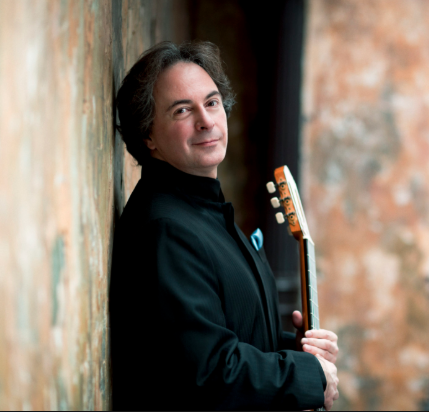
In celebration of his newest CD release Tanguero: Music from South America (Signum Classics SIGCD 538), guitarist Christoph Denoth appeared in recital at SubCulture on June 10, 2019. With works by Villa-Lobos, Brouwer, Piazzolla, and Matos Rodriguez, it was an opportunity for one to hear not only the work of a outstanding musician, but also his thoughts about composers and their works as he spoke to the audience.

The basement confines of SubCulture are ideally suited to this type of event. It has the intimate feeling that is characteristic of smaller venues, but also comfortable seating and ample room to move about. One could enjoy a wine or other beverage at the bar before the concert. The one oddity was the almost subliminal level music being piped in prior to the performance, which might be okay for a more casual concert, but really was distracting for this kind of program, which benefits from some silence beforehand.

Mr. Denoth opened with the Villa-Lobos Cinq Préludes, one of the staples of the guitar repertoire. They pay homage to the varied peoples of Brazil, from peasants and urbanites to the indigenous, with a tribute to J.S. Bach as well. They are filled with Villa-Lobos’s characteristic folk idiom as well as a Romantic spirit. Mr. Denoth captured the flavor of this music in highly nuanced performances. He followed with the Villa-Lobos Etude No, 11 (Paris 1929), another example of both the composer’s highly idiomatic guitar writing and the fine playing of Mr. Denoth.

Leo Brouwer’s 1990 Sonata (for Julian Bream) followed the Villa-Lobos works. Each movement is influenced by a different epoch. The first movement, Fandangos y Boleros was humorous, an almost self-deprecating example of Spanish styles, with occasional “wrong notes” popping up. The second movement, Sarabande de Scriabin was a look at the Russian before his “Mystic” transformation. The final movement, Toccata de Pasquini was a moto perpetuo with a “cuckoo” call. Mr. Denoth played with unflagging energy as the music simmered, but he was always well under control. The Brouwer was this listener’s favorite work of the evening.

Four Piazzolla pieces followed, Chiquilín de Bachin, Verano Porteño, Oblivion, and Triunfal. When one thinks tango, one thinks Piazzolla, such is the power of the composer’s mastery of the style. Mr. Denoth did not disappoint- the soulful laments, the fiery passions, and the infectious rhythmic vitality were all on full display.

Gerardo Matos Rodriguez’s La Cumparsita ended the program. It’s the tango everyone knows, even if they don’t know the name or the composer. Heaven knows how many cartoonish renderings have been done, complete with the rose-in-mouth, but thankfully there was none of that here. Mr. Denoth played it straight, which revealed subtleties often lost in the hammy performances.

Mr. Denoth does not rely on his formidable technique alone. The fast runs, the harmonics, and the cascades of sound that made it seem if there were multiple players were all there, but one never was overwhelmed by these qualities to the detriment of the music itself. Mr. Denoth is like a skilled painter carefully creating a masterpiece – each note and phrase is given the right “color.” The pacing is never hurried, but the rubato used is never excessive either, and the expressive aspect is always the priority. Even though it was obvious that Mr. Denoth had thought out every note carefully, the end result was still completely natural in sound and execution.

Mr. Denoth offered Joaquin Malats’s Serenata Española as an encore, to the delight of the appreciative audience.


Share

Star Concert Productions presents Carine Gutlerner in Review

Star Concert Productions presents Carine Gutlerner in Review

Star Concert Productions presents Carine Gutlerner
Carine Gutlerner, piano
Weill Recital Hall at Carnegie Hall, New York, NY
October 27, 2016


A sizeable crowd picked its way through the chilly autumn drizzle, spirits undampened, to hear the recital by Belgian/French pianist Carine Gutlerner. Ms. Gutlerner is multi-talented not only as a pianist, but also as choral conductor, composer, and visual artist (her published book of drawings was on view in the lounge adjacent to the recital hall).

As a pianist, her recital presented many paradoxes. It is always refreshing to hear someone with a distinct, vivid, even controversial point of view, as opposed to someone comfortable in a “musical straitjacket.” However, some of Ms. Gutlerner’s virtues quickly became mannered, even working against her.

The concert opened with Ms. Gutlerner’s own composition: the American premiere of excerpts from her film music for Ann Frank’s Diary (an animated presentation aimed at children primarily). It is always risky to turn tragic events into music, as one risks merely trivializing them. That was not the case here, although the unrelieved gloom of the sections chosen shows more about our post-Holocaust response than it does about the often-optimistic teen spirit of the heroine.

After this, the program turned quite standard, with three large-scale works. The first of these was Brahms’ Third Piano Sonata in F minor, Op. 5. When Brahms arrived on the Schumanns’ doorstep in 1853, he was a slender, blond twenty-year-old with a satchel full of compositions, and both Schumanns promptly fell in love with him and his music. His celebrated belly and beard came much later. It seemed that Ms. Gutlerner was relating much more to the wild, untamed passionate outpouring of youth that this work can represent. If you like your Brahms autumnal or more sober, this was not the version for you. Fiery and impetuous would be the two adjectives to reach for in characterizing her interpretation. The beautiful Andante with its poetic preface from Sternau was played much too quickly—it didn’t sound like the two hearts were united in love under the moonlight, rather that they were hurrying to catch the last tram down the mountain. The Scherzo lacked the lilting references to the Viennese waltz that underlie its demonic energy (though the Trio section was lovely), and overall it was messy. The unusual fourth movement, titled Rückblick (A Look Back), was too angry for my taste, though a case could be made for one of the former lovers from the second movement having precisely that emotion. The Finale was anything but moderato.

If Ms. Gutlerner could slightly tame her inner “wild animal” perhaps her brain would follow suit, for every work was marred by major memory issues, from which she recovered however. After all, it’s not so much what happens as how one continues. She also needs to find some tie-backs for her ample hair, which had to be continually brushed back with one of her hands. It even got in her mouth. One final complaint: the hands-in-the-air drama at the end of nearly every piece gets old fast—one per recital, please? (If that.)

After intermission, the first work was Chopin’s Second Ballade, Op. 38 in F major (though it ends in A minor). This was a sloppy performance, though the lyrical opening had great potential. Ms. Gutlerner had every reason to be rattled, because yes, a STUPID cellphone went off several times, including during the final pregnant pause before the last two chords. People who are reading this: DISCONNECT while at live performances, and tell your friends to as well. No matter how many announcements are made, it always seems to happen.

Then came the immense challenge of Mussorgsky’s Pictures At An Exhibition. I thought that Ms. Gutlerner’s outsized temperament would be an asset in this sprawling and fiercely difficult work, and at times that was the case, but too often her technique was just not up to the demands of the music. Two sections that were absolutely perfect, however, were: the Promenade between Bydlo and the Ballet of the Unhatched Chicks, and then the Con Mortuis in Lingua Mortua (not “Latina,” as the program stated). Otherwise, the left hand was overbearing, even bangy, an issue that threatened the earlier works on the program as well. Loud does not equal Russian authenticity. The Great Gate of Kiev was unduly hurried, lacking the majesty it needs, and her troubles seemed to multiply until she just ended the work with a few perfunctory chords.

She played another mournful section of Anne Frank as an encore.

Ms. Gutlerner could become quite a formidable interpreter if she learns to balance her natural fire with more control, even quietude—it will make the fire stand out that much more.

Share

The Clarion Orchestra And Mario Chang, Tenor; Steven Fox, Conductor

The Clarion Orchestra And Mario Chang, Tenor; Steven Fox, Conductor

THE CLARION ORCHESTRA AND MARIO CHANG

Rossini – Overture and Arias from Il barbiere di siviglia
Donizetti – Arias and Duets from Le duc d’Albe, L’elisir d’amore and Lucia di Lammermoor 

Mario Chang, tenor
The Clarion Orchestra
Steven Fox, conductor

Rising star and ‘born bel canto tenor’ [The New York Times] Mario Chang joins The Clarion Orchestra and Steven Fox for an evening of sparkling Rossini and Donizetti overtures and arias from the Romantic age of opera.

This concert is a Landmarks50 Alliance event, commemorating the 50th Anniversary of the passage of the NYC Landmarks law.

Share

Tempo Trapezio CD in Review

Tempo Trapezio CD in Review

Tempo Trapezio CD
Misha Quint, cello
Svetlana Gorokhovich, piano
Blue Griffin Recordings BGR323 (also available on iTunes)


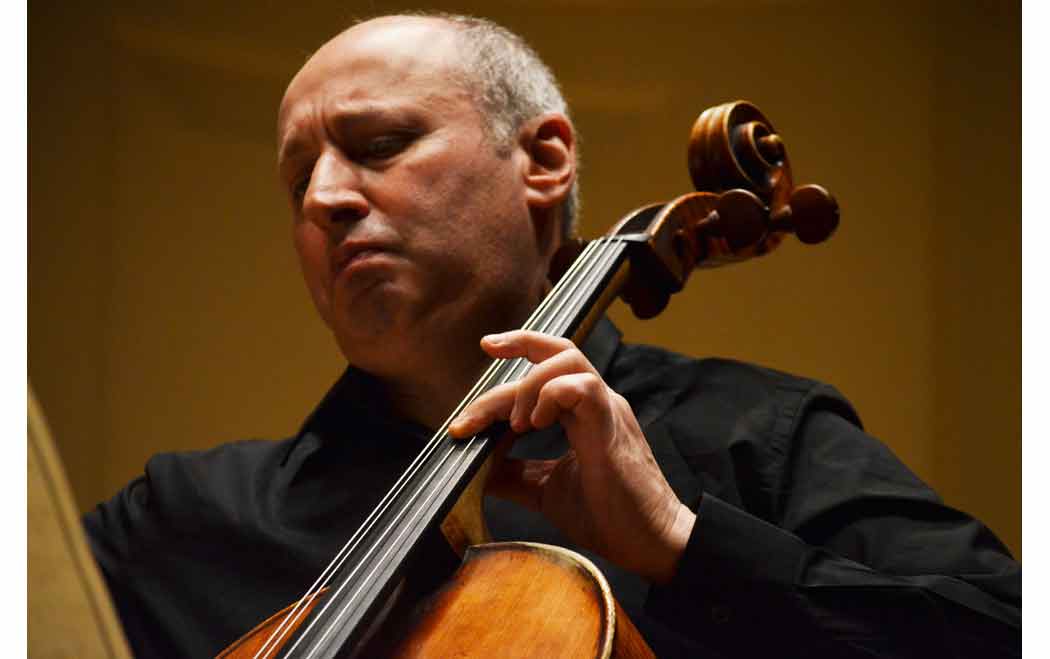
Misha Quint has recorded a wonderfully diverse array of works on his new CD, Tempo Trapezio. His pianist, Svetlana Gorokhovich, provides much more than accompaniment, as she interweaves her intermittent solo passages with subtlety and—when called for—real virtuosity. Together, they make an impressive pair; the notes are all there, and they play with a solid unity throughout. Yet, more than just excellent ensemble-work, they seem to identify with each composer on this disc in a personal way.

Thomas Fortmann’s Sonata for Quintcello, premiered at Weill Recital Hall at Carnegie Hall in 2014, is a funny play on words, with the cellist’s name obviously inserted, but also indicating the work’s prevalent usage of the perfect fifth interval. What would the title be if arranged for string quintet? No matter; the work is terrific writing in its own right. Clever and comical, the work’s eclecticism includes hints from the rock era—a simulation of guitar open fifths—plus music that points to Schoenberg and the twelve-tone school in the slow movement. Mr. Quint handles all the technical demands with ease.

Krzysztof Penderecki’s Per Slava—a Rostropovich dedication (for those who are unaware of the legend’s nickname) is also a demanding piece which deserves more performances and is well-interpreted here. The first notes depict Bach’s name: B—A—C—H (Bb-A-C-B♮), and this permeates the six minutes of music. One might therefore expect some Bach to be included on this disc, but one will have to wait for Mr. Quint’s next album. And it would be interesting to hear the Penderecki paired next to a Bach Suite in recital (no doubt, Mr. Quint has already done that or thought of the idea.)

Also included on this uniquely-selected program is Richard Strauss’s early Cello Sonata in F major, Op. 6 (1880-1883). Like Brahms’ Op. 99 (1886), F major has proven to be a winning key for a cello sonata. Brahms must have been impressed with this early cello sonata—to the point of writing one in the same key three years later? Brahms and Strauss still engaged artistically during this period, and Brahms was somewhat of a mentor before Strauss became a deep-seeded Wagnerite and anti-Brahmsian. What a wonderful work this Strauss is- this is not by any means a student work. It makes great demands on the cellist and pianist. One can hear the charm and devilish nature of his future Til Eulenspiegel in its strands, but more importantly, it is easy to notice that this work shows the hand of a young master. Both Mr. Quint and Ms. Gorokhovich play with passion and elegance here. The tempos and transitions are paced and timed admirably—the phrasing always engaging; not a note goes by without meaning or an arrival-point in mind.

Schubert’s Impromptu is recorded well and is exquisitely shaped. Works by Stravinsky: the Pas de Deux from Divertimento and the Chanson Russe are stellar additions to this disc. They are presented with a vast range of dynamics and color; at times humorous and graceful—at other times, wild and bombastic. If purchasing on iTunes, I would have to recommend getting the album and not just the individual selections—since the Sonata for Quintcello is only available with an album-only purchase. If purchasing individually, I would recommend the Strauss and Stravinsky works as absolute must-haves on your playlist. You will want to enjoy listening back and forth, again and again.


Share

Manhattan Concert Productions presents Masterworks Festival Chorus and New York City Chamber Orchestra in Review

Manhattan Concert Productions presents Masterworks Festival Chorus and New York City Chamber Orchestra in Review

Manhattan Concert Productions presents Masterworks Festival Chorus and New York City Chamber Orchestra
Masterworks Festival Chorus
San Jose State University Choraliers
The Phoenix Symphony Chorus
New York City Chamber Orchestra
Jeffrey Benson and Thomas Bookhout, conductors
Layna Chianakis, mezzo-soprano; Jessica Sandidge, soprano; Michael Scarcelle, bass; Marguerite Krull, soprano; Amy Maude Helfer, mezzo-soprano; Nathan Munson, tenor; Paul An, bass
Stern Auditorium at Carnegie Hall, New York, NY
April 27, 2015


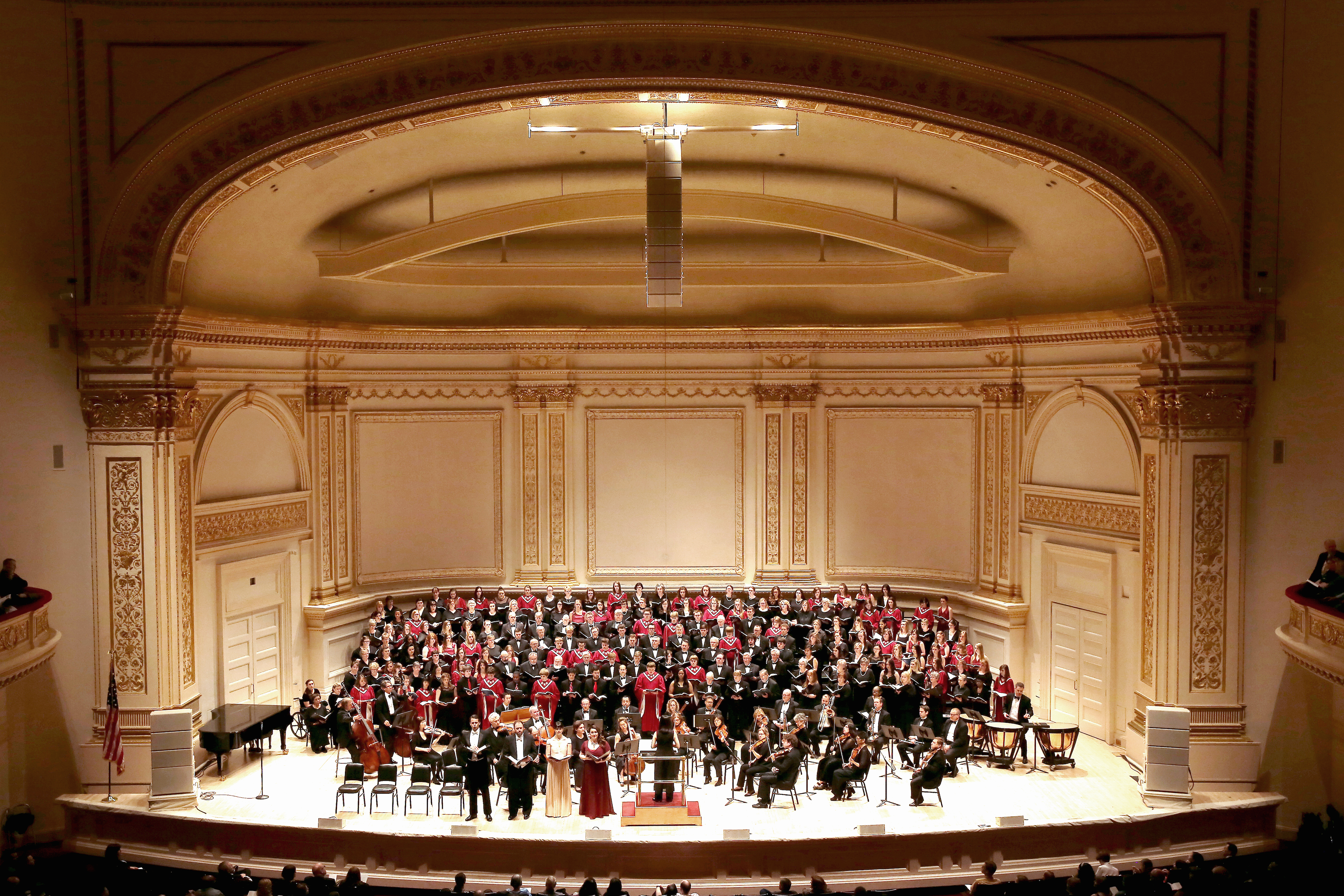
Manhattan Concert Productions gives community choruses great opportunities to perform in leading concert halls across America, including Carnegie Hall. Their umbrella reaches from children’s choirs to high-school, collegiate, and community and symphony choruses. These groups then travel to New York and work with the permanent instrumental ensemble known as the New York City Chamber Orchestra. The evening of April 27, 2015, on the main stage of Stern Auditorium at Carnegie Hall, a wonderful range of talent and music was on display.

The program began with the San Jose State University Choraliers, who indeed proved that they have “choral ears,” in fine renditions of Finzi and Elder. Finzi’s music deserves to be much more widely known. Their diction in his My Spirit Sang All Day was exemplary, as was the feeling of tenderness, which followed into Elder’s Willow-Wood, conducted by their own Jeffrey Benson. They were then joined by the extraordinary mezzo-soprano Layna Chianakis in two spirituals. If my pitch-sense isn’t failing me, I could swear she did an effortless high D near the end of This Little Light of Mine, a light which shone brightly indeed.

The main business of the first half was Fauré’s Requiem, Op. 48. This work is comforting, austerely sensuous, and serene in its appeal, unlike the melodramatic/operatic settings of Verdi or Berlioz that emphasize damnation. It was composed in 1888 in memory of Fauré’s recently deceased father. The Requiem, which was modified by Fauré three complete times over many years, has the unusual scoring of omitting the “first violin” sound, thus giving it a darker coloration and symbolizing absence perfectly. Then when the angelic solo violin of concertmaster Robert Zubrycki entered in the Sanctus, the effect was stunning. Again, the conductor was Mr. Benson, from whose group (a massed choir of people from California, Michigan, and New York) I could have used a greater dynamic range, especially in the pianissimi. Their sound was exciting in the louder dynamics, but I missed the great emotional power of a large number of people all singing extremely softy, held-in. I was also sorry to hear some choral diphthongs, especially on the open “e” vowels, which made the church Latin sound so American. The range of instrumental dynamics was not wide enough, from the very first note, a fortissimo D that is supposed to decline to a pianissimo choral entry. This resulted in a “smooth” performance, but one that didn’t maximize contrast. The sound of the electronic organ, the only type Carnegie and other New York halls have at their disposal (with the exception of Alice Tully Hall), was unfortunate and crude, though well-played by the uncredited organist. This is a shame that New York really needs to address if such works are to be presented. The two soloists handled their work admirably, with the soprano Jessica Sandidge wisely not scaling her lovely voice into anything “boy”-sounding in the Pie Jesu, even though the premiere was by a boy soprano. Michael Scarcelle sang the Offertoire and Libera me, Domine with power and intimacy by turns.

After intermission, the Phoenix Symphony Chorus, conducted by Thomas Bookhout, sang a beautiful work by Stephen Paulus, The Pilgrims’ Hymn, excerpted from his opera The Three Hermits, and a less-original but still heartfelt Psalm of Ascension by Dan Forrest. This group, of considerably more mature singers than had been heard in the first half, delivered all the contrasts of text and tone that one could wish for.

They were then joined by choirs from Arizona, New Jersey, and Wisconsin (and apparently some free-lance individuals from New Jersey) for a rousing performance of Haydn’s well-known “Lord Nelson” Mass, originally titled Missa in Angustiis (Mass for Troubled Times). The tempi were moderate, allowing the grandeur of the music to breathe, while articulation, dynamics, and transparency all reflected some of the advances in historically-informed playing that one expects in this repertoire (And again that electronic pseudo-organ). All four soloists were excellent, but I must single (or double) out the soprano Marguerite Krull and the tenor Nathan Munson for the clarity of their tone, its brilliance, and forward placement. Bass Paul An, an accomplished Juilliard graduate, sang well but should nevertheless be advised not to try to sound too “old” or vocally dark before his time, even though he is a bass, because this will eventually wear out the voice. This chorus achieved that magical hush in the final Dona nobis pacem (Grant us peace), a fitting end to a well-done evening of choral music.

Share

Eunmi Ko in Review

Eunmi Ko in Review

Eunmi Ko, Piano
Weill Recital Hall at Carnegie Hall, New York, NY
June 3, 2014


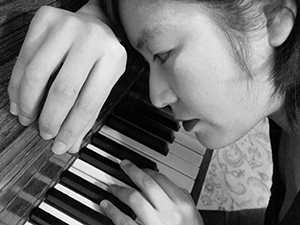
Pianist Eunmi Ko gave an exceedingly interesting recital at Weill Recital Hall at Carnegie Hall on the evening of June 3, 2014. Her programming was original, as were her interpretations. In general, her strengths are an abundance of technique, as well as a beautiful array of pianistic colors, particularly in the soft dynamic levels.

She began with Mécanisme, the first movement of the two-movement work Dichotomie (2000), by conductor/composer Esa-Pekka Salonen (b. 1958), which she plunged into without even waiting for the welcoming applause to die down. The piece has a certain steely resolve that suits its title, as well as an over-reliance on glissandi; but it creates sonorities that are not often heard from the piano, particularly in Ko’s headlong, momentum-filled rendition. In the composer’s own words: “Mécanisme, is indeed like a machine, but not a perfect one: more like one of the Tinguely sculptures (or mobiles, they really defy all attempts to categorize them), which are very active, extroverted and expressive, but produce nothing concrete. I imagined a machine that could feel some sort of joie de vivre, and in that process, i.e. becoming human, would lose its cold precision.”

Then came the poignant cycle O matince, Op. 28 (About Mother), by Czech composer Josef Suk (1874-1935). Composed in 1907, its five sections are reflective of the various functions of a mother in the course of her life. Obsessive pedal points are found in each movement, symbolizing different things: the enthusiasm of the young mother, springtime, singing to comfort a sick child, her own heartbeat, and finally a remembrance, presumably after the death of the mother. The music was beautifully presented by Ms. Ko, with gleaming color and balances, making it sound more like forward-looking Janáček than a fond look backward to the nineteenth century.

After intermission came a New York premiere with the neo-Baroque high jinks of John Liberatore’s She Rose, and let me in: Variations and Fugue on a Scottish Folk Song, after F. J. Haydn (2013), which takes as its pretext the words to a folksong about seduction, intercourse, unintended pregnancy, and regret, all wrapped up in a happy ending. As Mr. Liberatore’s own aesthetic statement says: “He endeavors to bring together seemingly contradictory aesthetic tendencies: nuance with overtness, strangeness with purpose, levity with depth and sincerity, and outward simplicity with subtle complexity.” All of which was achieved in this witty, whimsical, sometimes abrupt work, whose accessibility to the listener masks its difficulty for the pianist. Ms. Ko had no trouble clarifying the textures, especially in the Fugue. In the concluding Epilogue, played at the softest dynamic levels achievable on the piano, where individual notes from the theme and its variations are heard individually with extreme registral transposition. It was the loveliest playing of the evening, and it was truly magical. The composer, present in the sparse but enthusiastic audience, was duly honored, and must have been pleased.

To conclude, Ms. Ko played an often-heard masterpiece from the core nineteenth-century repertoire: Schumann’s Fantasie, Op. 17. To this work she brought a fierce momentum, organizing it toward the “long line” rather than allowing herself to get caught up in myriad details. This approach resulted in a different interpretation for the piece than one often hears, and I quickly became accustomed to it, usually with pleasure. Her tone was liquid, and there was plenty of poetry, but not bathos or sentimentality. The concluding chords of the first movement seemed to emanate from another world, so quiet were they. In the famously terrifying (to pianists) “skips” of the second movement, she plunged with abandon, the tempo pressing forward boldly. One could forgive the occasional missed note in light of the sheer drive. She brought out a puckish or impish side that is rarely heard in this movement. For me, the only blemish of the recital was the third section of this work, played too quickly and which ended far too loudly, as though Ms. Ko was afraid to let the piece become introverted again, as it should. This work has always been a programming challenge for pianists: where to put it, precisely because of this soft ending. Have courage, pianists!

She offered an encore: Chopin’s Etude Op. 10, No.4, played at a cartoon-chase tempo, way too fast for any poetic musical sense to emerge, but astonishing as a feat of sheer digital prowess. It was a well-earned romp after a well-played demanding program.


Share